Tag: albuquerque notes

  • The Road Teaches Us to Listen

    The Road Teaches Us to Listen

    Salt, Ink & Soul — Field Journal Series, Part I

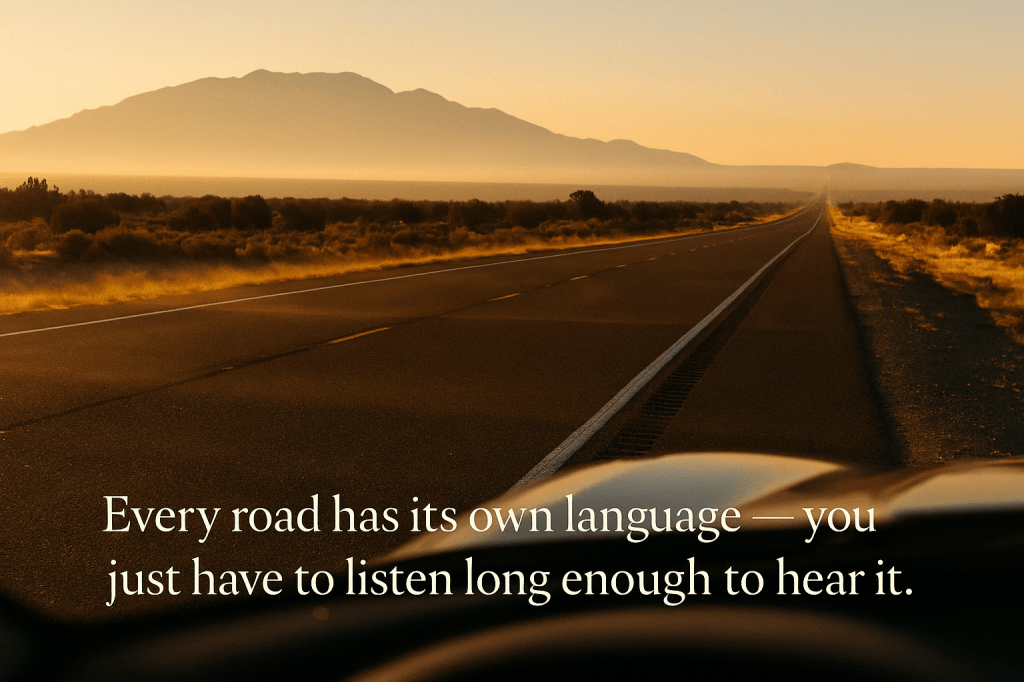
    The road begins long before you step onto it.

    For me, it starts with a small decision that never feels small: go. That’s the quiet contract I sign with myself in the dark—turn off the clock, get out of bed, make coffee even if the morning looks like a bad idea. Rain against the window, frost on the glass, wind leaning into the stucco—you go anyway. Jacket. Keys. A hand to the door, a muttered prayer that sounds like breath.

    Inside the car, I choose the season by touch. Heat in winter until my fingers thaw. Air in summer until the cabin stops tasting like sleep. The engine wakes with that low, devotional sound—humble, faithful, unglamorous. I sit with it a moment, letting my doubts burn off like fog on a warm hood. There’s always a reason to cancel. Fatigue. Weather. The long shadow of a mood I can’t name. The old lie that today isn’t the day.

    I have learned this much about myself: the early stops are the trap. You pause for a snack you don’t need, a second coffee you’re already holding, and suddenly the road becomes optional. Detours multiply. The invisible hand is never dramatic—it taps your shoulder with errands and returns you safely to the couch. So I pass the first exit. I don’t look right or left. I’ve stocked the snacks, filled the tank, and told no one where I’m headed. Commitment looks like a car at speed. The on-ramp curves up like a question, then drops you into a lane where the only language is forward.

    The interstate is my point of no return. The lines gather under the car like stitches sewing me to the day. I breathe out—a slight relief that feels larger than it should. I did the hard part. I left. I find the playlist that knows my miles: songs that ride low and steady, not too eager, not too clever. Something with space in it. Enough room for the land to speak.

    This is where the road begins to teach, if you let it.

    It teaches patience first. Mile markers count like beads through your fingers. Semis pass with the dignity of whales. The horizon doesn’t arrive; it reveals. You become a witness to your own habits—how your chest loosens after the second exit, how your jaw unclenches when the first long stretch unfolds, how your shoulders drop when the radio fades to static. The world steals the choreography you keep trying to impose on it. You start to hear the hum—tires negotiating asphalt, crosswinds tuning the cabin to a note you can almost name, the slight rattle of a life you’ve packed in a hurry.

    It teaches with small mercies. A gas station clerk who calls you “love” without making it a performance. A church sign that gets the parable right by accident. A plastic bag snared on a fence, stubborn against the wind. The familiar ache of a diner mug against your palms. Eggs that taste better for the road it took to get there. The cook who doesn’t look up but understands precisely who you are: someone who left a house this morning to go looking for something they can’t carry back in both hands.

    It teaches with the kind of quiet that isn’t empty. Out here, silence has texture. It lives in the low whine of steel guardrails, in the dry grass that whispers even when there’s no breeze, in the pale blue that the sky saves for days like this. You roll the window down and the air meets you, honest—dust, oil, a memory of rain. Somewhere just beyond the shoulder, a hawk draws solemn circles in a column of heat and refuses to explain itself.

    The road talks in fragments and expects you to assemble meaning. A boarded-up motel where someone once honeymooned in good faith. A burial of sun-bleached crosses huddled on a ridge. A billboard sermon that works only because the sky won’t stop listening. Nothing arrives tidy. The point isn’t clarity. The point is attention.

    I used to believe you traveled to escape your life for a while. Now I think you travel to stop lying to it. Movement scrapes the varnish off your days. It replaces routine with exposure: the vulnerability of a stalled engine, the humility of a wrong turn, the grace of a stranger who points you toward a road you didn’t know you needed. Each mile asks a better question than the one before it. Who are you when nobody is asking for your performance? Who are you when the only thing to do is keep going?

    The farther I get from my usual noise, the more I understand the discipline of listening. I turn the music down until the speakers barely breathe. I count cattle guards without trying. I let the wind dictate when the window goes up or down. The road becomes a metronome for the part of me that won’t learn patience any other way. My foot steadies. My mind does not empty; it organizes. Old griefs get filed under new light. The never-ending list shortens, not because the tasks vanish, but because the road insists on proportion: you are small, and still held.

    By midday, the light changes its mind. Shadows shorten, and the heat decides what kind of day it wants to be. 

    I pull off onto a frontage road that minors in regret and majors in perspective. The surface is rough enough to earn respect. A low ridge rises, and I climb it on foot because the day asks and because sometimes the answer is yes, even when you don’t know the question. Up top, the wind has a cathedral voice. The land arranges itself into a map you can read with your tongue—dust, sun, iron, a little mercy. I don’t take a picture. I don’t say a word. I let the horizon do what it does best: decide nothing for me and change everything anyway.

    Back in the car, I don’t check the time. Time is a city tool. Out here, we measure by light—how it sharpens, how it softens, how it lifts off the hood like a thin leafing. I aim the nose toward home, not because I’m finished, but because finishing is not the point. The road has said what it needed to say: that listening is work, that attention is a sacrament, that the world is not waiting to be narrated so much as witnessed with a bit of respect.

    Near the interstate, the old instincts return. The exits appear like promises or temptations. The hand that tried to steer me back this morning is quieter now. It didn’t vanish; it lost its authority. I put the playlist away and let the tires do the singing. The lines pull me forward, not faster, just truer.

    I don’t come back with revelations big enough for billboards. I come back with small instructions written in dust: drink water; call your people; cook something simple; write a sentence that owes nothing to applause. The engine cools. The day lowers its shoulders. I sit a moment before going in, the car clicking as it forgets its heat.

    Maybe the road isn’t a way out so much as a way through. Maybe its gift is not destination but calibration—the chance to tune your own noise until you can hear the hum beneath everything, the one that was there before playlists and plans, the one that sounds like wind across open ground.

    Maybe the point was never to arrive.

    Maybe it was to finally listen.

    Kyle J. Hayes

    kylehayesblog.com

    Please like, comment, and share
  • The Invisible Hand and the Road Not Taken

    The Invisible Hand and the Road Not Taken

    I bought a vehicle that can go anywhere—mountains, mesas, the forgotten roads that stretch like veins across the desert. Yet somehow, I’ve gone nowhere. There’s an invisible hand that holds me in place, the same quiet force that makes stepping into a restaurant alone feel like walking into a storm. I need purpose, or company, or both, to push past it.

    Lately, though, the sky has been whispering louder than my fear. During the Balloon Fiesta, I watched people from every corner of the world stand in awe of the same morning light I’ve taken for granted. Strangers were out there feeling the beauty of this place—my place—while I stood behind my walls, waiting for permission to belong. That realization loosened the hand’s grip just enough for me to move.

    So I began small.

    Tiguex Park

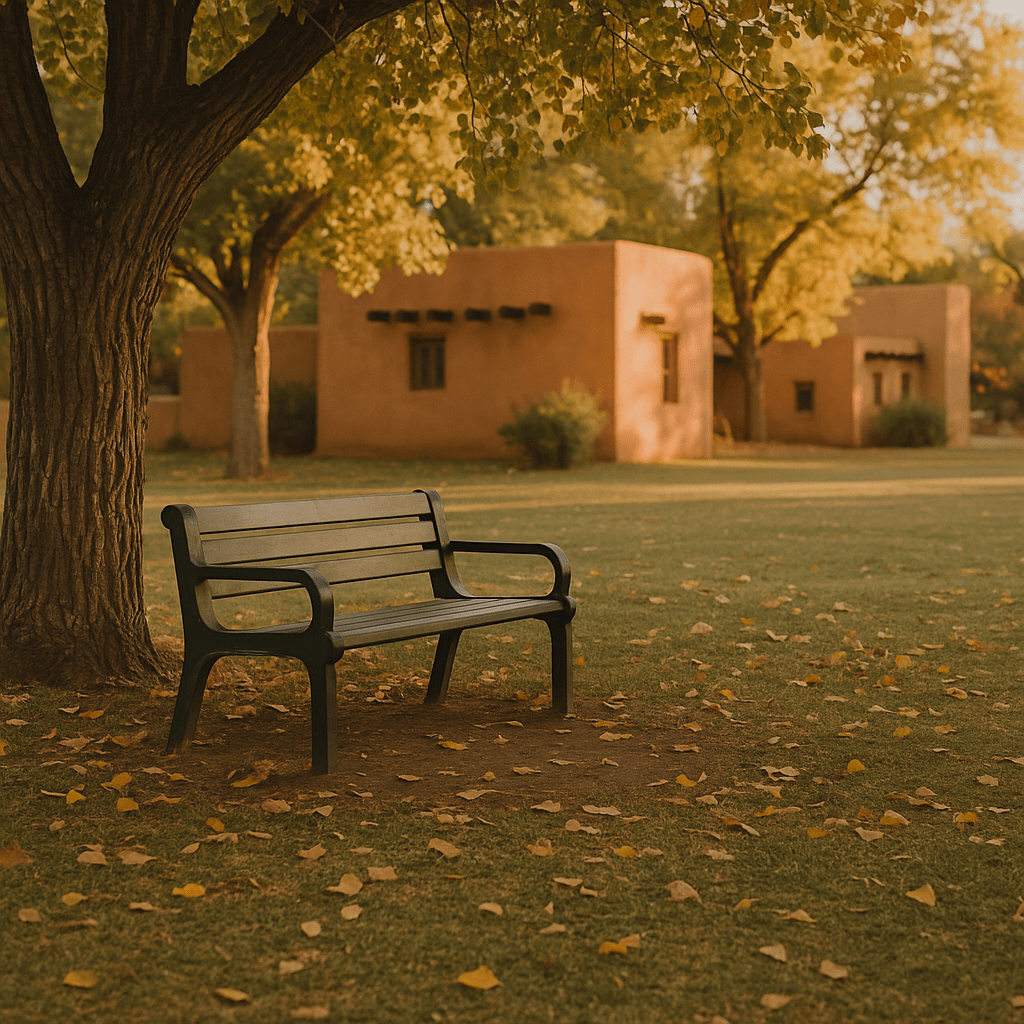
    Tiguex Park isn’t large or loud. It’s one of those places that feels like an exhale—the kind of open green that reminds you the desert can still be gentle. Cottonwoods border its edges, their leaves whispering stories to anyone who’ll listen. The grass carries the echo of a thousand family picnics, soccer games, and lazy afternoons.

    I sat on a bench and listened. The wind carried the faint clang of church bells from San Felipe de Neri. A child laughed somewhere behind me; a dog barked once and then twice. The air smelled faintly of dust and Pinon Coffee from stores nearby. I could almost feel the heartbeat of Albuquerque pulsing under the soil—slow, steady, stubborn.

    For a few minutes, I wasn’t thinking about where I should be. I was simply here. And that was enough.

    Old Town

    When I left the park, I drifted toward Old Town, a place I wasn’t even sure I’d ever been. The streets were narrower than I expected, like they were designed to make people slow down and see. My vehicle felt too big for this kind of space, a metaphor I didn’t miss—how often have I felt too big, too loud, too something for the places I wanted to fit into?

    I found parking near a cluster of adobe buildings washed in warm earth tones and trimmed in turquoise. Every corner seemed alive with color: handwoven blankets, clay pottery, silver jewelry glinting in the sun. But the crowds pressed close, a river of bodies and voices that threatened to sweep me away. Anxiety whispered, You don’t belong here, and I believed it for a moment.

    Still, I stayed long enough to see what I needed to see. The history in the walls. The persistence of beauty. The courage of people who choose to create, to sell, to share, even when the world is watching. Eventually, the noise became too much, and my anxiety reminded me it was time to go. But as I left, I felt something else—I had gone.

    Sometimes that’s the victory: motion.

    Chile Addict

    Leaving Old Town, I wasn’t ready for home yet. I wanted something that spoke to the culture I had only brushed against. A museum? A gallery? Maybe food? I found all three at Chile Addict on Eubank.

    If passion had a smell, it would be chile. Inside, every inch of space was filled—ristras hanging from the ceiling like red jewelry, shelves lined with sauces from every corner of New Mexico, even dish towels embroidered with peppers in every shade of fire. I bought a bottle of Albuquerque Hot Sauce, labeled “Extra Hot.” I didn’t realize “extra” meant something different here—this was heat meant for native tongues, not transplants like me. But I loved that. It was honest. It burned like truth.

    There was something sacred in that store: the way it celebrated an ingredient that’s more than food—it’s memory, identity, inheritance. It reminded me that culture isn’t confined to museums or galleries. Sometimes it’s bottled, hanging, or simmering quietly in someone’s kitchen.

    What Comes Next

    Driving home, I thought about how long I’ve let that invisible hand dictate my movements. How many experiences have I let anxiety edit out before they began? This small journey—Tiguex Park, Old Town, Chile Addict—felt like a rebellion against that stillness.

    Maybe I should do this every week? Not for content or performance, but as a ritual of re-entry into life. To see my city not as a backdrop but as a living text—one I’ve been too afraid to read.

    Exploration doesn’t always begin on the open road. Sometimes it starts at the park down the street, or in the narrow lanes of a place you’ve always avoided. Sometimes the bravest thing you can do is just go.

    Maybe that’s what growth really looks like—not grand adventures, but small acts of motion. What do you think… Should I keep going?

    Kyle J. Hayes

    kylehayesblog.com

    Please like, comment, and share
  • The Quiet

    The Quiet

    Salt, Ink & Soul — Albuquerque Notes

    It’s not silence I’m afraid of.

    It’s what it asks me to notice.

    After the city winds down and the last porch light clicks off, a different gravity settles over Albuquerque. The air thins and sharpens. The clock doesn’t tick so much as announce—each second a footstep down an empty hall. Even the refrigerator hum sounds like a confession. Outside, the street goes soft: figures moving like ghosts, wind pushing fine dust into corners as if to whisper, look closer.

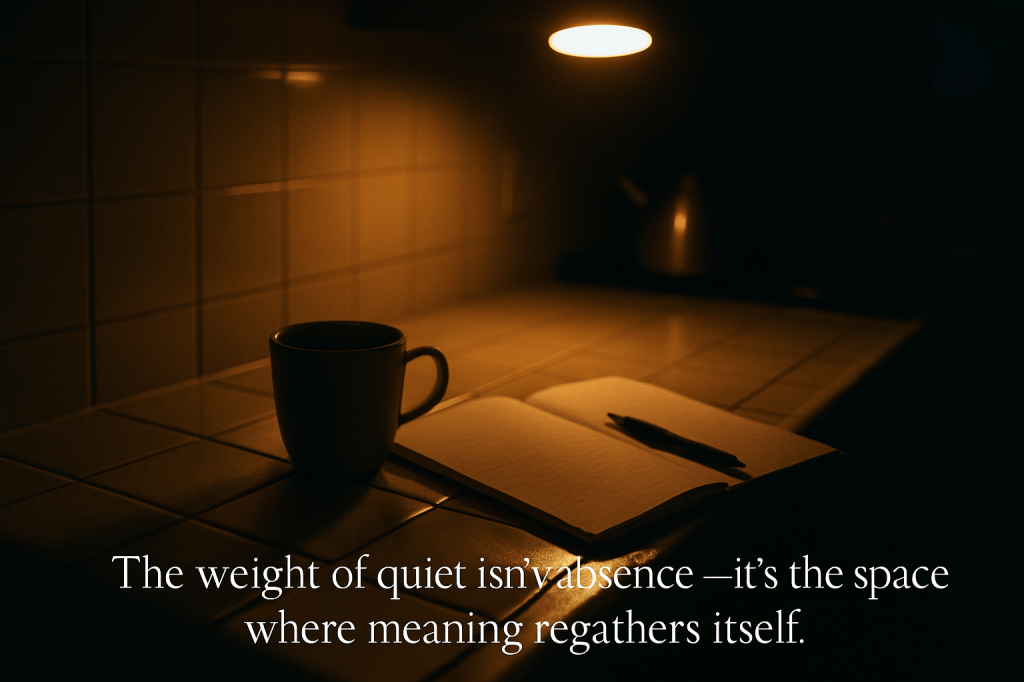
    In the kitchen at night, I stand there, unsure. Wanting to make something, not knowing if I’m even hungry. Under one dim bulb, a small pool of gold forms on the counter. Tile throws the light back in fragments—little squares of moon you can touch. The sink holds its breath. Somewhere above the cabinets, the house settles into itself, wood remembering the day it was a tree. The room is stocked—spices, onions, bones for broth—but hunger doesn’t arrive on command. The emptiness isn’t in the pantry. It lives somewhere between the throat and the hands.

    They say a writer’s greatest enemy is the blank page. They’re not wrong, but that’s not all. Emptiness has cousins: a cook’s dim kitchen when the body isn’t hungry; a road at midnight when the destination is gone and home hasn’t yet declared itself. The quiet asks for something you can’t measure—faith in a spark you cannot see.

    What does it mean to keep creating when the world around you—and inside you—goes still? What do you do when the excitements of special events are gone?

    There’s a restlessness inside the calm, like ducks on a pond—serene on the surface, paddling like hell beneath. After the community’s noise, the quiet feels heavier than the rest. It carries expectation without applause, work without witnesses. You can hold peace and pressure at once: the relief of not performing, the terror that maybe the next sentence, the next meal, won’t arrive.

    So I walk the rooms, listen to the house breathe, look out at adobe walls silvered by the moon, at porch lights fluttering like low-altitude stars. In this desert city, quiet isn’t absence—it’s landscape. Wind hums in the eaves. A lone car slips past, tires whispering secrets to the asphalt. Somewhere, behind a thin wall, soft laughter breaks and fades—the way a match surrenders after doing its job.

    If I cook, I begin with what listens back: onion, oil, salt, low flame. I don’t chase a masterpiece; I court a whisper. Heat slowly, until the room remembers its purpose. If I write, I let the hands move before the story arrives—detail by detail: the scrape of chair legs, the nick on the cutting board shaped like a small country, the clock insisting it is the only drummer left. I ask the night to tell me what it knows that daylight talks over.

    Quiet becomes a compass if you let it. It points not north but inward. It wants fewer clever sentences and more honest ones. It returns me to the first question: Who taught you to make something from almost nothing? Who fed you when there wasn’t much to eat? What did their hands look like under this same small bulb?

    I used to treat stillness like a problem to solve. I believed I should always be doing something—don’t waste time. Now I try to honor it as part of the work. The pause isn’t an intermission between lives; it’s the dark soil where the next season’s roots grow. It’s where endurance gathers; where healing grows legs.

    So I keep the rituals small and faithful. I leave a clean spoon on the counter. I set a glass of water by the notebook. I promise myself ten minutes of heat—words or stove, I don’t care which—then I let the ember decide. Some nights it becomes soup for nobody but me. Some nights it becomes a paragraph that holds after morning. The work is quiet, and it is enough.

    Outside, the Sandias keep their shape against deeper blue—mountain patience refusing to be hurried. Inside, the kitchen bulb halos the room like a blessing I didn’t think I’d earned. The page accepts a first line. The pan agrees with the first hiss. The world does not erupt in applause. It doesn’t need to.

    The fire worth trusting now is the low one—the barely visible ring that keeps the pot honest; the internal pilot light that refuses extinction. Creation isn’t the thunder of a finale; it’s the stubborn heat that stays when the audience goes home.

    The quiet isn’t asking me to fill it—only to listen long enough to remember why I speak.

    Kyle J. Hayes

    kylehayesblog.com

    Please like, comment, and share