I was raised in the Quad-Cities — an area that, to this day, feels suspended in amber. It isn’t just the winters that freeze you to the bone, when the wind whips across the Mississippi and leaves your face raw. It’s the people, the rhythm of life, the way the place still breathes as though the 1980s never ended.
Factories were our backbone then: John Deere, International Harvester, Caterpillar, The Rock Island Arsenal, and ALCOA. Their names were more than brands; they were birthrights. People clocked in and out not just for paychecks but for identity. Houses were bought once and held onto for a lifetime, just like jobs. Men retired in the same overalls they wore when they started, women retired in the same churches and kitchens that shaped them. It was a life that promised stability. Predictability. A bubble.
But bubbles keep things in as much as they keep things out.
I had seen time move differently elsewhere — places that reinvented themselves, cities that shifted, people who didn’t cling so tightly to sameness. And once you see that, once you know the world isn’t fixed in place, it’s impossible to believe that standing still is survival.
I left Iowa more than once. The first time, it was the military that pulled me out — not a choice so much as a summons. Later, work carried me away. And yet, I came back, each time.
Coming back felt inevitable, like the bubble had its own gravitational pull. But deep down, I knew I couldn’t keep circling the same orbit. There’s a difference between leaving because the world demanded it and going because you chose to.
That’s what Albuquerque was for me: a choice.
On paper, the decision made sense.
No hurricanes to rip through your home. No earthquakes to split the ground. No volcanoes threatening fire. No endless rain to drown the days. It wasn’t Phoenix, where the heat presses against your chest like a punishment. It wasn’t the overcrowded sprawl of the West Coast. It was manageable. It was human-sized.
And yes — the racial makeup mattered. I wanted a place where diversity wasn’t a buzzword, where the face of the city itself carried the mark of many histories, not just one.
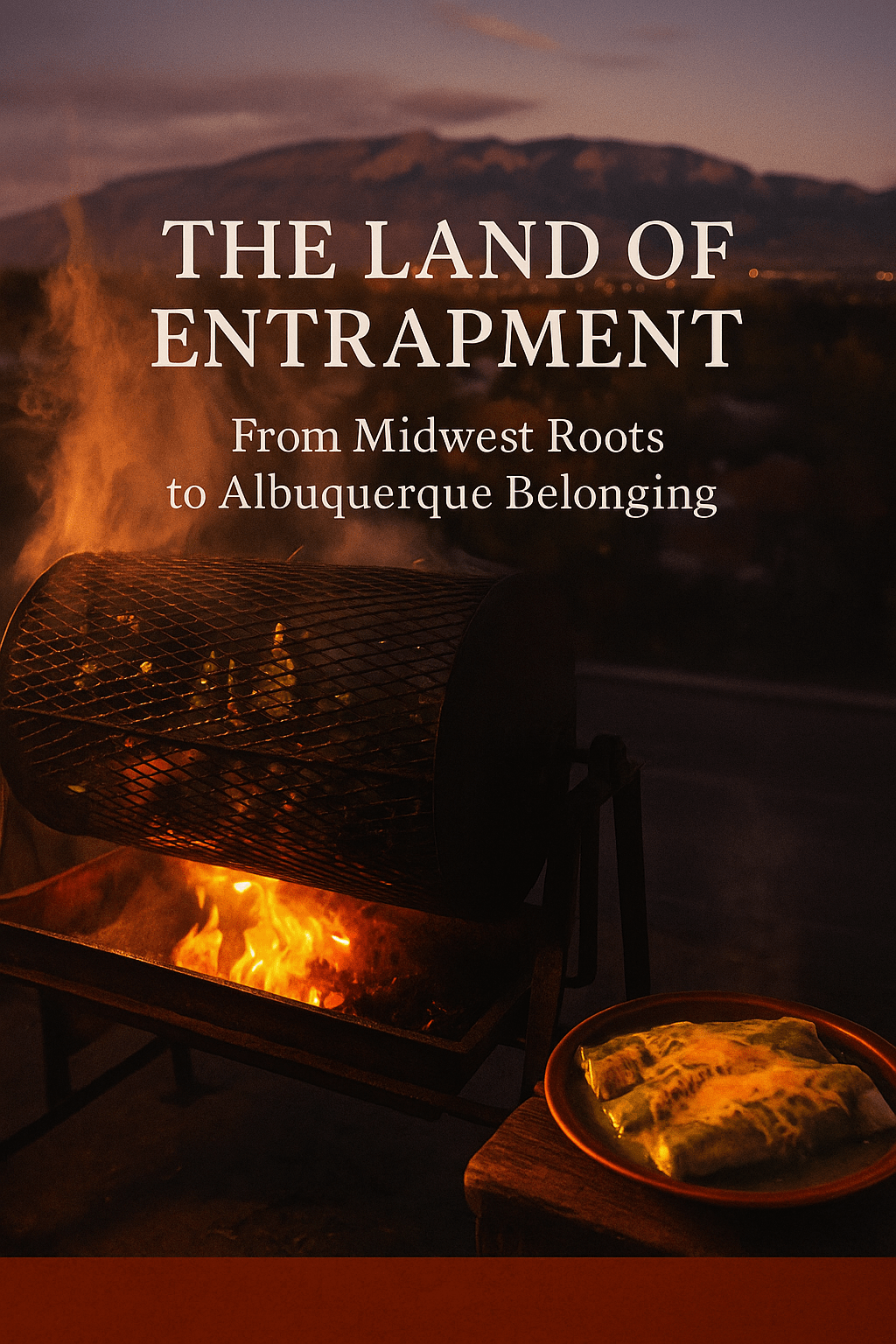
When I arrived, I heard the jokes: The Land of Entrapment. Come on vacation, leave on probation. They were said with a smirk, half-warning, half-truth. Albuquerque has its shadows. Addiction, poverty, violence — scars on a city that has seen too much. But to stop there, to see only the flaws, is to miss the marrow of the place.
I didn’t know I liked landscapes until I saw the Sandias burn pink at sunset, watermelon hues spilling across the horizon like the desert itself was blushing. I didn’t know I needed vast skies until I stood beneath them, their sheer immensity forcing me to recognize how small I was — and how alive.
Then the culture. The way Catholic feast days blur into Pueblo ceremonies, how murals tell stories, how music leaks from church doors and lowriders in the same breath. The way traditions survive here is not as nostalgia but as living practices, stitched into daily life.
And the food.
If the Midwest were pot roast and casseroles, Albuquerque is chile — unapologetic, fiery, alive. Chile roasters appear outside grocery stores in September, flames licking metal drums, smoke curling into the crisp air until the entire city smells like memory. Red or green isn’t a question of preference; it’s a declaration of identity. Enchiladas stacked high and smothered, tamales at Christmas, burritos at the Balloon Fiesta — food here doesn’t just fill you, it binds you.
I’ve said before that I wasn’t raised on green chile chicken enchiladas. I was raised on soul food, or as most people now know it, “Southern Cuisine”. That food was survival dressed as a celebration. It was what you ate to remember who you were.
But Albuquerque taught me to make room for new rituals. When I’m sick, I still crave soul food, but I’ve learned to crave enchiladas too. I’ve learned that “red or green?” comes as naturally now as “sweet or unsweetened?” once did. I’ve learned that my hands, though clumsy, can roll tortillas and fold tamales.
Food, I’ve realized, doesn’t erase what you came from. It layers it.
Iowa was entrapment too — but of a different kind. Entrapment of sameness, of repetition, of a rhythm so predictable it could suffocate.
Albuquerque’s entrapment is something else. It seduces. It draws you in with Chile smoke in the fall, with the way the mountains change color by the hour, with a culture that makes you feel like you’re walking through both past and present at once.
People warn you about it: The Land of Entrapment. But I’ve started to hear it differently, not as a warning, but as an invitation.
Because here’s the truth: I don’t want to leave.
What began as a practical choice has become something more intimate, something stitched into me. Albuquerque caught me — with its flaws, its grit, its beauty, its food — and I don’t feel trapped. I feel claimed.
That could be what home is. Not where you start, not even where you end. But where you finally stop running, because you no longer want to.
By Kyle J. Hayes
kylehayesblog.com
Please like, comment, and share
 Salt,Ink, & Soul