The word culture gets used carelessly now.
It gets flattened into playlists and palettes. Into slang that travels faster than its meaning. Into food that’s photographed better than it’s remembered. People say culture when they mean style. Or vibe. Or whatever is popular long enough to be profitable.
But that’s not what we mean.
When we say “our culture,” we’re not talking about trends.
We’re talking about what stayed.
Our culture is not defined by how visible it is, but by how much pressure it survived. It is the set of practices that held when everything else was designed to break. The habits that outlived laws. The knowledge that didn’t need permission to be passed down.
I learned that before I could explain it.
I learned it in kitchens where nobody measured anything, but nothing was wasted. In the way elders cooked like they were remembering something with their hands, in the discipline of knowing when enough was enough—when to add heat, when to lower it, when to let something rest.
That restraint is culture.
It’s the same restraint you hear in certain sentences. The kind that don’t rush to impress. That leaves space on purpose. You hear it in Baldwin’s insistence that language must tell the truth even when it makes people uncomfortable.
Before history was written, it traveled by sound.
It moved through voices that carried grief without explanation and joy without apology. Through spirituals that mapped escape. Through blues that name loss, without begging for sympathy. Through singers like Billie Holiday, who could hold an entire history in a pause.
Nina Simone understood this: that art wasn’t decoration.
It was testimony.
That wasn’t entertainment.
That was record-keeping.
And the cooks were doing it too.
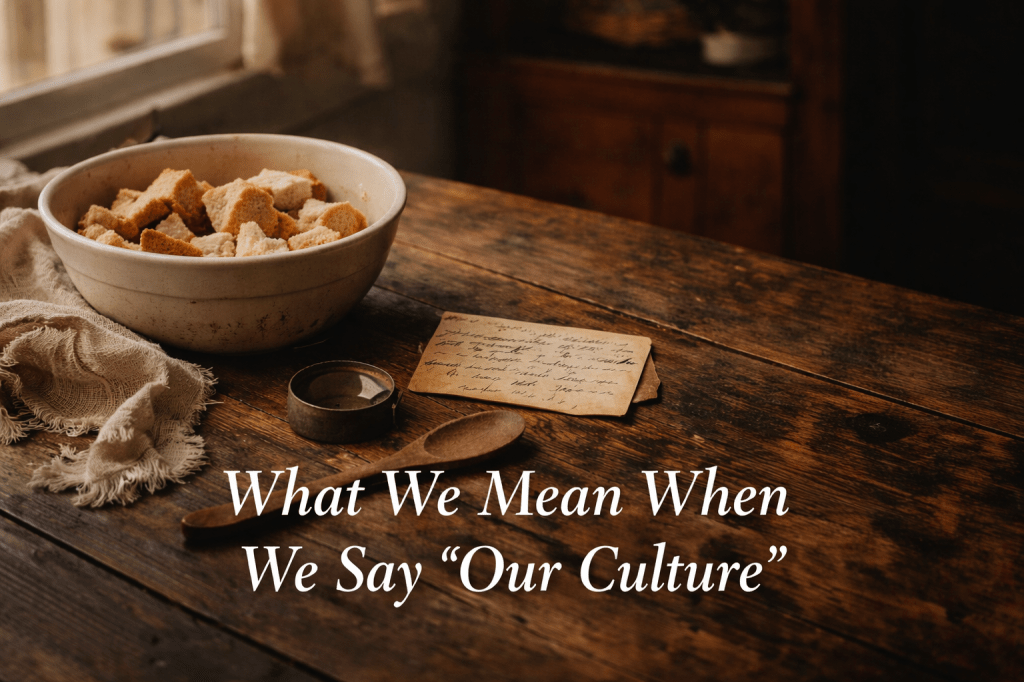
Our food was never just about flavor. It was about continuity. About making sure people ate, yes—but also about making sure they remembered who they were while doing it. Recipes weren’t written down because they didn’t need to be. They lived in repetition. In watching. In correction offered gently. In knowing when something tasted right without explaining why.
That’s why recipes function as records.
A dish tells you where a people were. What they had access to. What they were denied. What they salvaged anyway. It tells you how they thought about care—who was fed first, how far food was expected to stretch, how sweetness showed up even when conditions said it shouldn’t.
Bread pudding exists because waste was not an option.
Lemon sauce exists because joy was still necessary.
Neither of those things happened by accident.
This is what makes our culture specific.
Not borrowed.
Not interchangeable.
Not a costume someone can put on without carrying the weight.
Our culture was shaped by constraint and refined by care. It learned to be precise because excess wasn’t available. It learned to be expressive because silence was dangerous. It learned to be communal because survival required it.
That’s why defining it matters.
Not to build gates.
But to keep the record straight.
Because erasure rarely announces itself. It arrives as minimization. As everybody struggled. As to why keep bringing it up? As we’re all the same now. It arrives by disconnecting culture from origin and selling the leftovers as novelty.
But culture isn’t a vibe.
It’s a system.
A system of survival practices passed hand to hand. Voice to ear. Pan to plate. Sentence to sentence.
And when we say our culture, what we mean is this:
We kept something alive when it wasn’t supposed to survive.
We carried memory without archives.
We built beauty without resources.
We made care look ordinary so it wouldn’t be taken from us.
Writers did it with language.
Musicians did it with sound.
Artists did it with vision.
Cooks did it with repetition.
All of them answered the same question:
How do you tell the truth without disappearing?
So when I write about food, I’m not being nostalgic. I’m being precise. I’m pointing to one of the most reliable records we have. An archive you can eat. A history that still feeds people.
That’s our culture.
Not because it’s popular.
But because it held.
Kyle J. Hayes
kylehayesblog.com
Please like, comment, and share
Resources for Hard Times
If you’re looking for practical help, food support, or community resources, you can visit the Salt, Ink & Soul Resources Page.
 Salt,Ink, & Soul