Tag: Dawn Patrol

  • The Sky Doesn’t Wait: Reflections from the First Weekend

    The Sky Doesn’t Wait: Reflections from the First Weekend

    The Balloon Fiesta has begun.

    The traffic is slow, the lines are long, and still—people come. They come from every corner of the city, from quiet neighborhoods and dusty pueblos, from out-of-state hotels and small-town motels. They come in flocks and families, in rental cars and pickup trucks, all heading toward that same expanse of sky.

    There’s something almost sacred about that patience—thousands of people inching forward, headlights cutting through the dark, chasing a sunrise that promises color and lift. When you finally reach the field, you feel the chill in the air and the hum of anticipation. It’s not just another event; it’s a pilgrimage.

      For me, it doesn’t feel real until I see him—Steve Stucker, the man who for decades became as much a part of the Fiesta as the balloons themselves.

    Even now, after retirement, the sight of him on-screen—covered in pins and smiling like he’s been greeting the dawn for a hundred years—makes it official: the Fiesta has arrived. His jacket tells its own story, each pin a memory, each one earned through years of showing up before dawn, rain or shine, to bring us the sky.

    In a world that changes so fast, there’s something steady in seeing a face that’s weathered every kind of morning—warm, biting, calm, or unkind. That’s what the Fiesta does: it pulls us together not just around balloons, but around continuity. Around the faces and names that remind us that we’ve been here before, and that we’ll come again.

    When the Wind Says “Not Today”

    This year, the wind won.

    The first mass ascension—canceled. But even that didn’t stop the people. They stayed. Walked the fields, drank coffee, ate breakfast burritos, told stories of years when the balloons had risen, and of mornings when they hadn’t. The disappointment didn’t linger long; it couldn’t.

    Because the Fiesta isn’t just about flight—it’s about the faith that flight will come again.

    Later that night, the “Glowdeo” filled the sky with candlestick burns—columns of flame roaring against the dark, balloons grounded but still alive, like sleeping giants stirring in their dreams. A drone show followed, lights moving in perfect symmetry—a new generation of flight, precision replacing intuition. I stood there wondering what comes next.

    Drones and Dreams

    The drones were beautiful. So were the balloons. But they spoke in different languages.

    The balloons moved like old souls—soft, human, uncertain. They relied on wind and patience. The drones moved like thought—fast, bright, efficient. Controlled. Predictable. One whispered of freedom, the other of order. Both were beautiful, and maybe both are necessary.

    Maybe this is what the Fiesta has become: a conversation between the past and the future, between the handmade and the programmed, between the art of drift and the science of control. The balloons remind us what it means to trust the air. The drones remind us what it means to master it.

    I watched both, side by side, and thought: maybe one day, they’ll find a way to share the same sky.

      Even without ascension, it felt right. People still looked up. Kids still pointed. Strangers still smiled. Coffee still steamed in paper cups, and laughter still carried across the cold morning air.

    That’s the quiet truth of this place—the Fiesta doesn’t need perfection to be beautiful. It needs people. It needs presence. It needs the shared belief that, for one week every year, Albuquerque becomes something greater than itself—a city suspended in wonder.

    And maybe that’s why we come back: not for the perfect flight, but for the reminder that even when the wind says “not today,” hope still fills the sky.

    Kyle J. Hayes

    kylehayesblog.com

    Please like, comment, and share
  • The Sky Belongs to Balloons

    The Sky Belongs to Balloons

      It’s the time of year when the desert begins to remember the cold. The mornings bite a little sharper, the light shifts from golden to amber, and in Albuquerque, the rhythm of fall comes with rituals all its own. The State Fair folds up its tents and carnival lights, and before the dust has even settled, the sky gives itself to balloons.

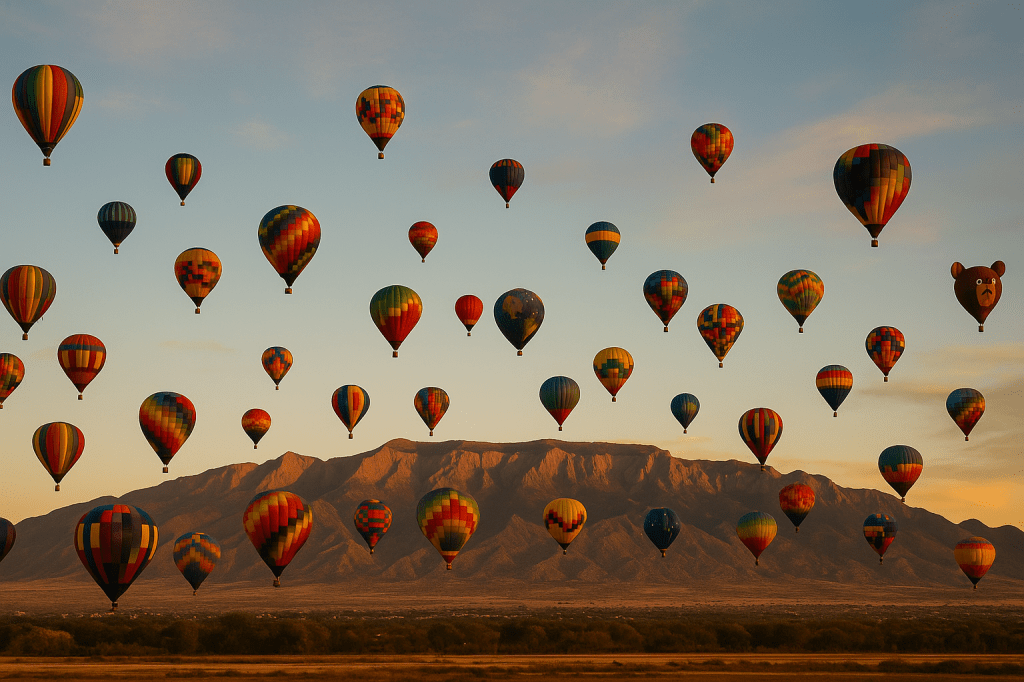
    The Albuquerque International Balloon Fiesta is not just an event here; it is a season. The largest gathering of hot air balloons in the world, and every year, it pulls tens of thousands of people into its orbit. It rewrites the city’s mornings. Commutes pause. Joggers stop mid-stride. Children tug their parents toward the sidewalk, phones raised, because a balloon — shaped like a cow or a stagecoach or just a simple rainbow stripe — has drifted so low it seems ready to brush the rooftops.

    And then the chase crews arrive, pickup trucks trailing, men and women moving quickly, packing away the canvas like a secret folded back into itself. You see this enough, you could call it ordinary. But I’m still too new here, not jaded enough, because every time I look up and catch sight of one, it feels like the sky has been interrupted by wonder.

      There’s a madness in waking at 3:30 a.m. just to stand in the cold. Yet thousands of us do it, year after year. The roads snake toward Balloon Fiesta Park in the dark, headlights lined up like a procession. Coffee cups steam in cup holders, blankets drape over shoulders, and conversations hum with anticipation.

    When you arrive, the field is still hushed, waiting. Crews shuffle around baskets, propane tanks hiss faintly, and in the distance you hear murmurs, laughter, the rustle of nylon being unfurled. The night sky holds onto its stars a little longer.

    And then — the Dawn Patrol.

    A handful of balloons rise first, lighting their burners in unison, glowing like lanterns against the indigo dark. The sound is unmistakable: the sudden whoosh of flame, the gasping exhale of fire against the silence of morning. The crowd breathes with them, every burst of light pulling eyes upward. For a moment, it feels less like a spectacle and more like a ceremony.

    And then the Mass Ascension begins.

    Dozens, then hundreds, then more than you can count. Balloons rising in waves until the sky is littered with color — a slow unfurling of the surreal, so vast and so improbable that it borders on disbelief. You look up and the horizon is gone, erased by canvas and flame.

      There’s a peculiar intimacy in standing with thousands of people you don’t know, all of you bundled against the same chill, sipping coffee, biting into breakfast burritos, sharing a collective awe. You don’t need names. You don’t need history. For a few hours, you are kin to anyone whose head tilts back in wonder.

    Children squeal at the “special shapes” — bees holding hands, Darth Vader and Yoda, cows larger than houses. Photographers kneel, point, capture. Tourists beam into news cameras, their voices shaky with joy, telling reporters this was a lifelong dream.

    And I wander among it all, part of the throng but also apart, notebook in my pocket, questions in my head. What does it mean that people travel across the world just to stand in this field and look up? What does it mean that beauty, when shared, feels almost like communion?

      By mid-morning, the sky begins to empty. Balloons scatter, floating toward the mesa, toward neighborhoods, toward open lots where chase crews wait to claim them. The field thins out, tourists drift toward vendors selling chile and frybread, and traffic snarls for miles.

    You sit in it, inching forward, the high of the morning giving way to the dull grind of engines and exhaust. The burrito is gone, the coffee cold. Reality asserts itself.

    And yet, even in that crawl, I find myself replaying the moment of lift. The quiet between burner blasts. The way balloons floated like prayers, drifting wherever the wind allowed. My fear of heights keeps me on the ground, tethered by gravity, but still — I wonder what it must be like to surrender that control. To look down on this desert city not as blocks and intersections but as a sprawl of lives stitched together under the watch of mountains and sky.

    Part of the gift of the Fiesta is this: that you don’t need to rise to feel lifted. Wonder has its own gravity, and it doesn’t care whether you leave the earth or not.

      Living here, you learn to get used to things. Chile roasters set up outside grocery stores in September, flames spitting, smoke curling into the air until the whole city smells like survival. The Sandias are turning pink at dusk, like the mountains are reminding you that the day is theirs to close. Balloons dotting the sky in October, so common they could be dismissed as background.

    But used to doesn’t mean unmoved by.

    Maybe that’s the secret of Albuquerque — that it can hold the extraordinary and the ordinary at the same time without letting either collapse the other. It teaches you that wonder isn’t about distance but attention. That staying, not leaving, sometimes brings you closer to beauty.

    The Balloon Fiesta comes and goes, the crowds depart, the fields go quiet again. But for one week, every year, the sky itself becomes a canvas — and it belongs to balloons.

    And that’s what keeps me here. Not the spectacle, not the scale, not even the food or the music or the culture, as rich as all of that is. It’s the reminder that beauty doesn’t always come from someplace else. Sometimes it rises right in front of you, again and again, until you learn to stop, to look up, to hold still in the presence of wonder.

    By Kyle J. Hayes

    kylehayesblog.com

    Please like, comment, and share
  • Dawn Patrol

    Dawn Patrol

    There is a moment before the day decides itself. A hush. The city holds its breath, streetlights humming like distant hymns, the Rio Grande moving somewhere you can’t quite see. You turn on the television and the anchors talk logistics—lift-off times, pilot briefings, winds at five hundred feet. They say Dawn Patrol the way a foreman says day shift, voice flat with utility. Experienced pilots rise before sunrise, sample the air, and radio the numbers so the rest can follow. It is a system, a safety net, a way to choreograph the sky.

    All of that is true. None of it explains why you wake in the dark and put on layers you haven’t touched since last winter.

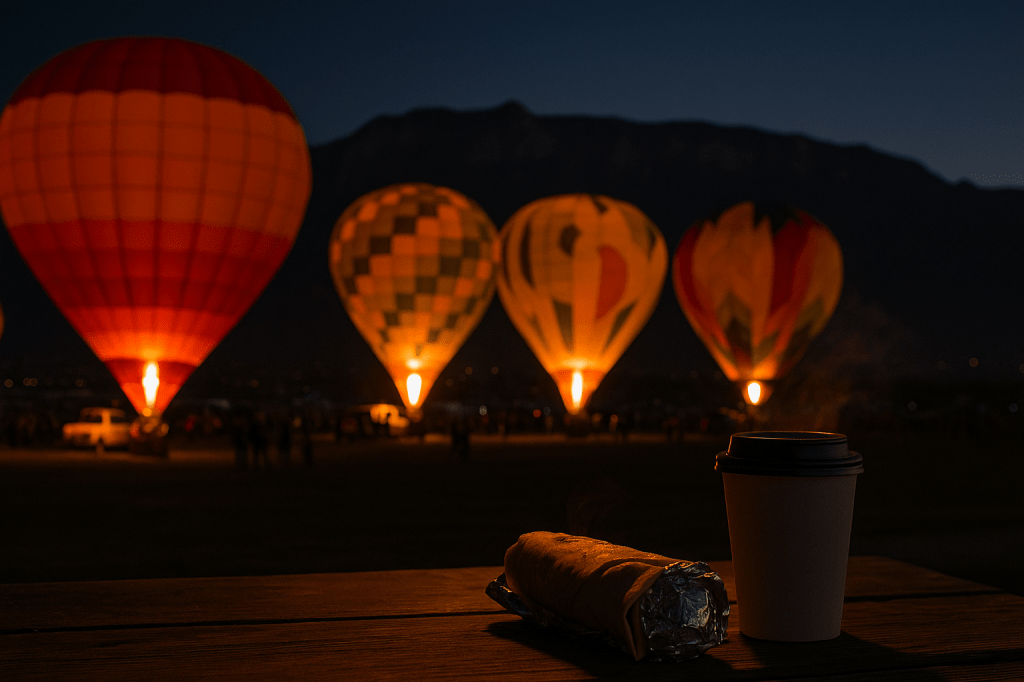
    I went once—before dawn, coffee scalding my palm through a cheap lid, a breakfast burrito warming the other hand because the desert pretends it’s summer by day and remembers it’s a high plain by morning. I went expecting to watch balloons fill. Fabric, fire, lift. A diagram with flames.

    What I got was a glow.

    On the field, the balloons lay like sleeping animals, bright skins spread across the grass. Then the burners woke—one, then another, hissing like some prehistoric choir. A body of color rose where there had been only shadow. Then the flame cut, and the color collapsed back into the night. It was breath, not mechanism. Inhale. Exhale. Light. Dark. Over and over until the timing took on a pulse.

    Some mornings, a dozen of them rise together, a Dawn Patrol show choreographed to music—since 1996, people say—as if we couldn’t admit that we’ve always wanted the night itself to have a soundtrack. You stand there with thousands of others, strangers knitted together by cold and a shared tilt of the head, and the field becomes a stained glass window lit from the inside. No sermon necessary. The windows preach in orange and blue.

    I didn’t expect the characters. Darth Vader drifted up first, glossy black helm drinking fire. Then Yoda, ears like sails, face wise and ridiculous at the same time. I laughed out loud. Not a cynical laugh—something closer to relief. As if a muscle you didn’t know had tightened, it finally let go. Wonder snuck in wearing a costume. For a few beats, I was younger than the hour, the cold, the years I carry in my shoulders. I was just a person in a field, neck craned, mouth open.

    I took too many pictures. Everyone does. You can feel how flimsy the phone is in your grip compared to what’s happening above you, but you try anyway. Later, you scroll those photos when the day turns officious and small, and they feel like contraband: proof that the sky once made room for joy before 6 a.m.

    The news will always explain Dawn Patrol as a service to the Mass Ascension—pilots sampling the invisible, calling down the conditions so others can rise with some measure of certainty. That’s real. It’s also a poor translation. What happens on the field isn’t data; it’s discipline. Standing in the dark and waiting for light is an ancient ritual. We practice it for exams, for diagnoses, for shifts that start before dawn. Out on that grass, we rehearse it for a different reason: to remember that hope is not loud. Hope flickers. Hope needs tending. Hope is a burner you ignite again and again until the fabric holds its shape.

    You eat while you wait. Eggs, potatoes, green chile tucked into a foil-wrapped cylinder—the kind of food that tastes better outdoors, better in the cold, better when you’ve decided to be awake with other people who have also decided to be awake. The coffee is almost too hot, and that’s the point. It scalds reality into you. It locates you in the body while the eye is busy chasing fire.

    Balloons do not promise much. A canvas, a basket, a bottle of fuel, a willingness to negotiate with the wind. They are humble in that way. Honest. They rise when the air says yes. They bow when the air says no. That humility is part of the love here. The desert teaches it daily—no water without asking, no shade without planning, no shortcuts through noon. Dawn Patrol is the desert’s lesson painted in flame: attention first, then ascent.

    I have returned since that first morning. I’ve stood through other shows, other glows, other crowds bundled into a single breath. But the first time is the one that lives in me. The shock of color against a sky that wasn’t ready for it. The burn of coffee and chile at the edge of my tongue. Vader and Yoda rising like jokes the universe told to remind us it still has a sense of humor. The way thousands of people could grow quiet together without being told.

    What stays with me isn’t the scale—though hundreds of balloons carving a horizon is a kind of madness worth seeing. What remains is the practice: wake before there is a reason, bring your own heat, and stand still long enough to witness. Let the first light come from within something—within a balloon, within yourself—before the sun claims the credit. Accept that the work of rising begins in the dark, where the world can’t yet see you, where the radioed wind is just a voice naming what the invisible intends.

    They’ll talk about the Box on other mornings, about the clever wind that carries you south low and north high so you can drift out and then come home again. But the Box is a later magic. Dawn Patrol is earlier, older. It’s the choice to step into the unproven, to measure a future with nothing but flame and nerve. It’s a handful of people going first, not with bravado but with care, so that when the mass ascension comes—and it always comes—the rest of us can rise with fewer doubts.

    I still look at those photos from my first visit. They’re poorly framed. My thumb is in one. The exposure is wrong in three. It doesn’t matter. I keep them because they’re true. They remind me of what the day sometimes tries to make me forget: that awe is something you can work toward, that joy can be prepared like coffee, and that you can choose to show up for wonder before it becomes convenient.

    On paper, Dawn Patrol is a safety protocol. In the body, it is a liturgy: fire, breath, lift, drift. In the soul, it is a compact you make with the morning—if I come to meet you, will you meet me back? Some days the answer is no. The wind turns, the field stays quiet, the burners never speak. But on the days it’s yes, the sky answers in lanterns. And for a few minutes, the world is what it could be: a chorus of small lights, rising.

    By Kyle J. Hayes

    kylehayesblog.com

    Please like, comment, and share