
Tag: emotional honesty

  • Light the Candle Anyway

    Light the Candle Anyway

    I like Christmas.

    I like the lights strung too tightly across porches, the decorations that appear overnight as if the neighborhood agreed on a quiet truce with darkness. I like the music—some of it at least—and the movies most of all. The old ones. The ones that arrive every year like familiar witnesses, reminding you that time keeps moving whether you’re ready or not.

    I genuinely like these things.

    All of them.

    And still, something is missing.

    There’s supposed to be a warmth that comes with this season, a fullness that settles somewhere in the chest, a feeling people speak about as if it’s inevitable—like snowfall or sunrise. But for me, that space feels hollow. Not empty exactly. More like a room that remembers being lived in, but hasn’t been occupied in a long time.

    I’ve noticed that absence more acutely as the years pass. Christmas doesn’t hurt.

    It just… echoes.

    The Space Between

    For a long time, I responded to that hollowness by quietly opting out.

    No decorations.

    No tree.

    No deliberate effort to invite the season inside my walls.

    Not out of bitterness—just a kind of emotional economy. Why set a place at the table for a feeling that might not show up?

    But this year, something shifted.

    Not dramatically. Not with a revelation or a promise to feel differently. Just a small, stubborn thought that kept returning, dressed up as a borrowed line from a movie I’ve carried with me for decades:

    If I build it, it will come.

    So this year, I’m decorating.

    Not because I suddenly feel festive.

    Not because joy has arrived early and knocked politely.

    But because sometimes hope isn’t about how you feel—it’s about what you do anyway.

    Choosing Hope Without Demanding Joy

    There’s an unspoken rule around the holidays: you’re supposed to feel something specific.

    Gratitude.

    Warmth.

    Cheer.

    A sense of completion.

    And if you don’t, it can feel like a personal failure—like you missed a memo everyone else received.

    But Christmas Eve, if you really look at it, isn’t about arrival.

    It’s about waiting.

    It’s the night before. The space between. The moment when nothing has happened yet, and that’s precisely the point. Christmas Eve doesn’t ask you to open gifts, sing loudly, or prove anything.

    It asks you to sit with anticipation—however fractured that anticipation might be.

    For some people, that anticipation is joyful.

    For others, it’s complicated.

    For many, it’s heavy with memory, absence, and unfinished grief.

    And still, the night remains.

    The Candle

    That’s where the Candle comes in.

    Lighting a candle isn’t a declaration of happiness. It isn’t a performance of belief or a promise that everything is fine. It’s an acknowledgment of darkness—and a refusal to let it have the final word.

    A candle doesn’t banish the night.

    It simply says:

    I’m still here.

    The Quiet Work of Building Something First

    I haven’t decorated my home in years. Not because I hate the season, but because I didn’t want to confront the gap between what Christmas is supposed to feel like and what it actually feels like inside me.

    Decorating means effort.

    It means intention.

    It means admitting you want something to happen—even if you’re not sure it will.

    This year, I’m doing it anyway.

    Not as a ritual of joy, but as an act of survival.

    I’m hanging lights not because my heart is full, but because it isn’t. I’m placing decorations not to summon nostalgia, but to acknowledge that I’m still capable of making space. Still willing to try. Still open enough to say, maybe.

    Maybe warmth doesn’t arrive on its own.

    Maybe it needs scaffolding.

    Maybe it needs permission.

    Or maybe it never comes at all—and the effort still matters.

    Because the real loss isn’t failing to feel the right thing.

    It’s giving up on the possibility of feeling anything.

    Holding Space

    Christmas Eve doesn’t need you to be joyful.

    It needs you to be present.

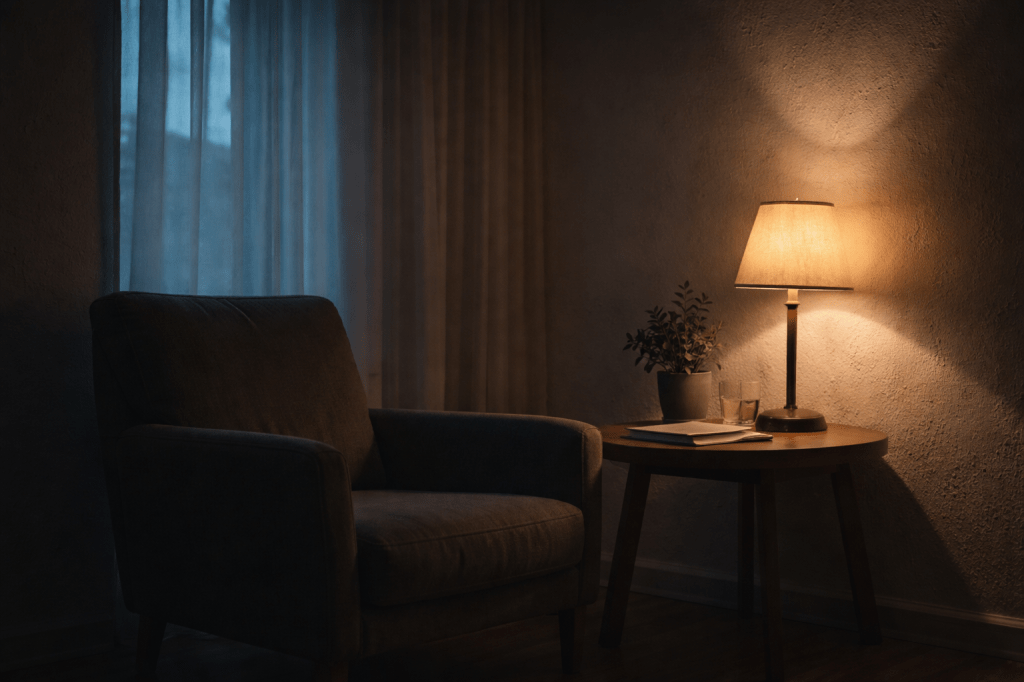
    It needs you to recognize that choosing hope doesn’t always look like celebration. Sometimes it looks like lighting a candle in a room that feels too quiet and letting that small flame testify on your behalf.

    Sometimes hope is understated.

    Sometimes it’s tired.

    Sometimes it shows up without confidence.

    But it shows up.

    And tonight, that’s enough.

    If your heart feels full, celebrate.

    If it feels heavy, you’re not broken.

    If it feels hollow, you’re not alone.

    Light the Candle anyway.

    Not because you’re sure something will come—but because the act itself is a declaration:

    I am still willing to make room.

    And on Christmas Eve, that may be the most honest form of hope there is.

    Kyle J. Hayes

    kylehayesblog.com

    Please like, comment, and share

    Resources for Hard Times

    If you’re looking for practical help, food support, or community resources, you can visit the Salt, Ink & Soul Resources Page.
    👉 Resources for Hard Times

  • Don’t Answer Too Fast

    Don’t Answer Too Fast

    This reflection was written in response to the passing of Lamar Wilson.

    When a man dies, the world rushes to explain him.

    We build stories quickly—causes, warnings, neat conclusions—because uncertainty makes us uncomfortable. But the truth is simpler and harder to sit with: the only person who can fully name the reasons someone leaves this life is the person who left it. Everyone else is guessing in the dark.

    Still, the darkness teaches us things if we’re willing to look.

    There is a place where it’s just you.

    No audience.

    No applause.

    No performance.

    Just you, alone with your thoughts, listening to them pace the room.

    That place is where the real battle lives.

    Some people look like they have everything. Visibility. Momentum. Laughter. A life that seems full from the outside. But sometimes, all of that is scaffolding for a private war. Sometimes success isn’t peace—it’s camouflage.

    Especially for Black men.

    We are taught early how dangerous honesty can be. How pain is read as weakness. How softness is punished. How exhaustion is moral failure. The world prefers us sharp or silent—never tender, never unsure.

    So we learn to armor ourselves. We learn how to smile through weight. How to carry pressure without complaint. How to translate suffering into something palatable.

    And then we pass that lesson to each other.

    “You good?”

    It’s a small question, almost polite. A check-in that lasts no longer than a breath. We ask it in passing—at work, in hallways, in group chats, at cookouts. And the answer is almost always the same.

    “I’m good.”

    Sometimes it’s true.

    Often it’s not.

    “I’m good” keeps things moving. It protects the room. It spares everyone the discomfort of slowing down. It’s the answer you give when you don’t know how much space your truth would be allowed to take.

    Because telling the truth can feel dangerous.

    There is a particular loneliness in being surrounded by people who know your face but not your fight in being visible and unseen at the same time. In realizing that the strength as it’s been taught to you requires a kind of daily self-erasure.

    This is the quiet violence no one names.

    Not sirens.

    Not headlines.

    Just the steady pressure of swallowing yourself because the world has never been kind to men who admit they are drowning.

    And so the battle stays private. Fought every day. From the moment you wake up to the moment sleep finally loosens its grip. A war without witnesses. A war without language.

    What if we stopped answering too fast?

    What if, instead of reflex, we allowed the question to linger long enough for honesty to find its footing?

    “No. I’m not good.”

    That sentence is not weak. It is a risk.

    It is opening a door without knowing who will stay. It is admitting you are human in a world that has asked you to be indestructible. It is naming pain without packaging it as motivation, humor, or grit.

    And it is a beginning.

    Not a solution.

    Not a cure.

    A beginning.

    Because once the truth is spoken, the battle is no longer invisible. It becomes something that can be shared, witnessed, and held. And being witnessed—truly witnessed—is not nothing. It is not a platitude. It is a form of care.

    We won’t save everyone by asking better questions. We won’t fix despair with the right words. This isn’t about heroics.

    It’s about presence.

    So we could change the ritual. Maybe we should

    “How are you really holding up?”

    And then we stay quiet long enough for the answer to breathe.

    No fixing.

    No rushing.

    No telling someone how strong they are.

    Just staying.

    If you’re reading this and you have been answering too fast—if you have been saying “I’m good” when you’re not—please hear this clearly:

    You do not have to fight the entire war alone.

    Say it once.

    To one person.

    To someone safe.

    “No. I’m not good.”

    That sentence will not solve everything. But it can keep you here long enough for something else to begin.

    And if someone says it to you—if a brother finally lets the truth slip—don’t reach for wisdom. Don’t reach for advice.

    Reach for presence.

    “I’m here.”

    “I’m listening.”

    “You don’t have to carry this by yourself.”

    We don’t need perfect answers.

    We need rooms where the truth can survive being spoken.

    The battle is real.

    And it is daily.

    But it should not be silent.

    And it should not be solitary.

    Kyle J. Hayes

    kylehayesblog.com

    Please like, comment, and share

    Resources

    If this reflection brings up more than you expected, and you’re in the U.S., you can call or text 988 to reach the Suicide & Crisis Lifeline. If you’re elsewhere, local crisis resources are available in many countries. You don’t have to hold everything alone.