Tag: emotionalresilience

  • The Weight of What You Carry

    The Weight of What You Carry

    In the American South, where heat teaches patience whether you want the lesson or not, there lived a small boy named Amari.

    Adults called him full of energy. What they meant was that his body often moved faster than his judgment. His feet were quick. His mouth was quicker. He laughed before asking and burned hot when he felt small.

    He lived near a road that once mattered more than it did now. Trucks still passed. Church folk still waved. Old men still sat in folding chairs like they were guarding something no one had named aloud. His mother worked long days. His Uncle Michael cooked.

    Not fancy food.

    Not restaurant food.

    The kind that fed tired hands. The kind that smelled like onions in cast iron and meant you’re safe here. Salt mattered in that kitchen—not just for taste, but for balance. For knowing when something was right.

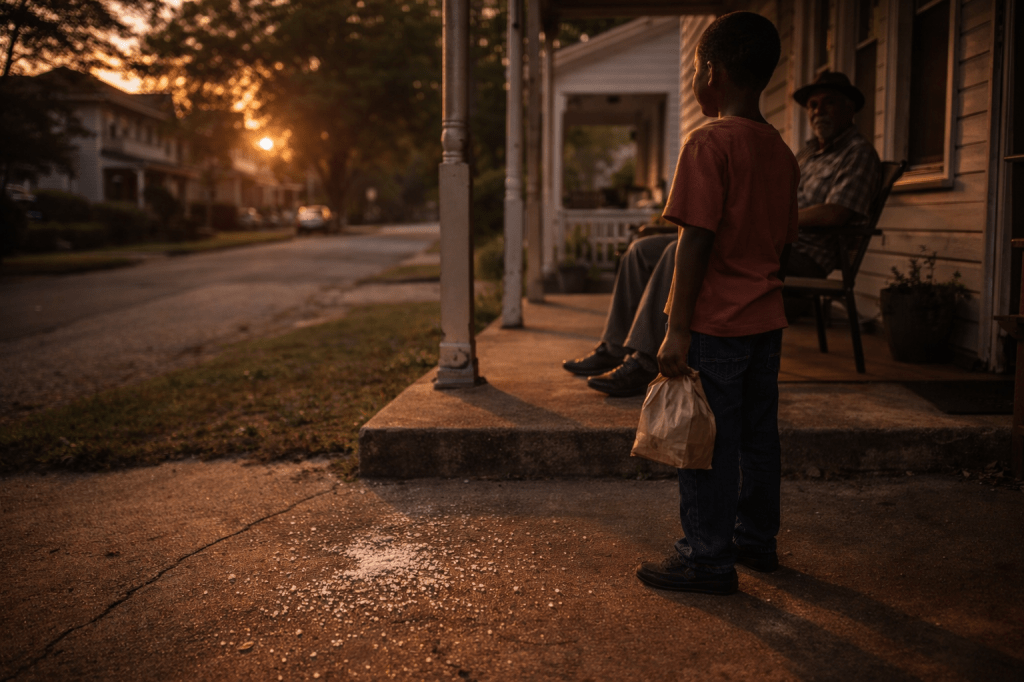
    One morning, his Uncle Michael handed Him a small paper sack.

    “Take this next door,” he said. “And don’t spill it.”

    Amari nodded. Serious. Focused. For a moment.

    Outside, the block was alive—boys throwing rocks at a rusted can, a radio too loud, laughter ricocheting between houses. Amari wanted to be seen.

    So he set the sack down for just a second.

    The wind came without asking. It tipped the bag. Salt scattered across the concrete, bright and unforgiving.

    Amari froze.

    Salt doesn’t come back once it’s rushed. It only tells the truth about what happened.

    Someone laughed. Not cruel. Just careless.

    That’s when Mr. Lewis, who sat on his porch every morning like time had placed him there on purpose, spoke up.

    “You know what that is?” he asked, nodding at the ground.

    “Just salt,” Amari said.

    Mr. Lewis shook his head. “Salt is what’s left after everything else burns away. You don’t rush it.”

    Then he asked, gently, “What were you really trying to do, son?”

    Amari swallowed. “I wanted to look strong.”

    Mr. Lewis nodded. “Strength ain’t speed. It’s control.”

    Amari carried the empty bag back and told his Uncle the truth before fear could dress it up. He didn’t yell.

    “Today,” he said, “you cook with me.”

    All day, Amari learned to wait. To stir without splashing. To listen to the heat, to the timing, to himself. By evening, his Uncle Michael handed him another sack.

    “This time,” he said, “carry it slow.”

    And Amari did.

    Not out of fear.

    Out of understanding.

    That night, with cicadas humming and the wind still moving through the trees, Amari learned what no one had rushed to teach him:

    Resilience isn’t never spilling.

    Self-discipline isn’t punishment.

    Self-awareness is knowing when you’re rushing—

    and choosing to hold what matters steady.

    The wind kept blowing.

    But Amari knew how to carry now.

    Kyle J. Hayes

    kylehayesblog.com

    Please like, comment, and share

    Resources for Hard Times

    If you’re looking for practical help, food support, or community resources, you can visit the Salt, Ink & Soul Resources Page.


    👉 Resources for Hard Times

  • I’m Learning

    I’m Learning

    As I’ve said before—and as most of my close friends know—I’m just now beginning to like my birthday.

    That might sound small. But to me, it’s seismic.

    You spend enough years pretending your day of birth is just another day, and eventually, you believe it.

    You teach yourself not to expect anything; over time, even the presence of joy feels like an intrusion.

    A noise in a quiet room you worked hard to make still.

    But now, because of the stubborn kindness of those around me, it’s changing.

    Slowly.

    Quietly.

    Almost against my will.

    They’ve made my birthday a project.

    Not a celebration, but a mission.

    To make me smile. 

    And I won’t lie—something about that type of caring, unsolicited but insistent, humbles me.

    Still, no amount of cake or candles wipes away the long memory of absence.

    There’s still the question of what was missing.

    And maybe worse, those who never cared enough to say they were wrong.

    A friend told me something today that I can’t get out of my head.

    She said, “Sometimes we don’t get an apology. That’s just reality. That’s why we have faith. God said, ‘Vengeance is mine.’ He will make it right.”

    I nodded.

    But the part of me that’s been carrying silence for decades didn’t just nod.

    It stirred.

    Because she’s right.

    We don’t always get the apology.

    We don’t always get the closure.

    Some of us are walking around with unfinished stories tattooed on our backs.

    We carry them into every conversation, every argument, every strained holiday dinner, hoping—just once—someone might say, “I’m sorry.”

    But they don’t.

    And the truth is…

    Maybe they never will.

    So I’ve been praying.

    I pray for guidance.

    Not for patience—not anymore.

    I used to pray for patience until I realized  God has a sense of humor.

    A disturbing one.

    Because when you ask for patience, God doesn’t hand you peace.

    He hands you people.

    Situations.

    Moments designed to strip you raw.

    I asked for patience and was placed in a line behind an elderly woman who was handwriting a check and logging it in her journal.

    I asked for patience and got coworkers who don’t do their treatments or charting.

    I asked for patience, and God reminded me I still have so far to go.

    So now I pray for guidance.

    Because I know right from wrong.

    But I don’t always know how to move through it.

    Because doing the right thing doesn’t come with applause.

    It comes with silence. With resistance.

    Biting your tongue so hard it leaves marks.

    Smiling at people you know would sell you out for less than you’re worth.

    Standing still while someone else gets away with what you could never do.

    So yes—I smile.

    Because I’ve learned that’s easier for other people.

    And on some days, it’s easier for me, too.

    But it’s not just a smile.

    It’s a shield.

    A sermon.

    A small declaration of war.

    Because inside that smile is the tension between “I’m trying” and “Don’t push me.”

    Because even though I’m praying for guidance,

    Even though I believe God fights my battles,

    Even though I believe vengeance isn’t mine to seek,

    I also think that some people walk too close to the edge—

    And that if I weren’t actively praying,

    I’d push them.

    Into traffic.

    Into silence.

    Into the reflection, they keep avoiding.

    So I breathe.

    I pray.

    I eat the cake.

    I take the hugs I never asked for.

    I thank the people who won’t let me hate this day.

    And when someone asks how I’m doing,

    I say, “Fair.”

    Because I am.

    And I thank God for the strength to keep from doing what I want to do.

    Even if He knows exactly how close I get.

    By Kyle J. Hayes

    Please like, comment, and subscribe.

  • The Gift I Never Asked For (Except One)

    The Gift I Never Asked For (Except One)

    My birthday is tomorrow.

    I don’t dread it, but I don’t celebrate it either—not in the way most people do, not in the way I’ve learned people expect.

    That probably says something about me.

    I imagine it always has.

    I didn’t grow up with the kind of birthdays that get remembered in photo albums.

    There were no decorated cakes, no noisy gatherings, no traditions that wrapped the day in joy.

    What I remember is silence.

    Birthdays went like any other day—quiet, functional, uncelebrated.

    Maybe someone said something in passing.

    Maybe not.

    It wasn’t cruel. Just… normal.

    We weren’t a family that hugged often.

    We weren’t loud with our affection.

    And because of that, I grew up with the kind of relationship to my birthday that you might have to a train passing in the distance: you hear it, you recognize it, but you don’t stop to wave.

    It wasn’t until I got married that birthdays began to take shape.

    My ex-wife refused to let the day go unnoticed.

    She planned parties like she was fighting for my soul.

    Decorations, dinners, full schedules.

    And no matter how uncomfortable it made me feel, she insisted.

    She believed birthdays should be celebrated with loud joy and wide arms, and she took it personally if mine wasn’t.

    To her, celebrating me was an act of love.

    It was like learning a new language I hadn’t asked to speak.

    And even after we separated, that kind of love followed me.

    I’m single again, but I’ve somehow surrounded myself with people who continue that mission.

    My coworkers—kind, relentless, hilarious—have made it their business to celebrate me whether I like it or not.

    They’ve done everything from surprise cupcakes to group lunches to awkwardly sincere birthday cards taped to my monitor.

    They’ve forced hugs, knowing I didn’t grow up with them.

    They’ve insisted on gifts, even after I said I didn’t want anything.

    And still, I smile.

    I say thank you.

    I stand there, arms stiff, trying to remember that this is what care looks like.

    And yet, for all my stoicism, I do make one request.

    Every year, since I’ve known them, without fail:

    Chantilly cake.

    That’s the line I allow myself to cross.

    The one indulgence I name without shame.

    A soft, sweet wedge of joy—light, delicate, touched by berries and memory.

    Not because I need it.

    But because I love it.

    They know that.

    They remember.

    And every year, without asking, they make sure I get it.

    I still say I don’t need anything when people ask what I want.

    It’s not deflection. It’s conditioning.

    When you’ve learned to expect little, asking for nothing becomes your native tongue.

    They always push back:

    “It’s not about what you need.”

    And I nod. I thank them. I accept their kindness as I’ve learned to accept compliments: carefully, quietly.

    Because I still don’t know how to explain that the desire to give is a gift enough.

    That is just the act of remembering, planning, and wanting me to feel loved—that’s the part that undoes me.

    What I’ve learned is this:

    The gift isn’t the gift.

    The gift is that they care enough not to listen to my resistance.

    The gift is the cake, they must be tired of eating every year,

    the smile behind the joke I didn’t know I needed,

    the group hug I’m still learning to stand in.

    Because deep down, there’s a part of me still believes I should be content with nothing.

    And these people—my coworkers and my friends—refuse to let me get away with that lie.

    So yes, I’ll smile.

    I’ll eat the cake.

    I’ll accept the hugs, even if I stiffen slightly.

    And I’ll be grateful.

    Because there’s a quiet joy in being cared for on your own terms—and a deeper, more humbling joy in being cared for beyond them.

    That could be what a birthday really is.

    Not a celebration of age, or survival, or candles.

    But a small, yearly protest by the people around you:

    “You matter. Even when you pretend not to.”

    And maybe—just maybe-I ‘m learning to believe them.

    By Kyle J. Hayes

    Please like, comment, and subscribe.