Salt, Ink & Soul — Humanity Through Food Series
There’s a particular kind of loneliness that only shows up when the room is full.
The plates are set, the glasses sweating, conversation circling the table in half-sentences and faded memories. Someone laughs at a story you told five years ago. Someone else is reaching for the salt. And still, somehow, you feel like you’re eating alone.
Because right there—between the fork and the folded napkin—sits the real guest of honor: the glowing screen.
I’ve watched it happen more times than I care to admit.
A table full of people I care about, people I don’t see nearly enough, and right as the food hits the table, the choreography begins.
Not grace. Not a clinking of glasses.
The camera roll.
Phones are raised like tiny altars. Plates turn and rotate, bowls are angled just so, garnishes are nudged into the light. Someone stands up to get the “better angle.” Another person rearranges the dish itself—not to eat it, but to make it photogenic. I’ve watched steam rise and fade while people adjust filters.
I’ve seen folks talk to their followers before they talk to the person sitting next to them.
“Hold on, I just gotta post this real quick.”
“Wait, don’t eat yet—I didn’t get the shot.”
The food is right here, the people are right here, but we’re busy proving it to everyone who isn’t.
We live in a world where the meal isn’t real until it’s posted. Where you can sit across from someone and still be miles away from them, because their attention is split into a hundred glowing fragments. They know what’s trending. They know who broke up, who clapped back, and who went viral. But ask them how their mother is doing or what they’ve truly been carrying this year, and suddenly there’s a silence you can’t blame on the Wi-Fi.
It’s a strange thing: to be left alone inside a conversation that never actually stops.
To share a meal and still feel like you were never really there.
I grew up in a world where the table did quiet magic.
The table was where you found out the truth.
You learned who was mad at whom based on who passed the cornbread and who didn’t.
You could measure the mood of the room by how the macaroni and cheese moved: whether it made it all the way around or stopped right in front of one person and stayed, like a confession. You heard about layoffs and breakups and diagnoses not through announcements, but through sighs and stories, passed around like side dishes.
The table was both a surveillance and a sanctuary.
You were seen there.
You couldn’t hide—at least not entirely.
Back then, if you were distant, somebody noticed.
If you stared at your plate too long, someone asked, “Baby, you alright?”
If you got quiet three dinners in a row, you had at least one aunt ready to corner you at the sink while washing dishes and say, “Tell me what’s really going on.”
Now, you can sit at a table full of people and vanish in plain sight.
All you have to do is look down.
We call it “staying connected.”
We tell ourselves we’re just checking something “real quick.”
But the quickness stacks up. One check becomes ten. One notification becomes a thread. We leave the room without ever leaving our chairs.
We say we don’t want to lose touch, but somewhere along the way, we stopped noticing who we were losing touch with.
There’s a particular cruelty to the way the digital world replaces the slow work of getting to know people.
Instead of asking, “How have you been?” we scroll.
Instead of listening to how someone’s year cracked and healed, we skim their updates like headlines.
We trade depth for highlights. We replace presence with proof.
And there is always proof.
Proof you were here, proof you ate well, proof you have people—whether or not you actually felt held by them.
I’ve sat at tables where every story got interrupted by a ringtone.
Where the joke doesn’t land because someone had to answer a text.
Where the meal never quite settles into that deep, heavy rhythm—the one where everyone is finally full enough, comfortable enough, to let the truth slip out between bites.
I’ve watched someone look more devastated by a low battery than by a friend’s confession.
This is not just about etiquette.
This is about what we’re willing to lose in the name of never missing out.
The table used to be a place where we risked being known.
Now it’s another backdrop.
But here’s the thing: we’re not powerless in this.
The digital world didn’t sneak into our homes through the foundation. We invited it in. We set the place for it. We laid out the napkin. We made room.
Which means we can uninvite it, too—or at least ask it to wait its turn.
I keep thinking about a small, almost silly rebellion:
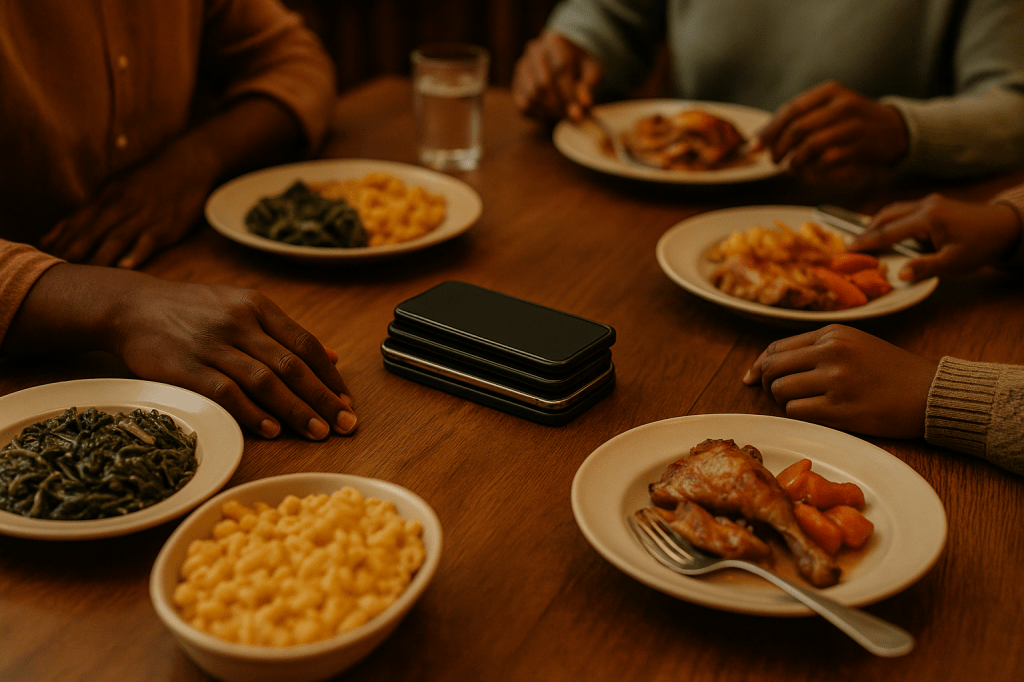
A stack of phones in the center of the table, all face down.
No grand speeches.
No self-righteous declarations about “screen time” or “kids these days.”
Just a quiet, intentional act of reclaiming.
You walk into the dining room, set your plate, and hug the people you haven’t seen in weeks or months. Maybe you’re tired. Maybe you’re grieving. You may be just here because showing up feels easier than explaining why you didn’t.
Before you sit down, you take your phone—the same device that holds your calendar, your playlists, your panic, your plausible deniability—and you place it in the middle of the table, face down. Everyone else does too. No buzzing on laps. No screens glowing beneath the table like secret altars. Just a small pile of surrendered attention.
Not forever.
Just for this meal.
That stack becomes its own centerpiece.
A reminder: we are here. Together. Right now.
Without the screens, the room feels different. At first, it might feel awkward—like standing in a house after the power’s gone out. You can almost hear the absence of the digital hum. You look up and realize you’re making eye contact with people you haven’t really seen in months, even though you’ve “liked” every single update.
You notice the way your cousin’s shoulders slump when she says work is “fine.”
You hear the tremor in your friend’s voice when he talks about how the holidays feel different this year.
You catch the way your father stares at an empty chair a moment too long.
None of that would’ve made it into a caption.
It doesn’t photograph well.
But it’s the real meal.
Reclaiming the family table in a digital world isn’t about pretending the internet doesn’t exist. It does, and it’s not going anywhere. Our recipes live there now. Our group chats. Our long-distance love stories and late-night confessions. Our survival has braided itself into those wires and signals.
But the table—the real, physical table—does something the feed can’t.
It holds the weight of us.
It reminds us that people are not content.
They are bodies and breath, nervous laughter and long pauses, second helpings and half-finished sentences. They are the way someone leans back in their chair when they’re finally relaxed, the way they push food around when they’re not okay, the way they reach for your hand without checking who’s watching.
If we want to rebuild community in a culture addicted to elsewhere, we have to start by choosing here.
Not every meal will be a breakthrough. Some nights, the best you can do is talk about nothing and pass the beans. That’s fine. Sacred, even. But when we stop curating our lives for people who aren’t in the room, we make space to notice the people who are.
We make room for the slow, unglamorous work of knowing and being known.
We make room for the kind of silence that isn’t empty, but safe.
We make room for stories that don’t need hashtags to be real.
Maybe the revolution isn’t dramatic.
It could be a small family in a small kitchen, stacking their phones face down and picking up their forks. Maybe it’s a group of friends deciding that for one hour, they don’t need proof—only presence.
Because the truth is, the table remembers us.
Even when we forget ourselves.
The chair still holds your shape after you leave.
The plates still carry fingerprints.
The air above the table holds the echo of your laughter, your arguments, your apologies.
The digital world will always want another piece of you—another photo, another thought, another performance of your life. But the table wants something different.
It wants you as you are: tired, hungry, complicated, half-healed, fully human.
And that—no matter how advanced our screens become—is something no app can ever duplicate.
Kyle J. Hayes
kylehayesblog.com
Please like, comment, and share
Resources for Hard Times
If you’re looking for practical help, food support, or community resources, you can visit the Salt, Ink & Soul Resources Page.
 Salt,Ink, & Soul