Tag: generosity

  • The Quiet Reckoning of Leftovers

    The Quiet Reckoning of Leftovers

    Salt, Ink & Soul — Humanity Through Food Series

    There’s a certain hush that falls after Thanksgiving — not the fullness or fanfare of the holiday itself, but a softer, more settling quiet. The kind that wraps around a home like a warm blanket. The kind that whispers that the celebration may be over, but the comfort isn’t.

    Because today is when the real magic begins.

    Today is the day the leftovers come alive.

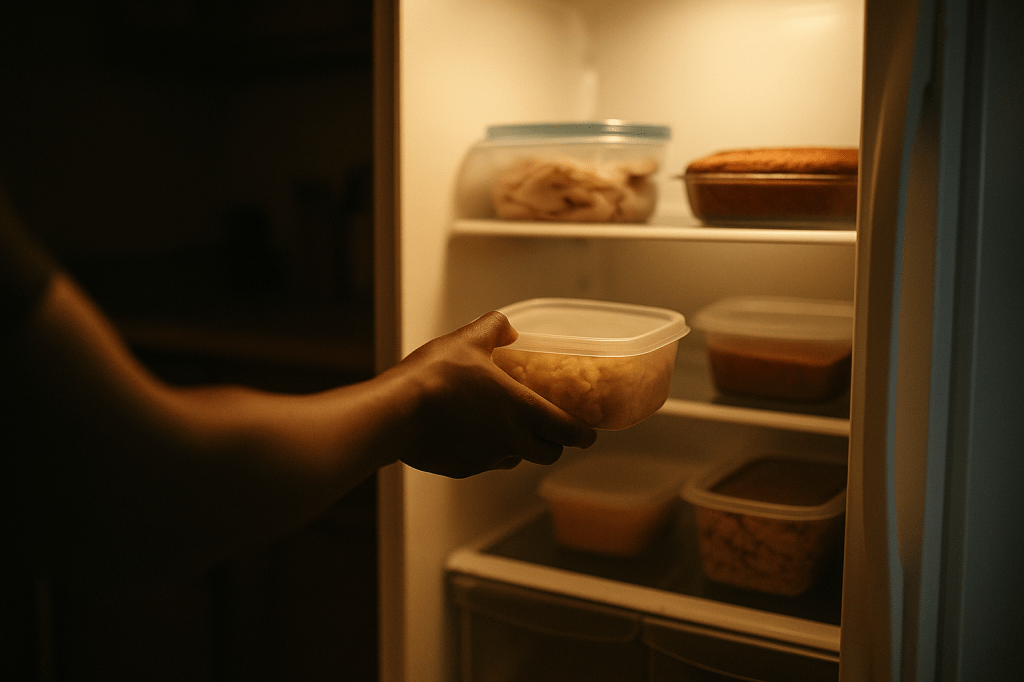
    The fridge becomes its own little universe of possibility — containers lined like tiny promises. Dressing that deepens overnight, turkey that’s ready to reinvent itself into a dozen different meals, pound cake that turns into breakfast without anyone questioning a thing. Leftovers are the afterglow of a holiday well-lived, and maybe even better lived the day after.

    For those of us raised to stretch meals like muscles, leftovers weren’t just “extra food.” They were reassurance. Security. A quiet kind of abundance that steadied you through the next few days. Maybe even next week.

    Leftovers meant:

    We’re okay. At least for now.

      There’s a joy to leftovers that feels almost childlike — the thrill of opening the fridge and imagining what new creation you’ll craft from what remains.

    Turkey and rolls?

    That’s a sandwich ritual.

    Dressing and gravy?

    That’s comfort in a bowl.

    Macaroni and cheese?

    Somehow it gets better every time it’s reheated — nobody knows the science, but nobody questions it.

    In a world obsessed with novelty, leftovers teach us a quieter truth:

    There is beauty in returning to what you already have, in transforming what remains, in finding comfort in the familiar.

    The feast is flashy.

    The leftovers do the real work.

      And then there’s the kind of generosity that only shows up after the plates are cleared — the people who send you home with more than you expected, more than you asked for, maybe even more than you felt worthy of receiving.

    The friend who packs you a dessert “just in case.”

    The auntie who fills your container until the lid strains.

    The host who insists you take another tray, their eyes saying what words never do:

    I want you fed.

    I want you steady.

    I want you to be cared for when you walk out that door.

    That is its own kind of love.

    A quiet, intentional love that doesn’t perform — it provides.

    Sometimes the food you bring home is better than anything you ate at the table, not because of the taste, but because someone wanted you to have it.

    Leftovers can be a love language, too.

      If the holiday feast is the performance, the leftovers are the truth.

    They reveal:

    • what was made with abundance

    • what was shared freely

    • what was loved most

    • what people wanted you to take with you

    • and what gets better when it rests

    Leftovers tell the story of a household — the real version. The version where people quietly look out for each other. The version where meals stretch because life requires it. The version where comfort doesn’t disappear once the guests go home.

    Leftovers tell us that survival doesn’t always look heroic.

    Sometimes it looks like enough food for tomorrow.

    Sometimes it looks like mac and cheese after a long day.

    Sometimes it looks like a pound cake eaten slowly because it feels like a blessing wrapped in foil.

      Leftovers aren’t scraps.

    They’re gifts.

    Gifts of ease.

    Gifts of warmth.

    Gifts of a holiday that lingers.

    Gifts from people who fed you in more ways than one.

    They carry the flavor of yesterday into today.

    They soften the week ahead.

    They remind you that abundance doesn’t always roar —

    sometimes it whispers from behind a refrigerator door, waiting for you to reach in and begin again.

    Because leftovers aren’t just evidence of what you had.

    They’re evidence of what still remains.

    And sometimes?

    That’s more than enough.

    Kyle J. Hayes

    kylehayesblog.com

    Please like, comment, and share

    Resources for Hard Times

    If you’re looking for practical help, food support, or community resources, you can visit the Salt, Ink & Soul Resources Page.
    👉 Resources for Hard Times

  • A Love Letter to Potlucks, Church Basements, and Aluminum Trays

    A Love Letter to Potlucks, Church Basements, and Aluminum Trays

    Salt, Ink & Soul — Humanity Through Food Series

    There’s a special kind of magic that happens when a community decides—quietly, without fuss—that everyone needs to be fed.

    Not in some grand, official sense.

    Not with grants or committees or agendas.

    Just fed.

    Fed the old-fashioned way:

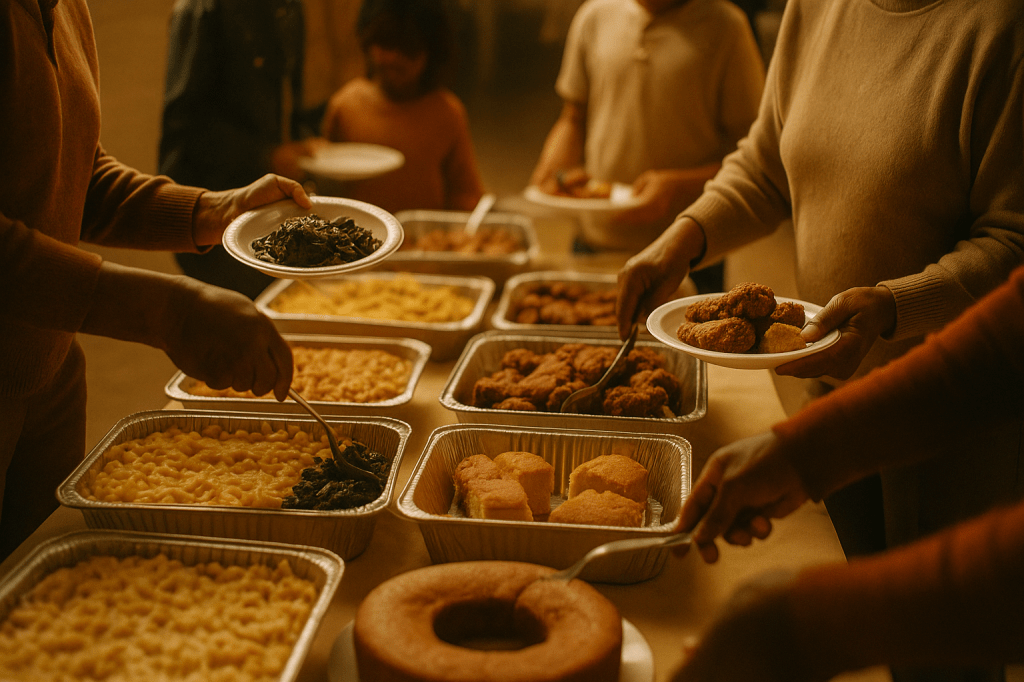
    On a folding table in a warm room that smells like memory, grief, pride, and somebody’s auntie’s best Fried Chicken.

    I’ve always had a soft spot for potlucks. Maybe it’s because people bring their best selves to those tables—literally. Every dish arrives covered in foil and hope, carried by someone who has spent the whole morning stirring and tasting and adjusting because they wanted to show what they could do. Not to brag. But to share.

    A potluck is a quiet confession:

    This is the dish I trust to speak for me.

    And there’s something beautiful about the way people place their food on the table and then pretend not to watch. They hover from a distance—not out of ego, but out of longing. Waiting for that smile. That small nod. That moment when someone tastes their dish and closes their eyes, just for a heartbeat, because something familiar touched them.

    You can’t buy that moment.

    You can only feed it.

    Church basements have their own flavor of truth.

    The ceilings are low. The chairs wobble. The lighting flickers. But none of that matters, because the food—the real food—is honest. Greens cooked down until they surrendered. Cakes that lean to the left but taste like heaven. Macaroni and cheese that could heal almost anything.

    People don’t come to impress in those spaces.

    They come to belong.

    They come to be held by the warmth of a room that has seen everything: baptisms, funerals, heartbreak, and survival. And in every season of life, the table stays set.

    Long before the world used terms like mutual aid, this was it.

    This was the safety net.

    This was how communities kept each other alive.

    No one asked, “What can I bring?”

    They asked, “Who needs to eat?”

    And somehow the table always balanced itself—one person bringing meat, another bringing bread, someone else bringing something sweet, and a few saints making sure the greens showed up so the ancestors wouldn’t fuss.

    It wasn’t organized.

    It was instinctual.

    Care doesn’t need a sign-up sheet.

    It just needs a kitchen.

    I think about those aluminum trays—the ones that bend if you hold them wrong. They don’t look like much, but they’ve carried entire histories. Weddings. Funerals. Reunions. Wednesday nights where people just needed a reason not to be alone.

    Aluminum trays are our generation’s scarred cast-iron skillets: humble, overlooked, essential.

    And they remind me of something I fear we’re losing in our digital, curated world:

    We were feeding each other long before we were performing for each other.

    A potluck isn’t content.

    It’s a community.

    It’s generosity without ceremony.

    It’s survival disguised as Sunday comfort.

    That’s probably why I love them so much.

    Because in a culture obsessed with individualism, a potluck is a rebellion.

    It says: We do this together.

    It says: Come as you are, and bring whatever you can.

    It says: There is room for you at this table, even if life hasn’t been kind, even if you feel small, even if all you could manage today was paper plates.

    Food has always been the language that makes room for the parts of us we don’t know how to name.

    So here’s my love letter—

    to the potlucks, the church basements, the community centers, the too-small living rooms, the aluminum trays carried in trembling hands.

    To the people who show up with their best dishes and their quiet hopes.

    To those who feed others before feeding themselves.

    To the tables that held us long before we had the words for what we were carrying.

    May we never forget how to gather like this.

    May we always remember that survival was never meant to be a solo act.

    And may we keep spreading these tables—wherever we can, with whatever we have—so no one has to face the world hungry, unseen, or alone.

    Kyle J. Hayes

    kylehayesblog.com

    Please like, comment, and share

    Resources for Hard Times

    If you’re looking for practical help, food support, or community resources, you can visit the Salt, Ink & Soul Resources Page.

    👉 Resources for Hard Times