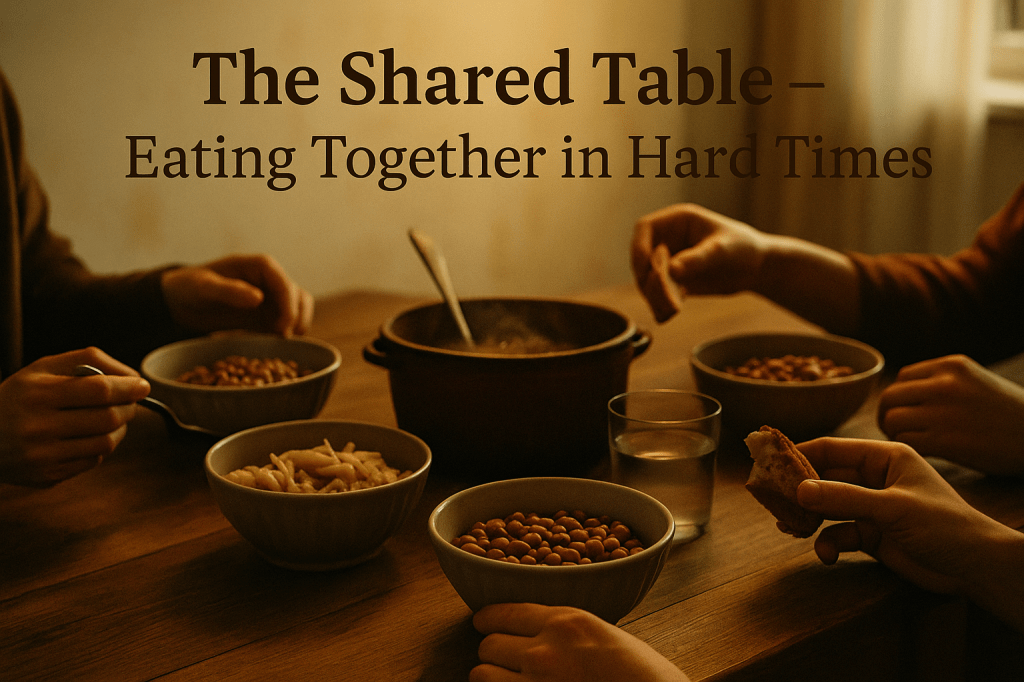
I’ve written before about family-style restaurants, about Sunday dinners, and the long-lost art of staying at the table after the plates are cleared. The way the conversation lingers even after the food is gone. The way silence settles differently when you’re not alone.
But the older I get, the more I realize there are seasons in life when once a week isn’t enough. When being with family or people who feel like family isn’t just tradition — it’s survival.
There are cultures where no one ever really leaves. Even after marriage, generations live under the same roof. They eat together, pray together, argue in the hallway, and make up around the stove. Grandparents pass down stories across the dinner table, not through group chats. Aunties and uncles drift in and out like weather systems. There’s always somebody home, always another chair, always another plate.
From the outside, we look at those households and say, “Too crowded. Too dependent.”
But they thrive anyway.
Children grow up knowing they’re held by more than one pair of hands.
Elders age, knowing they are still seen, still needed.
Nobody has to pretend they’re an island.
Is that really so bad?
Here in the United States, we’re taught to crave distance like oxygen. We can’t wait to get out on our own, can’t wait to prove we’re independent, self-sufficient, “grown.” We call it freedom, and some of it is. There is something sacred about carving out your own life. But somewhere along the way, we confused independence with isolation. We decided that to stand tall, we had to stand alone.
In our thirst for independence, a lot of us burned the bridges back home. We said things we can’t unsay. Rolled our eyes one too many times. Took the help, then resented the hands that gave it. Some parents, carrying their own ghosts, pushed their kids out into the world with a kind of hard love: sink or swim. Some kids, desperate to prove themselves, jumped before they could walk steadily.
Some landed on their feet. The parents took the credit.
Others didn’t land at all. They slipped through the cracks — a missed paycheck here, a bad relationship there, a layoff at the worst possible time. Some ended up in shelters, while others slept in cars, bounced from couch to couch, or lived on the street with their whole life zipped into a backpack.
We tell ourselves that’s just how it goes. That everyone has a choice. That if they really wanted to, they’d “get back on their feet.”
But people don’t fall apart all at once.
They unravel slowly, thread by thread, often in silence.
I understand this better than most.
I was one of those people — feeling unwelcome in my own family home, trying to breathe in a house that felt too tight, too tense, too full of things nobody would say out loud. At seventeen, I signed my name on a line and left for the Army with no real plan, no sense of direction — just a vague conviction that I had to go. I didn’t know what I was chasing. I only knew what I was running from.
I’ve been on my own ever since, making my own decisions. Some good, some bad, some I still feel in my bones. I burned bridges, too. Spoke out of anger. Walked away instead of talking it through. Convinced myself I didn’t need anyone. That needing people was a weakness.
You tell yourself stories like that long enough, and they start to sound like the truth.
Now I work with people who have quietly invited me into their lives.
Co-workers. Friends. Families who say, “Come over, we’re having dinner,” and mean it.
I’ve sat at their tables — fork in hand — watching the choreography of people who have stayed close to one another. Kids interrupting adults. Adults interrupting each other. Someone’s cousin is laughing too loudly. A grandmother fussing over whether you’ve eaten enough.
And in those moments, I am both present and somewhere else. I’m looking at the food, but I’m also looking at the thing beneath it — the web of relationships, the unspoken history, the familiar arguments, the small forgivenesses that happen without a word.
And what would it have been like to have that with a family of my own?
Not just a Sunday call.
Not just a holiday visit.
But the everyday kind of belonging — the weeknight dinners with nothing to celebrate except the fact that you’re together.
I wonder who I might have been if I had grown up with more chairs around the table, more chances to stay instead of run.
That wondering doesn’t come from regret.
It comes from recognition.
Recognition of what connection can do — how it steadies you, how it humbles you, how it reminds you that you were never meant to go through life alone.
The shared table is one of the last places in this country where we still practice that truth.
When times get hard — when prices climb, when paychecks shrink, when systems fail — the table becomes a kind of refuge. It’s where someone decides to make a large pot of something that can be shared and enjoyed over time. Where cousins and neighbors and strays-who-became-family show up with whatever they have: a dish, a drink, a story, their tired selves. It’s where nobody asks for a résumé, just whether you’re hungry.
I’ve written about food banks, church kitchens, and community centers — places where people line up for a hot meal and leave with more than calories. They leave with eye contact. With their name spoken kindly. With the knowledge that, at least for today, they were not invisible.
Hunger isolates.
But eating together does the opposite.
Screens are always on, but doors often stay closed.
We scroll through a thousand dinners while our own table stays dark.
Meanwhile, someone in your neighborhood — maybe even someone you know — would show up if they knew you needed a place to sit.
But somewhere along the way, we stopped knocking on doors.
We stopped saying, “Come eat with us.”
I wish I knew how to fix all of this — the homelessness, the hungry children, the broken families, the pride that keeps us apart. I don’t. I don’t have a blueprint for repairing what this culture has spent decades tearing down.
What I do have is a small, stubborn belief in the power of the shared table.
Maybe the first step isn’t policy or program — but an invitation.
Maybe it’s offering help without attaching shame.
Maybe it’s calling the kid you pushed out too soon and saying, “Do you want to come home for dinner?”
Maybe it’s reaching out to the parent you’ve avoided and whispering, “Can we try again over a meal?”
Maybe it’s rebuilding a bridge you thought was ash — not because you’re guaranteed a reunion, but because you believe someone might want to come back one day.
One thing I do believe, deeply and without hesitation, is this:
Families are better together.
Whether they’re the ones we come from or the ones we gather along the way.
The table won’t fix everything.
It won’t erase history, won’t undo every mistake, won’t silence every hurt.
But it is a place to start.
A place where pride softens.
Where hunger — for food, for belonging, for forgiveness — can finally speak.
The table doesn’t have to be full to matter.
It just has to be real.
It just has to be offered.
It just has to be shared.
Kyle J. Hayes
kylehayesblog.com
Please like, comment, and share
Related Reading:
The Taste of Home,The taste of here
Resources for Hard Times
If you’re looking for practical help, food support, or community resources, you can visit the Salt, Ink & Soul Resources Page.
 Salt,Ink, & Soul