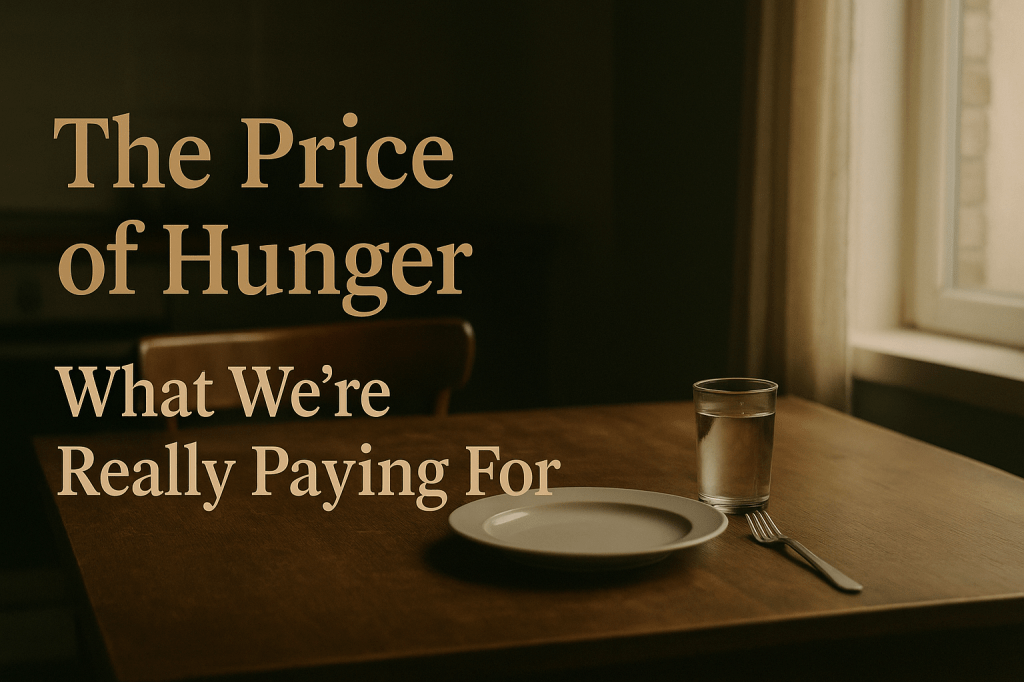
I’ve been thinking about what things cost—and not the kind you swipe a card for. I mean the deep arithmetic of living in a country where a cell phone plan can be unlimited, but food is not. Where the signal is strong, but the pantry is weak. Where the glow of a screen lights up a car window because that car has become a home.
Almost everyone I know carries the world in their pocket. You can stream news of wars, scroll through lives curated to look full, and order meals you can’t afford to make. You can stay endlessly connected and still be utterly alone. The internet promised us closeness, but it delivered distraction. It can be a tool, yes—a way to organize, inform, share—but more often it steals the most human thing we have: presence.
We’ve mistaken communication for connection. And in the process, we’ve forgotten what togetherness feels like.
Yet hunger—real hunger—has a way of bringing humanity back into focus.
When the cupboards empty and the paychecks stop, when storms tear down homes or fires erase entire neighborhoods, something ancient stirs in us. The same thing that once made neighbors knock on doors with covered dishes, or gather in church basements with ladles and folding chairs. In the worst times, people still find their way to one another. Hunger is cruel, but it’s also clarifying. It reminds us that survival was never meant to be a solo act.
After disasters—after hurricanes, blackouts, floods—it’s always the same. People cook what’s left on their grills before the food spoils. They feed whoever shows up. They offer coffee, blankets, and soup. They don’t check a person’s party affiliation before pouring them a bowl. The same is true every day in quieter ways—at food banks, shelters, and community kitchens. The volunteers who show up to serve a hot meal aren’t there for headlines. They’re there because they remember what it’s like to need help.
That’s the part we don’t talk about enough. The grace in hunger. The way it exposes the seams of a society, yes, but also the threads that still hold it together.
We live in a nation where internet access is often cheaper than dinner. Where people can scroll for hours, but can’t afford eggs. Where the hunger of the people becomes another talking point, tossed around by politicians who will keep getting paid, even through shutdowns. They talk about “the economy” as if it were a creature separate from the hungry people. But I’ve never seen a spreadsheet feed a child.
This isn’t the first time America has been hungry. We’ve seen breadlines stretch through city blocks and soup kitchens spring up in church basements. The difference now is distance. We’ve grown disconnected—not just from each other, but from the skills and spirit that carried those before us through hard times. They knew how to make a little stretch far. They understood that sharing wasn’t charity—it was a matter of survival.
It may be time we remembered.
When I write about food, I’m not writing about recipes; I’m writing about ritual. The act of caring. The alchemy of turning scarcity into sustenance. Bread from four ingredients. Beans with patience and salt. Casseroles that forgive substitutions. Meals that stretch and still have enough to share. These are more than thrift; they’re gestures of faith.
But hunger asks something deeper than budgeting—it asks who we are when faced with someone else’s emptiness.
Do we scroll past, or do we look up? Do we hoard, or do we serve? Do we build walls of data or bridges of care?
The truth is, despite our wealth and connectivity, hunger remains what still binds us. It humbles us. It makes neighbors out of strangers. It reminds us that no matter how digital the world becomes, nothing replaces the sound of a shared meal—plates clinking, chairs scraping, laughter mixing with steam.
That’s the humanity the internet can’t replicate. The kind that can’t be uploaded, only witnessed.
So the answer to hunger begins not with politics or algorithms, but with presence. Remembering that someone, somewhere, is hungry tonight—and that we still have the power to feed them, even if only with our time, our attention, our company.
The price of hunger isn’t just food insecurity; it’s the loss of empathy, the forgetting of our collective pulse. But it’s not too late to remember the rhythm.
Because the thing about hunger—the painful, human truth—is that it teaches us what the internet can’t: that we were never meant to eat, to live, or to heal alone.
Kyle J. Hayes
kylehayesblog.com
Please like, comment, and share
If this reflection spoke to you, I invite you to explore the rest of the Humanity Through Food collection — stories of endurance, community, and the quiet grace of making “enough” in uncertain times.
Each piece is a reminder that food is never just food — it’s a memory, a means of survival, and the most human act of all: sharing.
Bread, Memory, and the Price of Enough
How the simplest ingredients teach us what we’ve forgotten about patience and provision.
The Weight of Enough – The Evolution of Survival Food
A $10 casserole that became a symbol of family resilience and ingenuity.
Nothing Wasted – The Grace of Leftovers
A reflection on thrift, gratitude, and the sacred art of using what remains.
Resources for Hard Times
If you’re looking for practical help, food support, or community resources, you can visit the Salt, Ink & Soul Resources Page.
 Salt,Ink, & Soul