Tag: life

  • Night Glow: A Fire for the People

    Night Glow: A Fire for the People

    There are moments in life that feel less like events and more like rituals — moments not designed for necessity, not crafted for competition, but for nothing more than the simple wonder of being alive together. The Night Glow at the Balloon Fiesta is one of those moments.

    It is not about the chase, or the science of wind, or the mechanics of lift. It is not even about the sky. This one belongs to the ground. To the people. To us.

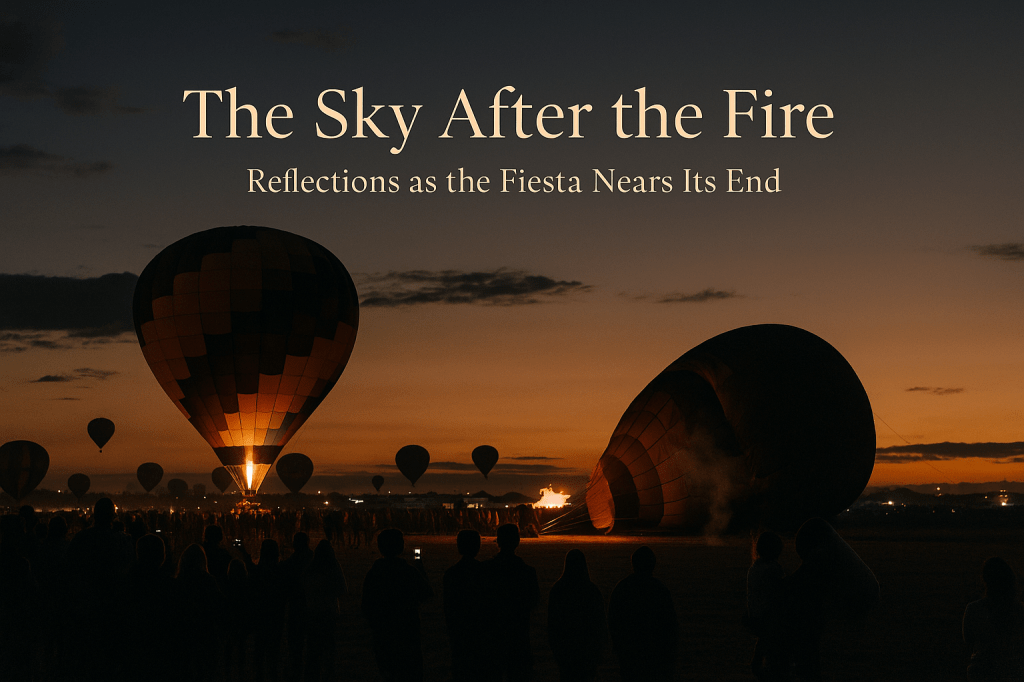
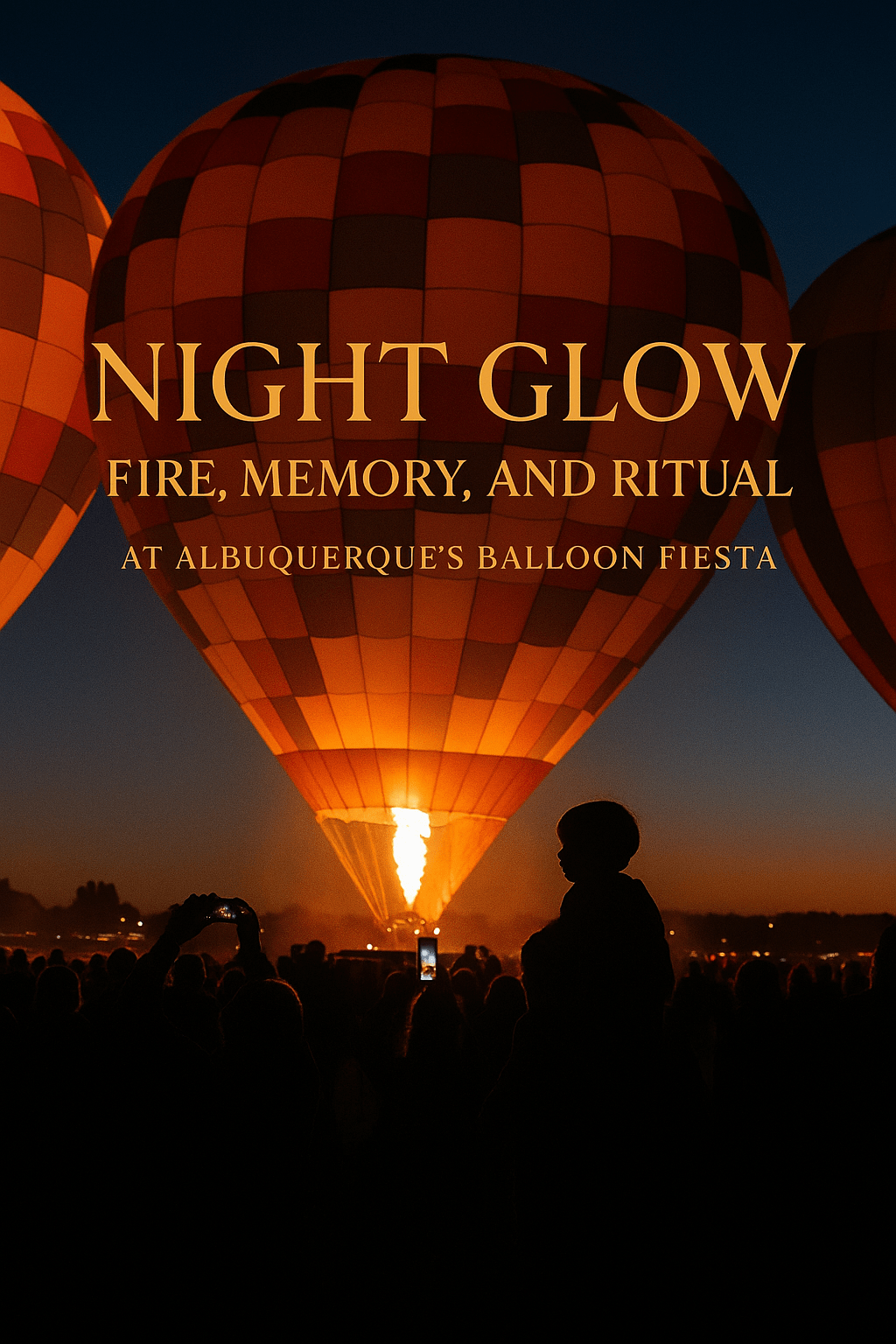
    If you’ve never been, go. Find yourself in the crowd as the sun slips beneath the Sandias, as the night takes its place in the sky. The balloons stay tethered, their great bodies still and waiting, while the pilots prepare their burners. Then it happens — one flame, then another, and suddenly the field becomes a cathedral of fire and color. Sometimes the burners roar in unison, turning the night into daylight for a breath. Sometimes it is a dance, coordinated bursts that ripple across the horizon like notes of a song too big for words.

    The sound of the burners is guttural, alive — a rush that shakes you in your chest. Around you, there is laughter. Children dart through the grass with glow sticks in their hands. Families huddle together, necks tilted back, faces painted in red and orange light. Strangers turn into companions, caught in the same breathless silence when the balloons flare together, and the park glows as though the earth itself has caught fire.

    It feels ancient in its way. Humanity has been gathering around flame for as long as we’ve been here — caves, camps, hearths, bonfires. Fire has always been the place we return to, the place we make our myths and find our meaning. The Night Glow is no different. It is our modern bonfire, our ritual of light against the dark, a spectacle that reminds us that not everything we do needs to point forward. Some things, like this, simply point inward.

    You don’t think about this when you’re there. You’re too busy taking it in — the heat that flashes across your face, the squeals of the children, the cameras held up like prayer offerings. But later, as you walk to your car and join the crawl of taillights trying to leave Balloon Fiesta Park, you feel it settling in. You carry it with you. And one day, maybe weeks later, maybe years, something will spark it again — a flame in a grill, a child’s laugh at dusk — and you’ll remember. The glow, the crowd, the sound. And you’ll smile, because you were there, part of it.

    The balloons will always belong to the sky. But the glow — the glow belongs to us.

    Kyle J. Hayes

    kylehayesblog.com

    Please like, comment, and share
  • The People Who Make the Sky Possible

    The People Who Make the Sky Possible

      We always start with the balloons. It’s hard not to; those floating colors command the horizon, pulling the eye upward until you forget your neck is sore. We discuss the chase trucks, their history, and the roots of flight in France and its rebirth in the soil of New Mexico. We speak of mass ascensions and Dawn Patrol, of Darth Vader and cows and hearts suspended against the dawn. But beneath all of it—the fabric, the burners, the photographs—is something more ordinary, and maybe more sacred: the people.

    Not just the pilots, not just the crews. The others.

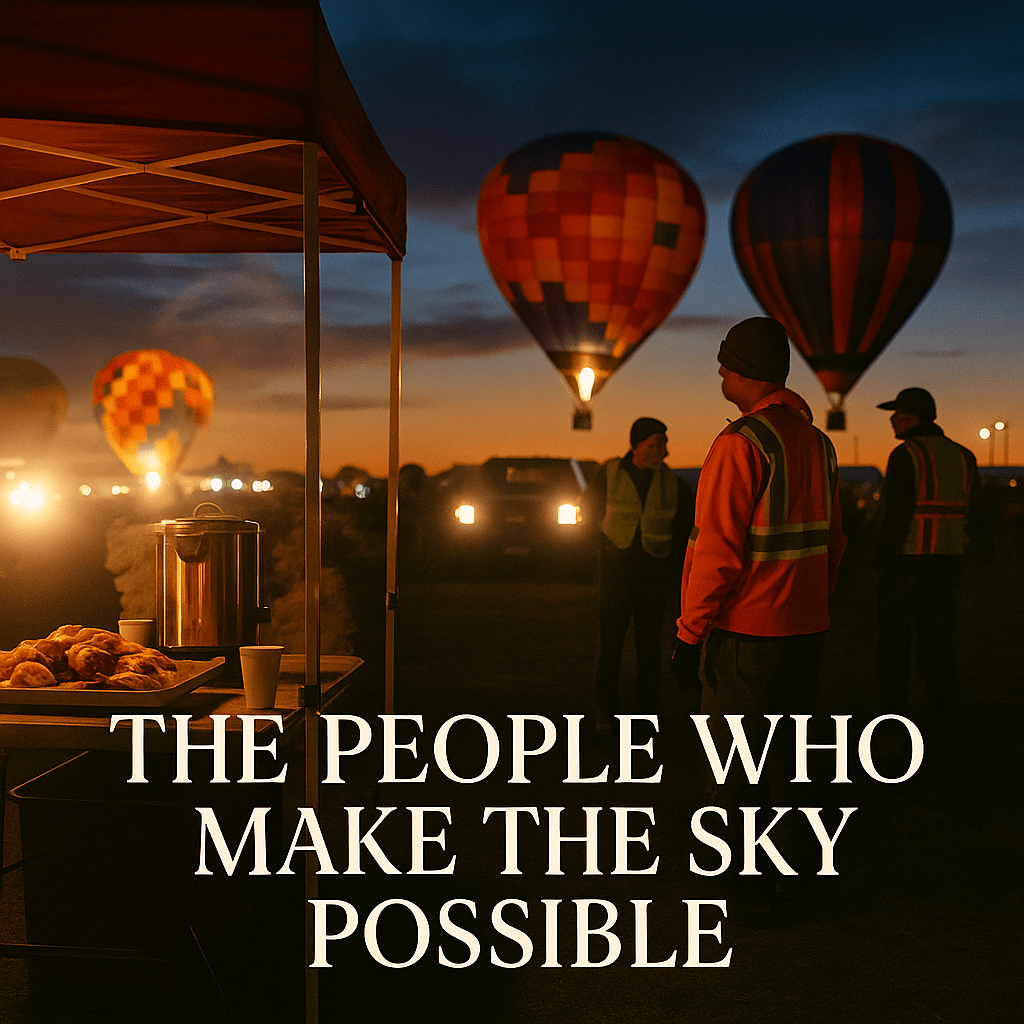
    The volunteers, for instance, who rise earlier than even the birds, long before the sun thinks of climbing over the Sandias. They are there in the half-dark, directing traffic, holding ropes, keeping the rhythm of a ritual that looks effortless only because someone else made it so. They do this not for glory or paychecks, but because something within them decided that one week in October was worth sacrificing their sleep and time to help thousands of strangers feel wonder. They are the kind of people who disappear into the background, allowing the balloons to dominate the frame. And yet without them, there is no frame at all.

    Then there are the vendors. Their labor is not spectacle—it is fuel. They stand in lines of steam and scent, ladling out hot coffee, burritos, and sweet pastries to crews, balloonists, and wide-eyed tourists who arrive before dawn. They are there in the cold, their hands working the heat of the griddle while we marvel at the heat of the burners. They remind us that even awe requires calories. That memory is easier to hold when your fingers are warm against a paper cup.

    But the Fiesta isn’t confined to the field. For nine days, Albuquerque becomes a host. Visitors don’t only look up; they wander sideways. They move through Old Town’s adobe walls, tracing steps along Route 66, ducking into shops where turquoise glints under fluorescent light. They pause to listen to a drumbeat in a plaza, to hear the echoes of Native voices that remind them this land has been witness to centuries before balloons ever grazed its skies. They sit in diners and brewpubs, ask about “red or green,” and learn the shorthand of a state where chile is not just food but language, not just spice but identity.

    That’s what we forget when we reduce the Fiesta to balloons alone: it is not just a celebration of flight. It is a celebration of place. A city, a state, a culture flinging its doors wide and saying Come see us, come taste us, come know us. For nine days, New Mexico is not an afterthought on a map but the center of the world’s gaze. People arrive from Japan, Brazil, Wisconsin, Bristol, China, and Kenya. They stand shoulder to shoulder with locals, their accents colliding over green chile stew. And when they return home, they carry with them more than pictures of balloons—they carry New Mexico itself: the food, the hospitality, the community that rose as surely as the balloons did.

    I think about this often: balloons drift. They rise, they scatter, they vanish into the horizon. Their beauty is in their impermanence. But the people—the ones who cook, who sell, who welcome—are the tether. They keep the Fiesta from being only about what escapes into the sky. They anchor it in the soil, in red earth and chile smoke, in the hands that hand you coffee at dawn.

    Nine days in October. That’s what it is. Nine days when the world’s compass needle swings toward New Mexico, and all those who live here become part of something larger than themselves. Not by flying, but by feeding, guiding, welcoming, and reminding. The sky may belong to the balloons. But the heart of the Fiesta—always, inevitably—belongs to the people.

    By Kyle J. Hayes

    kylehayesblog.com

    Please like, comment, and share
  • The Sky Belongs to Balloons

    The Sky Belongs to Balloons

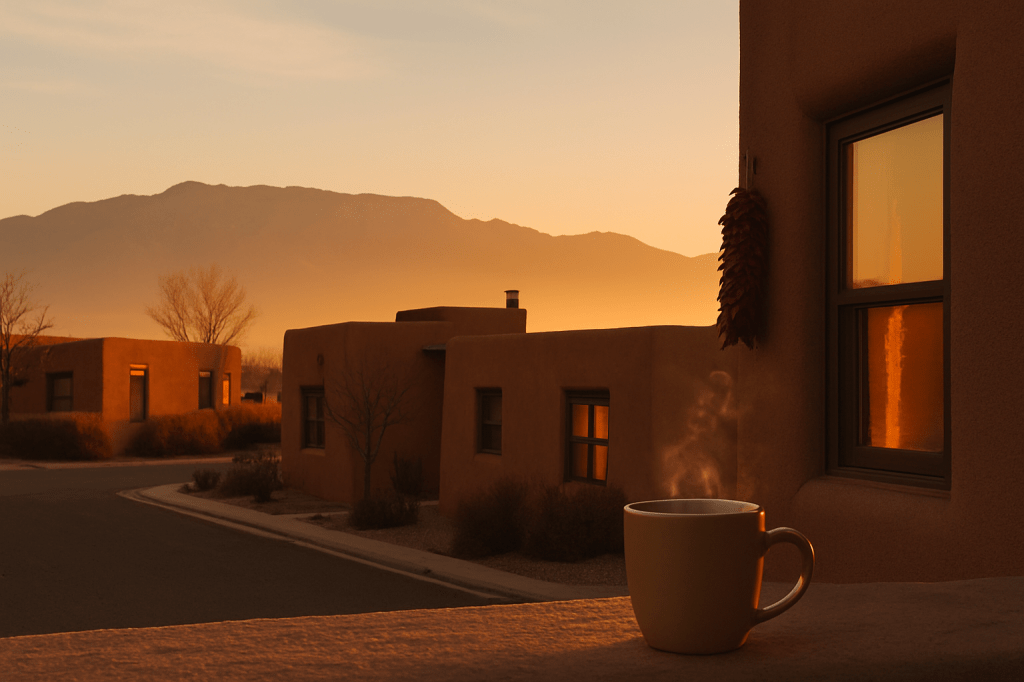
      It’s the time of year when the desert begins to remember the cold. The mornings bite a little sharper, the light shifts from golden to amber, and in Albuquerque, the rhythm of fall comes with rituals all its own. The State Fair folds up its tents and carnival lights, and before the dust has even settled, the sky gives itself to balloons.

    The Albuquerque International Balloon Fiesta is not just an event here; it is a season. The largest gathering of hot air balloons in the world, and every year, it pulls tens of thousands of people into its orbit. It rewrites the city’s mornings. Commutes pause. Joggers stop mid-stride. Children tug their parents toward the sidewalk, phones raised, because a balloon — shaped like a cow or a stagecoach or just a simple rainbow stripe — has drifted so low it seems ready to brush the rooftops.

    And then the chase crews arrive, pickup trucks trailing, men and women moving quickly, packing away the canvas like a secret folded back into itself. You see this enough, you could call it ordinary. But I’m still too new here, not jaded enough, because every time I look up and catch sight of one, it feels like the sky has been interrupted by wonder.

      There’s a madness in waking at 3:30 a.m. just to stand in the cold. Yet thousands of us do it, year after year. The roads snake toward Balloon Fiesta Park in the dark, headlights lined up like a procession. Coffee cups steam in cup holders, blankets drape over shoulders, and conversations hum with anticipation.

    When you arrive, the field is still hushed, waiting. Crews shuffle around baskets, propane tanks hiss faintly, and in the distance you hear murmurs, laughter, the rustle of nylon being unfurled. The night sky holds onto its stars a little longer.

    And then — the Dawn Patrol.

    A handful of balloons rise first, lighting their burners in unison, glowing like lanterns against the indigo dark. The sound is unmistakable: the sudden whoosh of flame, the gasping exhale of fire against the silence of morning. The crowd breathes with them, every burst of light pulling eyes upward. For a moment, it feels less like a spectacle and more like a ceremony.

    And then the Mass Ascension begins.

    Dozens, then hundreds, then more than you can count. Balloons rising in waves until the sky is littered with color — a slow unfurling of the surreal, so vast and so improbable that it borders on disbelief. You look up and the horizon is gone, erased by canvas and flame.

      There’s a peculiar intimacy in standing with thousands of people you don’t know, all of you bundled against the same chill, sipping coffee, biting into breakfast burritos, sharing a collective awe. You don’t need names. You don’t need history. For a few hours, you are kin to anyone whose head tilts back in wonder.

    Children squeal at the “special shapes” — bees holding hands, Darth Vader and Yoda, cows larger than houses. Photographers kneel, point, capture. Tourists beam into news cameras, their voices shaky with joy, telling reporters this was a lifelong dream.

    And I wander among it all, part of the throng but also apart, notebook in my pocket, questions in my head. What does it mean that people travel across the world just to stand in this field and look up? What does it mean that beauty, when shared, feels almost like communion?

      By mid-morning, the sky begins to empty. Balloons scatter, floating toward the mesa, toward neighborhoods, toward open lots where chase crews wait to claim them. The field thins out, tourists drift toward vendors selling chile and frybread, and traffic snarls for miles.

    You sit in it, inching forward, the high of the morning giving way to the dull grind of engines and exhaust. The burrito is gone, the coffee cold. Reality asserts itself.

    And yet, even in that crawl, I find myself replaying the moment of lift. The quiet between burner blasts. The way balloons floated like prayers, drifting wherever the wind allowed. My fear of heights keeps me on the ground, tethered by gravity, but still — I wonder what it must be like to surrender that control. To look down on this desert city not as blocks and intersections but as a sprawl of lives stitched together under the watch of mountains and sky.

    Part of the gift of the Fiesta is this: that you don’t need to rise to feel lifted. Wonder has its own gravity, and it doesn’t care whether you leave the earth or not.

      Living here, you learn to get used to things. Chile roasters set up outside grocery stores in September, flames spitting, smoke curling into the air until the whole city smells like survival. The Sandias are turning pink at dusk, like the mountains are reminding you that the day is theirs to close. Balloons dotting the sky in October, so common they could be dismissed as background.

    But used to doesn’t mean unmoved by.

    Maybe that’s the secret of Albuquerque — that it can hold the extraordinary and the ordinary at the same time without letting either collapse the other. It teaches you that wonder isn’t about distance but attention. That staying, not leaving, sometimes brings you closer to beauty.

    The Balloon Fiesta comes and goes, the crowds depart, the fields go quiet again. But for one week, every year, the sky itself becomes a canvas — and it belongs to balloons.

    And that’s what keeps me here. Not the spectacle, not the scale, not even the food or the music or the culture, as rich as all of that is. It’s the reminder that beauty doesn’t always come from someplace else. Sometimes it rises right in front of you, again and again, until you learn to stop, to look up, to hold still in the presence of wonder.

    By Kyle J. Hayes

    kylehayesblog.com

    Please like, comment, and share
  • Chasing Balloons, Chasing Time

    Chasing Balloons, Chasing Time

    In October, I step outside and my neck betrays me. It tilts. It’s a reflex now, a habit stitched into the muscle: look up. I’ve lived in Albuquerque for years and still, when the air is cool and the light is clean, I search the sky for color. I tell myself I won’t take more pictures—I have too many already, crooked and overexposed—but I do. I raise the phone anyway. Because a balloon drifting over a familiar street makes the world feel briefly unfamiliar, blessed, less ordinary. It’s hard not to look up when something is gently urging you to do so.

    But you cannot spend all your time with your eyes in the clouds. Others are looking up, too—looking for different reasons. Those are the crews. The chasers. They scan the same sky, but they are reading it. They are mapping a moving target, listening to radios crackle with wind reports and altitude changes, translating the invisible into action. Where I see spectacle, they see a set of decisions unfolding minute by minute.

    How the Chase Works

    The pilot calls down their altitude, drift, and plan. In the basket: a burner, a few tanks, and nerve. On the ground: the crew vehicle, a map app with layers of roads and arroyos, a stack of known landing spots, and the experience to know when to ignore them all. A good crew doesn’t just follow; they “lead from behind.” They stay downwind and look ahead, anticipating the arc of the flight, not tailgating the balloon but shadowing its intention.

    They read the day the way a cook reads heat. A small helium “piball” might have been launched before dawn to trace the low-level winds; the pilot tests layers by climbing or sinking—thirty feet, three hundred, three thousand—finding slight changes that turn the craft, teasing out a path. From the ground, the chase watches power lines and private land, traffic and fences, the geometry of a field that will forgive a landing. When the pilot radios, “Looking good to set down,” the crew hustles to the far side, positioning themselves where the envelope will finally touch down against the earth.

    The landing looks quiet from a distance. Up close, it’s choreography. Someone grabs the crown line to steady the top of the balloon. Someone else works the deflation port when the pilot says the word. Burners hush. Heat thins. The nylon slacks, then it lay down like a tired animal. Hands spread across fabric, smoothing, gathering, rolling. The envelope is folded and fed back into its bag—this miraculous, airborne thing turned back into luggage. The basket is tipped, the rigging coiled, the tanks stowed. Strangers wave from sidewalks. Kids ask if they can help push. Photos are taken. A little dust on the cuffs. The radio goes quiet.

    It isn’t glamorous. It is a practiced tenderness, the way a team returns something fragile to the ground without bruising it.

    The Metaphor We’re All Living

    This is where I stop pretending the chase is only about balloons. The longer I live here, the more I know: life is mostly pursuit. We chase the moments we cannot keep. We follow after brief, beautiful things—youth, luck, a parent’s laugh, a friend’s forgiveness—knowing they will descend somewhere we can’t reasonably predict. We listen for small signals. We study the currents. We get into the truck and try to be there—downwind, ready—when whatever we love returns to earth.

    Impermanence isn’t a flaw in the design. It is the design. Ballooning admits what we try to deny: everything rises; everything comes down. Beauty isn’t proof of permanence; it is evidence of grace while it lasts. You accept that, or you live angry at gravity. The crews seem to know this. They are at peace with the terms. They’ll chase again tomorrow.

    “If flying is the miracle, catching is the mercy.”

    Who We Chase With

    What saves all of this from loneliness is how many people do it together. Balloons make families out of strangers. Some have been crewing for decades—grandparents in fleece vests, their kids in ballcaps, their kids’ kids holding the crown line with serious faces, learning the work. Friends who met in a field at dawn are now godparents to each other’s children. Out-of-towners come from great distances—Wisconsin, Japan, South Africa, and Bristol—and are adopted for a week, handed gloves and a thermos, and told where to stand and when to pull. The language barrier disappears the moment the envelope tugs, and everyone leans in the same direction.

    I’ve seen reunions happen between baskets and tailgates, the kind only a shared ritual can produce. People who fly together once a year but text all year long. People who plan entire vacations around a wind pattern. People who teach their children to cheer not just when the balloon rises, but when the crew in the dust makes the landing gentle. There are potlucks at rented casitas, toasts at brewery patios, quiet walks along the bosque when the morning debrief is done. A city of chasers, binding themselves to a season and, in doing so, to each other.

    What the Chase Teaches

    It would be easy to romanticize this, to pretend it is always a postcard. It isn’t. Sometimes the wind is wrong, the traffic snarls, a landing field vanishes into a “No Trespassing” sign, the radio fritzes, the plan collapses. Sometimes you arrive on time, and sometimes you don’t. Sometimes you watch the balloon settle two streets over, and all you can do is wave and keep moving. There is a lesson in missing, too: you cannot own what you love; you can only accompany it faithfully.

    Still, when it works—when the crew turns down the last dirt road and the basket kisses the earth softly—something inside unclenches. Relief, yes. But also recognition. The craft came back, and so did you. The chase isn’t only a pursuit; it’s a return.

    The Last Act

    By late morning, the city shrugs back into itself. On a block near an arroyo, a crew kneels in the grass, palms flat, as they push the final folds of nylon into a bag. Someone cinches the strap. Someone else pulls the zipper home. A kid ties a knot and grins like they invented rope. Tank valves are checked. The basket is loaded. A pilot thanks the landowner for the use of the field. Phones trade photos. Numbers are saved. Promises are made for next year.

    They pile into the truck, and the radio is silent now, not because the day is over but because the work has moved inside them. Another memory stored. Another morning added to the ledger. Albuquerque is good at this—turning weather into ritual, strangers into companions, a week in October into a reason to belong.

    Closing Reflection

    Suppose Origins was about our first attempts to rise, and Dawn Patrol was about the discipline of hope in the dark. In that case, the chase is their echo in daylight—the acceptance of impermanence, the grace of pursuit, and the belonging we find in catching together what can never be kept alone.

    I still look up when I step outside. I still take too many pictures. But I’ve learned to love the ground as much as the sky: the chase, the coordination, the imperfect arrivals. The balloon rises; we give chase; it lands; we fold it carefully and carry it out. We do not pretend it will last forever. We honor it because it won’t.

    That is the heart of this city’s October. Impermanence accepted, beauty in pursuit. We chase what can’t be kept, and in chasing together, we become the kind of people who know how to let go—gently, gratefully—and still remember where to meet again when the winds turn kind.

    By Kyle J. Hayes

    kylehayesblog.com

    Please like, comment, and share

  • Dawn Patrol

    Dawn Patrol

    There is a moment before the day decides itself. A hush. The city holds its breath, streetlights humming like distant hymns, the Rio Grande moving somewhere you can’t quite see. You turn on the television and the anchors talk logistics—lift-off times, pilot briefings, winds at five hundred feet. They say Dawn Patrol the way a foreman says day shift, voice flat with utility. Experienced pilots rise before sunrise, sample the air, and radio the numbers so the rest can follow. It is a system, a safety net, a way to choreograph the sky.

    All of that is true. None of it explains why you wake in the dark and put on layers you haven’t touched since last winter.

    I went once—before dawn, coffee scalding my palm through a cheap lid, a breakfast burrito warming the other hand because the desert pretends it’s summer by day and remembers it’s a high plain by morning. I went expecting to watch balloons fill. Fabric, fire, lift. A diagram with flames.

    What I got was a glow.

    On the field, the balloons lay like sleeping animals, bright skins spread across the grass. Then the burners woke—one, then another, hissing like some prehistoric choir. A body of color rose where there had been only shadow. Then the flame cut, and the color collapsed back into the night. It was breath, not mechanism. Inhale. Exhale. Light. Dark. Over and over until the timing took on a pulse.

    Some mornings, a dozen of them rise together, a Dawn Patrol show choreographed to music—since 1996, people say—as if we couldn’t admit that we’ve always wanted the night itself to have a soundtrack. You stand there with thousands of others, strangers knitted together by cold and a shared tilt of the head, and the field becomes a stained glass window lit from the inside. No sermon necessary. The windows preach in orange and blue.

    I didn’t expect the characters. Darth Vader drifted up first, glossy black helm drinking fire. Then Yoda, ears like sails, face wise and ridiculous at the same time. I laughed out loud. Not a cynical laugh—something closer to relief. As if a muscle you didn’t know had tightened, it finally let go. Wonder snuck in wearing a costume. For a few beats, I was younger than the hour, the cold, the years I carry in my shoulders. I was just a person in a field, neck craned, mouth open.

    I took too many pictures. Everyone does. You can feel how flimsy the phone is in your grip compared to what’s happening above you, but you try anyway. Later, you scroll those photos when the day turns officious and small, and they feel like contraband: proof that the sky once made room for joy before 6 a.m.

    The news will always explain Dawn Patrol as a service to the Mass Ascension—pilots sampling the invisible, calling down the conditions so others can rise with some measure of certainty. That’s real. It’s also a poor translation. What happens on the field isn’t data; it’s discipline. Standing in the dark and waiting for light is an ancient ritual. We practice it for exams, for diagnoses, for shifts that start before dawn. Out on that grass, we rehearse it for a different reason: to remember that hope is not loud. Hope flickers. Hope needs tending. Hope is a burner you ignite again and again until the fabric holds its shape.

    You eat while you wait. Eggs, potatoes, green chile tucked into a foil-wrapped cylinder—the kind of food that tastes better outdoors, better in the cold, better when you’ve decided to be awake with other people who have also decided to be awake. The coffee is almost too hot, and that’s the point. It scalds reality into you. It locates you in the body while the eye is busy chasing fire.

    Balloons do not promise much. A canvas, a basket, a bottle of fuel, a willingness to negotiate with the wind. They are humble in that way. Honest. They rise when the air says yes. They bow when the air says no. That humility is part of the love here. The desert teaches it daily—no water without asking, no shade without planning, no shortcuts through noon. Dawn Patrol is the desert’s lesson painted in flame: attention first, then ascent.

    I have returned since that first morning. I’ve stood through other shows, other glows, other crowds bundled into a single breath. But the first time is the one that lives in me. The shock of color against a sky that wasn’t ready for it. The burn of coffee and chile at the edge of my tongue. Vader and Yoda rising like jokes the universe told to remind us it still has a sense of humor. The way thousands of people could grow quiet together without being told.

    What stays with me isn’t the scale—though hundreds of balloons carving a horizon is a kind of madness worth seeing. What remains is the practice: wake before there is a reason, bring your own heat, and stand still long enough to witness. Let the first light come from within something—within a balloon, within yourself—before the sun claims the credit. Accept that the work of rising begins in the dark, where the world can’t yet see you, where the radioed wind is just a voice naming what the invisible intends.

    They’ll talk about the Box on other mornings, about the clever wind that carries you south low and north high so you can drift out and then come home again. But the Box is a later magic. Dawn Patrol is earlier, older. It’s the choice to step into the unproven, to measure a future with nothing but flame and nerve. It’s a handful of people going first, not with bravado but with care, so that when the mass ascension comes—and it always comes—the rest of us can rise with fewer doubts.

    I still look at those photos from my first visit. They’re poorly framed. My thumb is in one. The exposure is wrong in three. It doesn’t matter. I keep them because they’re true. They remind me of what the day sometimes tries to make me forget: that awe is something you can work toward, that joy can be prepared like coffee, and that you can choose to show up for wonder before it becomes convenient.

    On paper, Dawn Patrol is a safety protocol. In the body, it is a liturgy: fire, breath, lift, drift. In the soul, it is a compact you make with the morning—if I come to meet you, will you meet me back? Some days the answer is no. The wind turns, the field stays quiet, the burners never speak. But on the days it’s yes, the sky answers in lanterns. And for a few minutes, the world is what it could be: a chorus of small lights, rising.

    By Kyle J. Hayes

    kylehayesblog.com

    Please like, comment, and share
  • The Beginnings of the Balloon

    The Beginnings of the Balloon

      I like to imagine the first balloon not as a machine but as a dare. Paper, silk, fire—the audacity of lifting yourself from the quarrels of the earth with nothing but heat and faith. Before Albuquerque claimed the sky each October, before dawn burners hissed like dragons over the Rio Grande, there was France, 1783, when people looked up and saw a new verb forming over their heads: to rise.

      In June of that year, the Montgolfier brothers carried an ungainly sack of paper and cloth out onto a square in Annonay, set a fire beneath it, and watched it go—ten minutes of impossible, enough altitude to knock loose the old limits. By autumn, they carried their wonder to Versailles and sent a sheep, a duck, and a rooster into the royal air as if to ask: can life itself breathe up there? Two months later, in Paris, Pilâtre de Rozier and the Marquis d’Arlandes stepped into a wicker gondola and became the first to slip free of the rope, drifting twenty-five minutes over a city that suddenly looked small. Days after that, Jacques Charles and the Robert brothers gave the world a second path upward—hydrogen—launching from the Tuileries to show that there were many ways to translate fire into altitude. France was the cradle of ballooning; the first breath, the first animals, the first men, the first gas. The sky, once myth, grew technical. 

      What the French began as spectacle and science was, at root, a theology: a belief that we could climb. That theology made its way across oceans and centuries until it found a peculiar home in New Mexico, where dawn is a kind of religion and the horizon is an altar without walls. If France invented the act, Albuquerque invented the season.

      The beginning here was humbler—parking-lot humble. In 1972, a local radio station (KOB) threw a birthday party and asked Sid Cutter—pilot, showman, the first New Mexican with his own hot-air balloon—to bring the new miracle. Twenty-one pilots were invited, weather whittled them down, and thirteen balloons finally lifted from the Coronado Center mall lot while 20,000 people craned their necks and forgot, for a morning, that asphalt was meant for cars. That was the seed from parking lot to fairgrounds to a dedicated park, from a dozen to hundreds, from local curiosity to international pilgrimage.

      What made it stick wasn’t just romance; it was the map of the air. Albuquerque owns a wind pattern so local it has a name—the Box—layers of breeze moving in opposing directions, a morning inversion carrying you south at low altitude and north above it, a tidy loop that lets skilled pilots drift out and, with a climb, drift back toward where they began. In a world that scatters us, the Box offers the possibility of return. It is meteorology as mercy. 

      But a season doesn’t bloom without people to tend it. In 1978, three Albuquerque men—Ben Abruzzo, Maxie Anderson, Larry Newman—sailed a gas balloon called Double Eagle II from Presque Isle, Maine, to a barley field near Paris, the first to knit America and Europe together with fabric and helium. Six days, 137 hours, frostbite, fear, and then France—an answering echo to those first French ascents. Three years later, Abruzzo and crew wrote their signatures across the Pacific, too. Here, ballooning wasn’t just a pageant; it was an expedition, a frontier reopened.

      Albuquerque enshrined that hunger in a museum whose very name reads like a dedication: the Anderson-Abruzzo Albuquerque International Balloon Museum. The doors opened on October 1, 2005, a house for artifacts and a hall for stories—Ed Yost’s modern ballooning breakthroughs, Joseph Kittinger’s high-altitude courage, the Double Eagle’s audacity, and a thousand quieter feats of navigation, patience, and nerve. It sits north of town near the field, a kind of reliquary where flight is preserved not as myth but as craft.

    Still, museums and records are the scaffolding. Culture is the body that climbs it.

      Each fall, chile roasters roll out in front of grocery stores and seal the air with smoke and memory. The Sandias blush watermelon at dusk. And then, before even the sun admits morning, we drive to a park carved into the valley floor and stand under fabric that billows like lungs. Dawn Patrol lamps the dark. Mass Ascension repaints the sky. The burners sound like giant animals breathing; a chorus of whoosh and hush. Children point at cows and bees and dragons peeled up from the earth. Tourists cry into morning newscasts about bucket lists and first times. Locals—some of whom claim to be tired of it—still pause in their driveways when a low flyer ghosts the rooftops, or when a chase truck idles at the curb, and a balloon folds itself into a duffel the size of a life packed up between strangers.

      How did something invented in France become so beloved here? Because New Mexico has always been a country of ascents and survivals. Pueblo, Hispano, Black, Chicano, Diné—the genealogies here are layered as sediment, hard-earned as water. Ballooning fits our theology: small craft, large sky; simple tools, exacting attention; courage, and then surrender. The Box promises a kind of return, but the practice itself is drift, humility before the wind. It’s hard not to see yourself in that.

    And there’s this: Albuquerque takes care of things that gather us. We might joke that we’re a city of two left turns and a long light, that we’re grit and pothole and stubborn ache. But every October, we become a city that wakes at 3:30 a.m., bundling blankets and burritos, teaching our children to be quiet in the presence of something bigger than us. The Fiesta has hosted gas races older than the century, welcomed pilots from dozens of nations, and stitched international myth to local ritual. Year after year, the numbers climb and the field fills and the sky blooms. But the math is the least of it. What matters is that for a week, every day is interrupted by awe, and awe becomes our everyday language. 

      I think of those French firsts—the sheep and duck and rooster blinking over Versailles, the two men in Paris seeing their city surgically reduced to streets and sparks, the hydrogen globe lifting to a second sun—and I think of how, centuries later, three men from this desert wrote a line back to that beginning with a long, cold arc across the Atlantic. The story is a loop: France to New Mexico, museum to field, dawn to dusk, out on the low wind and back on the high. A Box, but also a bond.

      The roots of ballooning here are the same roots that hold so many New Mexico things in place: attention to weather, reverence for land, craft passed from hand to hand, and a willingness to meet the morning with both courage and caution. That’s why it’s no longer just an event. It’s an inheritance. It’s how a city remembers its capacity for wonder, not as escape but as evidence—that we can still rise, and that, if the winds are kind and we are careful, we might even find our way home again.

    By Kyle J. Hayes

    kylehayesblog.com

    Please like, comment, and share

  • The Land of Entrapment

    The Land of Entrapment

      I was raised in the Quad-Cities — an area that, to this day, feels suspended in amber. It isn’t just the winters that freeze you to the bone, when the wind whips across the Mississippi and leaves your face raw. It’s the people, the rhythm of life, the way the place still breathes as though the 1980s never ended.

    Factories were our backbone then: John Deere, International Harvester, Caterpillar, The Rock Island Arsenal, and ALCOA. Their names were more than brands; they were birthrights. People clocked in and out not just for paychecks but for identity. Houses were bought once and held onto for a lifetime, just like jobs. Men retired in the same overalls they wore when they started, women retired in the same churches and kitchens that shaped them. It was a life that promised stability. Predictability. A bubble.

    But bubbles keep things in as much as they keep things out.

    I had seen time move differently elsewhere — places that reinvented themselves, cities that shifted, people who didn’t cling so tightly to sameness. And once you see that, once you know the world isn’t fixed in place, it’s impossible to believe that standing still is survival.

      I left Iowa more than once. The first time, it was the military that pulled me out — not a choice so much as a summons. Later, work carried me away. And yet, I came back, each time.

    Coming back felt inevitable, like the bubble had its own gravitational pull. But deep down, I knew I couldn’t keep circling the same orbit. There’s a difference between leaving because the world demanded it and going because you chose to.

    That’s what Albuquerque was for me: a choice.

      On paper, the decision made sense.

    No hurricanes to rip through your home. No earthquakes to split the ground. No volcanoes threatening fire. No endless rain to drown the days. It wasn’t Phoenix, where the heat presses against your chest like a punishment. It wasn’t the overcrowded sprawl of the West Coast. It was manageable. It was human-sized.

    And yes — the racial makeup mattered. I wanted a place where diversity wasn’t a buzzword, where the face of the city itself carried the mark of many histories, not just one.

      When I arrived, I heard the jokes: The Land of Entrapment. Come on vacation, leave on probation. They were said with a smirk, half-warning, half-truth. Albuquerque has its shadows. Addiction, poverty, violence — scars on a city that has seen too much. But to stop there, to see only the flaws, is to miss the marrow of the place.

      I didn’t know I liked landscapes until I saw the Sandias burn pink at sunset, watermelon hues spilling across the horizon like the desert itself was blushing. I didn’t know I needed vast skies until I stood beneath them, their sheer immensity forcing me to recognize how small I was — and how alive.

      Then the culture. The way Catholic feast days blur into Pueblo ceremonies, how murals tell stories, how music leaks from church doors and lowriders in the same breath. The way traditions survive here is not as nostalgia but as living practices, stitched into daily life.

    And the food.

      If the Midwest were pot roast and casseroles, Albuquerque is chile — unapologetic, fiery, alive. Chile roasters appear outside grocery stores in September, flames licking metal drums, smoke curling into the crisp air until the entire city smells like memory. Red or green isn’t a question of preference; it’s a declaration of identity. Enchiladas stacked high and smothered, tamales at Christmas, burritos at the Balloon Fiesta — food here doesn’t just fill you, it binds you.

    I’ve said before that I wasn’t raised on green chile chicken enchiladas. I was raised on soul food, or as most people now know it, “Southern Cuisine”. That food was survival dressed as a celebration. It was what you ate to remember who you were.

      But Albuquerque taught me to make room for new rituals. When I’m sick, I still crave soul food, but I’ve learned to crave enchiladas too. I’ve learned that “red or green?” comes as naturally now as “sweet or unsweetened?” once did. I’ve learned that my hands, though clumsy, can roll tortillas and fold tamales.

      Food, I’ve realized, doesn’t erase what you came from. It layers it.

    Iowa was entrapment too — but of a different kind. Entrapment of sameness, of repetition, of a rhythm so predictable it could suffocate.

    Albuquerque’s entrapment is something else. It seduces. It draws you in with Chile smoke in the fall, with the way the mountains change color by the hour, with a culture that makes you feel like you’re walking through both past and present at once.

      People warn you about it: The Land of Entrapment. But I’ve started to hear it differently, not as a warning, but as an invitation.

      Because here’s the truth: I don’t want to leave.

    What began as a practical choice has become something more intimate, something stitched into me. Albuquerque caught me — with its flaws, its grit, its beauty, its food — and I don’t feel trapped. I feel claimed.

    That could be what home is. Not where you start, not even where you end. But where you finally stop running, because you no longer want to.

    By Kyle J. Hayes

    kylehayesblog.com

    Please like, comment, and share

  • The Taste of Home, The Taste of Here

    The Taste of Home, The Taste of Here

      There are nights when homesickness sneaks up on me. Not the kind that makes you want to book a ticket and run back, but the quieter version — the one that comes when you’re alone in your apartment in Albuquerque and your body aches for food that no one here makes.

      I wasn’t raised on green chile chicken enchiladas. My comfort food wasn’t rolled tortillas smothered in chile sauce, or tamales wrapped in husks and steamed until the masa gives way to tenderness. I was raised on soul food — though these days they like to call it “Southern cuisine,” as if renaming it erases where it really came from.

      I grew up on collard greens cooked until they surrendered, cornbread golden and crumbly, fried chicken with skin that cracked when you bit into it, mac and cheese that clung to your fork like it loved you. Those weren’t just meals; they were testimonies, proof of survival passed down on plates.

    And yet, here I am in New Mexico, learning to find comfort in different flavors.

      When someone offers me tamales now, I don’t hesitate. I ask, “Red or green?” without thinking. At the Balloon Fiesta, I know when I show up, to get in line for a breakfast burrito and a hot coffee to fight the predawn chill.

      I’ve even attempted green chile chicken enchiladas in my own kitchen. I call them “passable,” and that’s being generous. They’re edible, sure, but I know enough to know they don’t hold a candle to the ones made by someone whose hands were taught by generations. Still, they’ve become a ritual. A way of saying to myself: You belong here enough to try.

      Still, when I’m sick, I don’t crave green chile. I crave the food of my childhood. Fried chicken. Collard greens. Sweet potatoes baked down until they bordered on candy. Food that came from a time and a place that shaped me before I even knew it.

      That’s the thing about food — it doesn’t just fill you. It remembers for you. It pulls you back through time, reminds you who held the spoon, who stood at the stove, who called you in from outside when the plates were ready.

      No matter how far you travel, those cravings remain like old ghosts.

    But here’s the surprise: when the homesickness hits hardest, it’s not because I want to return to where I grew up. It’s because I want to return here, to New Mexico.

      That’s the contradiction I live with now. I miss home, yes, but home is no longer the place I left behind. It’s this desert with its endless skies and its Chile smoke drifting outside grocery stores in the fall. It’s the quiet of mornings when the Sandias catch fire with the sunrise. It’s the ritual of learning to love food I didn’t grow up on.

      When I’m away too long, I don’t miss the streets of my childhood. I miss the taste of green chile folded into eggs, the tamales shared at Christmas, the balloon-lit sky at dawn. I miss this place.

      Maybe that’s what it means to belong somewhere new. Not to erase what you came from, but to layer it. To carry collards and cornbread in one hand and green chile enchiladas in the other. To know that your soul food still holds you, but so does this food you had to learn.

    The older I get, the more I realize home isn’t fixed. It shifts. It stretches. It welcomes and demands at the same time. And if you let it, it changes you — until homesickness no longer means going back.

    It means going forward.

    By Kyle J. Hayes

    kylehayesblog.com

    Please like, comment, and share
  • Waiting for Pumpkin Spice

    Waiting for Pumpkin Spice

    I have a sweet tooth no matter the season.

    If you’ve been following my posts for a while, you already know about my disastrous history with cake — failed layers that sank like bad relationships, frosting that slid off like it had somewhere better to be. Cake and I have an uneasy truce: I respect its existence, but I don’t trust it in my kitchen.

    Pie, though — pie is a different matter altogether.

    Pie is forgiving.

    It doesn’t demand perfection; it rewards patience. It lets you work the butter into the flour until it feels right, and enables you to taste as you go. A pie can be rustic, uneven, a little rough around the edges, and still come out beautiful.

    Fall is the season when pie becomes gospel.

    Pumpkin, of course, with its deep, spiced filling that perfumes the entire house while it bakes. Apple, bubbling over with cinnamon and sugar until it spills onto the oven floor and burns just enough to make the kitchen smell like caramel. Pecan, glossy and rich, is a dessert that feels like a holiday no matter the day. Sweet potato pie, which in the right hands can taste like memory itself.

    This is what I love about pie — that while it bakes, the entire house becomes a sermon about comfort. The smell isn’t sharp or cloying like the sprays you buy in the store. It’s honest. It seeps into the walls, into your clothes, into the way you breathe. It makes you want to put on plaid and furry slippers, sit down with a mug of something hot, and just be still for a while.

      I know Albuquerque doesn’t get many cold days.

    But those few that do come — those rare mornings when the frost laces the windows and the Sandias catch the first light — I savor them. That’s when the heavier blankets come out, when the kitchen becomes a refuge.

    That’s when I want green chile stew simmering on the stove, a pot of pinto beans in the background, and cornbread in the oven. That’s when I make my baked macaroni casserole and lace it with green chile, because everything tastes better with chile when the air is cold.

      If fall is a religion, then chile season is its holiest feast.

    The roasters show up outside grocery stores, filling the air with the sound of the drums turning and the smell of blistering green chile skins. You can’t drive across town without catching the smoke in your nose, without being reminded that it’s time to stock up. Because the fresh green chile sells fast — faster than the weather can catch up.

    Green chile isn’t just for stew. In New Mexico, we put it in everything:

    • Green chile cheeseburgers, smoky and hot, are a state treasure.
    • Green chile chicken enchiladas, stacked or rolled, with a fried egg on top if you’re doing it right.
    • Breakfast burritos, smothered or handheld, are eaten at sunrise with a strong cup of coffee.
    • Rellenos, stuffed and fried until the pepper gives just enough heat to make your eyes water.
    • And yes, even green chile apple pie — sweet and spicy, proof that our chile has no boundaries.

      Some people wait for Christmas.

    I wait for this.

    For chile smoke in the air, for pumpkin spice in my coffee, for pies cooling on the counter, for the kitchen to smell like something worth coming home to. I wait for the few days when I can bundle up, when the air sharpens and the Sandias blush pink, when life feels like it slows down enough for me to notice it again.

    Because fall, for me, is not just a season. It’s a ritual.

    And while the rest of the world counts down to Christmas, I’m here, counting pies, stocking chile, and letting the smell of pumpkin and cinnamon remind me why I love this place, this time, this season.

    By Kyle J. Hayes

    kylehayesblog.com

    Please like, comment, and share
  • When the Air Turns in Albuquerque

    When the Air Turns in Albuquerque

    There’s a moment in Albuquerque when the air shifts and you know — without anyone needing to tell you — that summer is over. It’s not dramatic. There’s no storm to announce it, no hard edge to the sky. But one morning you step outside, and the heat that’s been pressing on you all summer is suddenly gone. The air has a crispness that cuts right through the haze.

    This is the air that makes you breathe a little deeper.

    This is the air that reminds you that fall in New Mexico is something holy.

    You smell it before you see it.

    Outside almost every grocery store, the roasters appear. Metal cages filled with green chile, spinning over open flame, popping and hissing until the skins blister and the air is thick with the smell of heat and earth and smoke.

    That smell is the anthem of autumn here. It gets into your hair, your clothes, the fabric of your car seats. You can’t escape it, and you don’t want to. It is the smell of the harvest, the smell of a city stocking its freezers, the smell of family kitchens about to come alive.

    The Chile roasters feel like a signal: time to slow down, time to gather, time to get serious about food again.

    The mornings turn cool, just enough to make you pull a hoodie over your T-shirt before heading out. The sky is still impossibly blue, but the light is different — softer, angled, as if it’s trying to remind you to look up and notice it before winter comes and steals it away.

    By late afternoon, the air warms just enough to make you consider peeling off that hoodie, but by sundown, you’re glad you didn’t. Nights are cold enough now that you crack the window and wake up with the chill brushing your face, pulling the heavier blankets closer around your shoulders.

    This is when you start taking longer routes home just to watch the Sandias turn that watermelon shade they’re named for.

    Something about this season sends me straight into the kitchen. Maybe it’s instinct — that ancient urge to prepare for the cold, to fill the house with smells that promise comfort.

    I start thinking about posole, about green chile stew, about beans simmering low and slow on the stove all afternoon. About roasts that take hours, about soups that taste better the next day, about meals that make you want to eat them by the window, wrapped in a blanket, with a book you’ve been meaning to finish.

    The coffee gets hotter. Pumpkin spice shows up in the morning routine, not as a gimmick but as a quiet ritual. I start debating pies — apple or pumpkin first? Maybe both. The oven feels less like an appliance and more like a hearth, a place to gather around.

    Fall does something to your insides. Summer is all noise — music from car windows, late-night parties, conversations shouted over the sound of swamp coolers. Fall is quieter. It asks you to turn inward, to sit with yourself a little longer.

    I find myself staying in bed just a little more, not from laziness but from gratitude — for the cool air, for the weight of the blankets, for the chance to just be still before the day starts.

    And I like it.

    I like the way this season invites me to slow down, to cook slower, to eat slower, to let the world grow softer around me.

    Every year, this shift feels both familiar and new — like returning to a house you used to live in and finding the furniture rearranged.

    The Chile roasters spin.

    The blankets come out.

    The hearty meals return.

    The city smells like smoke and earth and promise.

    I don’t know why this happens — why the season has this power over us, why we trade light linens for heavier ones, why we crave soups and pies and longer mornings.

    But I like it all the same.

    And maybe that’s enough: to notice the change, to mark it with food and ritual, to let the air turn you toward the kitchen, toward the table, toward yourself.

    By Kyle J. Hayes

    kylehayesblog.com

    Please like, comment, and share