Tag: Newmexico

  • When the Lord Smiles on You (And Brings Soup)

    When the Lord Smiles on You (And Brings Soup)

    I’ve lived in New Mexico for years now. Long enough to know the smell of roasting green chile means autumn and that the line between red and green isn’t just about salsa—it’s about identity. Long enough to pretend I’ve tasted it all.

    But that’s the thing about New Mexico. You never really taste it all.

    This place holds onto its secrets.

    It waits until just the right moment—until your guard is down, until your belly’s empty, and your soul is quiet—

    Then the Lord smiles on you, and someone places a bowl in your hands that changes everything.

    Last year, it was pozole.

    Not the pozole you find at a chain or off some laminated menu.

    This was the real thing.

    Pozole with history. With lineage.

    Pozole, made by my friend’s father-in-law—an old school Mexican, the kind of man who measures time by the slow dance of a simmering pot.

    His skills? Learned not from books or shows or trendy food blogs,

    but from Oaxaca, in the old country.

    Where ingredients are respected, and nothing is wasted.

    Where cooking isn’t a task—it’s an inheritance.

    This man—quiet, steady, always working—has done more than just feed people.

    He’s helped restore and preserve one of Albuquerque’s most beloved spots: El Pinto Restaurant.

    He’s a steward of flavor and tradition who reminds you that real craftsmanship never needs to shout.

    That pozole was a revelation.

    Deep, layered, soulful.

    A bowlful of memory, spice, and heat that reached places no therapy ever has.

    And then, today, the Lord smiled on me again.

    Same friend. Different bowl.

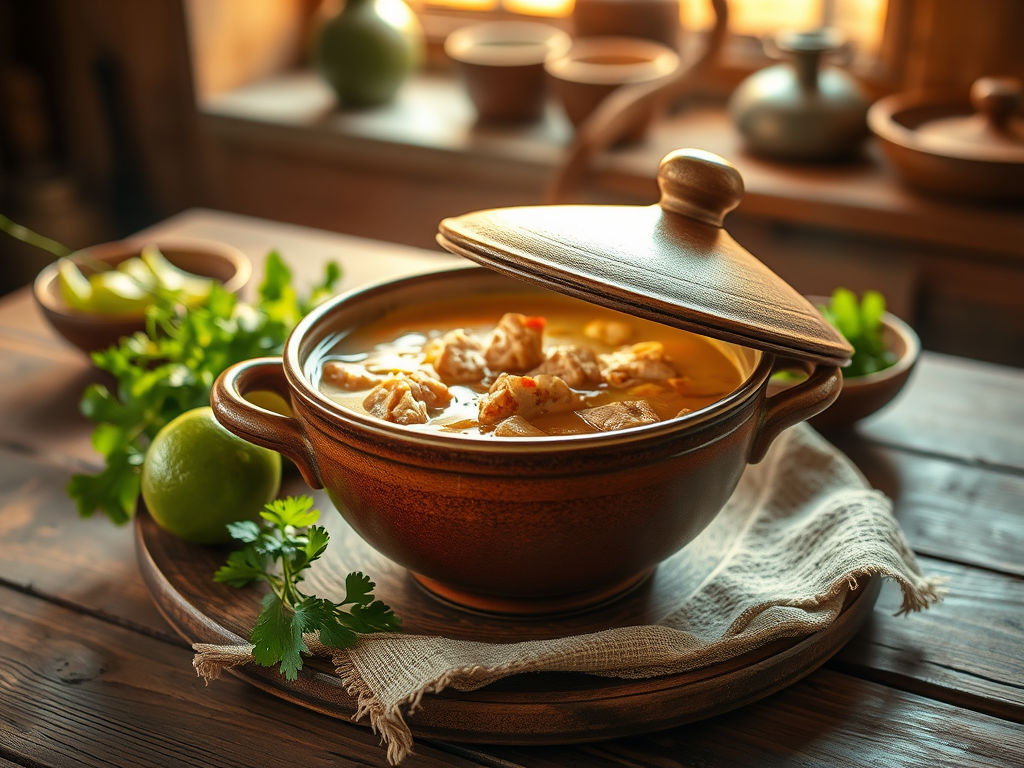
    This time, it was Chicken Caldo.

    No warning.

    No occasion.

    Just the quiet generosity of someone handing you a miracle in a paper bowl.

    Now, if you’ve never had a real caldo de pollo—not the half-hearted version simmered in a rush, but the kind that takes its time—

    let me try, poorly, to explain.

    It’s not just soup.

    It’s comfort liquified.

    Chicken is so tender it gives up.

    Vegetables that still taste like vegetables, not mush.

    And then—the lime.

    That fresh lime, squeezed just right, cuts through the warmth and lifts the flavor.

    Like a prayer whispered into something sacred.

    The taste?

    I won’t pretend I can describe it.

    All I know is that each bite felt like a home I didn’t know I missed.

    I closed my eyes and sat still, and for a few minutes, I was in heaven.

    I still haven’t tried everything New Mexico has to offer.

    Maybe I never will.

    But every now and then, I get lucky.

    And in this place, luck doesn’t come dressed in fine linen or gourmet plating.

    It comes humble, in a shared container,

    from someone who learned to cook in Oaxaca,

    someone who doesn’t care about Michelin stars,

    but who knows that feeding people—truly feeding them—is one of the last honest things we’ve got left.

    So I sit.

    I eat.

    I give thanks.

    And hope the Lord sees fit to smile on me again.

    By Kyle Hayes

  • On Uniforms, Crime, and the Price of Safety

    On Uniforms, Crime, and the Price of Safety

    By Kyle J. Hayes

    They’re calling in the National Guard.

    To Albuquerque, my city.

    Not for a natural disaster, Not to deliver food or clear debris after a storm.

    But to stand beside police officers—in full uniform, rifles slung, boots planted—to “assist” with crime.

    I understand the impulse.

    People are scared.

    They want safety, order, and something that feels like control in a city that has often felt like it’s slipping through the cracks.

    And yes, crime must be stopped.

    Yes, the police need help.

    But at what cost?

    Because when I hear the words National Guard deployed, I don’t think of peace.

    I don’t think of protection.

    I see troops on every corner, unmoving, impersonal.

    I see uniforms that don’t distinguish between law and war.

    I hear the crackle of radios and the soft click of rifles being adjusted in the early morning light.

    I imagine being stopped—not once, not twice, but every day—and asked to present identification to prove who I am, why I’m here, and where I’m going.

    And maybe you don’t see it that way.

    Maybe you see strength.

    Reassurance.

    But I’m a Black man in America.

    And I know—in my bones—that safety is a relative thing.

    What brings comfort to one community often brings fear to mine.

    I’m not romanticizing crime.

    I don’t dismiss what it means to be a victim, to lose your car, your wallet, your home, or worse—your life—to senseless violence.

    We have a problem here.

    We have judges who release the same people over and over, courts that cycle through the mentally ill like it’s just another box to check, another body to process.

    People clearly incapable of caring for themselves are handed bus passes and court dates like it’s a solution.

    And it’s not.

    But what I wonder—what keeps me up at night—is what exactly the troops are going to do about that.

    Will they post up outside the emergency room and intercept the man having a psychotic break before he steps into traffic?

    Will they appear in housing court and argue for more beds, doctors, and treatment?

    Will they stop a broken system from returning the same suffering people onto the same unforgiving streets?

    Or will they patrol the corners?

    Will they monitor “suspicious activity,” which too often means me—or someone who looks like me—walking, talking, breathing in the wrong place at the wrong time?

    Will they demand proof that I belong here?

    Because even if I have the right answers, even if I’ve done nothing wrong,

    I know from experience that sometimes that isn’t enough.

    Where does this end?

    How many steps from here to a society of passes, papers, checkpoints, and curfews?

    How many more emergencies before we normalize soldiers walking through our neighborhoods, not to help, but to enforce?

    To watch.

    To decide.

    And when they leave—if they leave—what have we lost in the meantime?

    Because there’s a difference between order and freedom.

    There’s a difference between law and justice.

    And we’ve walked this road before.

    We’ve seen what happens when we blur those lines too far.

    The uniforms and flags change, but the outcome stays the same.

    So yes, I want safety.

    But not if it means giving up the right to live without fear of my government.

    Not if it means turning my city into something that looks less like a community and more like a checkpoint.

    Because you can’t enforce peace at the barrel of a gun.

    You can only try to build it—patiently, painfully, imperfectly—until the ground beneath your feet feels like home again.

    And that’s what I want for Albuquerque.

    Not a fortress.

    But a home.

    Please comment and subscribe