
Tag: ReflectionEssay

  • What Stayed With Me This Month

    What Stayed With Me This Month

    January didn’t arrive with fireworks for me.

    It didn’t kick open the door and demand a reinvention.

    It sat down quietly and waited to see what I would do.

    Every year, January carries a certain pressure—the sense that you’re supposed to emerge from the holidays renewed, corrected, aimed in a better direction. As if surviving December isn’t an accomplishment in itself. As if rest only counts if it’s followed immediately by improvement.

    But this month didn’t ask that of me.

    And because it didn’t ask, I noticed more.

    What stayed with me wasn’t a resolution.

    It wasn’t a plan.

    It wasn’t the sudden clarity people like to perform this time of year.

    What stayed with me were smaller things.

    A kind of tired that didn’t feel like failure.

    The difference between being exhausted and being empty.

    The relief of realizing that not every ache is a problem to solve—some are just signals asking for care.

    What stayed with me was food that did its job without announcing itself.

    Meals that didn’t impress anyone but left me steady.

    Soup that didn’t look fancy.

    Chicken and cabbage in a single pan.

    Breakfast made from what was already there.

    There’s a particular kind of trust that builds when you stop chasing novelty and start paying attention to what actually holds you together. January reminded me that nourishment doesn’t need a spotlight. It needs consistency.

    What stayed with me were the stories meant for children that told the truth anyway.

    Felix learning that rest comes before effort.

    That nourishment matters more than appearance.

    That hard work has meaning when it serves something larger than ego.

    That staying—being present—is sometimes the bravest choice.

    Writing those stories reminded me that lessons don’t stop being true just because we age out of picture books. We just pretend we don’t need them anymore.

    What stayed with me was the question of work—the kind that doesn’t announce itself.

    The work of restraint.

    The work of not becoming what you oppose.

    The work of continuing without applause.

    Honoring Dr. King’s birthday this month brought that into sharper focus. Not the polished version of his legacy, but the disciplined one. The version that understood anger but refused to let it drive. The version that knew the dream was unfinished and chose responsibility anyway.

    That stayed with me.

    And maybe most of all, what stayed with me was permission.

    Permission to arrive slowly.

    Permission to trust what feeds me.

    Permission to stop fixing things that aren’t broken just because the calendar flipped.

    January didn’t make me new.

    It reminded me of what’s already working.

    As the month closes, I’m not carrying forward any goals. I’m carrying forward awareness. Attention. A quieter sense of direction.

    Not everything needs to be upgraded.

    Not everything needs to be optimized.

    Some things just need to be noticed—and kept.

    Kyle J. Hayes

    kylehayesblog.com

    Please like, comment, and share

    Resources for Hard Times

    If you’re looking for practical help, food support, or community resources, you can visit the Salt, Ink & Soul Resources Page.
    👉 Resources for Hard Times

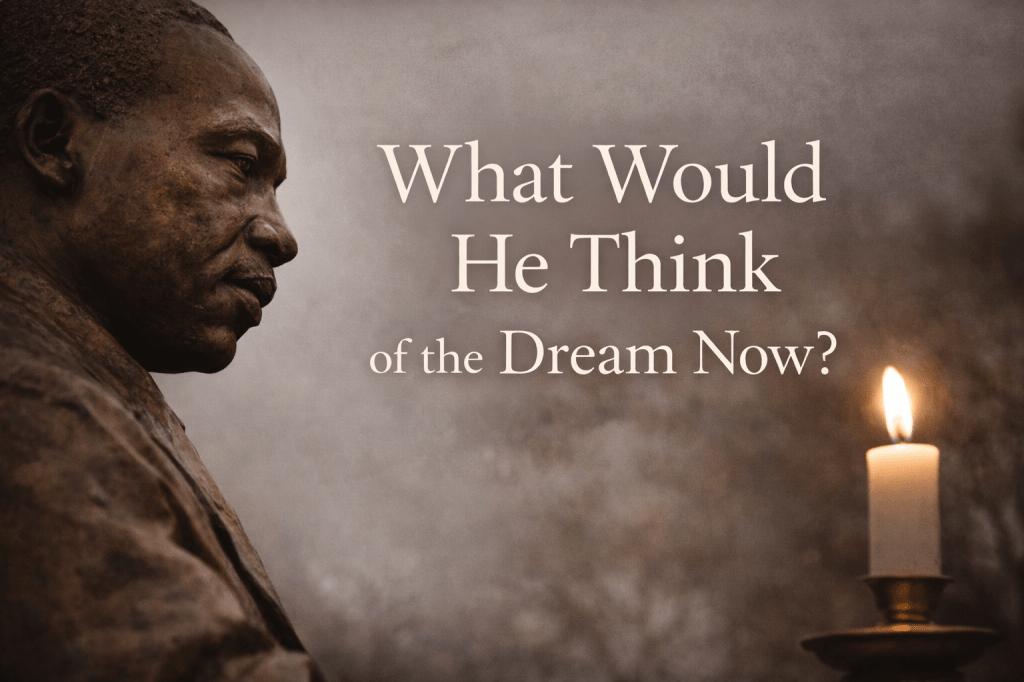
  • What Would He Think of the Dream Now?

    What Would He Think of the Dream Now?

    Today, we celebrate the birthday of a man who gave so much of himself that there was nothing left to take.

    A man who understood—long before the rest of us were ready to admit it—that speaking the truth in a country built on denial comes with a cost. A man who seemed to know, on some level, where the road he was walking would end, and chose to walk it anyway.

    As I look around today, I find myself wondering what he would think.

    Not in a ceremonial way.

    Not in a quote-for-the-day way.

    But honestly.

    Would he still have the same dream?

    Would he look at his people—their survival, their brilliance, their contradictions, their victories, and their wounds—and feel pride? Relief? Concern? All of it braided together?

    Would he believe the dream survived him?

    Or would he recognize it for what it has always been: unfinished work.

    What many people forget—or choose not to remember—is that his vision was never narrow. He did not fight for a single group at the expense of others. He fought for all who were crushed beneath unfair systems: Black and white, poor and working, seen and ignored. He stood against injustice itself, not just the version that wore familiar faces.

    That kind of fight costs more than slogans admit.

    As I sat wondering what to write today, I found myself at a loss. Not because there was nothing to say, but because the weight of the man and the moment does not lend itself easily to neat paragraphs. So I went back and learned again.

    I learned again about the discipline of nonviolence—not the softened version we like to remember, but the demanding one. The kind that requires you to absorb blows without letting your spirit turn brittle. The kind that asks you to restrain your hand even when your body is screaming to defend itself.

    That kind of restraint does not come naturally.

    It has to be practiced.

    I learned again how often he was arrested. How frequently he was removed from the streets not because he was wrong, but because he was effective. How some of his most enduring words were written while confined—stripped of movement, forced into stillness.

    Something is sobering about that.

    A reminder that confinement has never stopped truth from finding its way onto paper. That history’s sharpest insights are often written by people who were told to sit down and be quiet.

    And while others preached more aggressive paths—paths that made sense, paths that spoke directly to rage—he held to peace. Not because he was unfamiliar with anger, but because he understood what it could become if left unguided.

    That choice cost him credibility with some. It cost him patience with others. It cost him comfort. And eventually, it cost him his life.

    Which brings me back to the question I can’t quite put down:

    What would he think now?

    Would he be encouraged by the doors that have opened?

    Would he be troubled by the ones that quietly closed behind us?

    Would he recognize progress—and still point out how uneven it remains?

    I don’t believe he would be surprised by our divisions. He knew human nature too well for that. And I don’t think he would be shocked by our impatience either. When you’ve waited generations for justice, patience becomes a complicated request.

    But he would ask us something uncomfortable.

     Are you angry?

    But what are you building with that anger?

     Have you suffered?

    But have you learned how to keep your suffering from hardening your heart?

    Because the dream was never about perfection.

    It was about direction.

    About bending the arc—not snapping it in half. About insisting on dignity even when the world refuses to recognize it. About believing that the measure of a society is not how loudly it celebrates its heroes, but how faithfully it carries their work forward when they are gone.

    Today, we celebrate his birth. But birthdays are not only about candles and remembrance. They are about legacy—about what continues because someone once chose courage over safety.

    So the better question isn’t what he would think of us.

    The question is what we think of ourselves in light of what he gave.

    Are we still committed to fairness when it is inconvenient?

    Are we still willing to restrain ourselves from becoming what we oppose?

    Are we still able to imagine a future that extends beyond our own survival?

    Nonviolence, at its core, was never passive.

    It was active care.

    Care for the soul of a people.

    Care for the future they would have to live in.

    Care for the possibility that justice, pursued without hatred, might actually last.

    That kind of care is exhausting.

    And maybe that is why his life still speaks.

    Because it reminds us that change does not come from comfort. That the work is never finished. That the dream was not a destination, but a responsibility handed forward.

    Today, on his birthday, we are not asked to rehearse his words or turn his life into a symbol we can safely admire from a distance. We are asked something more complex and more honest: to sit with the cost of what he chose, to recognize that nonviolence was not comfort but discipline, not silence but intention.

    To consider whether we are still willing to be shaped by a dream that demands more than applause.

    A dream like that does not survive on remembrance alone. It survives only if someone, somewhere, decides—quietly and without cameras—to carry it forward.

    Kyle J. Hayes

    kylehayesblog.com

    Please like, comment, and share

    Resources for Hard Times

    If you’re looking for practical help, food support, or community resources, you can visit the Salt, Ink & Soul Resources Page.

    👉 Resources for Hard Times