By Kyle J. Hayes
I didn’t go to the Culinary Institute of America.
Never wore crisp whites in some Michelin-starred kitchen, never barked orders across a brigade.
I didn’t stage in Paris, and no, I never took a sabbatical to harvest sea salt in Portugal or study fermentation under a Zen monk in Kyoto.
I’m a home cook. First and foremost.
And that matters.
Not because it’s lesser.
But because it’s real.
My kitchen is not a theater. It’s a workspace.
It’s where dinner is made after work, mistakes burn on the pan, and the dog waits, hoping something edible hits the floor.
I’ve taken a few classes in person. Enough to know that ego and sharp blades are a bad combination.
But most of my knowledge? Most of what I’ve learned about food—about cooking, technique, flavor, and fire—came from TV cooking shows and late-night dives into YouTube videos and blogs written by people who probably never wore a toque.
And because I’m naturally stubborn, many of those lessons came the hard way.
The painful way.
Sliced fingers. Burnt sauces. Broken emulsions.
Learning, not by reading, but by failing.
And if you’re here—reading this—you probably want to learn, too.
Let me do something I wish more people did when I was starting out.
Let me save you a little pain.
Start with the Knife
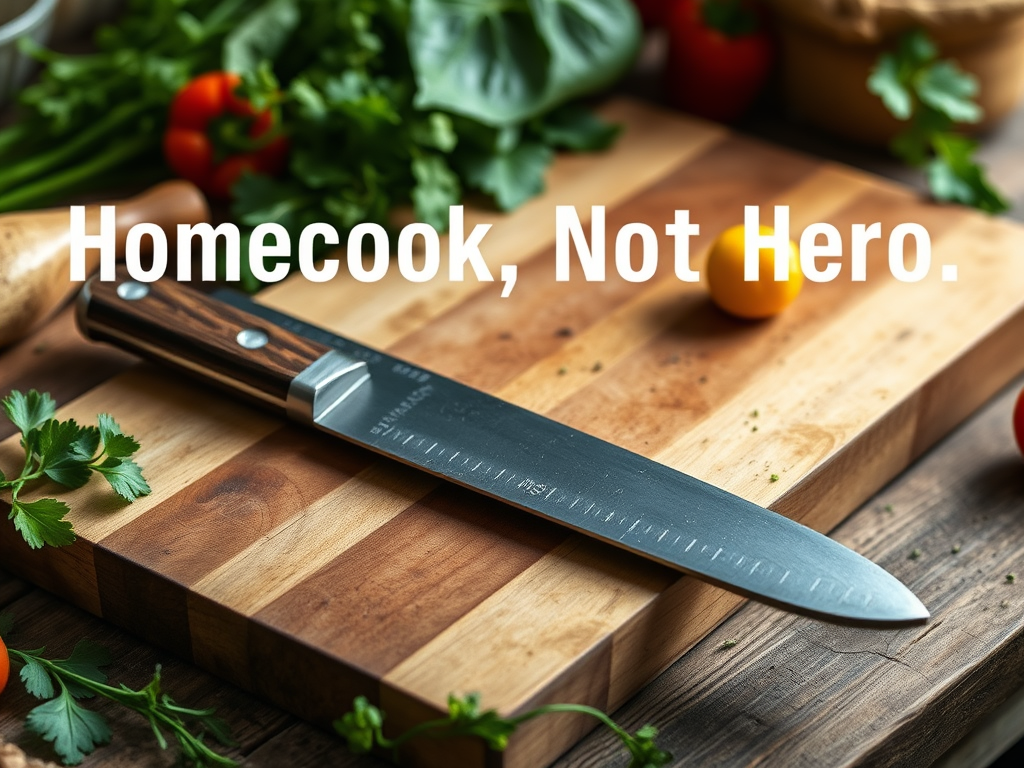
Get yourself a real chef’s knife.
Not the overpriced artisan steel you see on Instagram, not the flashy blades that look like they were forged by elves and come with a custom leather sheath. And definitely not the 27-piece Ginzu set some guy in a too-tight polo is selling on an infomercial.
No.
What you need is one good knife.
Something balanced.
Something you can resharpen, not throw away.
It doesn’t have to be expensive. It just has to be honest.
This knife?
It will be your best friend—and your most significant threat.
Treat it with respect.
Learn to Use It
Don’t worry about speed.
You’re not auditioning for Top Chef.
You’re trying to get through dinner without losing a finger.
Use the internet.
Watch the pros. Pause, rewind, practice.
Learn the claw grip, how to hold the blade, how to rock it, not slam it.
And each time you come away without injury, count it as a win.
Because cutting yourself doesn’t mean you’re bold or brave.
It just means you weren’t paying attention.
Cooking is about focus.
Precision.
Rhythm.
Knife skills aren’t just for looking cool—they’re about control,
About respecting the ingredients and yourself.
The Real Education
In the age we live in, everything you need to know is out there.
A click away.
Want to learn how to break down a chicken?
Roast bone marrow? Build a stock? It’s all waiting for you.
You don’t need a degree.
You need curiosity and maybe a willingness to be humbled.
Cooking is one of the few things that can still remind you daily that you’re not as smart as you think.
But if you pay attention, listen, and try again and again…
You get better.
So, no, I’m not classically trained.
But I’m trained just the same.
By the repetition that slowly teaches you how to get it right, burnt toast and cold pan oil, overcooked rice, and underseasoned chicken.
And if you’re just starting out—welcome.
Get the knife.
Keep it sharp.
And remember: every scar has a story, but it doesn’t have to be yours.
Please like, comment and subscribe



 Salt,Ink, & Soul