Tag: Ritual

  • The Sky Belongs to Balloons

    The Sky Belongs to Balloons

      It’s the time of year when the desert begins to remember the cold. The mornings bite a little sharper, the light shifts from golden to amber, and in Albuquerque, the rhythm of fall comes with rituals all its own. The State Fair folds up its tents and carnival lights, and before the dust has even settled, the sky gives itself to balloons.

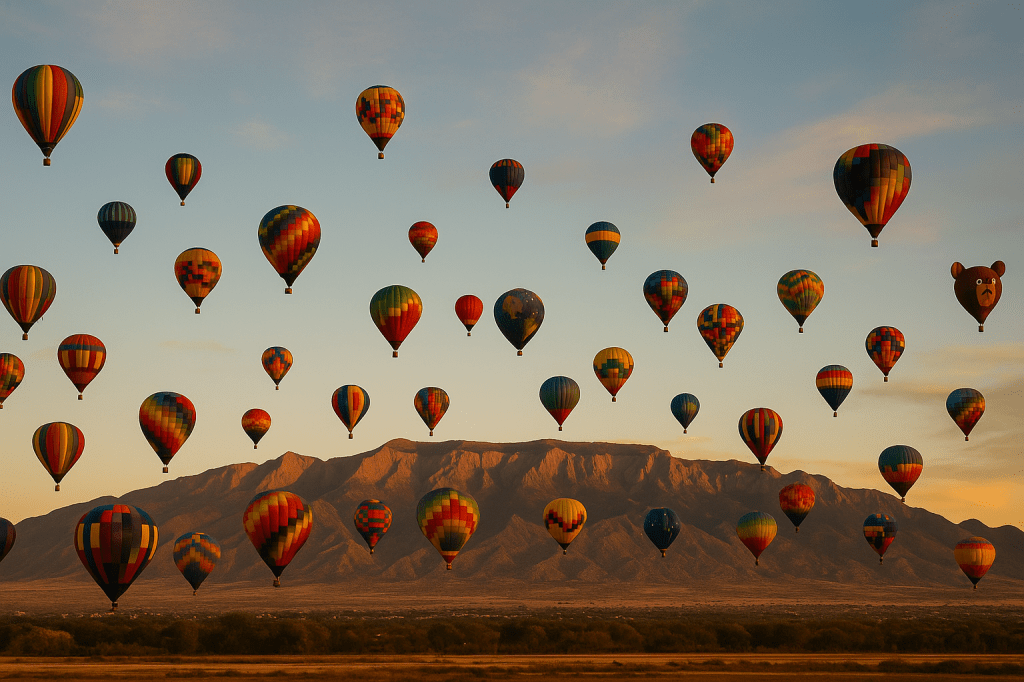
    The Albuquerque International Balloon Fiesta is not just an event here; it is a season. The largest gathering of hot air balloons in the world, and every year, it pulls tens of thousands of people into its orbit. It rewrites the city’s mornings. Commutes pause. Joggers stop mid-stride. Children tug their parents toward the sidewalk, phones raised, because a balloon — shaped like a cow or a stagecoach or just a simple rainbow stripe — has drifted so low it seems ready to brush the rooftops.

    And then the chase crews arrive, pickup trucks trailing, men and women moving quickly, packing away the canvas like a secret folded back into itself. You see this enough, you could call it ordinary. But I’m still too new here, not jaded enough, because every time I look up and catch sight of one, it feels like the sky has been interrupted by wonder.

      There’s a madness in waking at 3:30 a.m. just to stand in the cold. Yet thousands of us do it, year after year. The roads snake toward Balloon Fiesta Park in the dark, headlights lined up like a procession. Coffee cups steam in cup holders, blankets drape over shoulders, and conversations hum with anticipation.

    When you arrive, the field is still hushed, waiting. Crews shuffle around baskets, propane tanks hiss faintly, and in the distance you hear murmurs, laughter, the rustle of nylon being unfurled. The night sky holds onto its stars a little longer.

    And then — the Dawn Patrol.

    A handful of balloons rise first, lighting their burners in unison, glowing like lanterns against the indigo dark. The sound is unmistakable: the sudden whoosh of flame, the gasping exhale of fire against the silence of morning. The crowd breathes with them, every burst of light pulling eyes upward. For a moment, it feels less like a spectacle and more like a ceremony.

    And then the Mass Ascension begins.

    Dozens, then hundreds, then more than you can count. Balloons rising in waves until the sky is littered with color — a slow unfurling of the surreal, so vast and so improbable that it borders on disbelief. You look up and the horizon is gone, erased by canvas and flame.

      There’s a peculiar intimacy in standing with thousands of people you don’t know, all of you bundled against the same chill, sipping coffee, biting into breakfast burritos, sharing a collective awe. You don’t need names. You don’t need history. For a few hours, you are kin to anyone whose head tilts back in wonder.

    Children squeal at the “special shapes” — bees holding hands, Darth Vader and Yoda, cows larger than houses. Photographers kneel, point, capture. Tourists beam into news cameras, their voices shaky with joy, telling reporters this was a lifelong dream.

    And I wander among it all, part of the throng but also apart, notebook in my pocket, questions in my head. What does it mean that people travel across the world just to stand in this field and look up? What does it mean that beauty, when shared, feels almost like communion?

      By mid-morning, the sky begins to empty. Balloons scatter, floating toward the mesa, toward neighborhoods, toward open lots where chase crews wait to claim them. The field thins out, tourists drift toward vendors selling chile and frybread, and traffic snarls for miles.

    You sit in it, inching forward, the high of the morning giving way to the dull grind of engines and exhaust. The burrito is gone, the coffee cold. Reality asserts itself.

    And yet, even in that crawl, I find myself replaying the moment of lift. The quiet between burner blasts. The way balloons floated like prayers, drifting wherever the wind allowed. My fear of heights keeps me on the ground, tethered by gravity, but still — I wonder what it must be like to surrender that control. To look down on this desert city not as blocks and intersections but as a sprawl of lives stitched together under the watch of mountains and sky.

    Part of the gift of the Fiesta is this: that you don’t need to rise to feel lifted. Wonder has its own gravity, and it doesn’t care whether you leave the earth or not.

      Living here, you learn to get used to things. Chile roasters set up outside grocery stores in September, flames spitting, smoke curling into the air until the whole city smells like survival. The Sandias are turning pink at dusk, like the mountains are reminding you that the day is theirs to close. Balloons dotting the sky in October, so common they could be dismissed as background.

    But used to doesn’t mean unmoved by.

    Maybe that’s the secret of Albuquerque — that it can hold the extraordinary and the ordinary at the same time without letting either collapse the other. It teaches you that wonder isn’t about distance but attention. That staying, not leaving, sometimes brings you closer to beauty.

    The Balloon Fiesta comes and goes, the crowds depart, the fields go quiet again. But for one week, every year, the sky itself becomes a canvas — and it belongs to balloons.

    And that’s what keeps me here. Not the spectacle, not the scale, not even the food or the music or the culture, as rich as all of that is. It’s the reminder that beauty doesn’t always come from someplace else. Sometimes it rises right in front of you, again and again, until you learn to stop, to look up, to hold still in the presence of wonder.

    By Kyle J. Hayes

    kylehayesblog.com

    Please like, comment, and share

  • Chasing Balloons, Chasing Time

    Chasing Balloons, Chasing Time

    In October, I step outside and my neck betrays me. It tilts. It’s a reflex now, a habit stitched into the muscle: look up. I’ve lived in Albuquerque for years and still, when the air is cool and the light is clean, I search the sky for color. I tell myself I won’t take more pictures—I have too many already, crooked and overexposed—but I do. I raise the phone anyway. Because a balloon drifting over a familiar street makes the world feel briefly unfamiliar, blessed, less ordinary. It’s hard not to look up when something is gently urging you to do so.

    But you cannot spend all your time with your eyes in the clouds. Others are looking up, too—looking for different reasons. Those are the crews. The chasers. They scan the same sky, but they are reading it. They are mapping a moving target, listening to radios crackle with wind reports and altitude changes, translating the invisible into action. Where I see spectacle, they see a set of decisions unfolding minute by minute.

    How the Chase Works

    The pilot calls down their altitude, drift, and plan. In the basket: a burner, a few tanks, and nerve. On the ground: the crew vehicle, a map app with layers of roads and arroyos, a stack of known landing spots, and the experience to know when to ignore them all. A good crew doesn’t just follow; they “lead from behind.” They stay downwind and look ahead, anticipating the arc of the flight, not tailgating the balloon but shadowing its intention.

    They read the day the way a cook reads heat. A small helium “piball” might have been launched before dawn to trace the low-level winds; the pilot tests layers by climbing or sinking—thirty feet, three hundred, three thousand—finding slight changes that turn the craft, teasing out a path. From the ground, the chase watches power lines and private land, traffic and fences, the geometry of a field that will forgive a landing. When the pilot radios, “Looking good to set down,” the crew hustles to the far side, positioning themselves where the envelope will finally touch down against the earth.

    The landing looks quiet from a distance. Up close, it’s choreography. Someone grabs the crown line to steady the top of the balloon. Someone else works the deflation port when the pilot says the word. Burners hush. Heat thins. The nylon slacks, then it lay down like a tired animal. Hands spread across fabric, smoothing, gathering, rolling. The envelope is folded and fed back into its bag—this miraculous, airborne thing turned back into luggage. The basket is tipped, the rigging coiled, the tanks stowed. Strangers wave from sidewalks. Kids ask if they can help push. Photos are taken. A little dust on the cuffs. The radio goes quiet.

    It isn’t glamorous. It is a practiced tenderness, the way a team returns something fragile to the ground without bruising it.

    The Metaphor We’re All Living

    This is where I stop pretending the chase is only about balloons. The longer I live here, the more I know: life is mostly pursuit. We chase the moments we cannot keep. We follow after brief, beautiful things—youth, luck, a parent’s laugh, a friend’s forgiveness—knowing they will descend somewhere we can’t reasonably predict. We listen for small signals. We study the currents. We get into the truck and try to be there—downwind, ready—when whatever we love returns to earth.

    Impermanence isn’t a flaw in the design. It is the design. Ballooning admits what we try to deny: everything rises; everything comes down. Beauty isn’t proof of permanence; it is evidence of grace while it lasts. You accept that, or you live angry at gravity. The crews seem to know this. They are at peace with the terms. They’ll chase again tomorrow.

    “If flying is the miracle, catching is the mercy.”

    Who We Chase With

    What saves all of this from loneliness is how many people do it together. Balloons make families out of strangers. Some have been crewing for decades—grandparents in fleece vests, their kids in ballcaps, their kids’ kids holding the crown line with serious faces, learning the work. Friends who met in a field at dawn are now godparents to each other’s children. Out-of-towners come from great distances—Wisconsin, Japan, South Africa, and Bristol—and are adopted for a week, handed gloves and a thermos, and told where to stand and when to pull. The language barrier disappears the moment the envelope tugs, and everyone leans in the same direction.

    I’ve seen reunions happen between baskets and tailgates, the kind only a shared ritual can produce. People who fly together once a year but text all year long. People who plan entire vacations around a wind pattern. People who teach their children to cheer not just when the balloon rises, but when the crew in the dust makes the landing gentle. There are potlucks at rented casitas, toasts at brewery patios, quiet walks along the bosque when the morning debrief is done. A city of chasers, binding themselves to a season and, in doing so, to each other.

    What the Chase Teaches

    It would be easy to romanticize this, to pretend it is always a postcard. It isn’t. Sometimes the wind is wrong, the traffic snarls, a landing field vanishes into a “No Trespassing” sign, the radio fritzes, the plan collapses. Sometimes you arrive on time, and sometimes you don’t. Sometimes you watch the balloon settle two streets over, and all you can do is wave and keep moving. There is a lesson in missing, too: you cannot own what you love; you can only accompany it faithfully.

    Still, when it works—when the crew turns down the last dirt road and the basket kisses the earth softly—something inside unclenches. Relief, yes. But also recognition. The craft came back, and so did you. The chase isn’t only a pursuit; it’s a return.

    The Last Act

    By late morning, the city shrugs back into itself. On a block near an arroyo, a crew kneels in the grass, palms flat, as they push the final folds of nylon into a bag. Someone cinches the strap. Someone else pulls the zipper home. A kid ties a knot and grins like they invented rope. Tank valves are checked. The basket is loaded. A pilot thanks the landowner for the use of the field. Phones trade photos. Numbers are saved. Promises are made for next year.

    They pile into the truck, and the radio is silent now, not because the day is over but because the work has moved inside them. Another memory stored. Another morning added to the ledger. Albuquerque is good at this—turning weather into ritual, strangers into companions, a week in October into a reason to belong.

    Closing Reflection

    Suppose Origins was about our first attempts to rise, and Dawn Patrol was about the discipline of hope in the dark. In that case, the chase is their echo in daylight—the acceptance of impermanence, the grace of pursuit, and the belonging we find in catching together what can never be kept alone.

    I still look up when I step outside. I still take too many pictures. But I’ve learned to love the ground as much as the sky: the chase, the coordination, the imperfect arrivals. The balloon rises; we give chase; it lands; we fold it carefully and carry it out. We do not pretend it will last forever. We honor it because it won’t.

    That is the heart of this city’s October. Impermanence accepted, beauty in pursuit. We chase what can’t be kept, and in chasing together, we become the kind of people who know how to let go—gently, gratefully—and still remember where to meet again when the winds turn kind.

    By Kyle J. Hayes

    kylehayesblog.com

    Please like, comment, and share