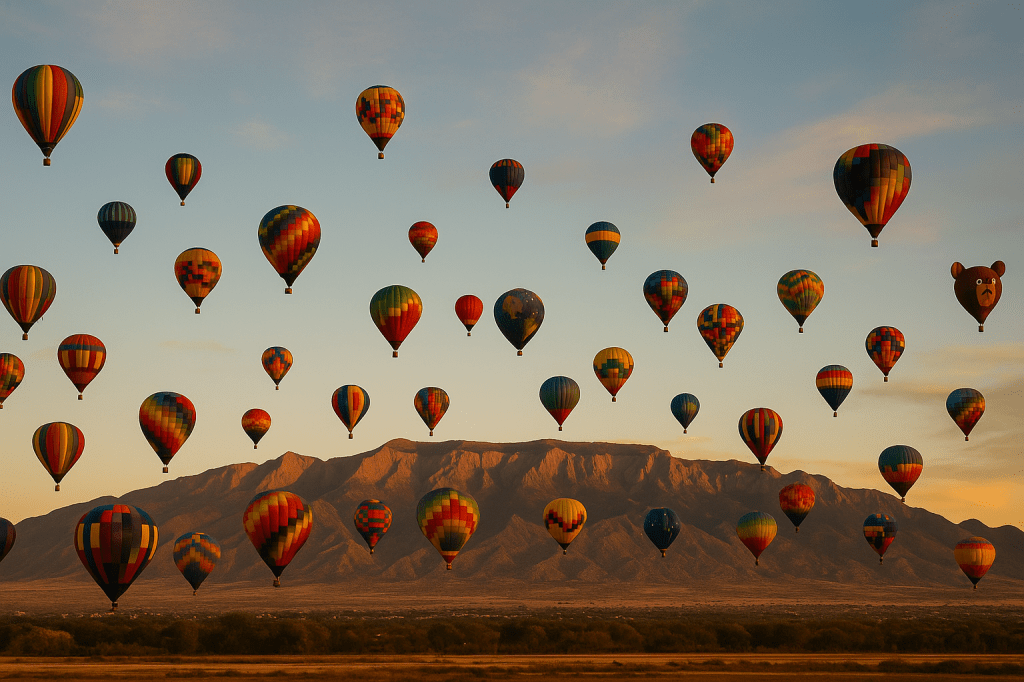
Tag: sandia mountains

  • The Sky Belongs to Balloons

    The Sky Belongs to Balloons

      It’s the time of year when the desert begins to remember the cold. The mornings bite a little sharper, the light shifts from golden to amber, and in Albuquerque, the rhythm of fall comes with rituals all its own. The State Fair folds up its tents and carnival lights, and before the dust has even settled, the sky gives itself to balloons.

    The Albuquerque International Balloon Fiesta is not just an event here; it is a season. The largest gathering of hot air balloons in the world, and every year, it pulls tens of thousands of people into its orbit. It rewrites the city’s mornings. Commutes pause. Joggers stop mid-stride. Children tug their parents toward the sidewalk, phones raised, because a balloon — shaped like a cow or a stagecoach or just a simple rainbow stripe — has drifted so low it seems ready to brush the rooftops.

    And then the chase crews arrive, pickup trucks trailing, men and women moving quickly, packing away the canvas like a secret folded back into itself. You see this enough, you could call it ordinary. But I’m still too new here, not jaded enough, because every time I look up and catch sight of one, it feels like the sky has been interrupted by wonder.

      There’s a madness in waking at 3:30 a.m. just to stand in the cold. Yet thousands of us do it, year after year. The roads snake toward Balloon Fiesta Park in the dark, headlights lined up like a procession. Coffee cups steam in cup holders, blankets drape over shoulders, and conversations hum with anticipation.

    When you arrive, the field is still hushed, waiting. Crews shuffle around baskets, propane tanks hiss faintly, and in the distance you hear murmurs, laughter, the rustle of nylon being unfurled. The night sky holds onto its stars a little longer.

    And then — the Dawn Patrol.

    A handful of balloons rise first, lighting their burners in unison, glowing like lanterns against the indigo dark. The sound is unmistakable: the sudden whoosh of flame, the gasping exhale of fire against the silence of morning. The crowd breathes with them, every burst of light pulling eyes upward. For a moment, it feels less like a spectacle and more like a ceremony.

    And then the Mass Ascension begins.

    Dozens, then hundreds, then more than you can count. Balloons rising in waves until the sky is littered with color — a slow unfurling of the surreal, so vast and so improbable that it borders on disbelief. You look up and the horizon is gone, erased by canvas and flame.

      There’s a peculiar intimacy in standing with thousands of people you don’t know, all of you bundled against the same chill, sipping coffee, biting into breakfast burritos, sharing a collective awe. You don’t need names. You don’t need history. For a few hours, you are kin to anyone whose head tilts back in wonder.

    Children squeal at the “special shapes” — bees holding hands, Darth Vader and Yoda, cows larger than houses. Photographers kneel, point, capture. Tourists beam into news cameras, their voices shaky with joy, telling reporters this was a lifelong dream.

    And I wander among it all, part of the throng but also apart, notebook in my pocket, questions in my head. What does it mean that people travel across the world just to stand in this field and look up? What does it mean that beauty, when shared, feels almost like communion?

      By mid-morning, the sky begins to empty. Balloons scatter, floating toward the mesa, toward neighborhoods, toward open lots where chase crews wait to claim them. The field thins out, tourists drift toward vendors selling chile and frybread, and traffic snarls for miles.

    You sit in it, inching forward, the high of the morning giving way to the dull grind of engines and exhaust. The burrito is gone, the coffee cold. Reality asserts itself.

    And yet, even in that crawl, I find myself replaying the moment of lift. The quiet between burner blasts. The way balloons floated like prayers, drifting wherever the wind allowed. My fear of heights keeps me on the ground, tethered by gravity, but still — I wonder what it must be like to surrender that control. To look down on this desert city not as blocks and intersections but as a sprawl of lives stitched together under the watch of mountains and sky.

    Part of the gift of the Fiesta is this: that you don’t need to rise to feel lifted. Wonder has its own gravity, and it doesn’t care whether you leave the earth or not.

      Living here, you learn to get used to things. Chile roasters set up outside grocery stores in September, flames spitting, smoke curling into the air until the whole city smells like survival. The Sandias are turning pink at dusk, like the mountains are reminding you that the day is theirs to close. Balloons dotting the sky in October, so common they could be dismissed as background.

    But used to doesn’t mean unmoved by.

    Maybe that’s the secret of Albuquerque — that it can hold the extraordinary and the ordinary at the same time without letting either collapse the other. It teaches you that wonder isn’t about distance but attention. That staying, not leaving, sometimes brings you closer to beauty.

    The Balloon Fiesta comes and goes, the crowds depart, the fields go quiet again. But for one week, every year, the sky itself becomes a canvas — and it belongs to balloons.

    And that’s what keeps me here. Not the spectacle, not the scale, not even the food or the music or the culture, as rich as all of that is. It’s the reminder that beauty doesn’t always come from someplace else. Sometimes it rises right in front of you, again and again, until you learn to stop, to look up, to hold still in the presence of wonder.

    By Kyle J. Hayes

    kylehayesblog.com

    Please like, comment, and share
  • The Land of Entrapment

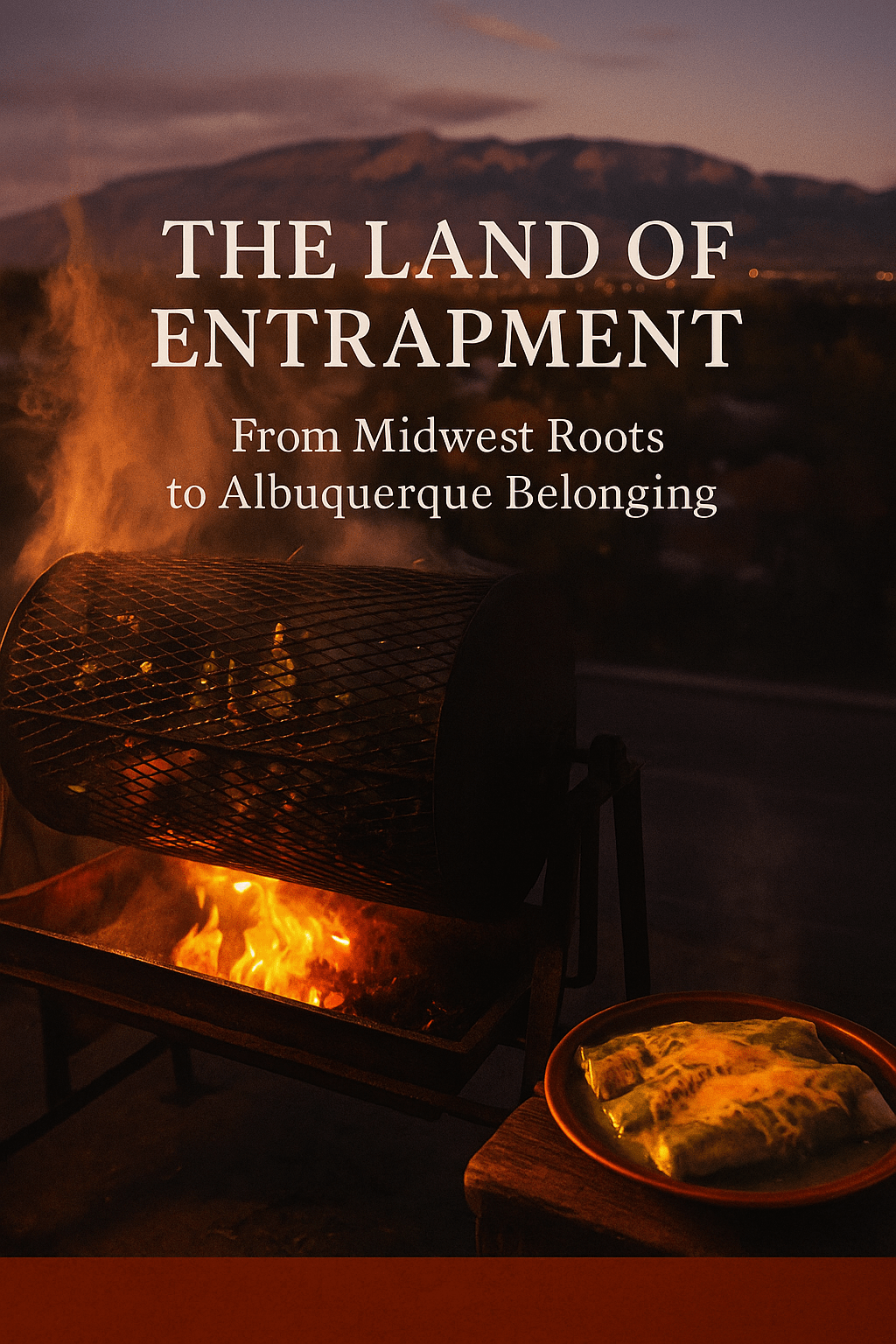
    The Land of Entrapment

      I was raised in the Quad-Cities — an area that, to this day, feels suspended in amber. It isn’t just the winters that freeze you to the bone, when the wind whips across the Mississippi and leaves your face raw. It’s the people, the rhythm of life, the way the place still breathes as though the 1980s never ended.

    Factories were our backbone then: John Deere, International Harvester, Caterpillar, The Rock Island Arsenal, and ALCOA. Their names were more than brands; they were birthrights. People clocked in and out not just for paychecks but for identity. Houses were bought once and held onto for a lifetime, just like jobs. Men retired in the same overalls they wore when they started, women retired in the same churches and kitchens that shaped them. It was a life that promised stability. Predictability. A bubble.

    But bubbles keep things in as much as they keep things out.

    I had seen time move differently elsewhere — places that reinvented themselves, cities that shifted, people who didn’t cling so tightly to sameness. And once you see that, once you know the world isn’t fixed in place, it’s impossible to believe that standing still is survival.

      I left Iowa more than once. The first time, it was the military that pulled me out — not a choice so much as a summons. Later, work carried me away. And yet, I came back, each time.

    Coming back felt inevitable, like the bubble had its own gravitational pull. But deep down, I knew I couldn’t keep circling the same orbit. There’s a difference between leaving because the world demanded it and going because you chose to.

    That’s what Albuquerque was for me: a choice.

      On paper, the decision made sense.

    No hurricanes to rip through your home. No earthquakes to split the ground. No volcanoes threatening fire. No endless rain to drown the days. It wasn’t Phoenix, where the heat presses against your chest like a punishment. It wasn’t the overcrowded sprawl of the West Coast. It was manageable. It was human-sized.

    And yes — the racial makeup mattered. I wanted a place where diversity wasn’t a buzzword, where the face of the city itself carried the mark of many histories, not just one.

      When I arrived, I heard the jokes: The Land of Entrapment. Come on vacation, leave on probation. They were said with a smirk, half-warning, half-truth. Albuquerque has its shadows. Addiction, poverty, violence — scars on a city that has seen too much. But to stop there, to see only the flaws, is to miss the marrow of the place.

      I didn’t know I liked landscapes until I saw the Sandias burn pink at sunset, watermelon hues spilling across the horizon like the desert itself was blushing. I didn’t know I needed vast skies until I stood beneath them, their sheer immensity forcing me to recognize how small I was — and how alive.

      Then the culture. The way Catholic feast days blur into Pueblo ceremonies, how murals tell stories, how music leaks from church doors and lowriders in the same breath. The way traditions survive here is not as nostalgia but as living practices, stitched into daily life.

    And the food.

      If the Midwest were pot roast and casseroles, Albuquerque is chile — unapologetic, fiery, alive. Chile roasters appear outside grocery stores in September, flames licking metal drums, smoke curling into the crisp air until the entire city smells like memory. Red or green isn’t a question of preference; it’s a declaration of identity. Enchiladas stacked high and smothered, tamales at Christmas, burritos at the Balloon Fiesta — food here doesn’t just fill you, it binds you.

    I’ve said before that I wasn’t raised on green chile chicken enchiladas. I was raised on soul food, or as most people now know it, “Southern Cuisine”. That food was survival dressed as a celebration. It was what you ate to remember who you were.

      But Albuquerque taught me to make room for new rituals. When I’m sick, I still crave soul food, but I’ve learned to crave enchiladas too. I’ve learned that “red or green?” comes as naturally now as “sweet or unsweetened?” once did. I’ve learned that my hands, though clumsy, can roll tortillas and fold tamales.

      Food, I’ve realized, doesn’t erase what you came from. It layers it.

    Iowa was entrapment too — but of a different kind. Entrapment of sameness, of repetition, of a rhythm so predictable it could suffocate.

    Albuquerque’s entrapment is something else. It seduces. It draws you in with Chile smoke in the fall, with the way the mountains change color by the hour, with a culture that makes you feel like you’re walking through both past and present at once.

      People warn you about it: The Land of Entrapment. But I’ve started to hear it differently, not as a warning, but as an invitation.

      Because here’s the truth: I don’t want to leave.

    What began as a practical choice has become something more intimate, something stitched into me. Albuquerque caught me — with its flaws, its grit, its beauty, its food — and I don’t feel trapped. I feel claimed.

    That could be what home is. Not where you start, not even where you end. But where you finally stop running, because you no longer want to.

    By Kyle J. Hayes

    kylehayesblog.com

    Please like, comment, and share

  • When the Air Turns in Albuquerque

    When the Air Turns in Albuquerque

    There’s a moment in Albuquerque when the air shifts and you know — without anyone needing to tell you — that summer is over. It’s not dramatic. There’s no storm to announce it, no hard edge to the sky. But one morning you step outside, and the heat that’s been pressing on you all summer is suddenly gone. The air has a crispness that cuts right through the haze.

    This is the air that makes you breathe a little deeper.

    This is the air that reminds you that fall in New Mexico is something holy.

    You smell it before you see it.

    Outside almost every grocery store, the roasters appear. Metal cages filled with green chile, spinning over open flame, popping and hissing until the skins blister and the air is thick with the smell of heat and earth and smoke.

    That smell is the anthem of autumn here. It gets into your hair, your clothes, the fabric of your car seats. You can’t escape it, and you don’t want to. It is the smell of the harvest, the smell of a city stocking its freezers, the smell of family kitchens about to come alive.

    The Chile roasters feel like a signal: time to slow down, time to gather, time to get serious about food again.

    The mornings turn cool, just enough to make you pull a hoodie over your T-shirt before heading out. The sky is still impossibly blue, but the light is different — softer, angled, as if it’s trying to remind you to look up and notice it before winter comes and steals it away.

    By late afternoon, the air warms just enough to make you consider peeling off that hoodie, but by sundown, you’re glad you didn’t. Nights are cold enough now that you crack the window and wake up with the chill brushing your face, pulling the heavier blankets closer around your shoulders.

    This is when you start taking longer routes home just to watch the Sandias turn that watermelon shade they’re named for.

    Something about this season sends me straight into the kitchen. Maybe it’s instinct — that ancient urge to prepare for the cold, to fill the house with smells that promise comfort.

    I start thinking about posole, about green chile stew, about beans simmering low and slow on the stove all afternoon. About roasts that take hours, about soups that taste better the next day, about meals that make you want to eat them by the window, wrapped in a blanket, with a book you’ve been meaning to finish.

    The coffee gets hotter. Pumpkin spice shows up in the morning routine, not as a gimmick but as a quiet ritual. I start debating pies — apple or pumpkin first? Maybe both. The oven feels less like an appliance and more like a hearth, a place to gather around.

    Fall does something to your insides. Summer is all noise — music from car windows, late-night parties, conversations shouted over the sound of swamp coolers. Fall is quieter. It asks you to turn inward, to sit with yourself a little longer.

    I find myself staying in bed just a little more, not from laziness but from gratitude — for the cool air, for the weight of the blankets, for the chance to just be still before the day starts.

    And I like it.

    I like the way this season invites me to slow down, to cook slower, to eat slower, to let the world grow softer around me.

    Every year, this shift feels both familiar and new — like returning to a house you used to live in and finding the furniture rearranged.

    The Chile roasters spin.

    The blankets come out.

    The hearty meals return.

    The city smells like smoke and earth and promise.

    I don’t know why this happens — why the season has this power over us, why we trade light linens for heavier ones, why we crave soups and pies and longer mornings.

    But I like it all the same.

    And maybe that’s enough: to notice the change, to mark it with food and ritual, to let the air turn you toward the kitchen, toward the table, toward yourself.

    By Kyle J. Hayes

    kylehayesblog.com

    Please like, comment, and share