Tag: #Soulfood

  • “Smoke and Silence: A Juneteenth Reflection”

    “Smoke and Silence: A Juneteenth Reflection”

    They said we were free. They said June 19, 1865, was the day we finally heard it out loud—that we were no longer property, no longer counted like cattle or taxed like tobacco. Two years late, but freedom, they said. They say.

    But what they don’t say—what’s often left in the silence between fireworks and food trucks—is that Juneteenth wasn’t just a date on the calendar. It was a memory passed like tongs over hot coals, shared in backyards, in neighborhoods carved from red lines and resilience. It was a whisper of freedom held between ribs and potato salad before there was ever a hashtag or a plastic cup with red, black, and green printed on the side, “Made in China.”

    Before it was named a federal holiday, Juneteenth was ours. Foundational Black Americans. The descendants of those who labored resisted and died without so much as a headstone to mark their names. It was celebrated not with grandeur but with soul. Small parades down streets we paved but never owned. Sunday choirs echoing freedom songs older than the Constitution. Fathers firing up grills, uncles telling stories that turned mythic over time, and grandmothers seasoning more than just food—seasoning identity, memory, grief, and joy into every bite.

    We didn’t need permission to celebrate. We needed remembrance.

    But now? Now, the world has discovered Juneteenth like a new flavor of soda—for a limited time only, available at your nearest big-box retailer. There’s a profit in our pain. A market for our memory. You can buy a Juneteenth T-shirt from the same store that called the cops on us last month. You can eat a “Freedom Day Cupcake” sold by hands that never once lifted a tray at a family reunion.

    Even in celebration, they find a way to own it.

    Federal recognition was supposed to be acknowledgment. But somewhere in the process, it started to feel like appropriation. As soon as it was made official, they also made it theirs—to monetize, to control, to parade around with branding guides and Instagram filters.

    They charge us for permits on our own blocks. They raise vendor fees at parks we once filled for free. They line the streets with booths and banners but ask none of the elders to speak. No stories. No truth. Just commerce.

    What once felt sacred now feels staged.

    And so I offer this:

    Celebrate quietly. Celebrate deeply. Celebrate honestly.

    Not with mall sales and glittered slogans, but with memory. With reverence. With fire and flesh and laughter and smoke curling upward like a prayer.

    Light a grill in your backyard. Share a story with your child. Tell them about the General who rode into Galveston with two years of truth in his mouth. Tell them about the cotton and the blood. About the chains. About how some of us never made it to June 19 but dreamed of it in our final breath.

    Gather your family close—not for spectacle, but for sanctuary.

    Reclaim the sound of laughter in the yard. The creak of old lawn chairs. The gospel hum of freedom echoing off brick walls. Let the smell of ribs and spice be our resistance. Let the rhythm of our joy be the sermon.

    Because Juneteenth isn’t for sale.

    It never was.

    And if they ask where the parade is, tell them it’s right here—

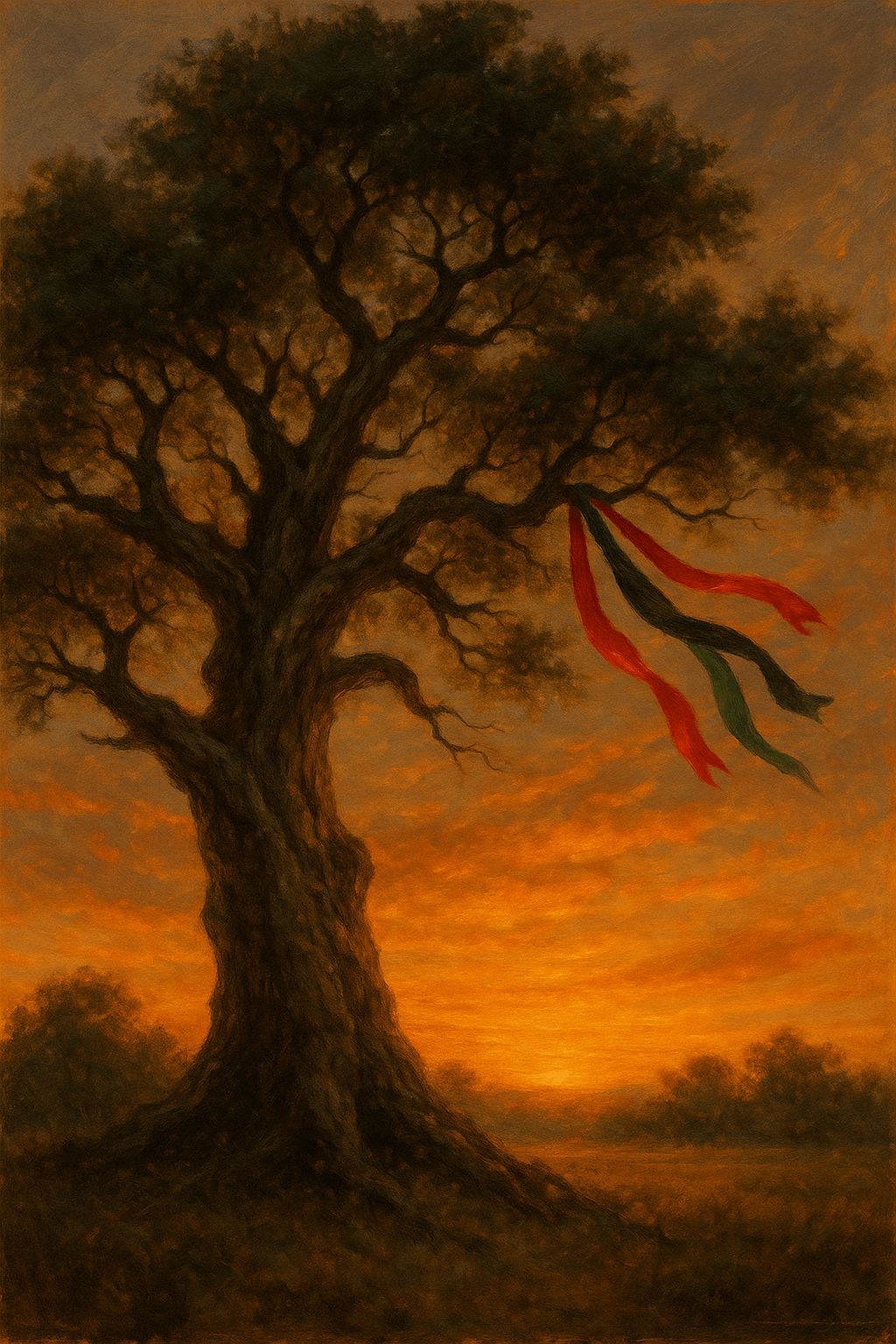
    in the circle of Family and friends , under the tree, where freedom still sings low and slow.

    By Kyle Hayes

    Please Like, Comment, and subscribe

  • Bread and Memory: A Loaf, A Legacy

    Bread and Memory: A Loaf, A Legacy

    By Kyle J. Hayes

    Some smells don’t just linger—they haunt. Not in the way a ghost knocks a glass off a table, but in the way they slip beneath your skin, settle deep in your chest, and curl around your ribs like something half-remembered.

    For me, it’s bread.

    The scent of dough rising—warm, yeasty, patient—takes me back to a church that no longer smells like bread and a family that no longer lives above it. The first name I knew it by was “True Faith.” Later, it became Penson Temple Church of God in Christ, named after my great-grandfather, George Penson. It sat sturdy in Chicago, a place where Sundays were long and the sermons longer, but there was always a rhythm to it. Scripture, music, prayer… and the rising of bread.

    Upstairs, above that sanctuary, lived my grandparents. And on certain Sundays, before the Holy Ghost stirred the congregation, something else stirred first. A batch of dinner rolls, tucked under a clean towel, warming in the silence. The smell would drift down into the pews, enveloping the base of the pulpit, blending with the scent of lemon polish and the aroma of old hymnals. And somehow, in that mingling, the church felt even more sacred.

    That recipe is gone now. Nobody wrote it down. Nobody learned it.

    We lose it to time, just as we lose so many things we assume will always be there. We didn’t think to ask, or we didn’t know it mattered. And now, when I bake bread, I am not trying to recreate it exactly. I know I never will. What I am doing is chasing a feeling. Trying to knead memory into flour, water, and salt. Trying to bring back the ghost of a moment I didn’t know I needed to preserve.

    In that pursuit, I’ve learned more than I expected. About precision. About patience. About what happens when you try to rush something sacred.

    And I found this recipe—a humble, sturdy loaf. Nothing fancy. Just good sandwich bread. The kind that makes you feel like the house is full, even when it’s not.

    My Favorite Sandwich Bread Recipe:

    • 350g (1.5 cups) warm water
    • 3g (1 tsp) instant yeast
    • 530g (4 1/4 cups) bread flour
    • 12g (1 tbsp) sugar
    • 20g (1 1/2 tbsp) olive oil
    • 125g (2/3 cup) ripe poolish or sourdough starter
    • 11g (2 tsp) salt

    To Make the Poolish (Preferment):

    • 65g (about 1/2 cup) bread flour
    • 65g (about 1/4 cup) water (room temperature)
    • A pinch of Active Dry yeast
    1. In a small bowl, combine the flour, water, and yeast.
    2. Stir until the ingredients are fully incorporated into a smooth, wet dough.
    3. Cover loosely with plastic wrap or a clean towel.
    4. Let sit at room temperature for 24 hours or until bubbly and fragrant.

    Once your poolish is ready, use 125g (about 2/3 cup) of it in the recipe above.

    Instructions for the Dough:

    1. Combine all ingredients in the bowl of a stand mixer with a dough hook. Mix on low for 3 minutes until just combined.
    2. Increase to high and mix for an additional 6 minutes until smooth and elastic. (To mix by hand, knead vigorously on a floured surface.)
    3. Place the dough into a bowl, cover it, and let it rise at room temperature for 2 hours.
    4. After 30 minutes, do a strength-building fold. Cover.
    5. After another 30 minutes (1 hour into rise), repeat the fold.
    6. Let rise for the remaining hour.

    Prepare a 13″x4″x4″ Pullman loaf pan by oiling it with olive oil or butter.

    1. Turn the dough out onto a floured surface and gently de-gas it with your fingertips.
    2. Shape into loaf and place seam-side down in Pullman pan.
    3. Cover and let the dough rise for 1 hour or until it has reached 3/4 of the height of the pan.
    4. If using the lid, slide it on before baking. If baking uncovered, lightly score the top of the cake.
    5. Bake at 425°F (218°C) for 40-45 minutes. Remove the lid after 35 minutes if the top is covered and brown.

    Cool completely before slicing.

    The bread will speak for itself. But it will also say more if you let it.

    It might remind you of a kitchen you haven’t stood in since you were eight. Of someone who made space for you in a world that didn’t. Of a church that held both gospel and gluten.

    I bake to remember. I bake to reclaim. I bake because the world is loud, but bread rises in silence.

    And sometimes, that silence smells like home.

    By Kyle J. Hayes

    Please like, comment, and subscribe