Tag: writing

  • “Questions for the Future”

    “Questions for the Future”

    There’s a kind of fear that doesn’t arrive all at once. It doesn’t kick down the door. It seeps in, like humidity through cracked paint or smoke through the seams of a closed window. The kind that makes a home in your chest, building slowly and silently. That’s the kind of fear I’ve had about writing.

    Because writing—real writing—isn’t just performance. It’s not what you show them. It’s what leaks out in the spaces you don’t control. In the metaphors you didn’t mean to use. The slip of a memory. The softness in a sentence when you swore you were being strong. That’s the terror. That somehow, on a blank page, people will see you—unasked, unfiltered, unprepared.

    And I’ve been dodging that kind of exposure for a long time.

      You grow up learning to hide parts of yourself. In some neighborhoods, vulnerability is just another way to get hit—emotionally, spiritually, or with something less metaphorical. So you learn. You get good at it. You make armor out of silence and humor out of pain. You laugh loud enough to drown out the parts of yourself you don’t want heard.

      For me, it started early—ridiculed for being soft. For caring. For feeling things too deeply. Every time I let something slip, there was a consequence. Sometimes it was teasing. Sometimes it was loneliness. Over time, the message became clear: protect yourself.

    So I did. I built walls with intention. Not just to keep people out, but to keep something in—me.

      Lately, though, I’ve started letting people in. Not the whole crowd. Just a few. Just enough. You find someone you trust—maybe a friend who knows the shape of your silence—and you let them see a little more. A crack. A draft of warmth. Not a storm.

    But still, I worry.

      Because once the dam is broken, who controls the flood?

    That’s the thing about pain: it’s obedient until it isn’t.

    So I let it out in trickles. A sentence here. A sigh there. I’ve convinced myself that’s safer. That if the moment goes sideways, I can slam the valve shut and pretend like I never said anything at all.

    I’m curious if that’s preservation or cowardice. Or both.

      Sometimes, the isolation feels like a weighted blanket that won’t get off my chest. You carry the weight of your untold stories like overdue bills, knowing the interest is accumulating. You pretend you’re just private. But privacy, in excess, becomes starvation.

    You tell yourself you’re protecting yourself—but at what cost?

    When no one knows your whole name, who will mourn you properly?

      That’s the mess of it. Writing—this act of storytelling—isn’t always about catharsis. Sometimes it’s confrontation. Sometimes it’s putting a mirror to your own face and realizing you’ve spent years looking away. The stories we don’t tell are often the ones we most need to understand.

    I write now not because I want to be known, but because I’m starting to believe that parts of me are worth knowing.

    And if someone out there reads this and recognizes their own mask, their own silence, their own slow-burning rage and resignation—maybe we’ve both done something that matters.

      I don’t have answers. Just questions for the future.

    What happens when you open too much?

    What happens when you never open at all?

    Maybe the trick isn’t to dam the flood or drown in it—maybe it’s to learn to wade.

    Even if it means revealing that you bleed just like everyone else.

    Kyle J. Hayes

    kylehayesblog.com

    Please like, comment, and share

    Resources for Hard Times

    If you’re looking for practical help, food support, or community resources, you can visit the Salt, Ink & Soul Resources Page.
    👉 Resources for Hard Times

  • The Quiet

    The Quiet

    Salt, Ink & Soul — Albuquerque Notes

    It’s not silence I’m afraid of.

    It’s what it asks me to notice.

    After the city winds down and the last porch light clicks off, a different gravity settles over Albuquerque. The air thins and sharpens. The clock doesn’t tick so much as announce—each second a footstep down an empty hall. Even the refrigerator hum sounds like a confession. Outside, the street goes soft: figures moving like ghosts, wind pushing fine dust into corners as if to whisper, look closer.

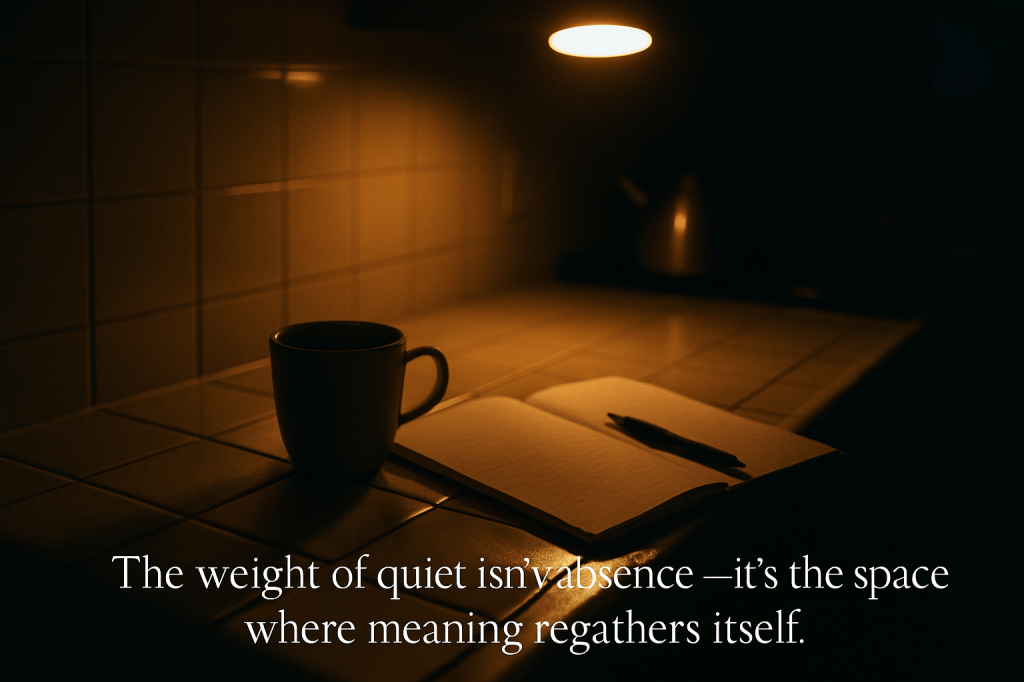
    In the kitchen at night, I stand there, unsure. Wanting to make something, not knowing if I’m even hungry. Under one dim bulb, a small pool of gold forms on the counter. Tile throws the light back in fragments—little squares of moon you can touch. The sink holds its breath. Somewhere above the cabinets, the house settles into itself, wood remembering the day it was a tree. The room is stocked—spices, onions, bones for broth—but hunger doesn’t arrive on command. The emptiness isn’t in the pantry. It lives somewhere between the throat and the hands.

    They say a writer’s greatest enemy is the blank page. They’re not wrong, but that’s not all. Emptiness has cousins: a cook’s dim kitchen when the body isn’t hungry; a road at midnight when the destination is gone and home hasn’t yet declared itself. The quiet asks for something you can’t measure—faith in a spark you cannot see.

    What does it mean to keep creating when the world around you—and inside you—goes still? What do you do when the excitements of special events are gone?

    There’s a restlessness inside the calm, like ducks on a pond—serene on the surface, paddling like hell beneath. After the community’s noise, the quiet feels heavier than the rest. It carries expectation without applause, work without witnesses. You can hold peace and pressure at once: the relief of not performing, the terror that maybe the next sentence, the next meal, won’t arrive.

    So I walk the rooms, listen to the house breathe, look out at adobe walls silvered by the moon, at porch lights fluttering like low-altitude stars. In this desert city, quiet isn’t absence—it’s landscape. Wind hums in the eaves. A lone car slips past, tires whispering secrets to the asphalt. Somewhere, behind a thin wall, soft laughter breaks and fades—the way a match surrenders after doing its job.

    If I cook, I begin with what listens back: onion, oil, salt, low flame. I don’t chase a masterpiece; I court a whisper. Heat slowly, until the room remembers its purpose. If I write, I let the hands move before the story arrives—detail by detail: the scrape of chair legs, the nick on the cutting board shaped like a small country, the clock insisting it is the only drummer left. I ask the night to tell me what it knows that daylight talks over.

    Quiet becomes a compass if you let it. It points not north but inward. It wants fewer clever sentences and more honest ones. It returns me to the first question: Who taught you to make something from almost nothing? Who fed you when there wasn’t much to eat? What did their hands look like under this same small bulb?

    I used to treat stillness like a problem to solve. I believed I should always be doing something—don’t waste time. Now I try to honor it as part of the work. The pause isn’t an intermission between lives; it’s the dark soil where the next season’s roots grow. It’s where endurance gathers; where healing grows legs.

    So I keep the rituals small and faithful. I leave a clean spoon on the counter. I set a glass of water by the notebook. I promise myself ten minutes of heat—words or stove, I don’t care which—then I let the ember decide. Some nights it becomes soup for nobody but me. Some nights it becomes a paragraph that holds after morning. The work is quiet, and it is enough.

    Outside, the Sandias keep their shape against deeper blue—mountain patience refusing to be hurried. Inside, the kitchen bulb halos the room like a blessing I didn’t think I’d earned. The page accepts a first line. The pan agrees with the first hiss. The world does not erupt in applause. It doesn’t need to.

    The fire worth trusting now is the low one—the barely visible ring that keeps the pot honest; the internal pilot light that refuses extinction. Creation isn’t the thunder of a finale; it’s the stubborn heat that stays when the audience goes home.

    The quiet isn’t asking me to fill it—only to listen long enough to remember why I speak.

    Kyle J. Hayes

    kylehayesblog.com

    Please like, comment, and share

  • “What We Remember, We Keep-Alive”

    “What We Remember, We Keep-Alive”

    I had been working on the newest book in my Culinary Crossroads series, where Jamaal was supposed to return home—to the States and the old South.

    I thought it would be simple.

    A return to where it all began.

    A pilgrimage from the polished kitchens of Manila to the front porches, fields, and kitchens that shaped so many of us long before we ever touched a passport.

    I thought I was writing about food.

    But the deeper I dug, the more I realized that it was never just food.

    It was survival.

    It was remembrance.

    It was resistance disguised as Sunday dinner.

    I read everything I could find.

    The recipes were there, sure.

    But what kept catching me, snagging me like thorns on an old fence line, were the traditions.

    Not just what we ate but how we ate.

    Why we seasoned the way we did.

    Why were our celebrations, mourning, and rituals around food and music crafted in ways no cookbook could fully explain?

    It started long before we were “we” in any way we would recognize now—

    on the plantations,

    where bits and pieces of fading memories were passed down by those brought here, enslaved, stolen, stripped, but not erased.

    They blended what they remembered with what little they had.

    Cornmeal. Greens. Off-cuts and castoffs.

    They made necessity taste like something more than survival.

    They made it taste like home.

    And over generations, through sheer will and stubborn brilliance, we built something uniquely ours.

    Not just in the food but in the music,

    the way we buried our dead,

    the way we married our loved ones,

    and the way we danced when the sun went down and the cotton fields emptied.

    These traditions aren’t static.

    They are not museum pieces under glass.

    They are living and breathing things—regional and even tribal, depending on where your people ended up.

    That phrase kept echoing in my mind:

    “Where your people from.”

    The old folks would ask you that when they met you.

    After you named whatever city you lived in now—Detroit, Chicago, Kansas City—they’d look deeper, waiting for the real answer.

    They were talking about the South.

    Not the city, but the state.

    The county.

    The plantation.

    The place that owned your ancestors.

    It was a question about roots.

    (Writing that even now feels like swallowing glass.)

    The place that owned your ancestors.

    So many years later, and it’s still hard to say.

    Still hard to look at without flinching.

    And then came the “Great Migration,” or as some called it, “The Great Exodus.”

    We left with almost nothing.

    No land. No wealth. No easy road.

    But we took what mattered.

    We carried our recipes.

    We carried our songs.

    We carried the parts of ourselves that they could not steal, whip out of us, or erase.

    And for decades, it sustained us.

    Soul Food. Soul Music.

    Names born not in marketing rooms but in living rooms, storefront churches, and kitchens where steam and sorrow rose together.

    And now?

    Now, the word “Soul” feels almost quaint.

    Almost forgotten.

    Funny, isn’t it?

    What slavery couldn’t kill, freedom quietly erased.

    In chasing new beginnings, we risk losing the old songs.

    The taste of real cornbread.

    The sound of a mother’s hum in the kitchen.

    The wisdom tucked into the folds of a handwritten recipe card.

    As I write Jamaal’s story, I realize I’m writing my own.

    Our own.

    The story of a people who carried more than pain.

    We carried genius.

    We carried grace.

    We carried soul.

    And it’s on us—not the history books, not the tourists looking for “authenticity”—to remember what we made from nothing.

    And to keep making it while we still can.

    Before the last song fades.

    Before the last plate is cleared.

    Before the last story goes untold.

    By Kyle Hayes

    Please Like, comment, and subscribe.

    #BlackVoices #MemoryAndLegacy #WeAreOurAncestorsDreams #StorytellingMatters

  • When Someone Shows You Who They Are: A Lesson from Maya Angelou

    When Someone Shows You Who They Are: A Lesson from Maya Angelou

    The older I get, the more I say it.

    “When someone shows you who they are, believe them the first time.”

    It is not just a quote. It is a warning, a wisdom, a truth that only deepens with time. And the woman who spoke it, Maya Angelou, was more than a poet, more than an icon—she was a force. A woman who understood the world not just as it was, but as it could be.

    Since it’s Women’s History Month, I could think of no one better to celebrate.

    Maya Angelou did not just write about life—she lived it. She survived it. She bore witness to its struggles, joys, and unbearable weight, and she did it all with a voice that refused to be silenced. She wrote with clarity that stripped the world down to its barest truth. And if you were listening—really listening—she was telling you exactly what you needed to hear.

    “When someone shows you who they are, believe them the first time.”

    How many times have we ignored that truth? How often have we made excuses for people, choosing to see them as we hope they are instead of who they have proven themselves to be? How much pain have we invited into our lives because we refused to accept what was right in front of us?

    But Maya Angelou knew.

    She knew that wisdom was not just in books but in lived experience. That some lessons had to be felt before they could be learned. She also knew that to survive in this world—to thrive in it—you had to recognize the truth in people, in systems, in history itself.

    She knew women, in particular, have been told to be patient, to give the benefit of the doubt, to soften themselves to make others more comfortable. But also that survival requires something stronger. It requires discernment. It requires the ability to see the truth and to act on it.

    Which is why we celebrate her.

    Not just for her words, but for the life behind them. For the way she carried herself, the way she refused to be broken, the way she taught an entire generation—generations after her—what it means to walk in your own truth, unapologetically.

    So this month, as we celebrate the women who have shaped history, let us also remember the wisdom they left behind. Let us remember Maya’s lesson. Let us see people for who they are—not for who we wish they were.