Category: Black History Month

  • Sweet Potato Buttermilk Pancakes with Bourbon Maple Syrup

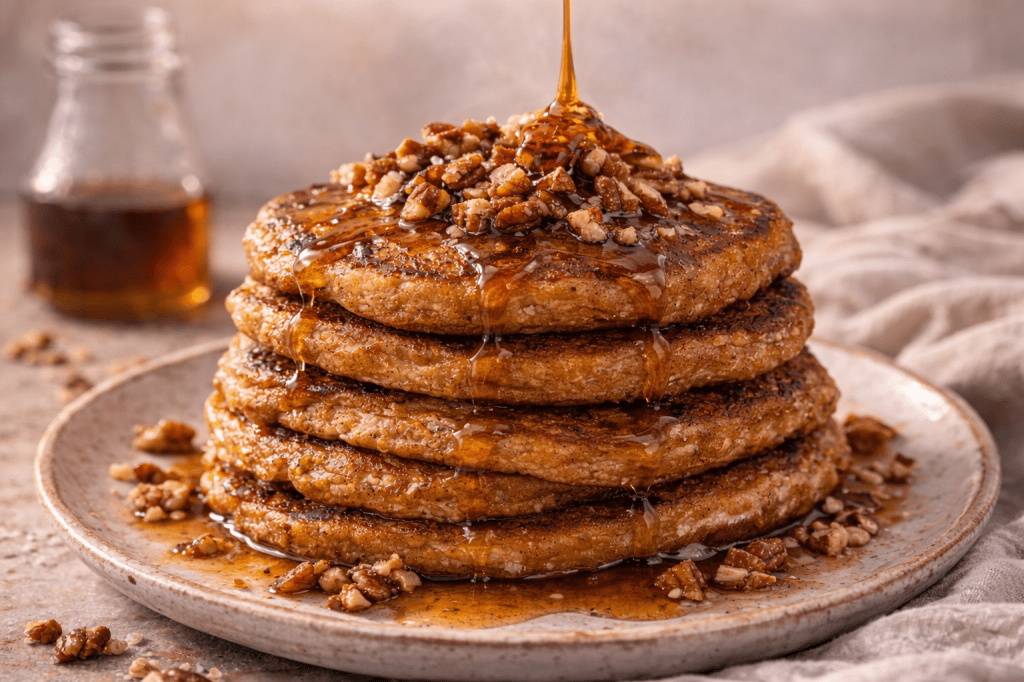
    Sweet Potato Buttermilk Pancakes with Bourbon Maple Syrup

    There’s a reason certain combinations survive long enough to become myth.

    Chicken and waffles did not rise because it was clever. It rose because it was honest.

    In Harlem, long after midnight, musicians stepped off stages with their shirts still damp and their bones still humming. They wanted fried chicken. They wanted waffles. They wanted both. At places like Wells Supper Club, someone understood that hunger does not neatly divide itself into categories. Dinner or breakfast. Savory or sweet. Survival or joy.

    So they were given both.

    That instinct β€” to refuse narrowing β€” runs deep in our kitchens.

    It lives in the sweet potato.

    A root carried across water it did not choose. Pressed into unfamiliar soil. It grew anyway. Fed families anyway. Quietly. Steadily. Without demanding recognition.

    Roast it long enough, and it deepens. The sugars darken. The flesh softens. What seemed simple reveals complexity.

    I love sweet potato pie.

    I love pancakes.

    And the older I get, the less patience I have for pretending I must choose one love over another.

    So, for the final recipe of Black History Month, I did what those musicians did, in my own way.

    I said yes to both.

    Sweet Potato Buttermilk Pancakes with Bourbon Maple Syrup.

    Not as a gimmick.

    As a continuation.

    The pancakes are tender but grounded. The sweet potato gives them weight without heaviness. The buttermilk brings tang. Cinnamon and nutmeg whisper rather than shout. The syrup carries a faint burn at the edge β€” just enough to remind you that sweetness has always required something.

    This is not performance food.

    It is an inherited food.

    Black history is often spoken loudly in February. Speeches. Panels. Timelines. Names we should never forget.

    But history also lives in smaller places.

    In cast iron, warming slowly.

    In flour dusted across a wooden counter.

    In a root mashed by hand.

    Sometimes remembrance is not a declaration.

    Sometimes it is breakfast.

    Made with both hands.

    Served warm.

    Eaten without apology.

    πŸ₯ž Sweet Potato Buttermilk Pancakes with Bourbon Maple Syrup

    Ingredients

    Pancakes

    • 1 cup mashed roasted sweet potato (cooled)
    • 1 ΒΌ cups all-purpose flour
    • 1 tablespoon brown sugar
    • 1 teaspoon baking powder
    • Β½ teaspoon baking soda
    • Β½ teaspoon salt
    • Β½ teaspoon cinnamon
    • ΒΌ teaspoon nutmeg
    • 1 cup buttermilk
    • 1 large egg
    • 2 tablespoons melted butter
    • Β½ teaspoon vanilla extract

    Bourbon Maple Syrup

    • Β½ cup pure maple syrup
    • 1 tablespoon unsalted butter
    • 1–2 teaspoons bourbon (optional)
    • Pinch of sea salt

    Method

    1. Roast the Sweet Potato

    Roast at 400Β°F until fork-tender and caramelized at the edges. Mash until smooth. Let cool fully before mixing.

    Depth matters.

    2. Combine the Dry Ingredients

    Whisk flour, brown sugar, baking powder, baking soda, salt, cinnamon, and nutmeg in a bowl.

    Keep it simple.

    3. Combine the Wet Ingredients

    In another bowl, mix sweet potato, buttermilk, egg, melted butter, and vanilla.

    Stir gently. No rushing.

    4. Bring Them Together

    Fold wet into dry. Do not overmix. Small lumps are welcome.

    Tenderness lives there.

    5. Cook

    Heat a lightly buttered skillet over medium heat.

    Pour ΒΌ cup batter per pancake.

    Cook until bubbles rise and edges set. Flip once. Finish until golden brown.

    Low heat rewards patience.

    6. Make the Syrup

    Warm the maple syrup and butter in a small saucepan. Remove from heat. Stir in bourbon and sea salt.

    The scent should rise before the steam fades.

    Serve With

    Toasted pecans.

    Soft butter.

    Strong coffee.

    Unhurried conversation.

    Kyle J. Hayes

    kylehayesblog.com

    Please like, comment, and share

    Resources for Hard Times

    If you’re looking for practical help, food support, or community resources, you can visit the Salt, Ink & Soul Resources Page.
    πŸ‘‰Β Resources for Hard Times

  • The Neighborhood Mom

    The Neighborhood Mom

    For T.S. β€” my sister, and the Neighborhood Mom to so many.

    Every neighborhood had her.

    Not appointed.

    Not elected.

    Not funded.

    But known.

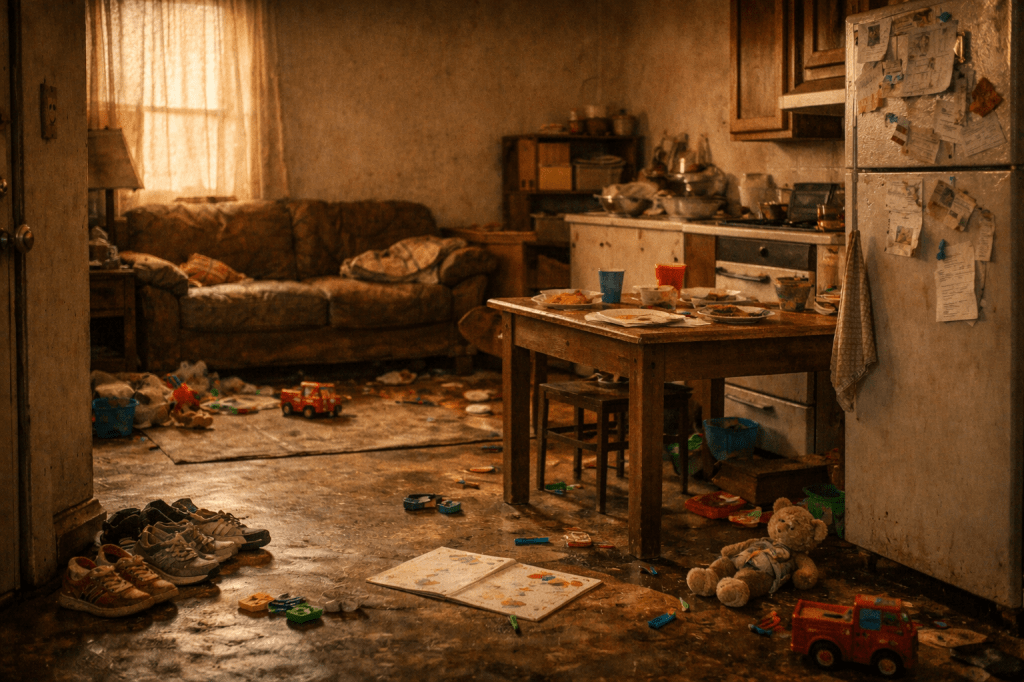
    She didn’t live in the biggest house. Most of the time, it was the opposite. Paint tired. Couch worn thin. The kitchen light was buzzing like it had something to say. The kind of home that didn’t look like much from the sidewalk β€” but felt like oxygen once you stepped inside.

    We didn’t call her a social worker.

    We didn’t call her a guardian.

    We didn’t call her a saint.

    We just knew: if things got bad, you could go there.

    I remember walking into a house like that once and being startled β€” not by silence, but by the opposite. Children everywhere. Some on the floor. Some on couches. Some are half-asleep with homework still open. Shoes by the door that didn’t all belong to the same family. A pot on the stove that seemed to stretch itself every night to feed one more mouth than it should have been able to handle.

    It looked chaotic if you didn’t understand it.

    But if you stayed long enough, you saw the pattern.

    You saw the safety.

    She wasn’t rich. Sometimes she was barely holding her own household together. Bills late. Refrigerator thinner than she would admit. You could tell by the way she portioned things that she knew how to stretch. How to make a little feel like enough. How to season scarcity until it didn’t taste like embarrassment.

    How she fed so many on so little is still a mystery to me.

    But she did.

    Plates appeared. Clean shirts appeared. Towels were shared. Soap was rationed but never withheld. And at night β€” no matter how crowded it was β€” there was always a space cleared for someone who didn’t have one.

    Some of those children came because home was loud in the wrong way.

    Some came because home was silent in the wrong way.

    Some came because there was no home at all.

    She didn’t interrogate the reason.

    She made space.

    In neighborhoods where systems were underfunded and futures were over-policed, women like her were infrastructure. They were the unofficial institutions. The gap-fillers. The quiet counterweights to chaos.

    You could write a thousand policy papers about community stabilization and still miss the fact that sometimes it was one woman’s kitchen table doing the heavy lifting.

    She didn’t have a nonprofit.

    She had a heart that wouldn’t let her turn children away.

    And that kind of heart is not soft.

    It is disciplined.

    Because compassion without discipline collapses under pressure. But she kept showing up. Every day. Every week. Every time a new pair of eyes looked at her from the doorway with that question in them:

    Can I stay?

    And she almost always said yes.

    What we didn’t understand as children was the cost.

    We didn’t see the arithmetic she was doing in her head.

    We didn’t hear the sighs she swallowed.

    We didn’t know how tired she was.

    We only saw the outcome:

    We were clean.

    We were fed.

    We were safe.

    And in neighborhoods where safety was not guaranteed, that was no small thing.

    It’s easy to celebrate the visible heroes β€” the ones with microphones, the ones whose names are etched in textbooks. But communities are often held together by people whose names never leave the block.

    The neighborhood mom.

    She was not perfect. She had her rules. Her voice could rise when it needed to. She knew who was lying before the lie finished forming. She demanded respect not because she craved control, but because order was the only way love could function in a crowded house.

    That house was not just a shelter.

    It was a rehearsal.

    It taught children what stability felt like, even if only for a season. It modeled what adulthood could look like when responsibility wasn’t optional. It showed that care is not about abundance. It’s about commitment.

    I think about her sometimes when conversations turn to “community breakdown” or “youth crisis.” People talk about statistics. Funding gaps. Cultural decline.

    And you can measure many things.

    But you can’t easily measure the woman who refuses to let children sleep outside.

    You can’t quantify the moral gravity of a person who says, “You can stay here,” when she barely has enough for herself.

    That is not charity.

    That is architecture.

    She built invisible scaffolding around young lives until they were strong enough to stand on their own.

    And maybe the most powerful part is this:

    She did not do it for applause.

    She did not do it for legacy.

    She did it because her heart would not let her do otherwise.

    There are people whose goodness is not strategic.

    It is instinctive.

    The neighborhood mom was one of them.

    As adults, we sometimes look back and realize something uncomfortable:

    We survived partly because of someone else’s quiet sacrifice.

    Because somewhere along the way, a woman with too little decided to stretch herself further.

    And now the question isn’t just about honoring her.

    It’s about becoming her in whatever way we can.

    Not necessarily by opening our homes to a dozen children β€” though some still do.

    But by asking:

    Where is the open space in my life?

    What safety do I need to provide?

    How can I make “a little” feel like enough for someone else?

    In a world obsessed with visibility, the neighborhood mom practiced invisible greatness.

    She did not trend.

    She endured.

    Kyle J. Hayes

    kylehayesblog.com

    Please like, comment, and share

    Resources for Hard Times

    If you’re looking for practical help, food support, or community resources, you can visit the Salt, Ink & Soul Resources Page.

    πŸ‘‰Β Resources for Hard Times