Category: Black Life & Culture

  • The Villain Who Made Me Think

    The Villain Who Made Me Think

    Have you ever liked a villain more than the hero? Who and why?

    View all responses

    Have you ever liked a villain more than the hero?

    I have.

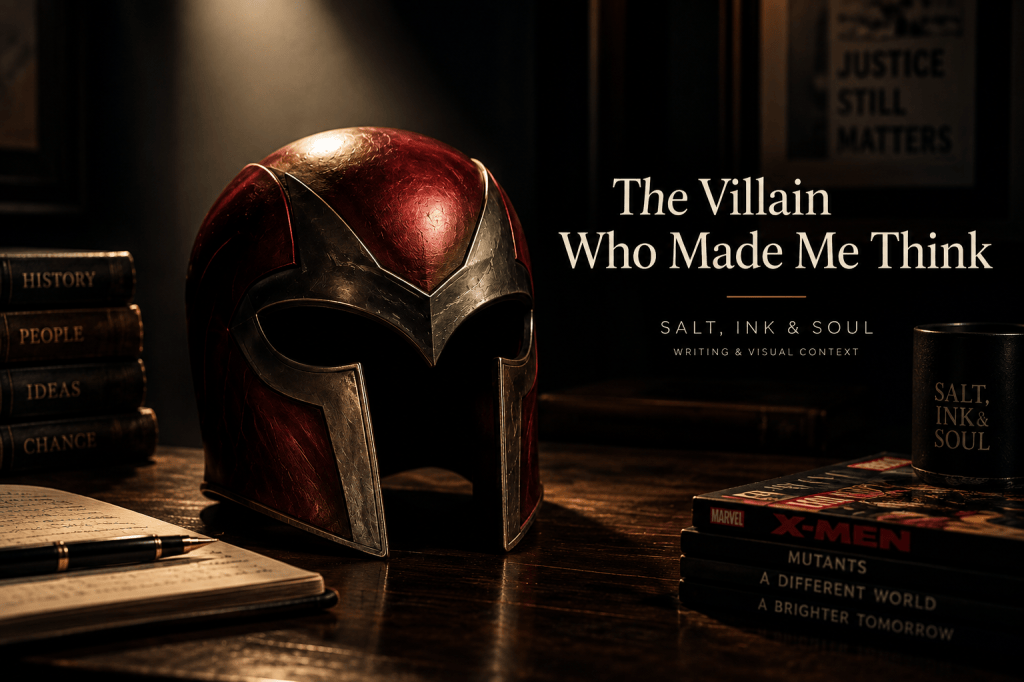
    Magneto.

    And I liked him before I ever really knew him.

    I was a boy when I saw Stan Lee being interviewed on television. I couldn’t tell you the program now. I couldn’t repeat the interview. Memory rarely keeps things that neatly.

    But I remember what stopped me.

    He was talking about the X-Men.

    Professor X, he explained, could be seen as closer to Dr. Martin Luther King Jr.

    Magneto was closer to Malcolm X.

    That was it.

    I needed to know more.

    Until then, comic books had mostly been what comic books are supposed to be when you’re a kid.

    Heroes.

    Villains.

    Costumes.

    Powers.

    Good guys trying to stop bad guys from doing bad things.

    But suddenly someone was telling me there were ideas underneath those costumes.

    History underneath those battles.

    That a fight between two men with extraordinary powers could really be an argument about how people survive in a world that fears them.

    That interview made me an X-Men fan.

    More importantly, it helped make me a serious comic-book reader.

    And when I began reading Magneto, I found something much more complicated than the villain I expected.

    He frightened people.

    He threatened people.

    Sometimes he did terrible things while convincing himself they were necessary.

    I understood that.

    But I also understood something else.

    Magneto believed his people were in danger.

    And he had decided they would never be helpless again.

    That mattered to me.

    Because underneath the helmet, the powers, and all that anger was memory.

    Magneto remembered what happened when people decided another group was different.

    He remembered what happened when different became dangerous.

    And he knew what could happen when dangerous became something people believed needed to be eliminated.

    So when Professor X looked at humanity and saw the possibility of coexistence, Magneto looked at the same humanity and saw evidence.

    That doesn’t make Magneto right.

    I think that distinction matters.

    Understanding someone’s anger isn’t the same as approving of what they do with it.

    Magneto could become the very thing he claimed to be fighting. Protection could become domination. Fear could become hatred. The determination to keep his people safe could become permission to hurt someone else’s.

    But even then, I could never dismiss him.

    Because I understood the question underneath his anger.

    What if they come for us again?

    Professor X believed humanity could become better.

    Magneto wasn’t willing to bet his people’s survival on it.

    One offered hope.

    The other carried memory.

    I know people have discussed the Professor X and Dr. King, Magneto and Malcolm X comparisons for years. I also know those comparisons can become too simple. Dr. King was more complicated than the peaceful dreamer we sometimes reduce him to, and Malcolm X was far more complicated than the angry counterweight history sometimes makes him out to be.

    Real men don’t fit neatly inside comic-book metaphors.

    But as a boy, I didn’t know all of that yet.

    I only knew someone had opened a door.

    Comic books could be about more than heroes defeating villains.

    They could ask questions.

    About prejudice.

    About power.

    About identity.

    About what people owe one another.

    About whether peace requires trust, and what happens when history has given you very little reason to trust.

    I started reading differently after that.

    Maybe I started looking at villains differently, too.

    Because the most interesting villains aren’t necessarily the ones who make us wonder how someone could become so evil.

    Sometimes they are the ones who make us uncomfortable because somewhere beneath everything they have become, there is something we recognize.

    A wound.

    A memory.

    A fear.

    Maybe even a truth.

    Magneto never made me want the villain to win.

    He did something more important.

    He made me understand why the villain believed he should.

    Kyle J. Hayes

    kylehayesblog.com

    Please like, comment, and share

    Resources for Hard Times

    If you’re looking for practical help, food support, or community resources, you can visit the Salt, Ink & Soul Resources Page.
    πŸ‘‰Β Resources for Hard Times

  • The Foot and the Flower

    The Foot and the Flower

    This is a longer reflection than I usually share. I allowed it the space it needed because some wounds cannot be understood in a few sentences.

    For weeks now, I have been thinking about a flower.

    Not a particular kind. No rose or sunflower. 

    Just an ordinary flower trying to grow.

    Every morning, someone steps on it.

    Not hard enough to kill it. Just enough pressure to bend the stem. To bruise what has begun to open. To make the flower spend its strength recovering instead of growing.

    Then, after enough days have passed, the same person looks down and asks why it did not bloom properly.

    Why are you so small?

    Why do you lean that way?

    Why are your petals damaged?

    Why can’t you grow like the others?

    I have not been able to let that image go.

    Perhaps because I know what it feels like to be the flower.

    As a Black man, I have watched criticism presented as a form of love for most of my life. I have seen people embarrassed in front of others and told it was for their own good. I have heard jokes sharpened into weapons, then dismissed with the familiar accusation that the person wounded was too sensitive.

    We call it keeping someone humble.

    Keeping their head from getting too big.

    Making sure they don’t start thinking they are better than everyone else.

    Preparing them for the world.

    There is always a reason given for the foot.

    We are told that the world will not be gentle with us, so there is no point in being gentle with one another. We tell ourselves that ridicule builds a thick skin. That public embarrassment creates discipline. That if we cut someone down before the world gets the chance, perhaps they will be less surprised when it happens outside the safety of home.

    But I have begun to wonder what kind of safety requires us to imitate the danger.

    What kind of love practices the cruelty it claims to be preparing us to survive?

    The world has rarely needed our help hurting Black people.

    It has been remarkably capable on its own.

    I understand the value of correction. None of us should move through life surrounded by people too afraid to tell us when we are wrong. We need honesty. We need accountability. We need someone willing to say that we have fallen short, that our choices caused harm, or that the work we offered was not yet our best.

    But honesty does not require humiliation.

    Correction does not need an audience.

    Love does not have to leave a person smaller than it found them.

    Somewhere along the way, we began confusing humility with humiliation.

    Humility teaches us that we are not above anyone.

    Humiliation teaches us that we are beneath everyone.

    One keeps the ego from becoming a throne.

    The other convinces the spirit it does not deserve a chair.

    They are not the same.

    I have heard stories that some of this behavior may have roots in slavery. Stories of Black people hiding the intelligence, strength, skill, or beauty of someone they loved because being noticed by those who controlled their lives could be dangerous. An exceptional ability might attract attention. Attention could lead to exploitation, separation, or sale.

    I cannot say exactly how often it happened in that way.

    But I understand the fear beneath the story.

    There were times when being seen was dangerous for us.

    There were times when a person’s ability did not belong to them but became another thing someone else could profit from.

    Perhaps, under those conditions, love sometimes learned to hide itself.

    Perhaps protection sometimes sounded like criticism.

    Perhaps people made their children appear smaller because the world had made Black excellence unsafe.

    Survival can require strange disguises.

    But survival habits do not always disappear when the original danger changes.

    Sometimes they remain long after the people who first needed them are gone.

    A shield carried for generations can become too heavy to lift.

    A behavior created to protect the flower can eventually become the foot that keeps stepping on it.

    That is the question troubling me now.

    What are we protecting one another from today when we mock someone for being intelligent?

    What good are we creating when we ridicule a person for speaking differently, dressing differently, dreaming differently, or wanting more than the people around them were taught to expect?

    We excuse much of this by saying it is part of the culture.

    But culture is not an excuse.

    Culture is an inheritance.

    And like every inheritance, it must be examined.

    Much of what we carry is beautiful.

    But we have also carried wounds.

    Some have been passed down so carefully that we began mistaking them for traditions.

    Loving our culture does not require defending everything within it.

    Sometimes love means looking at what we inherited and asking whether it still serves us.

    Sometimes love means admitting that something once born from survival has become another source of pain.

    Not everything that survived deserves to lead us.

    I think of how often Black children are taught not to think too highly of themselves.

    There is wisdom in teaching a child that they are no better than anyone else.

    But there is danger in teaching them they are nothing special.

    The world will offer that lesson often enough.

    A child should not have to receive it first from home.

    How many young people have hidden their intelligence because achievement separated them from the group?

    How many have learned to pronounce words incorrectly so no one would accuse them of trying to sound white?

    How many sensitive boys learned to harden themselves because tenderness attracted ridicule?

    How many girls learned to dim their confidence so others would not call it arrogance?

    We tell ourselves we are keeping people grounded.

    Sometimes we are burying them.

    A particular expectation is placed on Black men.

    We are supposed to take it.

    The joke.

    The insult.

    The criticism.

    The public embarrassment.

    We are expected to remain still while someone cuts into us and then laugh to prove the blade was not sharp.

    If we admit that something hurt, we are called weak.

    If we object, we are told we cannot take a joke.

    So we learn to laugh.

    Sometimes we laugh before everyone else does.

    We make ourselves the joke so no one can accuse us of being unable to take one.

    We wound ourselves publicly and call it confidence.

    But laughter is not always evidence that something was harmless.

    Sometimes laughter is the sound a person makes while trying not to bleed in front of everyone.

    I have wondered how much of myself this shaped.

    How many times did I make myself smaller before entering a room?

    How often did I question my own thoughts because someone had taught me that confidence invited punishment?

    How often did I speak less clearly than I could have, not because I lacked the words, but because I did not want anyone to think I believed I belonged among those who used them?

    After being stepped on long enough, the foot no longer has to be present.

    You begin doing the work yourself.

    You criticize the idea before sharing it.

    You diminish the accomplishment before anyone can accuse you of pride.

    You reject the opportunity before someone else can tell you that you are not ready.

    You hide enthusiasm because joy makes you visible.

    You keep your expectations low and call it realism.

    That may be the cruelest part.

    The person who once harmed you can leave, but the voice remains.

    Then one day, you look at the life you have built and wonder why so much of it was shaped by fear of becoming visible.

    I do not believe the answer is empty praise.

    Flowers do not grow because we stand over them and tell them they are perfect.

    They need light, water, room, and care.

    Sometimes they need pruning.

    Care is not the absence of correction.

    Care is correction offered in service of growth.

    There is a difference between telling someone the truth and making them ashamed of being alive.

    There is a difference between preparing someone for difficulty and becoming one more source of it.

    There is a difference between helping someone grow and demanding that they prove they can survive being crushed.

    I wonder what would happen if we learned that difference.

    What might our communities look like if encouragement did not make us suspicious?

    What if we could watch someone rise without needing to remind them of every place they once fell?

    What if we understood that celebrating another person’s light does not dim our own?

    Perhaps more of us would reach adulthood without needing to rebuild the parts of ourselves that were dismantled at home.

    Perhaps excellence would feel less lonely.

    Perhaps a gifted child would not have to choose between belonging and becoming.

    Perhaps the young person who seems strange would be allowed enough time to discover that strangeness is a gift before the world has found a name for it.

    We often praise the person who grows through hardship.

    We admire the flower breaking through concrete.

    We photograph it.

    We turn it into a symbol of resilience.

    But we rarely ask why the flower had to fight concrete in the first place.

    Strength born from suffering is still strength.

    But suffering should not receive credit for everything a person became despite it.

    Pain may teach us.

    That does not mean pain was the only possible teacher.

    The flower that survived beneath the foot might have grown taller without it.

    It might have bloomed earlier.

    It might have spent less of its life healing from injuries others insisted were lessons.

    We may never know.

    That uncertainty carries its own sorrow.

    I cannot change every moment when I was cut down.

    I cannot recover every piece of myself I learned to hide.

    But I can decide what kind of person I will be when I stand near someone else who is beginning to grow.

    I do not want to be the foot.

    I do not want to wound them and then congratulate myself for making them stronger.

    I want to learn how to tell the truth with care.

    I want to recognize potential before it becomes achievement.

    I want to encourage people while they are still uncertain, not only after the world has permitted me to believe in them.

    I want to say:

    I see something in you.

    Keep going.

    You do not have to shrink to make me comfortable.

    Your gift does not threaten mine.

    That is how a culture changes.

    Not all at once.

    Not through speeches or declarations.

    Perhaps it begins with small acts of refusal.

    Refusing to laugh when the joke is meant to reduce someone.

    Refusing to mistake cruelty for honesty.

    Refusing to pass down a wound merely because it was handed to us.

    Perhaps it begins when we stop asking how much pressure a person can endure and start asking what they might become with the right care.

    A flower does not need to be stepped on to learn how to grow.

    It already knows to reach for the light.

    Our responsibility is not to test how much damage it can survive.

    It is to stop blocking the sun.

    Kyle J. Hayes

    kylehayesblog.com

    Please like, comment, and share

    Resources for Hard Times

    If you’re looking for practical help, food support, or community resources, you can visit the Salt, Ink & Soul Resources Page.

    πŸ‘‰ Resources for Hard Times

  • When Did We Stop Believing Each Other?

    When Did We Stop Believing Each Other?

    I don’t know exactly when we stopped believing each other.

    Maybe there wasn’t a moment.

    There rarely is.

    Things like trust don’t usually disappear all at once.

    They leave a little at a time.

    A promise not kept.

    A story that turned out not to be true.

    An institution that told us one thing while doing another.

    A person we trusted who taught us, painfully, that perhaps we shouldn’t have.

    Eventually, enough little fractures become a break.

    And lately, I have been wondering whether we are living inside that break.

    We don’t just disagree anymore.

    We suspect.

    We question motives before we consider words.

    Someone tells us something happened, and before we ask whether they are all right, somebody asks for proof.

    A photograph can be manipulated.

    A voice can be cloned.

    A video can be manufactured.

    A headline may have been written less to inform us than to make us angry enough to click it.

    Even our own eyes have become unreliable witnesses.

    So we approach one another with our hands already raised.

    Not necessarily to fight.

    Sometimes just to protect ourselves.

    I understand that instinct.

    Especially because some of us come from people who learned that trust could be dangerous.

    We Learned to Be Careful

    For Foundational Black Americans, distrust of institutions did not begin with social media.

    There is history behind our suspicion.

    Reconstruction came with promises that were abandoned.

    Black communities were redlined while being told opportunity was available to anyone willing to work for it.

    Black men with syphilis in Tuskegee were deceived by people they had every reason to believe were there to help them.

    The War on Drugs devastated communities while being presented as Protection.

    We learned something from all of that.

    Sometimes the people telling you to trust the system are protected from what happens when the system fails you.

    That lesson did not disappear simply because the calendar changed.

    It traveled.

    Grandparents taught parents.

    Parents taught children.

    Sometimes deliberately.

    Sometimes through nothing more than the way somebody’s voice changed when they said:

    Be careful.

    There was wisdom in that.

    There still is.

    But I have begun wondering about something else.

    What happens when Protection Becomes a Wall

    Distrust can protect you.

    It can also imprison you.

    That is the part we don’t talk about enough.

    If you have been betrayed, caution makes sense.

    If history has shown you that an institution is capable of harming people like you, skepticism isn’t paranoia.

    It can be memory doing its job.

    But there is a difference between asking someone to earn your trust and deciding nobody ever can.

    There is a difference between skepticism and allowing suspicion to become the lens through which you see the entire world.

    Because once you believe everyone is trying to fool you, eventually nobody can tell you anything.

    Not a journalist.

    Not a doctor.

    Not a teacher.

    Not a neighbor.

    Not your own family.

    Everybody has an angle.

    Everybody wants something.

    Everybody is lying.

    And the strange thing about living that way is that after a while it can begin to feel like wisdom.

    You can’t fool me.

    Perhaps not.

    But nobody can reach you either.

    A World Where Everything Can Be Fake

    Technology has made this more complicated.

    We carry machines in our pockets that can connect us to almost anyone on earth.

    And somehow many of us have never been more suspicious of the person on the other side of the screen.

    We scroll through arguments between strangers.

    We watch fifteen seconds of someone’s worst moment and decide we understand their character.

    We read a headline and decide we understand the story.

    We encounter information that confirms what we already believe and call it truth.

    Information that challenges us becomes propaganda.

    And now artificial intelligence has introduced something even more unsettling.

    We are entering a world where seeing may no longer be believing.

    A photograph can show something that never happened.

    A voice can say words its owner never spoke.

    A video can place someone somewhere they have never been.

    For most of our lives, proof meant something.

    We could argue about what something meant, but at least we could point to the photograph.

    Listen to the recording.

    Watch the video.

    Now even evidence can require evidence.

    We don’t yet fully understand what that will do to us.

    Because trust requires some shared agreement about reality.

    And when everything can potentially be fake, suspicion becomes almost reasonable.

    Almost.

    Somewhere behind all of this is another uncomfortable reality.

    Someone is making money.

    Anger keeps us watching.

    Fear keeps us scrolling.

    Suspicion keeps us engaged.

    A society constantly asking, Can you believe what they did? is very profitable.

    Trust is quieter.

    Trust doesn’t refresh every thirty seconds.

    Trust doesn’t generate nearly as much outrage.

    Trust is usually two people doing something remarkably uninteresting.

    Keeping their word.

    Showing up when they said they would.

    Telling the truth when lying would have been easier.

    Listening.

    Apologizing.

    Trying again.

    There isn’t much viral content in that.

    But there might be a civilization.

    When We Needed One Another

    I think about neighborhoods sometimes.

    Not because the past was perfect.

    It wasn’t.

    People lied then.

    People cheated.

    People stole.

    People disappointed one another.

    Human beings did not suddenly become flawed when Wi-Fi arrived.

    But needing one another required a certain amount of trust.

    Somebody watched the children.

    Somebody had a spare key.

    Somebody borrowed a cup of sugar.

    Somebody knew whose child belonged to whom.

    Someone noticed when the elderly woman down the street hadn’t opened her curtains that morning.

    You couldn’t build a community without taking some risk on other people.

    Maybe that is what trust has always been.

    Risk.

    We talk about trust as though it means certainty.

    It doesn’t.

    If I knew with absolute certainty that you would never hurt me, I wouldn’t need to trust you.

    Trust exists precisely because I don’t know.

    I am handing you something you could break.

    A confidence.

    A promise.

    My vulnerability.

    Sometimes my heart.

    And believing you will handle it carefully.

    That is terrifying when you’ve already had things broken.

    So I understand why people retreat.

    I understand the small circles.

    I understand the locked doors.

    I understand saying, I’m good by myself.

    There have been times in my own life when folding inward felt safer than reaching outward.

    But safety and living are not always the same thing.

    The Price We Pay

    There is a price for never trusting anyone.

    Eventually we stop showing up.

    Why help the neighbor if you think he’s taking advantage of you?

    Why believe someone’s pain if you assume everybody is exaggerating?

    Why join anything if you think everyone involved has an agenda?

    Why build community if community itself feels dangerous?

    Little by little, we become me.

    And perhaps that is one of the greatest costs of this age.

    Not simply that we don’t believe our institutions.

    But that we are slowly forgetting how to believe one another.

    I don’t think the answer is blind trust.

    Some people should not be trusted.

    Some institutions have earned scrutiny.

    Some doors should remain locked.

    But I don’t want betrayal to have the final say in what kind of person I become.

    I don’t want the people who proved themselves untrustworthy to teach me that nobody is worthy of trust.

    That gives them too much.

    The Quiet Work of Trust

    Maybe rebuilding trust begins much smaller than we imagine.

    Not with another platform promising to bring us together.

    Maybe it begins with keeping the promise you made yesterday.

    Calling when you said you would.

    Admitting when you don’t know something.

    Returning what you borrowed.

    Listening to somebody’s story before deciding whether you believe it.

    Being trustworthy yourself.

    People in my life have helped me through quiet battles without ever knowing they were doing it.

    They showed up.

    Again.

    And again.

    And again.

    Nothing dramatic.

    No speeches.

    Just consistency.

    Perhaps that is how trust returns.

    Not through declarations.

    Through repetition.

    One kept promise placed beside another until eventually somebody believes it is safe to put a little weight there.

    Then a little more.

    Until one day you realize something has been built between you.

    Something invisible.

    Something fragile.

    Something extraordinarily valuable.

    Trust.

    I don’t know whether we can restore trust in all the institutions that have lost it.

    Some of them have considerable work to do before they deserve it.

    We can decide what happens between us.

    We can remain cautious without becoming cold.

    We can remember history without letting it convince us that betrayal is inevitable.

    We can ask questions without assuming every answer is a lie.

    We can make people earn our trust without making the price impossible to pay.

    And perhaps most importantly, we can become people whose word still means something.

    Because the world may give us plenty of reasons to doubt one another.

    I don’t want to give it another.

    Maybe that is where rebuilding begins.

    Not by demanding that somebody trust me.

    By living in such a way that, eventually, they can.

    Kyle J. Hayes

    kylehayesblog.com

    Please like, comment, and share

    Resources for Hard Times

    If you’re looking for practical help, food support, or community resources, you can visit the Salt, Ink & Soul Resources Page.

    πŸ‘‰Β Resources for Hard Times

  • The Hat, the Swimmer, and the Chair

    The Hat, the Swimmer, and the Chair

    How an afternoon in Montgomery became Black American folklore.

    On August 5, 2023, a confrontation on the Montgomery, Alabama riverfront became something larger in Black American memory. Three years later, I find myself wondering how we might tell the story when today’s children have grandchildren of their own.

    I sometimes wonder if, years from now, little Black children will sit at the feet of their grandfather and ask him to tell the story again.

    Not one of the heavy stories.

    Not tonight.

    They will know those already.

    They will have heard about marches and bridges. About dogs and hoses. About people who walked into places where they were not wanted and sat down anyway. They will know there were times when being Black in America required a particular kind of courage just to make it home.

    But tonight they want the funny one.

    “Grandpa,” one of them will say, already smiling, “tell us about the Hat, the Swimmer, and the Chair.”

    And Grandpa will lean back.

    He will pretend he doesn’t know which story they mean.

    “The what?”

    “The Chair!”

    “Ohhh,” he’ll say.

    That story.

    He will tell them that the story has many names.

    Some called it the Montgomery Riverfront Brawl.

    Some called it the Alabama Boat Brawl.

    Some called it the Alabama Sweet Tea Party.

    Some called it Chairteenth.

    But Grandpa?

    Grandpa always preferred Fade in the Water.

    And the children will laugh before the story has even begun.

    Grandpa will tell them it happened a long time ago, on August 5, 2023, down in Montgomery, Alabama.

    And because the children know their history, they will understand that Montgomery is not just another American city.

    History has walked those streets before.

    Rosa Parks walked them.

    Dr. King walked them.

    Black people whose names never made it into textbooks walked them.

    And running beside the city is the Alabama River.

    That afternoon, a riverboat called the Harriott II was trying to return to its usual docking place.

    But another boat was sitting where it wasn’t supposed to be.

    The crew asked the people responsible for it to move.

    They wouldn’t.

    They asked again.

    Still nothing.

    Grandpa will pause here, because every good storyteller knows you cannot rush trouble.

    Eventually, a Black riverboat co-captain went ashore to deal with the situation.

    There were words.

    Then came a blow.

    And suddenly several people were upon him.

    Now, children, Grandpa will say, this is where the story begins to become something else.

    Because somewhere in those first moments, the man’s hat came off.

    And eventually that hat went into the air.

    There are moments in history whose meaning nobody gets to choose beforehand.

    A bell rings.

    A door opens.

    A hand goes up.

    A hat flies through the Alabama sky.

    Nobody held a meeting.

    Nobody formed a committee.

    Nobody sent out an agenda.

    But Black folks saw what was happening.

    And they started coming.

    Brothers answered.

    People ran toward the dock.

    And then came The Swimmer.

    A young man aboard the riverboat looked across the Water and saw what was happening.

    Apparently, this young brother decided that stairs, sidewalks, docks, and all other conventional methods of transportation were taking entirely too long.

    So he jumped.

    Fully dressed.

    Into the Alabama River.

    Grandpa will insist upon this detail.

    Fully.

    Dressed.

    Because some things deserve historical accuracy.

    Into the river he went, swimming toward the dock.

    Years later, the children will know him only by the name the people gave him:

    Aquamayne.

    Maybe Grandpa will tell them some of the other names too.

    Black Aquaman.

    Michael B. Phelps.

    Whatever name makes the children laugh hardest.

    Because that was part of what happened afterward.

    Black people saw something frightening, something that could have become another painful story, and somehow we also found room for laughter.

    Then more people arrived.

    The balance shifted.

    The man who had been alone was no longer alone.

    And just when future historians might have thought the symbolism was complete, somebody picked up a folding chair.

    Grandpa will become very serious here.

    The children will become quiet.

    Because they know what comes next.

    The Chair.

    Not an elegant weapon.

    Not particularly majestic.

    The same kind of chair you might find at a cookout, church basement, family reunion, repast, graduation party, backyard barbecue, or somebody’s grandmother’s house when twelve people arrive and there are only eight dining-room chairs.

    The humble folding chair.

    Black America’s reserve seating.

    And on that afternoon in Montgomery, somebody raised one.

    By then, the battle was effectively decided.

    Grandpa will tell the children that the chair did not really win the fight.

    People did.

    People who decided that they would not stand by and watch someone be overwhelmed.

    That distinction matters.

    Because beneath all the jokes, memes, nicknames, T-shirts, reenactments, songs, and laughter was something that many Black Americans recognized almost immediately.

    He was not left there alone.

    Maybe that is why the story stayed with us.

    We have inherited so many stories where help did not arrive.

    We know stories where someone called, and nobody came.

    Where somebody disappeared.

    Where somebody was hurt.

    Where witnesses looked away.

    Where justice arrived late, if it arrived at all.

    Our history contains too many photographs of Black people standing alone before crowds.

    But this picture was different.

    This time people came running.

    One came across the dock.

    Another came from the boat.

    One apparently looked at the Alabama River and thought:

    I can swim that.

    There was something almost absurdly beautiful about it.

    Not the violence.

    That part deserves no romance.

    People could have been seriously hurt. And the actual human beings involved were more complicated than the characters they eventually became online.

    Grandpa will make sure the children understand that.

    Folklore has a way of sanding down the edges of real events.

    But what people choose to remember tells us something too.

    We remembered the hat.

    We remembered the Swimmer.

    We remembered the chair.

    Most of all, I think we remembered the arrival.

    Maybe that is why we gave the day so many names.

    Naming things is something people do when ordinary language feels insufficient.

    Chairteenth.

    The Alabama Sweet Tea Party.

    Fade in the Water.

    We turned a riverfront fight into folklore almost before the sun went down.

    That is a particular kind of cultural alchemy.

    We have been doing versions of it for generations.

    Taking something painful and finding humor without denying the pain.

    Taking fear and making a story from it.

    Taking an ordinary object and turning it into a symbol.

    Taking a moment when one person appeared to be alone and remembering instead the moment when everybody else showed up.

    Years from now, those grandchildren may not understand why Grandpa laughs when he talks about a folding chair.

    They may wonder why an old man gets a little quieter when he tells them about a hat flying into the air.

    Perhaps that will be a good thing.

    Because maybe they will have grown up in a world where seeing someone who looks like them surrounded and attacked does not awaken something ancient in their chest.

    I hope they don’t immediately understand that part.

    I hope Grandpa has to explain it.

    And when he finishes, perhaps one of those children will ask the question children always ask when they sense there is something beneath the story adults aren’t saying.

    “Grandpa, is that really what happened?”

    Grandpa will smile.

    “Well…”

    Because by then, history and folklore will have been sitting beside each other for a long time.

    The facts will belong to historians.

    The jokes will belong to the internet.

    But the memory will belong to us.

    And maybe Grandpa will finally tell them the part that mattered most.

    A man stood alone.

    His hat went into the air.

    His people saw him.

    And they came.

    Some ran.

    One swam. And somebody brought a chair.

    Kyle J. Hayes

    kylehayesblog.com

    Please like, comment, and share

    Resources for Hard Times

    If you’re looking for practical help, food support, or community resources, you can visit the Salt, Ink & Soul Resources Page.
    πŸ‘‰Β Resources for Hard Times

  • The Other Talk

    The Other Talk

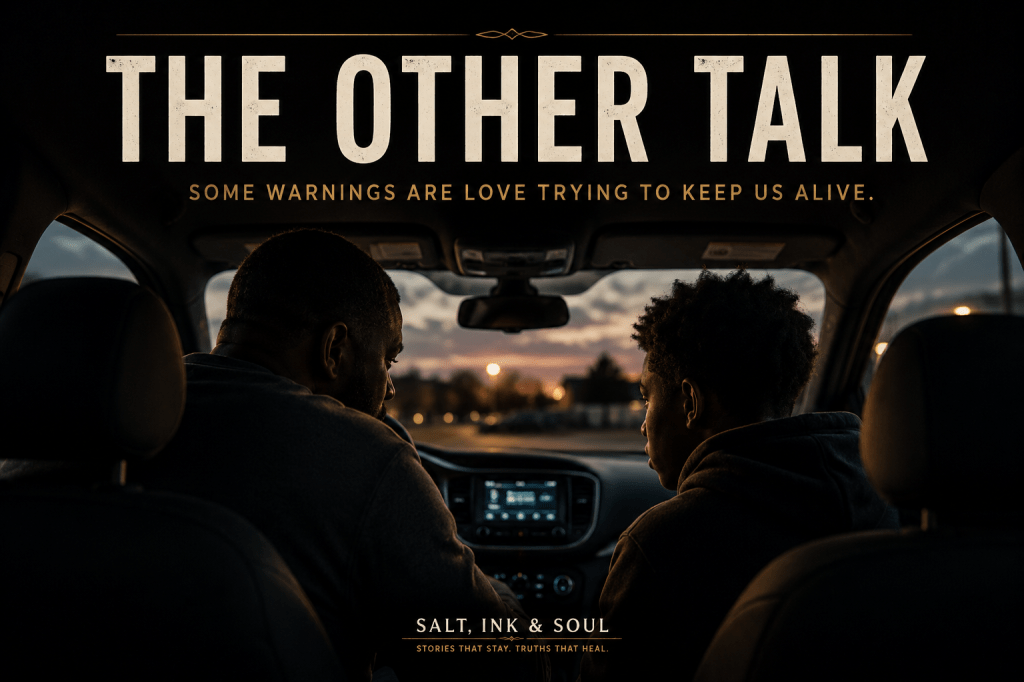
    Being Black in America means there is a good chance someone gave you the talk.

    Maybe it happened at the kitchen table.

    Maybe in the front seat of a parked car, with the engine still running and a parent staring straight ahead because looking at you would make the words harder to say.

    Maybe it came in pieces.

    Keep your hands where they can see them.

    Don’t reach for anything without telling the officer what you are doing.

    Don’t argue on the side road.

    Say yes, sir.

    Say no, sir.

    Make it home first.

    We call it the talk, but it is really an admission.

    It is a Black parent telling a child that being innocent isn’t enough. That being respectful may not be enough. That knowing your rights may not protect you from officers who have already decided you are dangerous.

    It is a terrible thing to place inside a young person.

    But we place it there because we want them to come home.

    That is the reason beneath every instruction.

    Come home.

    There is another talk, though.

    It is quieter.

    It does not always arrive in a single conversation. It is passed down in fragments, hidden inside warnings that may sound excessive until life gives them context.

    Watch your surroundings.

    Tell somebody where you are going.

    Keep your phone charged.

    Do not become so impaired that someone else must explain what happened to you.

    And never be the only one.

    The only Black person in the car.

    The only Black person at the party.

    The only Black person in the house.

    The only Black person on the trip.

    The only Black person out on the water, miles from shore, surrounded by people whose return home may be treated as ordinary while your absence becomes a mystery.

    Never be the only one.

    It is a difficult warning because it can sound like prejudice when removed from the history that produced it.

    It can sound as though we are teaching our children to fear every white person they meet.

    That is not what the warning means.

    It means that friendship does not erase history.

    It means being welcomed into a group is not always the same as being protected by it.

    It means there are places where, should something happen to you, no one present may understand the fear that will enter your mother’s body when the telephone rings.

    No one may understand why your family will not be satisfied with a hurried explanation.

    No one may understand why the words accident, misunderstanding, or nobody knows will not be enough.

    Lately, I have felt the need for this other talk again.

    Nolan Xavier Wells was eighteen years old.

    On July 4, 2026, he traveled with friends to Horn Island, a barrier island off the Mississippi Gulf Coast. The others returned. Nolan did not. His body was found on July 6. The official cause of his death had not been announced as of July 12, and authorities described the investigation as active. His family retained civil-rights attorney Ben Crump and called for a thorough and transparent investigation into Nolan’s final hours.

    Those are the facts as we know them.

    The rest remains unanswered.

    We don’t know everything that happened on that island.

    Concern is not evidence. History is not proof of what happened in one particular case. A photograph cannot tell us what occurred after the camera was lowered. The fact that Nolan was Black and the young men pictured with him were white does not, by itself, prove that someone harmed him.

    But there are things a photograph can awaken.

    There are memories older than the people standing inside it.

    When many Black people saw Nolan surrounded by white companions and learned that the others had returned without him, they felt something immediate.

    Not certainty, but Recognition.

    The feeling arrived before the details because Black people in America have inherited an archive of unfinished stories. We have watched too many families stand before cameras asking the public to care. We have watched too many mothers forced to introduce their children to strangers in the past tense.

    He was kind.

    He was loved.

    He had plans.

    He was more than the final thing that happened to him.

    There is a particular cruelty in the way a family must prove the fullness of a Black life after that life has been lost.

    They must bring out graduation pictures.

    Football photographs.

    Childhood memories.

    Stories about laughter, kindness, discipline, and promise.

    They must convince the world that this person was not merely a body recovered from an island.

    He was somebody’s son.

    And now there is a silence where his future was supposed to be.

    That is the sorrow I keep returning to.

    Not speculation.

    Not accusation.

    Sorrow.

    The sorrow of a mother having to learn that everyone else came back.

    The sorrow of imagining the hours between realizing your child is missing and knowing your child will not be found alive.

    The sorrow of wondering whether he called out.

    Whether anyone heard him.

    Whether he was frightened.

    Whether he believed someone was coming back.

    Whether, in his final moments, he understood how fiercely he was loved.

    These questions may never receive answers gentle enough for the people who must carry them.

    That is why the elders gave us rules.

    They knew rules could not guarantee safety. They had lived too long to believe that obedience could purchase protection. But they also knew that sorrow searches for something to do with itself.

    So sorrow became instruction.

    Call when you arrive.

    Don’t leave your drink unattended.

    Stay close to someone who knows you.

    Do not separate from the group.

    And never be the only one.

    Our funerals became lessons whispered to children before they were old enough to understand why the Elders’ voices had changed.

    We did not create these warnings to make our children afraid of the world.

    We created them because the world had given us reasons to fear losing our children inside it.

    There is a difference.

    Kyle J. Hayes

    kylehayesblog.com

    Please like, comment, and share

    Resources for Hard Times

    If you’re looking for practical help, food support, or community resources, you can visit the Salt, Ink & Soul Resources Page.

    πŸ‘‰Β Resources for Hard Times