Category: essays

  • The Laughter of Lions

    The Laughter of Lions

    I don’t know exactly when it happened.

    I couldn’t tell you the day, the hour, or the screen that made me notice. I don’t believe a single moment changed everything.

    But somewhere along the way, something shifted.

    Something in the way we see one another. Something in the way we respond to another person’s suffering. Something in what we have learned to laugh at, what we are willing to watch, and what no longer seems to trouble us.

    And I find myself wondering what we’ve lost.

    I scroll, and I see it.

    I turn on the television, and I hear it.

    Families turned into punchlines. Betrayal repackaged as entertainment. Someone’s private humiliation made public, shared thousands of times before anyone stops to consider the person at the center of it.

    A marriage falls apart, and we watch the arguments unfold in high definition. A man breaks down in tears, and we ask whether his pain is genuine. A woman reaches the lowest point of her life, and strangers gather to critique the way she handles it.

    Somewhere, someone is having the worst day of their life.

    And somewhere else, someone is laughing.

    We have become curators of collapse.

    I understand that entertainment has always reflected the darker parts of human nature. Conflict makes stories compelling. Betrayal, revenge, jealousy, and violence have occupied our stages and filled our books for centuries.

    I am not suggesting that every difficult story is harmful or that art should only show us the beautiful parts of being human.

    Some stories must be told precisely because they hurt.

    History demands that much of us.

    We need to witness some things because forgetting them would be another injustice. Some images expose cruelty, some stories preserve memory, and some accounts of suffering force us to acknowledge what others would prefer to hide.

    But there is a difference between witnessing someone’s pain to understand it and watching someone’s pain because we enjoy the spectacle.

    I wonder whether we are beginning to forget that difference.

    We have learned to consume tragedy in small, convenient portions.

    A few seconds of outrage. A few minutes of disbelief. A comment, a reaction, a share.

    Then we move on.

    The next video begins before we’ve had time to consider the last one.

    Someone dies, and the footage circulates.

    Someone is assaulted, and the argument becomes whether the recording is real.

    Someone humiliates a stranger in a grocery store, and millions of people are invited to watch.

    Sometimes those recordings serve a necessary purpose. They document wrongdoing. They challenge official accounts. They preserve evidence that might otherwise disappear.

    I understand the importance of that. I believe bearing witness is necessary.

    But I also wonder what happens when the camera stops witnessing and becomes part of the performance.

    When the person recording cares less about helping than about capturing the moment.

    When the audience cares more about the spectacle than the suffering.

    When another human being’s pain becomes an opportunity for attention.

    And when attention becomes its own kind of currency.

    Reality television has turned conflict into an industry. Social media has given humiliation an audience that never sleeps. Arguments become episodes. Betrayals become storylines. Families unravel while strangers take sides, choose favorites, and wait for the next confrontation.

    We watch people deceive one another, abandon responsibilities, manipulate relationships, and publicly destroy what once existed between them.

    And sometimes we reward the person who causes the most damage.

    Not because they are right.

    Not because they have something meaningful to teach us.

    But because they are entertaining.

    I wonder what that teaches us.

    Especially the young people watching, still learning what it means to love, to trust, to disagree, to forgive, and to live alongside others.

    What happens when cruelty begins to look like confidence?

    When manipulation is mistaken for intelligence?

    When loyalty becomes something to ridicule and kindness is treated as weakness?

    I don’t believe a television program or a video game can explain everything wrong with society. Human behavior is far too complicated for that.

    But I do believe the stories we tell, the behavior we celebrate, and the things we repeatedly reward can influence what we come to accept.

    And I worry about what we are learning to accept.

    An old image keeps returning.

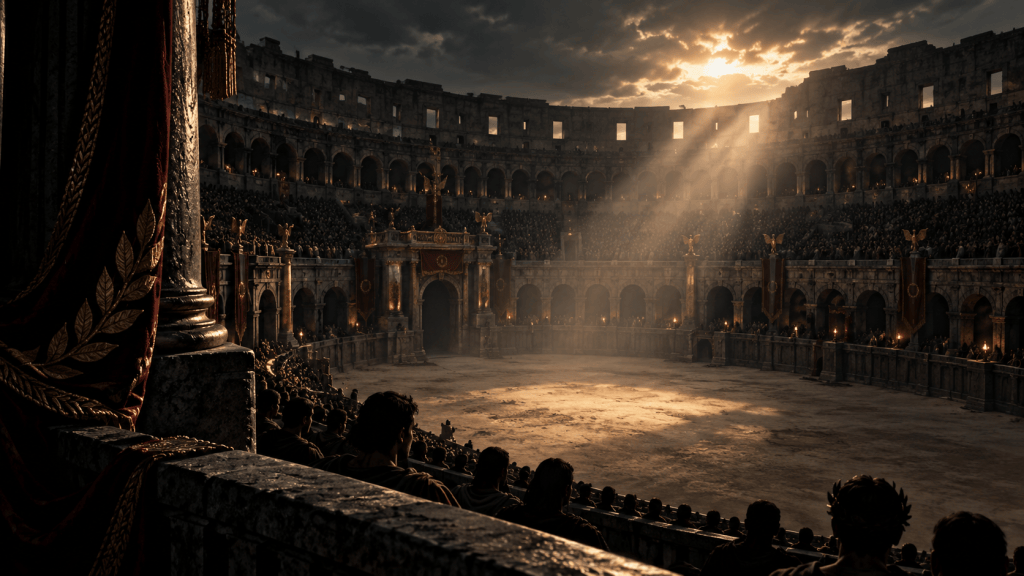
    The Roman Colosseum.

    I think about the crowds gathering to witness violence. About the excitement of the spectacle. About human suffering transformed into public entertainment.

    The Romans understood something about crowds.

    They understood that violence could become ceremony. That suffering could become an attraction. That the distance between spectator and victim could make cruelty easier to tolerate.

    Of course, Rome was more complicated than its arenas. Its history cannot be reduced to the entertainment its people enjoyed, just as our own society can’t be explained by what appears on our screens.

    But the image stays with me.

    Thousands of people gathered to watch someone else struggle to survive.

    And I wonder how different we really are when we measure the distance between ourselves and another person’s suffering by a screen rather than the walls of an arena.

    We are in the Coliseum again.

    But this time, we brought the lions.

    We are the lions.

    Not because every person who watches is cruel. Not because curiosity makes someone heartless.

    But because, in some moments, our attention helps keep the spectacle alive.

    We share what shocks us.

    We reward what angers us.

    We return to what we claim to despise.

    Somewhere along the way, the people producing these spectacles learn that the more outrageous the behavior, the larger the audience.

    The greater the audience, the greater the profit.

    Cruelty becomes a business model.

    Outrage becomes advertising.

    And suffering becomes content.

    Perhaps what troubles me most is how ordinary it can all begin to feel.

    A few years ago, something might have stopped us in our tracks. We might have talked about it for days, struggling to understand what had happened.

    Now, the next terrible thing arrives before we’ve finished thinking about the first.

    We are asked to feel everything at once and somehow continue our ordinary lives.

    I sometimes wonder whether what looks like indifference is actually exhaustion.

    Whether we have been exposed to so much suffering, presented so quickly and so relentlessly, that we struggle to know what to do with it.

    Perhaps some people have stopped reacting because they no longer care.

    Perhaps others have stopped because caring without knowing how to help has become unbearable.

    I suspect it’s both.

    And that troubles me, too.

    Because I don’t want to become someone who can look at another person’s suffering and feel nothing.

    I don’t want the terrible things I have witnessed to make me less capable of tenderness.

    I don’t want to mistake cynicism for wisdom.

    Or cruelty for honesty.

    Or humiliation for entertainment.

    I am not moralizing.

    I’m mourning.

    And I want to be careful about what I mean by that.

    I am not mourning some perfect past. I know enough history to understand that such a place never existed.

    Human beings have always been capable of extraordinary cruelty. We have built institutions around it, justified it with laws, defended it through religion, and disguised it as tradition.

    People have gathered to witness public executions. They have celebrated strangers’ suffering. They have turned punishment into theater and humiliation into a public ritual.

    We did not invent these things with smartphones.

    And I would never argue that previous generations possessed some special innocence that we have somehow abandoned.

    But I am mourning something.

    Maybe it is the expectation that cruelty ought to trouble us.

    That another person’s humiliation should make us uncomfortable.

    That someone’s tears should awaken something more human than curiosity.

    That seeing another person brought low should not automatically make us feel taller.

    I miss the idea that there are some things we should refuse to find funny.

    Not because laughter is wrong.

    I love laughter. I believe it can carry people through terrible circumstances. Sometimes it is the only relief available when life becomes difficult.

    I remember the kind of laughter that fills a room and makes everybody feel welcome. The kind that travels across a family table. The kind that comes from knowing someone well enough to laugh together without anyone becoming the victim.

    That laughter has a different sound.

    It brings people closer.

    What troubles me is the laughter that requires someone else’s destruction.

    The kind that demands a loser before anyone can celebrate a winner.

    The kind that mistakes embarrassment for justice and humiliation for accountability.

    I wonder how often we confuse the two.

    And I wonder what it costs us.

    Because I believe what we practice becomes easier.

    Practice patience, and perhaps we become more patient.

    Practice compassion, and perhaps we become more willing to recognize another person’s pain.

    But practice ridicule often enough, and I wonder whether it begins to feel natural.

    Whether we start carrying it beyond the screen.

    Into our conversations.

    Our relationships.

    Our families.

    The way we speak about people we have never met.

    The way we respond when someone makes a mistake.

    How we treat a stranger whose worst moment suddenly becomes public.

    It is easy to forget that the people we watch are not characters simply because we encounter them through a screen.

    They have families.

    They have ordinary mornings and sleepless nights.

    They have people who love them, people who worry about them, people who will still be living with the consequences long after the audience has moved on.

    The video ends.

    The comments stop.

    The algorithm finds something new.

    But the person remains.

    And whatever happened to them remains, too.

    I think that is what I wish we would remember.

    A human being is on the other side of our entertainment.

    Someone whose life continues after we have finished watching.

    Someone who may never know the people who laughed at them, but who must still live with what was done.

    Someone who deserves more than our passing attention.

    So what do we do?

    I don’t pretend to have an answer large enough to repair what troubles me.

    I cannot change the entire entertainment industry. I cannot make every person who watches a humiliating video recognize the humanity of the person in it.

    And I certainly cannot pretend that I have never been drawn into a spectacle myself.

    I have watched things that angered me. I have followed stories longer than I needed to. I have felt the pull of wanting to know what happened next.

    That, too, is part of what makes this uncomfortable.

    It is easy to criticize the crowd while forgetting that sometimes we are standing in it.

    But I believe we can make smaller choices.

    We can decide that someone else’s humiliation does not need our participation.

    We can refuse to share a recording simply because it is shocking.

    We can ask whether watching serves any purpose beyond satisfying our curiosity.

    We can remember that documenting injustice and enjoying suffering are not the same thing.

    We can teach children that popularity is not character, that attention is not affection, and that cruelty does not become admirable simply because people applaud it.

    We can learn to disagree without needing to destroy one another.

    And perhaps we can begin paying closer attention to the kind of laughter we invite into our lives.

    The laughter that welcomes.

    The laughter that heals.

    The laughter that reminds us we belong to one another.

    I still believe something decent lives within us.

    I see it when strangers help someone who has fallen. When neighbors bring Food to a family in trouble. When people offer kindness without recording it, without announcing it, without expecting anything in return.

    Those moments rarely get the attention a public scandal does.

    But they happen.

    Every day.

    And perhaps that is where hope begins.

    Not in pretending the world has suddenly become cruel, or imagining that we can return to an age when people were kinder.

    But in recognizing that we still choose what we encourage, what we reward, and what we allow ourselves to become.

    I began by wondering what we had lost.

    Maybe the better question is what we are willing to preserve.

    Our capacity to care.

    Our willingness to look at another person and recognize something of ourselves.

    Our understanding that suffering isn’t automatically entertainment, and that another person’s dignity shouldn’t depend on whether the crowd finds them amusing.

    I don’t know whether we can change the appetite for spectacle.

    But I know we can question our own.

    Perhaps the first act of compassion is refusing to cheer.

    Perhaps we cannot silence the lions.

    But we can decide whether they hear our applause.

    Kyle J. Hayes

    kylehayesblog.com

    If something here speaks to you, please like, comment, and share.

    Support Salt, Ink & Soul

    The stories, recipes, and reflections continue beyond the page. Visit the Salt, Ink & Soul Store to explore merchandise inspired by Food. Memory. Meaning.

    👉 Visit the Salt, Ink & Soul Store

    Resources for Hard Times

    If you’re looking for practical help, food support, or community resources, you can visit the Salt, Ink & Soul Resources Page.
    👉 Resources for Hard Times

  • The Things We Keep Because Someone Touched Them

    The Things We Keep Because Someone Touched Them

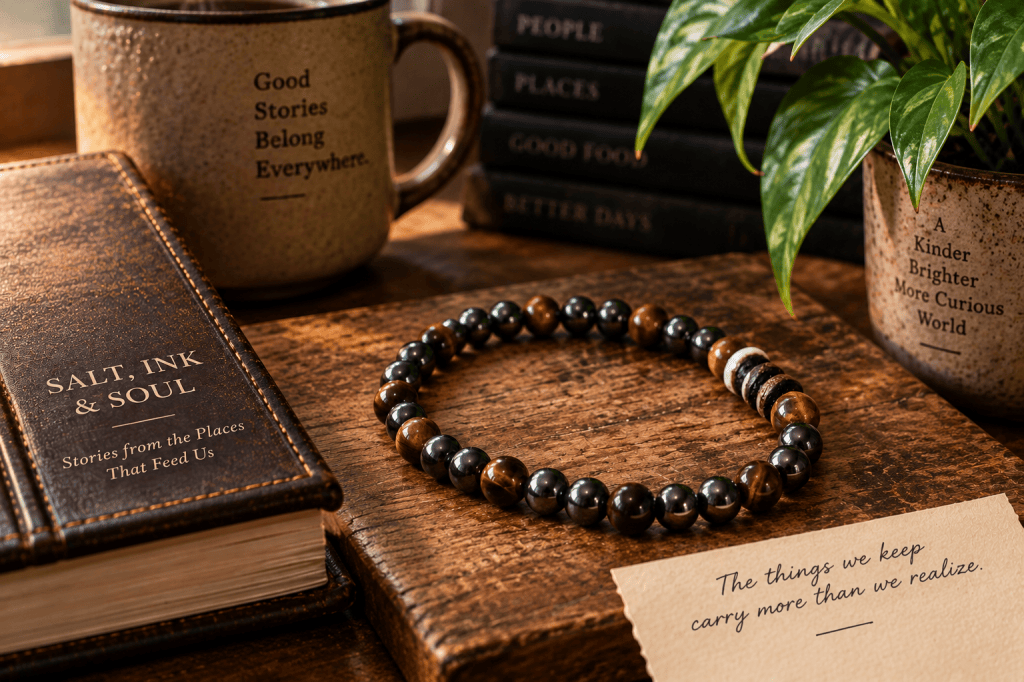
    Sometimes, when my feelings begin to overwhelm me, I reach down and touch the bracelet my sister made.

    It is a small movement. Easy to miss.

    My fingers find the beads, and I remember that somewhere, far from where I live, someone in my family took the time to make something for me. Then she sent it.

    There was no occasion.

    She thought of me.

    Some days, I need something I can touch to remember that.

    Those who have read certain pieces here know that my childhood was difficult. I have written about parts of it. Other parts remain harder to explain, even to myself.

    I live far from my family now. That was my choice, and much of the time, I believe it was the right one.

    It can also be lonely.

    There is an awkwardness in admitting that. Once you choose distance, you can begin to feel you have surrendered the right to miss anyone. As though loneliness were a consequence you agreed to accept without complaint.

    But a decision can be necessary and still leave something aching.

    I can appreciate the life I have here and sometimes wish being close to family felt simpler. I can enjoy my solitude and reach the end of a day wanting to hear a familiar voice.

    Both belong to me.

    At times, I look at the closeness other people seem to have with their families and feel that I missed something. The ease of belonging. The ordinary assumption that someone will call, that there is a place at the table, that your presence does not require an explanation.

    I know I cannot see the whole of another family from the outside. Every table has conversations people avoid.

    Still, there are kinds of ease I wish I had known.

    There is grief in that, too. Missing something you cannot quite remember having.

    My sister is an artist.

    Some time ago, she sent me a beaded bracelet she had made. I have become attached to it in a way that might be difficult to explain if you were only looking at the bracelet.

    Before I could hold it, she had to.

    Before it became something I wore, it was something she was giving her attention to.

    There is a tenderness in that which I did not fully understand until I found myself reaching for it.

    We speak about time so often as something we lack. We are busy. We are tired. We will call when things settle down. Most of us mean it.

    Then someone takes a little of the time they have and makes you something.

    You get to keep that time.

    I think this is why certain things become impossible to throw away.

    A coffee cup with a chipped rim. A cheap watch that no longer works. A book with someone’s handwriting in the margin. A recipe on a stained piece of paper, written by a person who never understood why you needed the measurements.

    A stranger might sort them into a donation box.

    We would have to sit down first.

    The value is difficult to explain because it lives outside the object. It belongs to a kitchen, a voice, an afternoon. Someone reaching across a table. Someone writing your name.

    We can describe what a thing is and still say almost nothing about why we keep it.

    My bracelet is like that.

    It also reminds us that we don’t have to wait until someone is gone to understand the importance of what they have given us. Distance has its own way of teaching us to notice. So does loneliness.

    Sometimes a gift becomes precious because the person who made it is alive, somewhere else, carrying on with her day.

    And here you are, carrying a little of her care through yours.

    A difficult childhood can make care complicated to receive.

    I sometimes wonder whether part of me is still learning what to do with affection that arrives without my having to ask for it. Whether I am so accustomed to managing my feelings alone that a small kindness can reach places a grand gesture would never find.

    There are moments when loneliness begins making claims beyond what it actually knows.

    You are alone becomes You have always been alone.

    No one is here becomes No one cares.

    When I am overwhelmed, those can feel like the same sentence.

    Then I touch the bracelet.

    My sister made this.

    She sent it to me.

    Whatever else I am feeling, those things happened.

    The bracelet does not settle every question I have about family. It does not repair my childhood or erase the reasons I live far away. I would not ask something so small to carry all of that.

    But it helps me leave room for a fact my sadness sometimes overlooks.

    Someone cared enough to make this for me.

    I am trying to let that matter without immediately qualifying it.

    Perhaps that is part of learning how to live with a complicated history: allowing a kindness to reach you without requiring it to answer for everything that came before.

    My sister’s gift deserves to be received on its own terms.

    She made something.

    She thought I should have it.

    And I do.

    There are still lonely evenings. I still live far away. Some feelings arrive with more force than I know what to do with.

    When they do, I reach down.

    My fingers find the beads.

    I think of my sister, and for a moment I can hold on to the thought that I may not be as alone as I feel.

    Kyle J. Hayes

    kylehayesblog.com

    Please like, comment, and share

    Resources for Hard Times

    If you’re looking for practical help, food support, or community resources, you can visit the Salt, Ink & Soul Resources Page.

    👉 Resources for Hard Times

  • The Villain Who Made Me Think

    The Villain Who Made Me Think

    Have you ever liked a villain more than the hero? Who and why?

    View all responses

    Have you ever liked a villain more than the hero?

    I have.

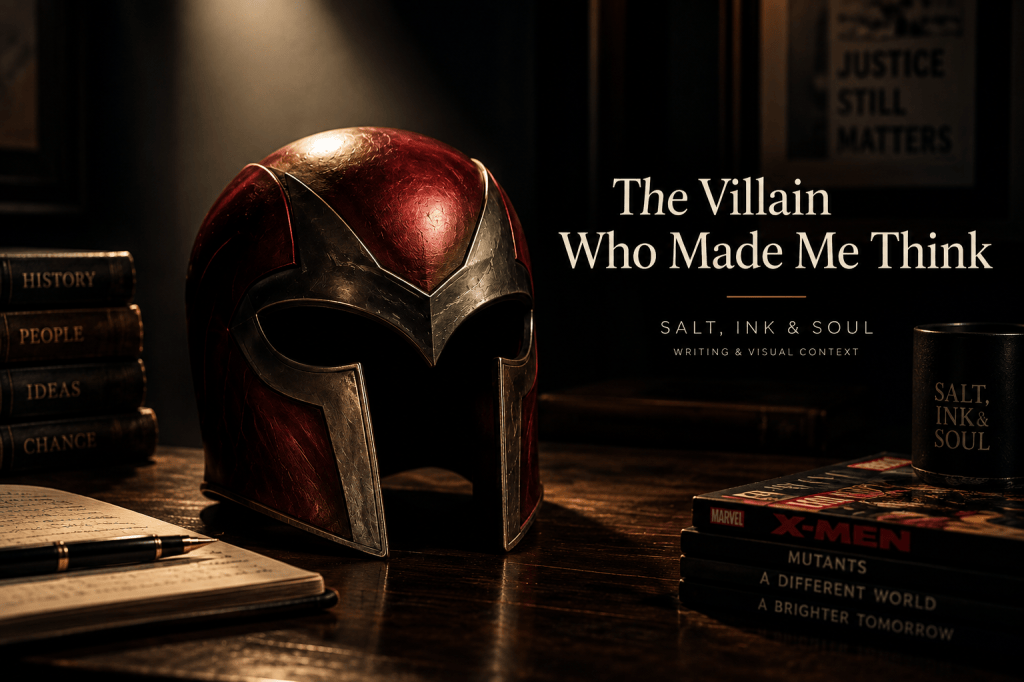
    Magneto.

    And I liked him before I ever really knew him.

    I was a boy when I saw Stan Lee being interviewed on television. I couldn’t tell you the program now. I couldn’t repeat the interview. Memory rarely keeps things that neatly.

    But I remember what stopped me.

    He was talking about the X-Men.

    Professor X, he explained, could be seen as closer to Dr. Martin Luther King Jr.

    Magneto was closer to Malcolm X.

    That was it.

    I needed to know more.

    Until then, comic books had mostly been what comic books are supposed to be when you’re a kid.

    Heroes.

    Villains.

    Costumes.

    Powers.

    Good guys trying to stop bad guys from doing bad things.

    But suddenly someone was telling me there were ideas underneath those costumes.

    History underneath those battles.

    That a fight between two men with extraordinary powers could really be an argument about how people survive in a world that fears them.

    That interview made me an X-Men fan.

    More importantly, it helped make me a serious comic-book reader.

    And when I began reading Magneto, I found something much more complicated than the villain I expected.

    He frightened people.

    He threatened people.

    Sometimes he did terrible things while convincing himself they were necessary.

    I understood that.

    But I also understood something else.

    Magneto believed his people were in danger.

    And he had decided they would never be helpless again.

    That mattered to me.

    Because underneath the helmet, the powers, and all that anger was memory.

    Magneto remembered what happened when people decided another group was different.

    He remembered what happened when different became dangerous.

    And he knew what could happen when dangerous became something people believed needed to be eliminated.

    So when Professor X looked at humanity and saw the possibility of coexistence, Magneto looked at the same humanity and saw evidence.

    That doesn’t make Magneto right.

    I think that distinction matters.

    Understanding someone’s anger isn’t the same as approving of what they do with it.

    Magneto could become the very thing he claimed to be fighting. Protection could become domination. Fear could become hatred. The determination to keep his people safe could become permission to hurt someone else’s.

    But even then, I could never dismiss him.

    Because I understood the question underneath his anger.

    What if they come for us again?

    Professor X believed humanity could become better.

    Magneto wasn’t willing to bet his people’s survival on it.

    One offered hope.

    The other carried memory.

    I know people have discussed the Professor X and Dr. King, Magneto and Malcolm X comparisons for years. I also know those comparisons can become too simple. Dr. King was more complicated than the peaceful dreamer we sometimes reduce him to, and Malcolm X was far more complicated than the angry counterweight history sometimes makes him out to be.

    Real men don’t fit neatly inside comic-book metaphors.

    But as a boy, I didn’t know all of that yet.

    I only knew someone had opened a door.

    Comic books could be about more than heroes defeating villains.

    They could ask questions.

    About prejudice.

    About power.

    About identity.

    About what people owe one another.

    About whether peace requires trust, and what happens when history has given you very little reason to trust.

    I started reading differently after that.

    Maybe I started looking at villains differently, too.

    Because the most interesting villains aren’t necessarily the ones who make us wonder how someone could become so evil.

    Sometimes they are the ones who make us uncomfortable because somewhere beneath everything they have become, there is something we recognize.

    A wound.

    A memory.

    A fear.

    Maybe even a truth.

    Magneto never made me want the villain to win.

    He did something more important.

    He made me understand why the villain believed he should.

    Kyle J. Hayes

    kylehayesblog.com

    Please like, comment, and share

    Resources for Hard Times

    If you’re looking for practical help, food support, or community resources, you can visit the Salt, Ink & Soul Resources Page.

    👉 Resources for Hard Times

  • A Long Way from Canned Tamales

    A Long Way from Canned Tamales

    Whenever I travel outside the Southwest, someone eventually asks.

    “Do you want to go out for Mexican food?”

    They mean it kindly.

    They are trying to offer me something familiar. Something they believe might remind me of home.

    And my answer is almost always no.

    Not because I dislike Mexican food.

    Because I have learned to love it too much.

    I am spoiled now.

    There are things you can unlearn. Facts you can forget. Names that slip loose from memory. Roads that disappear after enough years away.

    But once you have eaten certain foods prepared in certain places, your mouth becomes an unreliable diplomat.

    It no longer wishes to be polite.

    Before I moved west, Mexican food mostly meant Taco Bell.

    This is not an insult to Taco Bell. Taco Bell has been there for many of us at times when few others were willing to answer the call. It has fed college students, night-shift workers, road-weary travelers, and people who suddenly discovered at 11:43 p.m. that they had made no plans for dinner.

    There is nothing wrong with that.

    But a considerable distance separates a drive-through taco from somebody’s grandmother standing over a pot that has been simmering since morning.

    Before the Southwest, I did not understand that distance.

    My earliest knowledge of tamales came from a can.

    Hormel tamales.

    Wrapped in paper.

    Yes, paper.

    Whenever I tell people this, I have to stop and explain because they look at me as if I have confessed that my family ate soup with a fork.

    But they existed.

    You opened the can, slid out a stack of soft cylinders covered in sauce, and peeled the paper from each one. There was no corn husk. No assembly line of aunties around a kitchen table. No family recipe guarded more carefully than a Social Security number.

    Just a can.

    And paper.

    I ate them without complaint because children rarely question the borders of the world they inherit. If the can said tamales, then tamales were what they were.

    We believe many things simply because no one has yet taken us somewhere better.

    Arizona was my first real experience with Mexican food—not the idea of it, not the national chain interpretation, but food connected to people, place, heat, memory, and migration.

    The flavors were brighter than I expected. The chiles carried more than pain. The tortillas were not merely edible plates designed to keep your hands clean. They had texture. Warmth. A life before they reached the table.

    I began to understand that salsa was not just a thing in a jar.

    This felt important.

    Some salsa announced itself with tomatoes and freshness. Some arrived dark and smoky. Some offered a gentle handshake before setting fire to the furniture.

    You learned to respect them all.

    Then there was Texas.

    I had Mexican food there too, although Tex-Mex is its own country with its own laws. Cheese appears to hold elected office. Cumin has voting rights. Plates arrive carrying enough food to make you reconsider whatever plans you had for the afternoon.

    It is not lesser.

    It is simply itself.

    That distinction matters because we have a habit in this country of flattening other people’s food. We take cuisines with regions, histories, arguments, migrations, and generations of memory, then place them beneath one convenient name.

    Mexican food.

    As if Mexico were not an enormous nation.

    As if the border had not moved.

    As if families had not carried recipes across it.

    As if Indigenous traditions, Spanish colonization, African influence, geography, poverty, ingenuity, and survival had not all left fingerprints on the plate.

    Then I came to New Mexico.

    New Mexican food is also its own thing.

    People unfamiliar with it sometimes mistake that statement for regional pride.

    It is regional pride.

    But it is also true.

    Here, chile isn’t merely something added to food. Chile is a declaration of citizenship. Red or green is not a casual question. It is an inquiry into your character.

    “Christmas” is an acceptable answer, though it can feel like refusing to choose sides in a family argument.

    After enough years of eating this way, something happens.

    Your standards change.

    Not because you become sophisticated. I remain a man who can remember canned tamales with something dangerously close to affection. We should never become so refined that we start lying about where we came from.

    But experience widens the world.

    You learn the difference between heat and flavor. You learn that a dish can be spicy without being cruel. You learn the difference between a freshly made tortilla and one that came off a factory line.

    You learn that food tastes different when it belongs where it is being served.

    That may be why I hesitate when someone outside the Southwest asks if I want Mexican food.

    I know they are being hospitable.

    I also know someone in the kitchen might be preparing to place shredded lettuce, cold tomatoes, and orange cheese inside a hard shell, then charge eighteen dollars for the experience.

    I can’t do it.

    Not when I know what is waiting for me back home.

    This is one of the quieter ways a place claims you.

    We often think of home as the place where we were born, where our family lives, or where we made our oldest memories. But sometimes home is also the place that taught us what something is supposed to taste like.

    I did not grow up in the Southwest.

    I came here carrying other foods, other memories, other definitions. I came from a world where tamales emerged from a can wearing little paper coats.

    The Southwest did not erase that boy.

    It fed him.

    Phoenix introduced him to something larger. Texas showed him another variation. Albuquerque gave him red chile, green chile, stacked enchiladas, warm sopaipillas, and the understanding that cuisine is not a fixed object. It is a living record of who remained, who arrived, what survived, and what people learned to make together.

    Food does that.

    It enters through the mouth and quietly rearranges the heart.

    So when I travel, and someone asks whether I want Mexican food, my refusal may sound arrogant.

    It is not meant that way.

    It is the caution of a man who has seen too much.

    I have smelled chile roasting beneath the New Mexico sky. I have eaten tortillas that arrived warm and soft, carrying the small imperfections that reveal the presence of human hands. I have watched people debate red and green with the seriousness normally reserved for theology and football.

    There are some disappointments a person should avoid when he can.

    I would rather eat what the place I am visiting does well. Give me its neighborhood restaurant. Its old diner. Its beloved sandwich. Give me the dish the locals defend when outsiders make jokes about it.

    I will meet that place through its own food.

    Then, when I return to Albuquerque, I will order my enchiladas.

    Maybe Christmas.

    And I will think, with gratitude, of the strange journey that carried me from Taco Bell, through the canned tamales wrapped in paper, and into a life where I know better.

    Not better than other people.

    Just better than to order Mexican food too far from home.

    Kyle J. Hayes

    kylehayesblog.com

    Please like, comment, and share

    Resources for Hard Times

    If you’re looking for practical help, food support, or community resources, you can visit the Salt, Ink & Soul Resources Page.

    👉 Resources for Hard Times

  • Watching Live Aid Again

    Watching Live Aid Again

    Tonight I watched a documentary about the history of Live Aid.

    It carried me back to my teenage years. Back then, the story seemed simple. Millions of people were starving. The world came together. Musicians sang. People donated. Food would reach those who needed it.

    That was enough for a teenager.

    Adults, unfortunately, don’t get to keep many simple stories.

    Watching it now, I found myself noticing things I never would have seen then. Not just the images of hunger, but the people standing around it. The officials. The governments. The negotiations that always seem to appear whenever suffering becomes visible enough for the world to notice.

    One interview stayed with me.

    An Ethiopian official seemed more struck by Bob Geldof’s appearance—his long hair, his beard, the fact that he wasn’t wearing a suit—than by the catastrophe unfolding around him. Maybe there was context I didn’t see. Maybe there was more to the exchange than the documentary showed. But it left me unsettled.

    I found myself looking less at Geldof and more at the official.

    As a teenager, I probably wouldn’t have noticed him at all.

    As an adult, I couldn’t stop noticing.

    His appearance stood in sharp contrast to the images of starving people surrounding him. Fairly or unfairly, I found myself wondering how someone could stand so close to such unimaginable suffering and seem so emotionally distant from it. It felt, at least to me, as though the people who were starving had become something to point toward rather than people to grieve.

    I eventually turned the documentary off.

    Not because I couldn’t bear to look at the victims.

    Because I couldn’t stop thinking about everything happening behind the camera.

    Over the years, I’ve worked alongside more people from different parts of Africa. I’ve learned how deeply history, politics, ethnicity, and tribal identities have shaped many nations there.

    That complexity leaves me with questions I cannot answer.

    How much suffering was caused by drought alone?

    How much by war?

    How much by corruption?

    How much by governments that placed power above people?

    History is filled with stories of trucks waiting at checkpoints. Food sitting only miles away while paperwork, politics, greed, or war decided whether starving families would eat.

    How much of that food never reached the people it was meant to feed?

    Perhaps that is what disturbed me most.

    Not simply that people were starving.

    But that even starvation can become something to bargain over.

    A convoy waits.

    Someone demands payment.

    A permit.

    A tax.

    A favor.

    And while adults negotiate, children continue waiting.

    Live Aid showed the world extraordinary generosity. Millions of ordinary people opened their wallets because they believed another human being deserved to live.

    The people who donated weren’t thinking about politics. They were thinking about hungry children. They believed compassion could bridge the distance between their table and someone else’s empty plate.

    I hope that generosity reached those it was meant for.

    I also hope history continues asking difficult questions about the systems that allowed so many people to suffer in the first place.

    I miss believing that kindness was enough.

    Because feeding the hungry is an act of compassion.

    Asking why they were hungry for so long is an act of responsibility.

    Kyle J. Hayes

    kylehayesblog.com

    Please like, comment, and share

    Resources for Hard Times

    If you’re looking for practical help, food support, or community resources, you can visit the Salt, Ink & Soul Resources Page.

    👉 Resources for Hard Times