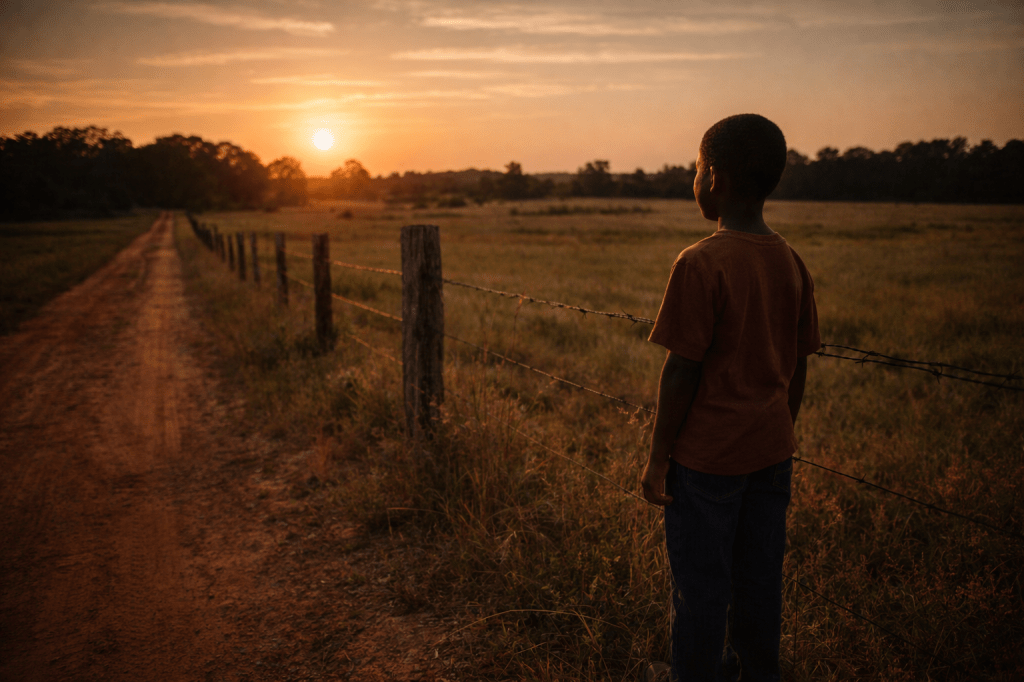
Kofi lived in the low, breathing cradle of a Southern town where the sun didn’t just rise—it pressed.
It leaned into the red dirt and the wooden porches, into the backs of people who worked outside because that’s what their lives required.
The town wasn’t large. It didn’t need to be.
Every face carried history.
Every house leaned a little with age, like it had listened to too many stories and decided to rest into them.
The land itself felt watched over, not owned—held carefully, as something fragile and sacred is.
Kofi spent his days moving through open fields and fence lines, helping his family tend what little they had: a few animals, a garden, the kind of labor that teaches a boy where his strength ends and his patience must begin.
He learned the rhythm of the place—the slow insistence of heat, the way time stretched instead of rushed.
His father was a quiet man.
Not the kind who filled rooms with speeches, but the kind whose words stayed with you because they were never wasted.
“To live right,” his father told him once, leaning against a fence post worn smooth by generations of hands, “is to stand straight even when nobody’s watching.
Especially then.”
One afternoon, a stranger came into town.
He arrived in a clean truck that looked too new for the road it traveled, carrying papers instead of tools. He spoke of opportunity. Of development. Of progress.
He pointed at maps and lines drawn where lives already existed.
He talked about money the way some people talk about salvation.
The town gathered.
Some listened closely.
Some crossed their arms.
Everyone felt the weight of the moment, even if they didn’t yet know how to name it.
The land he wanted wasn’t empty. It was layered—with memories, with loss, with people who had already been moved once before in stories their grandparents told quietly.
Kofi stood at the edge of the crowd, absorbing more than anyone realized.
The stranger noticed him.
Later, away from the others, the man crouched down and handed Kofi something small and shining.
A token.
A promise wrapped in metal.
“Just tell them it’s good,” the man said softly. “They’ll listen to you.”
Kofi felt the pull of it—the way temptation doesn’t shout but suggests.
The way it pretends to be harmless.
He remembered his father’s voice.
Calm.
Certain.
Unbending.
When the moment came, Kofi stepped forward.
His hands trembled, but his feet held.
“This land,” he said, his voice carrying farther than he expected, “isn’t just dirt. It’s where our people learned how to stay. It’s where they buried what they lost and planted what they hoped for.
You can’t sell something that’s still holding us up.”
The town grew quiet.
Not shocked.
Not dramatic.
Just still—like something important had been named out loud.
The stranger gathered his papers.
He left the same way he came, promises evaporating in the heat.
Kofi didn’t feel proud the way stories sometimes pretend you should.
He felt steady.
Anchored.
As if he had chosen to belong rather than to escape.
That evening, his father sat beside him without speaking for a long while.
Then he nodded once.
Integrity, Kofi learned, wasn’t loud.
It didn’t glitter.
It didn’t offer shortcuts.
It was the decision to stay rooted when leaving looked easier.
To speak truth even when silence offered comfort.
And as Kofi grew, the town grew with him—not richer, not shinier—but intact.
Still standing.
Kyle J. Hayes
Please like, comment, and share
Resources for Hard Times
If you’re looking for practical help, food support, or community resources, you can visit the Salt, Ink & Soul Resources Page.



 Salt,Ink, & Soul