Category: Humanity through Food

  • The Salad That Doesn’t Compete

    The Salad That Doesn’t Compete

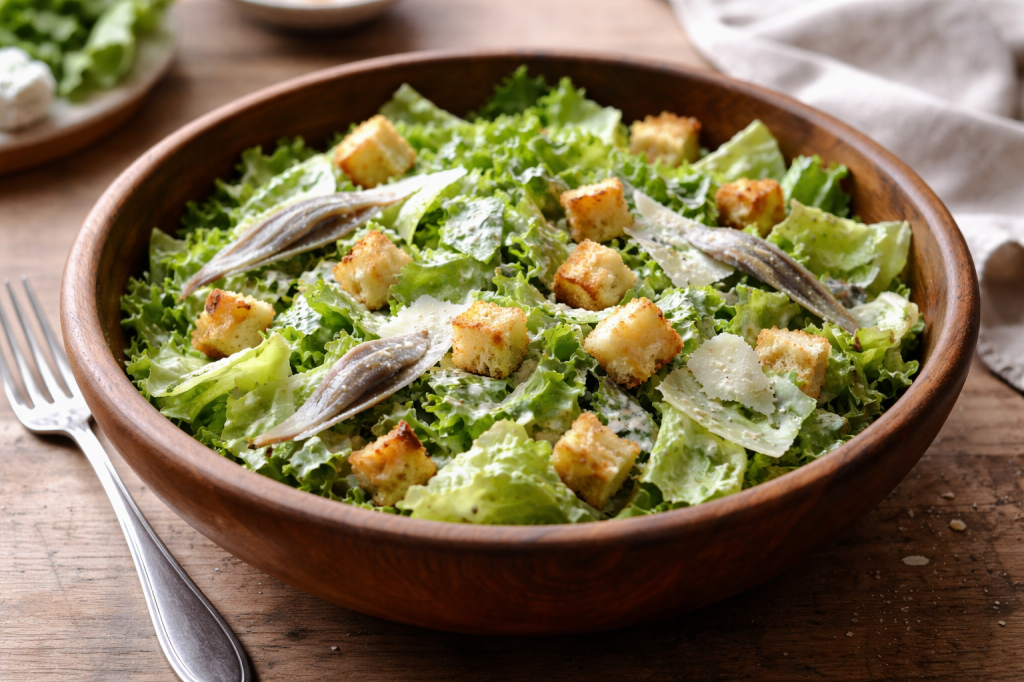
    Caesar Salad (As It Was Meant to Be)

    There’s a misunderstanding that follows certain dishes.

    Caesar salad is one of them.

    Somewhere along the way, it became something else.

    Covered. Overloaded. Turned into a platform for whatever someone felt like adding that day. Chicken most of all—placed on top like it needed saving, like it wasn’t enough on its own.

    But it was always enough.

    It was never meant to be heavy.

    Never meant to carry the whole meal.

    It was meant to support.

    To balance.

    To bring something sharp and clean to a plate that needed it.

    That may be why it belongs here.

    Next to something rich.

    Something warm.

    Something like jalapeño popper chicken.

    Because not everything on the plate needs to speak loudly.

    Some things just need to be right.

    Caesar Salad

    Serves 4 to 8

    Ingredients

    For the Croutons

    • 1 cup extra-virgin olive oil (from total below)
    • 4 oil-packed anchovies, drained
    • 2 garlic cloves, peeled and smashed
    • 6 slices of white sandwich bread, cut into ¾-inch cubes
    • ¼ cup finely grated Parmigiano-Reggiano
    • Salt and freshly ground black pepper

    For the Dressing

    • Remaining 1½ cups extra-virgin olive oil
    • 6 oil-packed anchovies, drained
    • 2 garlic cloves, finely chopped
    • 1 teaspoon Dijon mustard
    • Juice of 1 lemon (about 2 tablespoons)
    • ½ teaspoon Worcestershire sauce
    • Dash of Tabasco
    • 3 egg yolks
    • Salt and freshly ground black pepper

    For the Salad

    • 1 large or 2 small heads of romaine lettuce, washed, chilled, and coarsely chopped
    • ¾ cup finely grated Parmigiano-Reggiano
    • Boquerones (optional, for garnish)

    Instructions

    1. Make the Croutons

    In a wide pan, heat 1 cup of olive oil over medium-low heat.

    Add anchovies and smashed garlic, letting them slowly dissolve into the oil.

    Not rushed. Not forced.

    Increase the heat slightly and add the bread cubes.

    Toss until golden on all sides.

    Remove and transfer to a bowl.

    Toss gently with parmesan, salt, and pepper.

    Let them rest.

    2. Build the Dressing

    In a food processor or blender, combine:

    • anchovies
    • chopped garlic
    • mustard
    • lemon juice
    • Worcestershire
    • Tabasco
    • egg yolks

    Blend until smooth.

    Slowly drizzle in the remaining olive oil.

    Let it come together gradually.

    Taste. Adjust.

    This is where it becomes yours.

    3. Bring It Together

    In a large bowl, add the lettuce.

    Toss with dressing—just enough to coat.

    Not drown.

    Add the remaining parmesan.

    Toss again, gently.

    Plate it simply.

    This salad was made to sit beside something richer.

    Something warm. Something with weight.

    Like the Jalapeño Popper Chicken.

    Notes from the Kitchen

    • This salad is meant to balance, not compete.
    • Keep it clean. Keep it intentional.
    • The anchovies matter.
    • They don’t make it “fishy”—they make it complete.
    • Use enough dressing to coat, not overwhelm.
    • There’s a difference between flavor and excess.
    • And leave the chicken off.
    • It already has its place on the plate.

    A Quiet Understanding

    There’s something honest about a dish that knows what it is.

    It doesn’t try to become more.

    Don’t try to carry everything.

    It just does its job well.

    And next to something rich—

    something heavy with flavor and warmth—

    This salad reminds you that balance isn’t subtraction.

    Its intention.

    Not everything needs to stand alone.

    Some things are meant to stand beside one another.

    And when they do…

    The whole plate makes sense.

    Kyle J. Hayes

    kylehayesblog.com

    If this found you at the right time,

    Feel free to like, comment, or share it with someone who might need it too.

    Resources for Hard Times

    If you’re looking for practical help, food support, or community resources, you can visit the Salt, Ink & Soul Resources Page.
    👉 Resources for Hard Times

  • Cooking Once, Living Twice

    Cooking Once, Living Twice

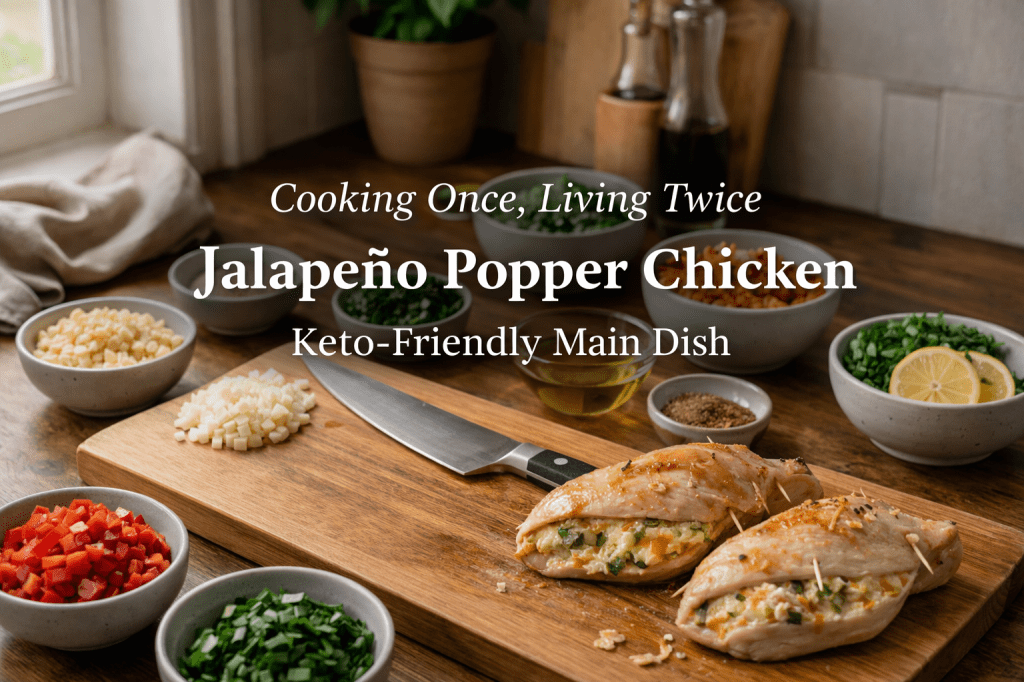
    Jalapeño Popper Chicken (Keto-Friendly Main Dish)

    There’s a certain kind of heat that doesn’t come from the stove.

    It comes from the day itself.

    From the bill you just paid.

    From the receipt, you didn’t want to look at too closely.

    From the quiet math you do in your head while standing in the grocery aisle, deciding what stays and what goes.

    And in the middle of all that, the kitchen still calls.

    Not for perfection.

    Not for performance.

    Just for something steady.

    I’ve learned this slowly—meals don’t always need to be made fresh every night to be meaningful. Sometimes the most honest kind of cooking is the kind that understands tomorrow before it gets here. The kind that asks: How do I take care of myself now… so I don’t have to struggle later?

    That’s where this dish lives.

    Not in nostalgia.

    Not in tradition alone.

    But in adaptation.

    Because this isn’t the casserole people expect.

    This is something sharper.

    Warmer.

    A little louder in flavor, but still grounded in the same idea that built kitchens long before ours—cook once, stretch it, make it last.

    And more importantly… make it good.

    Ingredients

    • 4 boneless, skinless chicken breasts
    • 8 oz cream cheese, softened
    • 1 cup shredded cheddar cheese
    • 1/2 cup diced jalapeños (adjust to your comfort)
    • 1/2 teaspoon garlic powder
    • 1/2 teaspoon onion powder
    • Salt and pepper, to taste
    • 1 cup crushed pork rinds (or almond flour for a softer coating)
    • Olive oil or cooking spray

    Instructions

    1. Preheat your oven to 375°F (190°C).
    2. Give the space time to warm up. Rushing the beginning rarely helps the end.
    3. Prepare the filling.
    4. In a bowl, combine cream cheese, cheddar, jalapeños, garlic powder, onion powder, salt, and pepper.
    5. Mix until it becomes one thing. Smooth. Intentional.
    6. Create space in the chicken.
    7. Lay each breast flat and slice a pocket into the side.
    8. Not too deep. Just enough.
    9. Sometimes that’s all that anything needs.
    10. Stuff the chicken.
    11. Divide the mixture evenly and fill each piece.
    12. Secure with toothpicks if needed. Nothing fancy. Just hold it together.
    13. Prepare the coating.
    14. Crush the pork rinds into fine crumbs—or use almond flour.
    15. Spread them on a plate, then press each chicken breast into the coating until it’s fully coated.
    16. Set the pan.
    17. Place the chicken on a parchment-lined baking sheet. Lightly coat with oil or spray.
    18. Give everything its place before the heat begins.
    19. Bake for 25–30 minutes, until the chicken is cooked through and the outside turns golden and crisp.
    20. This is the part where the house changes. Where effort becomes something you can smell.
    21. Rest before serving.
    22. Let it sit for a few minutes.
    23. Not everything needs to be rushed to the plate.

    Notes from the Kitchen

    • This dish holds well. That matters.
    • It reheats without losing itself, which makes it more than dinner—it becomes tomorrow, already handled.
    • Adjust the jalapeños to your tolerance.
    • Heat should support the dish, not overwhelm it.
    • If you’re planning ahead—and I suggest you do—prep everything the night before.
    • When the time comes, all you’ll need to do is move.
    • Pair it with something simple.
    • A side salad. Steamed vegetables. Nothing that competes. Just something that completes.

    A Quiet Understanding

    There’s a kind of respect that doesn’t get talked about enough.

    Respect for your time.

    For your energy.

    For the version of you that will walk into the kitchen tomorrow already tired.

    This kind of cooking honors that person.

    It says: I thought about you already.

    I made sure you’d have something waiting.

    And maybe that’s what this really is.

    Not just a recipe.

    Not just another meal.

    But a small refusal to live in constant reaction.

    A decision to step ahead of the moment instead of being caught inside it.

    Cooking once.

    Living twice.

    And in times like these…

    That’s not just practical.

    That’s necessary.

    Kyle J. Hayes

    kylehayesblog.com

    If this found you at the right time,

    Feel free to like, comment, or share it with someone who might need it too.

    Resources for Hard Times

    If you’re looking for practical help, food support, or community resources, you can visit the Salt, Ink & Soul Resources Page.
    👉 Resources for Hard Times

  • I Cook. I Am Not a Chef.

    I Cook. I Am Not a Chef.

    I Cook.

    I say that carefully, almost defensively, the way someone says I write but refuses the title that would make it sound like a performance. I cook, but I am not a chef. Not because I lack skill, but because I reject what that word has come to mean—at least in the way it’s been packaged, televised, plated, and praised.

    Turn on a screen or scroll long enough and you’ll find yourself staring at a meal made by someone with a coat, a pedigree, and an accent—something arranged with tweezers, built from ingredients you have to Google, let alone locate. The lighting is perfect. The language around it is reverent. The price is astronomical.

    And somewhere in the middle of all that spectacle, a quiet question tries to form:

    Does this feed anyone?

    Not the ego. That’s already been fed.

    Not the reputation. That’s the point.

    I mean the body. The soul. The tired person who’s been chewed up by the world and needs something warm, steady, and honest to bring them back to themselves.

    What Food Is Supposed to Do

    Food is meant to do two things at once.

    It should send you out into the world strong, grounded, nourished, capable of standing upright in whatever waits for you. And it should welcome you home, comforting you after the world has taken its cut.

    A good meal says, Sit down. You made it. You’re safe here for a moment.

    Too much of what passes for “great food” today does neither.

    Some of these five-star, white-tablecloth experiences leave you not with fullness, but with confusion. You spend the first five minutes asking how you’re supposed to eat it. The next five are asking what it even is. And the last few wondering, was that it?

    A smear.

    A foam.

    A reduction of something that once had a spine.

    You leave with a taste and a question mark. No warmth. No grounding. No sense that your body was actually consulted in the process.

    When Difficulty Gets Mistaken for Care

    Then come the reviews.

    Long, florid essays written by people who seem less interested in being fed than in proving they understood the meal. As if complexity itself were nourishment. As if difficulty were virtue. As if decoding were the same thing as being cared for.

    Sometimes I suspect those reviews exist not to describe the food, but to inflate it—to stretch a small experience into something larger than it was. To reassure the diner, the chef, and the culture that the emperor’s plate is, in fact, wearing clothes.

    About That Word “Chef”

    Maybe the problem starts with the word chef itself.

    At its root, a chef is a person trained in traditional French cooking. That’s not an insult. It’s a definition. But definitions matter—especially when they quietly turn into hierarchies.

    And here’s where I say the thing that makes people uncomfortable:

    I do not believe the French know how to cook.

    Not in the way that matters to me.

    They drown everything in sauce, then congratulate themselves for having learned how to drown properly. Technique over instinct. Presentation on nutrition. Control over generosity. The dish becomes a demonstration rather than an offering.

    The sauce isn’t always there to enhance. Sometimes it’s there to hide—to obscure the fact that without it, the food has nothing to say.

    What troubles me more is how that tradition looks down on everything that didn’t come from Europe—especially the cuisines built without academies, without written rules, without approval. The foods made by people who cooked because they had to. People who turned scraps into sustenance. Who learned flavor not from textbooks, but from hunger, memory, and survival.

    The Truth Told by Bread

    Ironically, the best thing to come out of France isn’t a sauce at all.

    It’s bread.

    The baguette.

    The food of the poor.

    Flour. Water. Yeast. Time. Crisp crust. Soft interior. No performance. No confusion. No question about what it is or what it’s for.

    You tear it.

    You eat it.

    You’re fed.

    Perfect in its simplicity.

    And that tells the truth the rest of the cuisine tries to avoid.

    The Lineage I Claim

    The true food of any people comes from those who make something out of nothing. From those who cook not to impress, but to sustain. From kitchens where the question isn’t Is this innovative? But will this carry us through the night?

    That’s the lineage I claim.

    I cook food meant to hold you together. Food that understands fatigue. Food that doesn’t need a narrator. Food that respects the eater enough not to turn them into an audience.

    When I cook, I’m not trying to challenge you.

    I’m trying to care for you.

    I want the meal to say, You don’t have to think so hard right now. I want it to meet you where you are—hungry, worn down, hopeful, human.

    Good food doesn’t leave you with questions.

    It leaves you with strength.

    It leaves you with comfort.

    It leaves you ready to go back out into the world—or prepared to rest from it.

    So no, I’m not a chef.

    Cooking is an act of hospitality, not hierarchy. An offering, not a performance. A quiet declaration that survival deserves pleasure—and pleasure doesn’t need permission.

    And if that means my food will never be plated with tweezers or praised in paragraphs, so be it.

    The people I cook for don’t need convincing.

    They just need to be fed.

    Kyle J. Hayes

    kylehayesblog.com

    Please like, comment, and share

    Resources for Hard Times

    If you’re looking for practical help, food support, or community resources, you can visit the Salt, Ink & Soul Resources Page.
    👉 Resources for Hard Times

  • The Kindness Hidden in a Pot of Soup

    The Kindness Hidden in a Pot of Soup

    Salt, Ink & Soul — Humanity Through Food Series

    Some foods impress, and foods that entertain, and foods that demand your attention with spice or technique or flair. And then there is soup. Soup doesn’t perform. It doesn’t shout for applause. It just shows up—quiet, warm, patient—and asks nothing from you except a moment to breathe.

    I’ve been thinking about that lately: the way soup holds a kind of kindness that almost feels ancient.

    When we were kids, a bowl of soup could fix almost anything.

    Cold hands from staying out far too long.

    A bruised knee.

    A disappointment you didn’t yet have words for.

    Your mother could ladle warmth into you faster than any doctor ever could. The steam rising from the bowl wasn’t just heat—it was shelter. It was a reminder that even if the world out there felt too sharp, too big, too cold, someone still wanted you warm.

    And what strikes me now, all these years later, is how that same kindness follows soup wherever it goes.

    Because the smile someone gives when they’re handed a bowl of soup—the real stuff, hot and fragrant and made with small care—is the same whether they’re nine years old coming in from the cold or a grown man standing outside a shelter on a hard December night. Soup doesn’t judge circumstance. It doesn’t sort people into deserving or not.

    It simply says: Here. Eat. You matter enough for this warmth.

    I’ve written before about my green chile chicken soup—how it’s one of the few dishes I make that feels almost ceremonial. Maybe it’s the Chile. Maybe it’s the slow simmer. Maybe it’s something about putting so much of yourself into a pot that you forget, until much later, just how much you made.

    This last time, the recipe made enough to feed an entire table. Or, in my case, one man for several days. I portioned it into bowls and froze them, little time capsules of comfort stacked in my freezer like quiet promises.

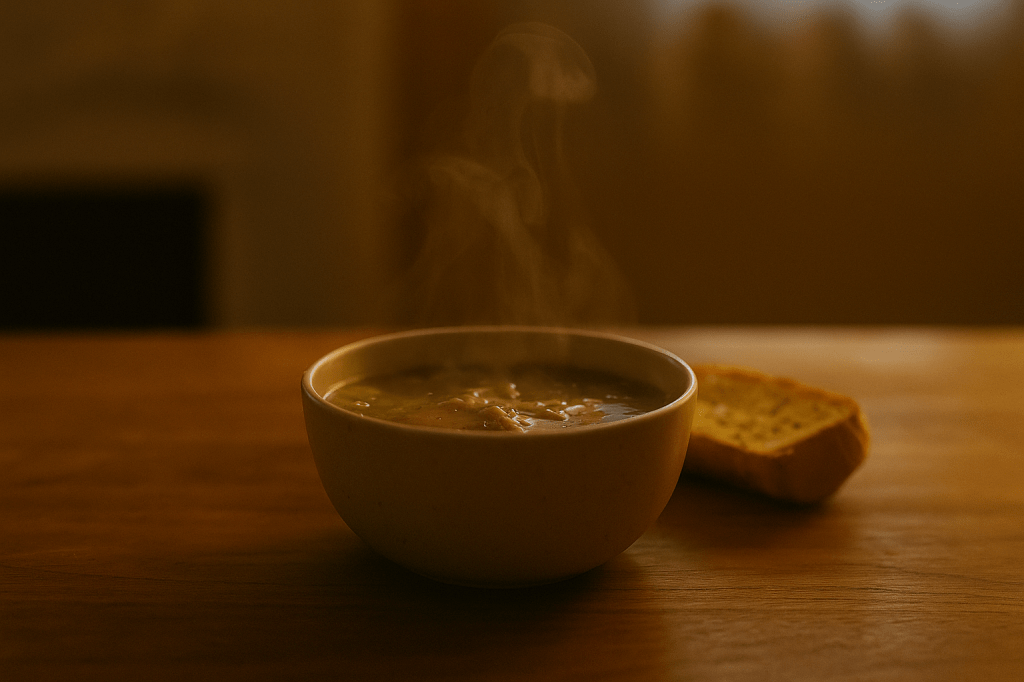
    Yesterday, I thawed one. But instead of rushing it, instead of taking the shortcut the microwave offers, I warmed it the slow way—in a pot, on low heat. Stirring occasionally. Letting the aroma rise up like a memory you didn’t realize you’d forgotten.

    Warming soup slowly feels like a kind of respect.

    A way of honoring the time it took to make it.

    A way of stepping back from the pace of everything else in life.

    When it was ready, I poured it into a bowl and paired it with garlic bread I’d tucked away in the freezer. Not fancy bread. Not homemade. But good enough—especially when its only job was to ensure that not a single drop of soup went uneaten.

    I’m generally not a fan of cold winters. The wind cuts too sharply. The days darken too early. The quiet feels heavier than I’d like to admit. But this soup—this simple bowl of warmth I made weeks ago and brought back to the stove—makes the season feel less like something to endure and more like something to move through gently.

    Soup does that.

    It softens hard days.

    It steadies you.

    It reminds you that survival doesn’t always have to be a battle—it can be as simple as letting something warm into your body and sitting still long enough to feel it.

    And maybe that’s why soup matters so much—not just to me, but to all of us.

    Because the ingredients may change. The hands that make it may differ. The kitchens may range from polished granite countertops to back-room burners in community centers. But the gift is the same:

    Here is warmth.

    Here is comfort.

    Here is something made with care, even if only for a moment.

    And in a world that asks so much of us, a simple bowl of soup can feel like an act of mercy.

    Kyle J. Hayes

    kylehayesblog.com

    Please like, comment, and share

    Resources for Hard Times

    If you’re looking for practical help, food support, or community resources, you can visit the Salt, Ink & Soul Resources Page.
    👉 Resources for Hard Times

    👉 Keto Green Chile Chicken Soup Recipe

    👉 Simple Garlic Chicken Soup Recipe

  • Holding Warmth: A Winter Note on Hot Chocolate

    Holding Warmth: A Winter Note on Hot Chocolate

    Salt, Ink & Soul — Humanity Through Food Series

    I’ve written before about meals and movies and the strange way they become anchors—how a plate of fried chicken and mac and cheese can turn into a place you go, not just something you eat. But there’s another piece of winter I’ve skimmed past. Something quieter. Smaller. The kind of comfort that doesn’t shout, just shows up and waits for you.

    Hot chocolate.

    It sounds too simple to write about. A mug of warm milk and cocoa, maybe some sugar, maybe a few marshmallows if you’re feeling generous with yourself. It doesn’t have the complexity of a slow stew or the weight of a Sunday dinner. It’s not a full meal, not a feast, not a showpiece.

    But in the right moment, it’s everything.

      Because there are nights in winter when the cold doesn’t just sit on your skin—it finds its way into your chest. Nights when the wind outside feels personal, when the dark comes a little too early and stays a little too long. Nights when you’re not sure if you’re tired or lonely or just worn thin from carrying yourself through another year.

    On those nights, hot chocolate is less about flavor and more about permission.

    Permission to pause.

    Permission to slow down.

    Permission to hold something warm when you don’t quite know how to hold yourself.

    It doesn’t really matter how you make it.

    You may be the kind of person who pulls out a saucepan, warms the milk slowly, and whisks in cocoa, sugar, and a pinch of salt, like a small ceremony. Maybe you’re standing in the kitchen with the microwave humming, a torn packet in one hand and a spoon in the other, watching the powder dissolve into something richer than it has any right to be.

    Scratch-made or instant, cheap packet or gourmet—it almost doesn’t matter.

    Because what hot chocolate really gives you isn’t just taste.

    It’s a ritual.

      For me, there’s usually a screen involved.

    A movie.

    Usually a familiar one.

    The kind you return to in December, the way other people return to a family home.

    It could be a Christmas special you’ve seen every year since childhood.

    It could be a romantic comedy that has nothing to do with the holidays, but still feels like winter because of when you first watched it.

    Maybe it’s something you stumbled onto one rough December and never let go of because it carried you through a night you didn’t want to face alone.

    The details change, but the pattern remains the same.

    You queue up the movie.

    You make the hot chocolate.

    You sit.

    And somewhere in that simple routine—screen glowing, cocoa cooling, blanket pulled up just enough—the world outside gets a little quieter. The worries don’t vanish, but they lose their sharp edges. The ache doesn’t disappear, but it stops feeling like it’s trying to swallow you whole.

    You’re not fixed.

    But you’re held.

      We love to romanticize big gestures this time of year: grand gifts, huge gatherings, the perfect table arranged like a magazine spread. But most of us are kept alive by smaller, humbler things.

    A text from a friend.

    A song we forgot we needed.

    A mug of something warm between our hands on a night when the cold feels like too much.

    Hot chocolate is one of those small mercies.

    It doesn’t demand conversation. It doesn’t care if you’re dressed right, if your house is clean, if you’ve “made the most” of the season. It doesn’t ask you to perform joy.

    It just asks you to sit down, breathe, and let yourself be warmed.

    That’s probably why it’s worth writing about.

    In a year where everything feels loud—news, opinions, expectations—this little ritual stays soft. You don’t have to earn it. You don’t have to deserve it. You just have to be willing to stand in a kitchen for a few minutes and deliberately choose to be gentle with yourself.

      You choose a mug.

    You choose a movie.

    You choose not to rush.

    And for a little while, you remember what it feels like to be cared for, even if you’re the only one in the room.

    So no, hot chocolate isn’t complicated.

    It’s not fancy.

    It’s not the kind of thing people brag about making.

    But in the heart of winter, when the air is sharp and the nights are long, it becomes something more than a drink.

    It becomes a way of saying to yourself:

    You’re still here.

    You still deserve warmth.

    You can make a little of it with your own hands.

    And sometimes, on a cold Saturday night with a good movie playing and the wind pressing against the windows, that’s enough.

    Kyle J. Hayes

    kylehayesblog.com

    Please like, comment, and share

    Salt, Ink, & Soul Hot Chocolate recipe

    Resources for Hard Times

    If you’re looking for practical help, food support, or community resources, you can visit the Salt, Ink & Soul Resources Page.

    👉 Resources for Hard Times

  • When a Meal Becomes a Memory

    When a Meal Becomes a Memory

    Salt, Ink & Soul — Humanity Through Food Series

      Certain meals stop being food and start becoming something else.

    They begin as plates you throw together because you’re hungry, because it’s Sunday. After all, that’s what somebody’s mother or grandmother always made when the week finally exhaled. But somewhere along the way, without ceremony or announcement, that meal crosses a line. It stops being just dinner and turns into a place you go.

    You don’t just eat it.

    You return to it.

    We don’t talk about it out loud most of the time, but all of us have that one plate we reach for when we’re sad, or tired, or quietly unraveling. The one we lean on when we’re happy, too. The meal that shows up for birthdays and bad days, big news and no news. The one you make when you want to be alone with your thoughts, and the one you order when you don’t have it in you to talk about what you’re feeling, but you still need something that understands.

    Mine is simple. So simple it almost feels silly to admit.

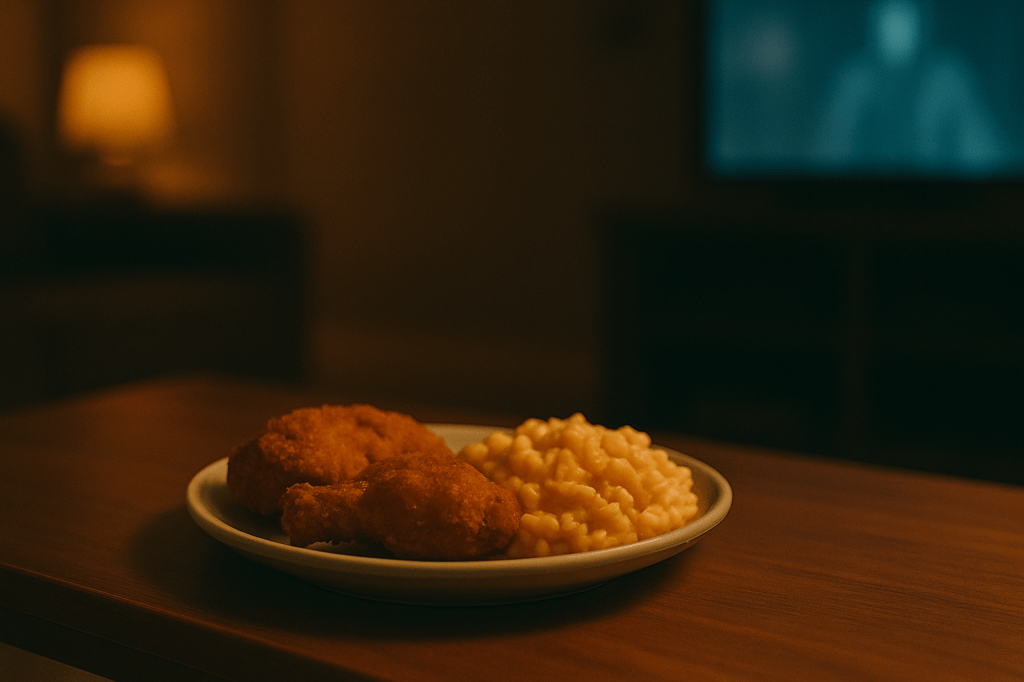
    Fried chicken and macaroni and cheese.

    That’s it.

    No fancy twist. No elevated version. Just what it is.

    From Sunday dinners to regular weekday meals, it has always been an all-purpose comfort for me. The kind of plate that doesn’t need a special occasion to make sense, but rises to meet any occasion anyway. I can’t tell you exactly when I started loving it this way. There wasn’t some cinematic moment where the camera zoomed in, and the music swelled. It just… settled in over time.

    Somewhere between childhood and now, that plate stopped being “fried chicken and mac and cheese” and became my meal. My anchor. My reset button.

      These days, it hits the hardest in December.

    Right now is the best time for it, because it’s wrapped up with another ritual: Christmas movies. The kind I’ve seen so many times I can mouth the lines before the actors say them, and yet it still doesn’t get old.

    For me, the centerpiece of that whole season is A Charlie Brown Christmas.

    I’ve watched it more times than I can count. I know when the music will swell, when the kids will dance on that small stage, when Charlie Brown will look around at the world and see something missing that nobody else wants to name. And yet, every time it comes on, it feels like I’m seeing it for the first time and coming home at the same time.

    There’s a rhythm to it now.

    I start the TV.

    I fix the plate—fried chicken, mac and cheese, nothing fancy, just right.

    I sit down and let both of them do what they do.

    The crunch of the chicken.

    The heavy, creamy weight of the mac.

    That soft, sad-sweet piano line drifting through the room.

    The screen glows. The fork moves. The world narrows down to a small circle of light, sound, and taste.

    And in that circle, I am okay.

      It’s not that the problems disappear. The bills don’t magically pay themselves because I put on a cartoon from the ’60s. The loneliness of December doesn’t evaporate because there’s cheese melting on my plate. The ghosts of old seasons, old arguments, old losses—they all still exist.

    But for the length of that special, with that plate in my lap, the sharp edges of life soften.

    The meal becomes more than calories.

    The movie becomes more than nostalgia.

    Together, they become a ritual—a small ceremony of survival.

    That’s the thing we don’t always say out loud: comfort isn’t always grand. Sometimes it’s just consistent. Sometimes it’s a plate you’ve had a hundred times and a story you know by heart showing up for you when you don’t have the words to ask for help.

    Fried chicken and mac and cheese aren’t heroic.

    Charlie Brown Christmas isn’t epic in scale.

    But somehow, when the house is quiet and the year feels heavier than you want to admit, they work together like a kind of emotional shorthand. The flavors tell your body, “You’ve been here before, and you made it through.” The movie tells your heart, “You’re not the only one who looks around and feels slightly out of place.”

      Over time, that combination becomes bigger than the sum of its parts.

    The meal calls up the memories: Sunday dinners, laughter from another room, people who were there and people who aren’t anymore. The movie folds around those memories like a blanket, wrapping the past and the present together in one long, uninterrupted feeling.

    That’s when a meal becomes a memory.

    Not because someone took a picture of it.

    Not because it landed on a holiday menu.

    But because you kept going back to it, again and again, until your life wrapped itself around it.

    You could take away the decorations, the gifts, the perfect tree, the curated seasonal playlists. And if I still had that plate and that movie, I’d still have something that felt like Christmas to me.

    It’s easy to dismiss these rituals as small, even trivial. Just comfort food. Just a cartoon. Just another December evening. But the older I get, the more I understand that these “justs” are the threads holding a lot of us together.

    Some people have big gatherings and full tables to mark this season. Others have a single plate and a glowing screen. Both are valid. Both are real. Both are ways of saying, “I’m still here. I’m still trying to feel something good.”

    So when I sit down with fried chicken, mac and cheese, and that familiar boy with the round head and heavy heart, I’m not just watching TV and eating dinner.

    I’m revisiting every version of myself that has ever needed that moment.

    Every year, I’ve made it this far.

    Every December, I’ve managed to carve out a little corner of warmth, even when the rest of the world felt cold.

    That’s the quiet power of a favorite meal in a favorite season: it doesn’t just fill you.

    It remembers you.

    It meets you where you are—sad, joyful, exhausted, hopeful, or somewhere tangled in between—and it says, “Come on. Sit down. We’ve been here before. We can do it again.”

    And in that way, a simple plate and a simple movie become something sacred.

    Kyle J. Hayes

    kylehayesblog.com

    Please like, comment, and share

    Resources for Hard Times

    If you’re looking for practical help, food support, or community resources, you can visit the Salt, Ink & Soul Resources Page.
    👉 Resources for Hard Times

  • The Quiet Dignity of Beans

    The Quiet Dignity of Beans

    Salt, Ink & Soul — Humanity Through Food Series

    I live now in New Mexico — a place where beans are more than food.

    They’re a landscape.

    A rhythm.

    A quiet religion built into the daily life of the people who’ve been here long before asphalt and subdivisions.

    Out here, beans carry the weight of generations. They simmer slowly on back burners, folded into stews, stretched across cold evenings, made sacred by repetition and memory. People speak of them with a kind of reverence I’m still learning to understand — the way you might talk about a story your grandmother told you a hundred times, knowing the hundred-and-first will still matter.

    But that wasn’t my experience growing up.

    Where I came from, the sight of beans didn’t bring comfort.

    It filled my stomach with dread.

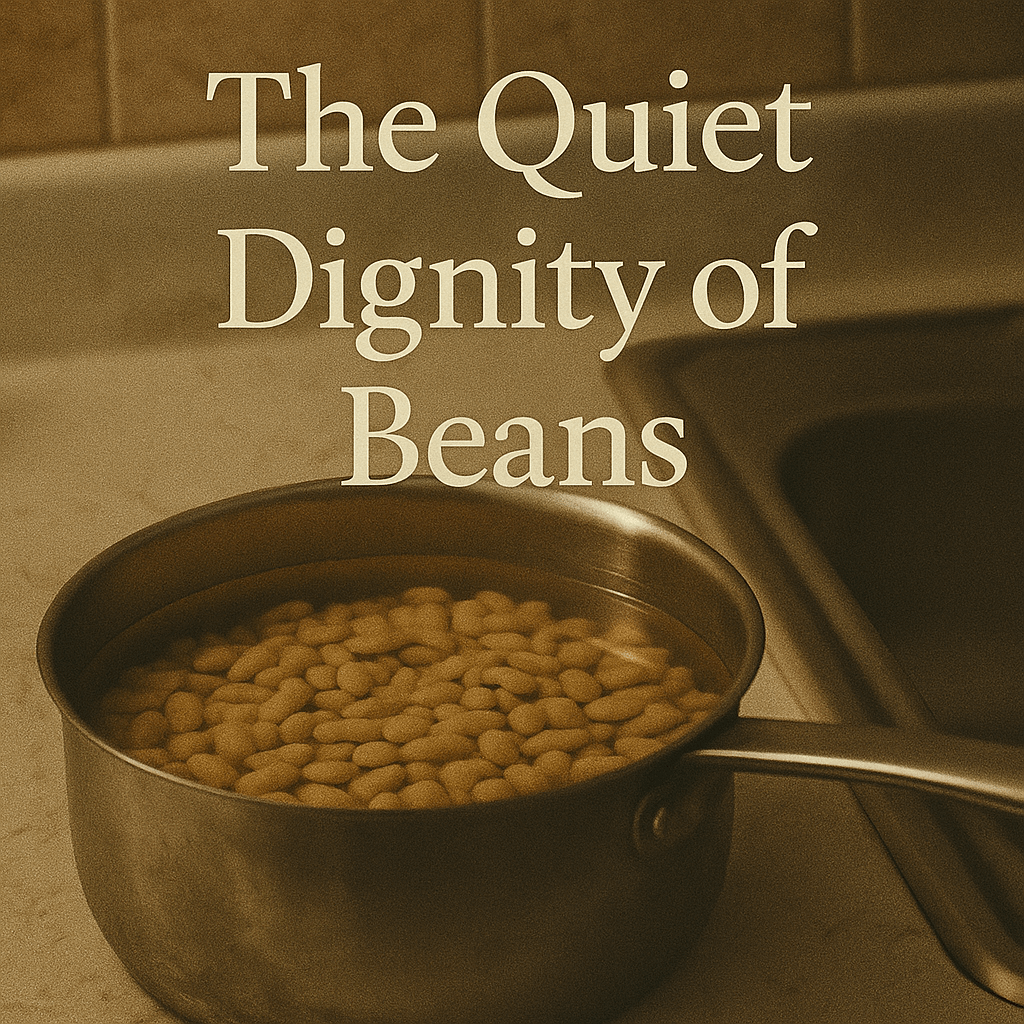
      I’ve written before about the sinking feeling that washed over me when I saw a pot of beans soaking in the sink. It was a kind of childhood math — unspoken but understood. Beans meant money was tight. Beans meant there were no extra groceries to choose from. Beans meant stretching, rationing, surviving.

    As kids, we formed a silent pact around it — not one spoken in words but in looks exchanged across the kitchen. We all felt it. That quiet disappointment disguised as appetite. Beans were never the meal we hoped for. They were the meal we needed.

    And the way we carried that memory into adulthood…

    That’s its own complicated story.

    One of my sisters swears she’s “allergic” to beans.

    A medical impossibility, the rest of us laugh at —

    not out of cruelty, but out of recognition.

    We know the truth.

    It’s not her body reacting — it’s the past.

    Invisible scars are funny that way —

    they flare up without warning,

    dictate tastes and habits,

    and live under the skin long after the hard years have passed.

    For each of us, beans became something to avoid —

    a symbol of the lean seasons we survived together.

    But here’s the truth buried under all that resistance:

    We didn’t like them…

    But they kept us alive.

    And we knew it.

    When I talk to others about this — about beans, scarcity, survival food — I’m surprised by how familiar the story feels.

    Almost everyone has a version of the same confession:

    “We didn’t like it. But we didn’t starve.”

    Peanut butter sandwiches.

    Canned soup.

    Government cheese.

    Rice dishes stretched thin.

    Leftovers reinvented until they became something else entirely.

    And, of course, beans.

    It’s strange how something so simple can carry so much emotional weight.

    A pot of beans meant another day we’d make it.

    Another day, we wouldn’t go to bed hungry.

    Another day, we’d stretch what we had until something better came along.

    Beans were the food that stood between us and the cliff.

    And now, all these years later, we still feel the echo of that grind.

      Moving to New Mexico forced me to reconsider everything I thought I knew about beans.

    Here, they aren’t a symbol of lack.

    They’re a symbol of identity.

    Of pride.

    Of cultural endurance.

    Of flavors perfected not out of necessity but out of intention.

    I’ve watched families here talk about beans the way some people talk about heirlooms — with respect, with memory, with joy. They’re part of feasts, gatherings, rituals. They hold meaning.

    It’s made me rethink what I grew up believing.

    Made me wonder if healing sometimes looks like learning to see an old wound through a new lens.

    Someone recently told me to try Navajo tacos.

    And maybe I will — perhaps that’s my first step into rewriting a relationship shaped by childhood scarcity.

    Maybe the world has been trying to teach me that beans are more than the fear I attached to them.

    I don’t know if my siblings feel that shift.

    I don’t know if they ever will.

    But I’m starting to.

    The Quiet Dignity of What Sustains Us

    The older I get, the more I realize this:

    There is a quiet dignity in the foods that kept us alive.

    Even the ones we claimed to resent.

    Even the ones that came with silent embarrassment.

    Even the ones we push away now, out of habit or history.

    Because survival has its own kind of grace —

    a soft, steady grace that doesn’t ask to be admired.

    It just asks to be acknowledged.

    Beans taught me that.

    They taught me resilience long before I had the language for it.

    They taught me how families stretch together.

    How siblings develop the same scars in different shapes.

    How a kitchen can hold both struggle and salvation at once.

      Beans may not have been our first choice. They may have carried more memories than flavor back then. But they fed us. They kept us standing. And in their own quiet way, they taught us how to survive when survival felt like the only thing we could afford.

      I wish I could end this with a great bean recipe—some treasured family dish or perfected method—but the truth is, I don’t have one. If you do, or if there’s a recipe that carried you through your own seasons of scraping by and making do, please share the link. I’d be grateful to learn from you.

    Kyle J. Hayes

    kylehayesblog.com

    Please like, comment, and share

    Resources for Hard Times

    If you’re looking for practical help, food support, or community resources, you can visit the Salt, Ink & Soul Resources Page.
    👉 Resources for Hard Times

  • “Questions for the Future”

    “Questions for the Future”

    There’s a kind of fear that doesn’t arrive all at once. It doesn’t kick down the door. It seeps in, like humidity through cracked paint or smoke through the seams of a closed window. The kind that makes a home in your chest, building slowly and silently. That’s the kind of fear I’ve had about writing.

    Because writing—real writing—isn’t just performance. It’s not what you show them. It’s what leaks out in the spaces you don’t control. In the metaphors you didn’t mean to use. The slip of a memory. The softness in a sentence when you swore you were being strong. That’s the terror. That somehow, on a blank page, people will see you—unasked, unfiltered, unprepared.

    And I’ve been dodging that kind of exposure for a long time.

      You grow up learning to hide parts of yourself. In some neighborhoods, vulnerability is just another way to get hit—emotionally, spiritually, or with something less metaphorical. So you learn. You get good at it. You make armor out of silence and humor out of pain. You laugh loud enough to drown out the parts of yourself you don’t want heard.

      For me, it started early—ridiculed for being soft. For caring. For feeling things too deeply. Every time I let something slip, there was a consequence. Sometimes it was teasing. Sometimes it was loneliness. Over time, the message became clear: protect yourself.

    So I did. I built walls with intention. Not just to keep people out, but to keep something in—me.

      Lately, though, I’ve started letting people in. Not the whole crowd. Just a few. Just enough. You find someone you trust—maybe a friend who knows the shape of your silence—and you let them see a little more. A crack. A draft of warmth. Not a storm.

    But still, I worry.

      Because once the dam is broken, who controls the flood?

    That’s the thing about pain: it’s obedient until it isn’t.

    So I let it out in trickles. A sentence here. A sigh there. I’ve convinced myself that’s safer. That if the moment goes sideways, I can slam the valve shut and pretend like I never said anything at all.

    I’m curious if that’s preservation or cowardice. Or both.

      Sometimes, the isolation feels like a weighted blanket that won’t get off my chest. You carry the weight of your untold stories like overdue bills, knowing the interest is accumulating. You pretend you’re just private. But privacy, in excess, becomes starvation.

    You tell yourself you’re protecting yourself—but at what cost?

    When no one knows your whole name, who will mourn you properly?

      That’s the mess of it. Writing—this act of storytelling—isn’t always about catharsis. Sometimes it’s confrontation. Sometimes it’s putting a mirror to your own face and realizing you’ve spent years looking away. The stories we don’t tell are often the ones we most need to understand.

    I write now not because I want to be known, but because I’m starting to believe that parts of me are worth knowing.

    And if someone out there reads this and recognizes their own mask, their own silence, their own slow-burning rage and resignation—maybe we’ve both done something that matters.

      I don’t have answers. Just questions for the future.

    What happens when you open too much?

    What happens when you never open at all?

    Maybe the trick isn’t to dam the flood or drown in it—maybe it’s to learn to wade.

    Even if it means revealing that you bleed just like everyone else.

    Kyle J. Hayes

    kylehayesblog.com

    Please like, comment, and share

    Resources for Hard Times

    If you’re looking for practical help, food support, or community resources, you can visit the Salt, Ink & Soul Resources Page.
    👉 Resources for Hard Times

  • What I’m Grateful For on the Days After

    What I’m Grateful For on the Days After

    Salt, Ink & Soul — Weekend Reflection

    The days after Thanksgiving have always felt like a breath I didn’t realize I was holding. The noise fades, the house settles, and suddenly there’s space — space to think, to feel, to hear the quiet truths that get lost in the rush of the holiday.

    There’s a different kind of gratitude that lives in these slower hours.

    Not the big, performative kind that gets spoken around tables or posted online.

    But the smaller, steadier kind — the gratitude that rises from the life you return to when the celebration ends.

    I’m grateful that I have a place to stay — a space that holds me, shelters me, and gives me room to breathe.

    I’m grateful that I have food to eat — not just the leftovers stacked in the fridge, but the comfort of knowing the next meal is within reach.

    I’m grateful that I have a job to go to — a place to show up, to contribute, to remain anchored in a world that often feels uncertain.

    And I’m grateful — deeply, quietly grateful — for my friends.

    The ones who check in without being asked.

    The ones who text or call just to make sure I’m alright.

    The ones who notice the small shifts in my voice and remind me I don’t have to carry everything alone.

    That kind of care is its own blessing.

    Soft, steady, and honest.

    I’m grateful for the leftovers that gently carry me into the days ahead.

    For the containers packed a little fuller than expected.

    For the warmth of yesterday lingering inside today’s refrigerator light.

    Some blessings arrive loud.

    Others whisper.

    And I’m learning — slowly, steadily — to hear both.

    Kyle J. Hayes

    kylehayesblog.com

    Please like, comment, and share

    Resources for Hard Times

    If you’re looking for practical help, food support, or community resources, you can visit the Salt, Ink & Soul Resources Page.

    👉 Resources for Hard Times

  • The Quiet Reckoning of Leftovers

    The Quiet Reckoning of Leftovers

    Salt, Ink & Soul — Humanity Through Food Series

    There’s a certain hush that falls after Thanksgiving — not the fullness or fanfare of the holiday itself, but a softer, more settling quiet. The kind that wraps around a home like a warm blanket. The kind that whispers that the celebration may be over, but the comfort isn’t.

    Because today is when the real magic begins.

    Today is the day the leftovers come alive.

    The fridge becomes its own little universe of possibility — containers lined like tiny promises. Dressing that deepens overnight, turkey that’s ready to reinvent itself into a dozen different meals, pound cake that turns into breakfast without anyone questioning a thing. Leftovers are the afterglow of a holiday well-lived, and maybe even better lived the day after.

    For those of us raised to stretch meals like muscles, leftovers weren’t just “extra food.” They were reassurance. Security. A quiet kind of abundance that steadied you through the next few days. Maybe even next week.

    Leftovers meant:

    We’re okay. At least for now.

      There’s a joy to leftovers that feels almost childlike — the thrill of opening the fridge and imagining what new creation you’ll craft from what remains.

    Turkey and rolls?

    That’s a sandwich ritual.

    Dressing and gravy?

    That’s comfort in a bowl.

    Macaroni and cheese?

    Somehow it gets better every time it’s reheated — nobody knows the science, but nobody questions it.

    In a world obsessed with novelty, leftovers teach us a quieter truth:

    There is beauty in returning to what you already have, in transforming what remains, in finding comfort in the familiar.

    The feast is flashy.

    The leftovers do the real work.

      And then there’s the kind of generosity that only shows up after the plates are cleared — the people who send you home with more than you expected, more than you asked for, maybe even more than you felt worthy of receiving.

    The friend who packs you a dessert “just in case.”

    The auntie who fills your container until the lid strains.

    The host who insists you take another tray, their eyes saying what words never do:

    I want you fed.

    I want you steady.

    I want you to be cared for when you walk out that door.

    That is its own kind of love.

    A quiet, intentional love that doesn’t perform — it provides.

    Sometimes the food you bring home is better than anything you ate at the table, not because of the taste, but because someone wanted you to have it.

    Leftovers can be a love language, too.

      If the holiday feast is the performance, the leftovers are the truth.

    They reveal:

    • what was made with abundance

    • what was shared freely

    • what was loved most

    • what people wanted you to take with you

    • and what gets better when it rests

    Leftovers tell the story of a household — the real version. The version where people quietly look out for each other. The version where meals stretch because life requires it. The version where comfort doesn’t disappear once the guests go home.

    Leftovers tell us that survival doesn’t always look heroic.

    Sometimes it looks like enough food for tomorrow.

    Sometimes it looks like mac and cheese after a long day.

    Sometimes it looks like a pound cake eaten slowly because it feels like a blessing wrapped in foil.

      Leftovers aren’t scraps.

    They’re gifts.

    Gifts of ease.

    Gifts of warmth.

    Gifts of a holiday that lingers.

    Gifts from people who fed you in more ways than one.

    They carry the flavor of yesterday into today.

    They soften the week ahead.

    They remind you that abundance doesn’t always roar —

    sometimes it whispers from behind a refrigerator door, waiting for you to reach in and begin again.

    Because leftovers aren’t just evidence of what you had.

    They’re evidence of what still remains.

    And sometimes?

    That’s more than enough.

    Kyle J. Hayes

    kylehayesblog.com

    Please like, comment, and share

    Resources for Hard Times

    If you’re looking for practical help, food support, or community resources, you can visit the Salt, Ink & Soul Resources Page.

    👉 Resources for Hard Times