Category: Culture & Identity

  • Another Year, Still Becoming

    Another Year, Still Becoming

    There is something strange about a birthday when you are no longer young enough to believe that time is endless, but not yet old enough to stop asking what can still be made from what remains.

    Another year has gone by.

    Usually, those words pass through me with a familiar feeling. A small accounting. A quiet glance backward. A brief pause before returning to the ordinary rhythm of the days. But this year feels different. Not louder. Not grander. Not wrapped in some sudden revelation or clean transformation.

    Just different.

    Quieter.

    Closer to the truth.

    I have been slowly becoming the person I once hoped I might be. Not in the polished way people talk about change when they want it to sound easy. Not in the clean language of motivation, where every wound becomes a lesson, and every loss becomes fuel. Real becoming is messier than that. It does not always arrive with applause. Sometimes it looks like sitting alone with a thought you used to run from. Sometimes it looks like writing one honest sentence and feeling your chest tighten because the page now knows something you were trying not to admit.

    For a long time, I carried things instead of naming them.

    Pain. Sorrow. Anger. Disappointment. The old ache of being misunderstood. The quiet exhaustion of trying to explain yourself to people who had already decided who you were.

    I kept too much inside.

    That is a dangerous kind of storage. The body becomes a basement. The mind becomes a locked room. The heart becomes a pantry full of old things nobody has touched, but everybody can smell. You think you are protecting yourself by not opening the door. But silence does not preserve pain. It ferments it.

    People say writing helps.

    I had heard that for years.

    Write it down. Get it out. Put it on the page.

    It sounded too simple to be true. Too soft. Too neat. The kind of advice people offer when they do not know what else to say. But this year, I learned there is a difference between hearing something and finally understanding it in your bones.

    Writing does help.

    Not because the page fixes everything. It does not. The page is not a miracle worker. It will not reach backward and undo what happened. It will not make childhood kinder, grief lighter, or disappointment less sharp. But the page gives the pain a place to stand outside of you.

    That matters.

    There are things I have written that no one will ever see. Things too private for public life. Things that belong only to me and the silence that held me while I wrote them. And maybe that is the point. Not everything has to be published to be powerful. Not every wound has to become content. Not every confession needs an audience.

    Some writing is not for the world.

    Some writing is how you survive yourself.

    This year, I learned how to write without holding back. Or at least, I began to learn. I started putting down the things I had been carrying in secret. The thoughts that came in the dark. The old sorrows with familiar faces. The questions that do not have clean answers.

    And somehow, in putting them down, I left some of them behind.

    Not all.

    I know better than that now.

    Healing is not a dramatic exit. It is not the door slamming shut behind pain while you walk into the sunlight reborn. Sometimes healing is smaller than that. Sometimes it is realizing that a memory no longer controls the whole room. Sometimes it is noticing you can speak of something that once broke you without breaking again. Sometimes it is simply waking up and discovering that yesterday’s sorrow did not take all of today.

    There are pains I have left behind.

    There are sorrows I no longer feed.

    I can now look at old versions of myself with compassion instead of shame.

    That is no small thing.

    We live in a world that loves measurement. Numbers. Milestones. Income. Followers. Weight lost. Books sold. Goals achieved. Proof, proof, proof. We are told to become better, but usually in ways that can be photographed, posted, monetized, or turned into a lesson for strangers.

    But some of the most important growth is invisible.

    No one claps when you stop hating yourself in one small area.

    No one sends flowers when you choose patience instead of anger.

    No one gives you a certificate for writing the truth in a private notebook and choosing not to drown in it.

    Still, these things count.

    They may be the only things that truly count.

    I still have goals. I still want to write better. I still want my work to reach people. I still want the sentences to carry more truth, more weight, more tenderness. I still want to build something that lasts beyond me, something my descendants might one day hold and say, He was here. He tried to tell the truth. He tried to leave a light on.

    But my goals feel different now.

    Less like a punishment.

    Less like a whip.

    Less like a scoreboard I use against myself.

    My current goal is simple.

    To be better.

    A better writer.

    A better person.

    That sounds plain, almost too plain. But there is depth in plain things. A pot of beans. A clean table. A quiet morning. A sentence that does not lie. The older I get, the more I trust what does not need decoration.

    To be better does not mean to become perfect.

    I am not interested in that kind of performance.

    Perfect people are usually hiding something. Or selling something. Or both.

    To be better means to be more honest than I was. More patient. More disciplined. More willing to listen. More willing to admit when I am wrong. More willing to soften without becoming weak. More willing to stand firm without becoming cruel.

    It means learning that strength is not always volume.

    It means understanding that manhood is not the absence of tenderness.

    It means knowing that pain may have shaped me, but it does not have to govern me.

    And it means accepting that none of this happens overnight.

    There is a kindness in that realization. A mercy. We are not finished products. We are not machines waiting for the correct program. We are living things. We grow unevenly. We bend toward light when we can. We carry damage in our rings like old trees. Some seasons produce fruit. Some seasons only teach the roots to hold.

    This year, I think I learned something about roots.

    I learned that private work matters.

    The unseen work matters.

    The quiet effort made when no one is watching matters.

    The sentence was written and deleted. The memory faced and survived. The apology is considered. The old anger questioned. The small promise kept. The day endured without giving up on yourself.

    These are not small things.

    They are the architecture of becoming.

    So this birthday does not feel like a celebration in the usual sense. I do not need noise. I do not need spectacles. I do not need the day to prove my worth through attention.

    What I want is quieter.

    A good meal.

    A little music.

    A clean room.

    A page.

    A moment to look at the man I was, the man I am, and the man I am still trying to become.

    And maybe that is enough.

    Maybe another year is not just a reminder that time is passing.

    Maybe it is also evidence.

    Evidence that I stayed.

    Evidence that I changed.

    Evidence that some part of me, even in the worst seasons, kept reaching toward the life I had not yet learned how to live.

    I am still becoming.

    Not quickly.

    Not perfectly.

    But honestly.

    And this year, that feels like a gift.

    Kyle J. Hayes

    kylehayesblog.com

    Please like, comment, and share

    Resources for Hard Times

    If you’re looking for practical help, food support, or community resources, you can visit the Salt, Ink & Soul Resources Page.

    👉 Resources for Hard Times

  • The Theater Forgot to Sing

    The Theater Forgot to Sing

    I loved the new Michael.

    I want to begin there plainly.

    Not with an argument.

    Not with a defense.

    Not with the careful language people sometimes reach for when something connected to memory, fame, Blackness, childhood, music, and history walks back into the room.

    I loved it.

    The songs moved me.

    Not in some distant, critical way. Not the way a person listens to music after they have read all the books, watched all the interviews, studied all the contradictions, and learned how to hold admiration at arm’s length. I mean, the songs moved me in the old way. The body-before-language way. The way music enters through some door you forgot was still open.

    At fifty-five, I do not hear those songs as artifacts.

    I hear them as weather.

    I hear them as radio coming through a kitchen that probably smelled like something frying, or boiling, or being stretched into enough. I hear them from the backseat of cars where adults controlled the dial, and children learned the world through whatever sound came through the speakers. I hear them on Saturday morning, as vinyl, as television, as that strange and beautiful era when even a cartoon version of the Jackson 5 felt like an event. I remember that cartoon. I remember what it meant to see Black children animated into joy, color, rhythm, and possibility.

    Maybe that sounds small to someone who did not come up that way.

    It was not small.

    There are certain things you do not understand as history when you are living them. You only know that they are there. You only know that they have become part of the wallpaper of your becoming. The music played, and you were young. The world was not simple, but for three minutes at a time, it had a beat. It had a hook. It had a high note that made you think the ceiling could be negotiated.

    So when I sat in that theater, I was not just watching a film.

    I was sitting with a younger version of myself.

    The boy who heard those songs before he knew how complicated people could be. The boy who watched the Jackson 5 cartoon without needing permission. The boy who did not yet understand how memory works, how it stores light right next to shadow, how it refuses to separate joy from the time that gave it to you.

    The theater itself was nice. Comfortable. Clean. Respectable.

    The audience was attentive and respectful.

    And that, oddly enough, became my problem.

    Because as a Black American, I know how we can be in a movie theater. And I will be honest: sometimes it bothers me. Sometimes the talking is too much. Sometimes the commentary arrives before the scene has finished breathing. Sometimes the theater becomes less a place of watching and more a place of public performance.

    There are times when I want quiet.

    There are times when I want people to sit down, hush, and let the movie do what it came to do.

    But this time, sitting in all that good behavior, I found myself missing the very thing I sometimes complain about.

    I had heard stories of other audiences singing along. People are dancing in their seats. People clapped when the old songs came alive. People who understood that certain music was never meant to be consumed silently, like medicine taken alone in a dark room. Some songs are communal property. Some songs do not belong to the screen once they begin. They belong to everybody who survived long enough to remember them.

    And I wished I had been there.

    I truly did.

    I wished I had been in the theater where somebody forgot themselves during a chorus. Where an auntie somewhere in the middle row could not help but sing. Where somebody’s foot betrayed them. Where the room stopped pretending it was only an audience and became, for a little while, a family reunion without potato salad, folding chairs, or somebody arguing over who made the greens.

    Because I would have joined in.

    I know that now.

    The part of me that usually wants order would have stepped aside. The part of me that loves silence would have understood that this was not noise. This was testimony. This was memory refusing to stay seated. This was the body remembering what the mind had tried to file away.

    There is a difference between disruption and communion.

    There is a difference between people being rude and people being careless.

    And maybe that is what I wanted.

    To be carried.

    Not just entertained. Not simply impressed. Carried backward and forward at the same time. Back to the radio. Back to the cartoon. Back to the sound of a people finding brilliance in children, rhythm in hardship, spectacle in discipline, and magic in a world that did not always make room for Black genius unless it could first package it, sell it, and survive off the shine.

    Michael’s music, especially for those of us who grew up with it, is not just celebrity memory. It is part of the architecture. It was in the rooms we lived in. It was in the cars. It was at family gatherings. It was on television when television still felt like a shared national fireplace. It gave us something to marvel at.

    And Black people know what marveling means.

    We know what it is to look at one of our own doing something impossible and feel, for a moment, that the impossible has been slightly revised.

    That is why the respectful silence felt incomplete to me.

    Not wrong.

    Just incomplete.

    Maybe it was only my particular audience. Maybe I caught the quiet room. Maybe everyone else was feeling what I was feeling, but had been trained, like me, to behave. Maybe we were all sitting there with songs rising in our chests, politely swallowing them back down.

    There is something sad about that.

    Not tragic. Just sad.

    Because sometimes respect can become another kind of restraint. Sometimes we are so careful not to disturb the room that we forget we are allowed to be alive in it. Sometimes adulthood teaches us to sit still during the very songs that once taught us how to move.

    I left the theater grateful, but also a little hungry.

    Hungry for the version of the experience where the room loosened. Where people remembered they had bodies. Where nostalgia wasn’t treated like a museum piece behind glass, but like something you could clap along to. Something you could sing wrong and still mean with your whole heart.

    Maybe that is why I believe I will go see it again.

    Not because I missed the film.

    Because I may have missed the room I was supposed to see.

    I want another chance to sit among people who remember. People who know that certain songs do not simply play. They open a door. And when that door opens, the child in you steps through first.

    At fifty-five, that child is still there.

    Older now. Quieter. More careful. More aware of the cost of everything.

    But still there.

    Still listening.

    Still remembering the radio.

    Still remembering the cartoon.

    Still waiting for the room to sing.

    Kyle J. Hayes

    kylehayesblog.com

    Please like, comment, and share

    Resources for Hard Times

    If you’re looking for practical help, food support, or community resources, you can visit the Salt, Ink & Soul Resources Page.

    👉 Resources for Hard Times

  • Time, Distance, and the Things We Call Family

    Time, Distance, and the Things We Call Family

    It doesn’t take much to realize how far we’ve drifted.

    Not in miles.

    Not even in years.

    In the quiet spaces

    where we used to sit together.

    We move now.

    We relocate.

    We begin again in other places.

    And somewhere in that movement, something else moves too.

    Something harder to name.

    The habit of being known.

    Our families are not always close.

    Sometimes that’s geography.

    Sometimes it isn’t.

    You can live down the street from someone

    and still feel like a stranger to them.

    So we tell ourselves the past was different.

    That families were closer.

    That people showed up more.

    But was it?

    Or do we remember what we need to?

    Memory softens things.

    It keeps the warmth.

    Let the rest fade.

    And maybe that’s how we survive.

    But it leaves us with a question—

    What do we really mean when we say family?

    Because family is supposed to be more than a relation.

    More than shared blood or a last name.

    It’s supposed to be the place

    where your existence isn’t negotiated.

    The room where you don’t have to prove your worth.

    The table where your presence is enough.

    It’s supposed to be a shelter.

    Not just from the world—

    But from the weight of it.

    A place you can arrive tired, uncertain, and undone…

    and still be received.

    Not fixed.

    Not judged.

    Received.

    It’s supposed to be people who remember you

    without holding you hostage to who you used to be.

    People who let you grow.

    Who makes room for who you’re becoming?

    People who don’t keep score.

    Who shows up with what they have—

    a meal, a call, a ride, a hand on your back—

    and remind you that you’re not alone.

    That’s what family is supposed to mean.

    But supposed to is a heavy phrase.

    Because for many,

    that wasn’t the truth.

    For some, family was distant.

    Or silence.

    Or something that looked like love

    but never felt like safety.

    And if we’re honest,

    people come and go.

    We accept that with friends.

    But is family really different?

    Sometimes it is.

    Sometimes it isn’t.

    People leave.

    Through distance.

    Through time.

    Through things we don’t always say out loud.

    And sometimes the ones who stay

    are the ones who choose to.

    Not because they have to.

    Because they want to.

    Friendship has done the work

    we were told only family could do.

    Showing up.

    Holding space.

    Staying.

    Which means maybe the question isn’t

    who we’re related to.

    It could be simpler than that.

    Who shows up?

    Who makes room?

    Who tells the truth gently.

    Who lets you be more than who you used to be?

    That might be family.

    And it might not always look the way we were taught it should.

    Time and distance don’t just pull people apart.

    They reveal things.

    Who was there out of habit.

    And who was there out of care?

    Who can survive the space

    and still come back with something human?

    And who only knew how to love you

    when you were close enough to reach.

    Family isn’t about perfection.

    Or permanence.

    Maybe it’s about home.

    The people who let you set something down.

    The people who don’t make you smaller to stay.

    The people who can sit with you

    after everything has shifted…

    and still recognize you.

    If you have that, hold it.

    If you didn’t,

    That absence isn’t your fault.

    And if you’re still looking—

    remember this:

    Family has always been more than blood.

    Kyle J. Hayes

    kylehayesblog.com

    If this found you at the right time,

    Feel free to like, comment, or share it with someone who might need it too.

    Resources for Hard Times

    If you’re looking for practical help, food support, or community resources, you can visit the Salt, Ink & Soul Resources Page.
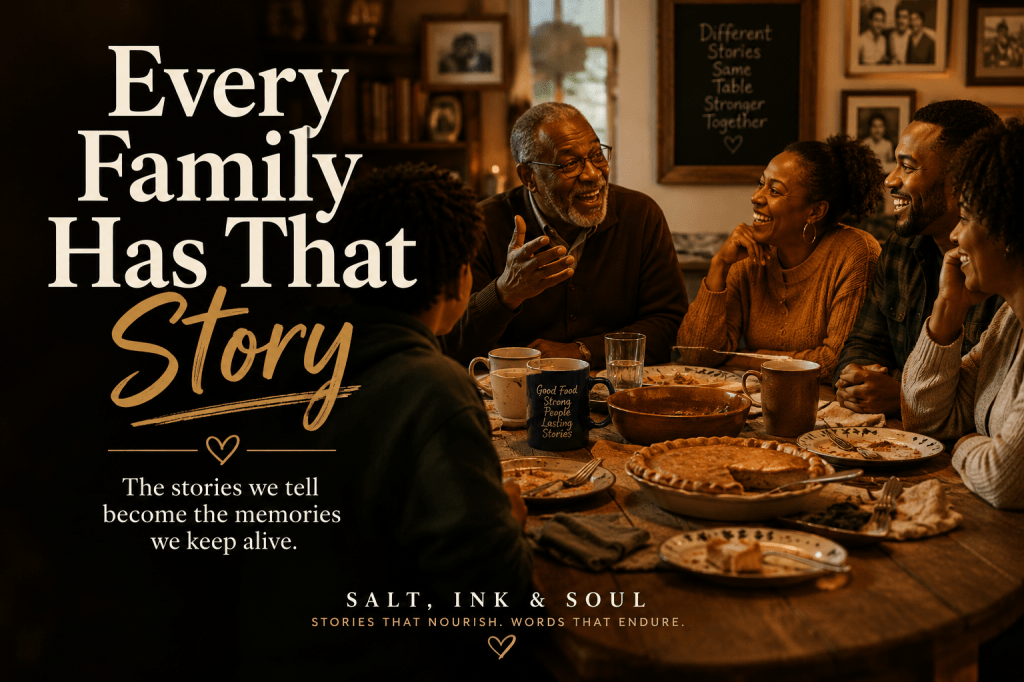
    👉 Resources for Hard Times

  • The Table Still Matters

    The Table Still Matters

    I try not to say much on Sundays.

    But this has been sitting with me.

    Food costs more now.

    You feel it at the store.

    You feel it before you even decide what to cook.

    But the part that stays with me isn’t just the price.

    It’s what we’re slowly letting go of.

    Sunday used to mean something.

    Not because everything was easier.

    But because people made time anyway.

    Now we go out.

    We wait.

    We pay.

    We leave.

    And somewhere in that, something quieter disappears.

    So maybe… stay home.

    Cook what you can.

    Nothing complicated.

    Nothing perfect.

    Sit down with people who know you.

    People who don’t need a menu to understand you.

    The table doesn’t need much.

    Just a place.

    A little time.

    Someone willing to share it.

    That might still be enough.

    Kyle J. Hayes

    kylehayesblog.com

    If this found you at the right time,

    Feel free to like, comment, or share it with someone who might need it too.

    Resources for Hard Times

    If you’re looking for practical help, food support, or community resources, you can visit the Salt, Ink & Soul Resources Page.

    👉 Resources for Hard Times

  • When a Rap Battle Becomes a Reckoning

    When a Rap Battle Becomes a Reckoning

    Two years ago, we didn’t yet understand what we were watching.

    It looked small at first. Familiar. Another flare-up in a genre built on pressure and pride. Another moment where two men sharpened language into something meant to cut. We have seen that before. We have been taught to expect it. Hip-hop has always known how to turn conflict into rhythm, into spectacle, into something you can nod your head to even as it bruises.

    But this felt different.

    Not immediately. Not at the beginning.

    It took time.

    That is how earthquakes work. The ground does not announce itself all at once. It shifts quietly beneath you, rearranging things you thought were fixed, until one day you realize the landscape is not what it was.

    And by then, it’s already happened.

    I did not arrive at Kendrick Lamar through reverence.

    I arrived the way many of us do now—through fragments. Through what was handed to me. Through what was already popular enough to reach me without effort. After the 2022 Super Bowl, I began listening, but not studying. Sampling, not sitting. I knew the songs people knew. The ones already flattened into familiarity.

    But I did not yet understand the architecture.

    I did not yet understand that some artists do not make songs. They are building rooms. And those rooms are not always comfortable places to stand.

    By the time Mr. Morale & the Big Steppers arrived, I could feel something shifting, even if I didn’t yet have the language for it. That album did not ask to be liked. It asked to be endured. It asked you to sit with a contradiction. With confession. With the uncomfortable truth that growth does not always look like progress.

    And maybe that was the beginning of it for me.

    Not the battle.

    But the preparation.

    Because the truth is, what happened in 2024 did not begin in 2024.

    It began in 2013, when Kendrick stepped onto “Control” and did something that, at the time, felt like sport. He named names. He made ambition sound like confrontation. It was framed as competition, but competition has a memory. And memory, when left long enough, becomes something else.

    You could hear it if you went back.

    In Drake’s “The Language.”

    In Kendrick’s verses that refused to soften.

    In “King Kunta,” where the accusations didn’t need to be named outright to be understood.

    For years, it lived in that space hip-hop knows well—half-lit, half-spoken, never fully denied. A tension you could feel without being told.

    Until someone said it plainly.

    “Big three.”

    And another voice answered:

    No.

    When “Like That” dropped, something old finally exhaled.

    And what followed was not just music.

    It was an escalation.

    “Push Ups.”

    “Taylor Made Freestyle.”

    “Euphoria.”

    “6:16 in LA.”

    “Family Matters.”

    “Meet the Grahams.”

    “Not Like Us.”

    “The Heart Part 6.”

    A sequence that felt less like a back-and-forth and more like a dismantling. Not just of reputations, but of identity itself. Each record didn’t just respond. It reframed. It attempted to redefine the other man in public.

    And that is where it stopped being entertainment.

    Because when accusation enters the room—real accusation, heavy accusation, the kind that reaches beyond art and into life—you are no longer just listening. You are witnessing something that carries weight beyond rhythm.

    The music no longer existed in isolation.

    It spilled.

    Into headlines.

    Into conversations that had nothing to do with rap.

    Into people who had never followed either artist, but suddenly had an opinion.

    That is when you know something has changed.

    When the audience is no longer just fans, but witnesses.

    After it ended—or at least after it slowed—I went backward.

    Because that is what moments like this demand of you. They send you into the archive. They make you reconsider what you thought you understood.

    Lines sound different when you know where they were headed.

    Verses carry a weight they didn’t have before.

    “Control” becomes less of a spark and more of a blueprint.

    “King Kunta” sharpens.

    “First Person Shooter” stops sounding like a celebration and starts sounding like a miscalculation.

    You begin to understand that some conflicts are not sudden.

    They are patient.

    They wait.

    And then came what felt, to me, like the real shift.

    Not the songs.

    Not even the outcome.

    But what came after.

    The lawsuit.

    Because something about that moment felt like crossing a line that had always been there, even if we didn’t acknowledge it. Hip-hop has always existed in tension with power—economic power, corporate power, the machinery that turns art into product.

    But to see a rap battle move from the booth to the courtroom…

    That changes the feeling of it.

    It reminds you that this thing we love does not live outside of systems. It moves through them. It is shaped by them. And sometimes, it is constrained by them in ways we don’t fully see until moments like this pull the curtain back.

    It is one thing to win a record.

    It is another thing to contest what that record does once it leaves your hands.

    And still, Kendrick kept moving.

    The album.

    The Grammys.

    The Super Bowl.

    The tour.

    Each step is not just a continuation, but a widening.

    Because winning a battle is one thing.

    Turning that moment into something lasting—that is something else.

    By the time he stood on that stage, in front of the largest audience possible, it no longer felt like we were watching a rapper.

    It felt like we were watching a moment that had outgrown its origin.

    And what stayed with me was not the victory.

    It was the restraint.

    The decision to center the story over spectacle.

    To stand in the aftermath of noise and choose something deliberate.

    That is harder than it looks.

    Kendrick has said he is not our savior.

    And I understand that.

    Because we ask too much of people, we turn them into symbols. We expect them to carry our belongings. Our questions. Our contradictions. Our need to believe someone else has clarity we do not.

    That is not fair.

    But I find myself returning to that word anyway.

    Not as worship.

    Not as absolution.

    But as recognition.

    Because sometimes what saves you is not a person.

    It is a reminder.

    A reminder that language can still be sharp.

    That art can still demand something of you.

    That you are allowed—maybe even required—to think more deeply than what is handed to you at the surface.

    That is what this did for me.

    It pulled me out of passive listening.

    It made me go back.

    Made me sit longer.

    Made me hear not just what was said, but what was built beneath it.

    And in a time where so much is designed to be consumed quickly, forgotten easily…

    That feels rare.

    So when I look back now, I don’t just see a feud.

    I see an education.

    I see how something that started as competition has become more like an examination. Of artistry. Of ego. Of truth and performance and the space between them.

    I see how I entered through familiarity and stayed because something deeper kept calling me back.

    And I think about how often we miss that.

    How often do we stand at the beginning of something, thinking it is small, not realizing we are already inside something that will change how we understand the thing itself?

    Some moments are noise while they are happening.

    And history once they pass.

    This was both.

    And what it left behind, at least for me, is simple:

    I listen differently now.

    And sometimes, that is enough.

    Kyle J. Hayes

    kylehayesblog.com

    If this found you at the right time,

    Feel free to like, comment, or share it with someone who might need it too.

    Resources for Hard Times

    If you’re looking for practical help, food support, or community resources, you can visit the Salt, Ink & Soul Resources Page.

    👉 Resources for Hard Times