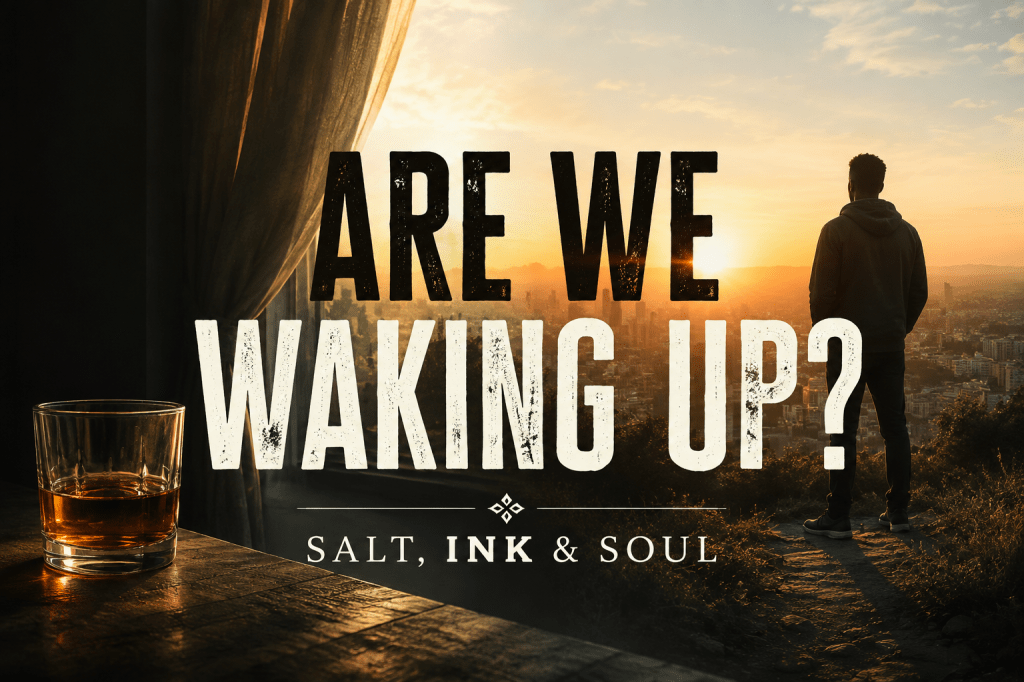
I heard someone say recently that alcohol makes you stupid.
That was it.
Nothing profound.
It was said almost casually, a quick explanation for the behavior of some people sitting around drinking. The kind of sentence you hear, maybe laugh at, and forget before the conversation moves on.
Except I didn’t forget it.
It followed me.
Because the more I thought about it, the less ridiculous it sounded.
Alcohol does not actually make a person stupid. Intelligence doesn’t disappear into the bottom of a glass.
But alcohol does remove things.
Judgment.
Restraint.
Inhibition.
Patience.
Sometimes fear.
Sometimes shame.
Sometimes that little voice inside us that says:
Maybe don’t do that.
We even have language for what happens afterward.
“He wasn’t himself.”
“She had too much to drink.”
“I don’t remember what happened.”
“I would never have done that sober.”
We say these things because somewhere inside them is an understanding that alcohol can interfere with some of the machinery we use to govern ourselves.
And I started wondering about that.
Not just about drinking.
About anesthesia.
About what happens when numbness becomes ordinary.
Because there is another side to alcohol that doesn’t get talked about nearly as much.
Sometimes people aren’t drinking because they want to become wild.
Sometimes they are drinking because they are tired.
Sometimes they want the world to become quiet for a few hours.
The bills are still sitting on the table.
The marriage is still failing.
The job still hurts.
The loneliness will still be waiting tomorrow morning.
The grief hasn’t gone anywhere.
But for a little while, something poured into a glass can soften the edges.
I understand that.
I think most of us can understand wanting relief.
Some days, being fully awake to your own life can feel like work.
And that is where my thoughts became uncomfortable.
Because alcohol has never existed outside history.
European colonists brought large quantities of distilled alcohol into Native communities and made it part of trade. Historical research describes traders discovering that alcohol could give them an advantage in negotiations. It became tangled with commerce, diplomacy, land, exploitation, and the larger machinery of colonization.
And then something familiar happened.
The people living with the consequences eventually became the stereotype.
The story became about the “drunken Indian” instead of everything that had happened around the drinking.
That distinction matters.
Because sometimes we look at people coping with devastation and blame them for the way they learned to survive it.
Black America knows something about that too.
Walk through enough poor Black neighborhoods, and you begin noticing what is available.
Liquor stores.
Convenience stores.
Fast food.
Cheap calories.
Cheap intoxication.
And sometimes precious little of what actually nourishes a human being.
People have been saying for years that in some neighborhoods it can feel easier to find a cold beer than fresh fruit and vegetables.
Think about what that means.
Not as a conspiracy.
Not as an excuse.
Just as geography.
What a neighborhood makes easy tells you something.
So does what it makes difficult.
And alcohol is remarkably easy.
There are bottles for celebration.
Bottles for heartbreak.
Bottles after work.
Bottles at the cookout.
Bottles at the funeral.
A drink because we won.
A drink because we lost.
A drink because somebody was born.
A drink because somebody died.
A drink because it is Friday.
Sometimes we don’t even ask what we are trying to escape.
That question may be too expensive.
So we order another round.
But lately I have been noticing something else.
People seem to be drinking less.
I thought perhaps it was only something I was seeing until I came across a USA Today article about Gen Z and Millennials changing their relationship with alcohol.
The research behind the article came from the Bank of America Institute. It found alcohol spending as a share of household budgets hovering near a forty-year low. Even more interesting to me, government data examined in the report showed that there were nearly 3.9 million fewer binge drinkers between the ages of 21 and 34 in 2024 than there had been a decade earlier.
The researchers described some of the change as moving from “barstools to barbells.”
Young people working out more.
Drinking less.
Finding different ways to socialize.
And it isn’t only young people.
Gallup reported in 2025 that 54 percent of American adults said they drank alcohol, the lowest level in nearly ninety years of its polling.
Something is changing.
What I don’t know is what that something means.
Because at roughly the same time, I find myself watching people questioning more things.
Organizing.
Reading.
Marching.
Building.
Arguing.
Documenting.
Demanding receipts.
Asking who owns what.
Asking who benefited.
Asking why their neighborhoods look the way they do.
Asking why their parents accepted certain things.
Asking why their grandparents had to.
Maybe the two have absolutely nothing to do with each other.
But I sometimes wonder.
What if we are watching people decide they would rather feel everything than continue feeling nothing?
What if we are tired of being numb?
Something is frightening about sobriety when you think about the word beyond alcohol.
To become sober is to see clearly.
And seeing clearly carries responsibility.
Once you see the crack in the wall, you cannot pretend the wall is whole.
Once you understand how something happened, ignorance becomes harder to retreat into.
Once you recognize injustice, you have to decide what your knowledge requires of you.
That is the difficult part.
Awareness doesn’t always feel good.
Sometimes awareness makes you angry.
Sometimes it makes you ashamed.
And sometimes you discover that something you believed your entire life wasn’t true.
Maybe that is why every society has invented ways of escaping itself.
Alcohol.
Drugs.
Food.
Television.
Shopping.
Work.
Phones.
Endless scrolling.
Different bottles.
Same promise.
You don’t have to think about it right now.
And perhaps that is the question that has been bothering me since I heard that crude little sentence.
Not whether alcohol makes us stupid.
That is too easy.
The better question is what happens when enough people decide they no longer want to be anesthetized.
What happens when people want their judgment back?
Their memory back?
Their anger back?
Their attention back?
What happens when somebody who has spent years trying not to feel finally decides that feeling is necessary?
Maybe nothing.
Maybe declining alcohol consumption and what I perceive as growing social awareness are two completely separate things that happen to occupy the same moment.
I am willing to accept that.
But I still find myself wondering.
Because power has rarely had much to fear from people who are asleep.
Awake people ask questions.
Awake people remember.
Awake people notice who is missing from the photograph.
Who wrote the history.
Who owns the building.
Who gets paid.
Who gets arrested.
Who gets forgiven.
Who gets forgotten.
Awake people can become inconvenient.
And maybe something beautiful is happening beneath all of this.
Not purity.
Not prohibition.
Not some judgment of the person sitting at the end of the bar trying to survive a Wednesday.
I have no interest in condemning them.
Life can hurt.
Sometimes terribly.
And human beings have always searched for ways to make the hurting quieter.
I understand that.
But there is a difference between understanding why we seek numbness and pretending numbness doesn’t cost us anything.
Maybe the question isn’t whether drinking is good or bad.
Maybe the question is simpler.
What are we trying not to feel?
And what might happen if, for once, we allowed ourselves to feel it?
The grief.
The anger.
The history.
The dissatisfaction.
The possibility.
Maybe we would discover that some of what we have been trying to numb was never weakness at all.
Maybe some of it was information.
Something inside us saying:
This hurts.
This isn’t right.
This needs to change.
There are worse things than being uncomfortable.
Sometimes discomfort is how the body tells us to move our hand away from the flame.
Sometimes anger is how the soul tells us something precious has been violated.
And sometimes clarity begins with the decision to stop looking away.
I don’t know if we are becoming a more sober people.
But I wonder if we are becoming a more awake one.
And if we are—
I hope we stay awake.
Please like, comment, and share
Resources for Hard Times
If you’re looking for practical help, food support, or community resources, you can visit the Salt, Ink & Soul Resources Page.


