
Category: Weekend Breakfast / Brunch

  • Chocolate Chip Pancakes and the Gift of a Slow Morning

    Chocolate Chip Pancakes and the Gift of a Slow Morning

    Most mornings are negotiations.

    The alarm goes off. The clock starts ticking. Coffee becomes less of a pleasure and more of a survival tool. Breakfast is whatever can be eaten with one hand while searching for keys with the other.

    I understand that. Most of us do.

    There is nothing wrong with convenience. Some mornings require it. Life asks enough of us already.

    But every once in a while, a different kind of morning arrives. A morning without urgency. A morning that gives you an extra hour. A morning that reminds you that living and merely getting through the day are not the same thing.

    Those mornings deserve something better.

    Not a home version of fast food.

    Something made slowly enough that you can hear the batter sizzle when it hits the pan. Something that fills the kitchen with the smell of vanilla and butter. Something that reminds you that food is more than fuel.

    Today, that something is a stack of chocolate chip pancakes.

    Not because they are fancy.

    Because they are kind.

    Chocolate Chip Pancakes

    Serves: 4

    Ingredients

    Dry Ingredients

    • 2 cups (250g) all-purpose flour
    • 2 tablespoons monk fruit sweetener
    • 1 tablespoon baking powder
    • Β½ teaspoon salt

    Wet Ingredients

    • 2 large eggs
    • 1ΒΎ cups (420ml) milk
    • 4 tablespoons (57g) melted butter
    • 2 teaspoons vanilla extract

    Add-In

    • 1 cup (170g) Lily’s semi-sweet chocolate chips

    For Serving

    • Butter
    • Sugar-free maple syrup
    • Fresh strawberries or blueberries
    • Good-quality turkey sausage

    Instructions

    1. Make the Batter

    In a large bowl, whisk together:

    • Flour
    • Monk fruit sweetener
    • Baking powder
    • Salt

    In a separate bowl, whisk together:

    • Eggs
    • Milk
    • Melted butter
    • Vanilla extract

    Pour the wet ingredients into the dry ingredients and stir gently until just combined. A few lumps are perfectly fine.

    Fold in the Lily’s chocolate chips.

    2. Cook the Pancakes

    Heat a cast-iron skillet or griddle over medium heat.

    Lightly butter the cooking surface.

    Pour approximately ΒΌ cup of batter for each pancake.

    Cook until bubbles form on the surface and the edges begin to set, about 2 to 3 minutes.

    Flip and cook another 1 to 2 minutes until golden brown.

    Repeat until all batter has been used.

    3. Cook the Turkey Sausage

    While the pancakes are cooking, prepare your favorite turkey sausage according to the package directions.

    Whenever possible, choose a quality organic brand with ingredients you recognize. Not every meal needs to be made entirely from scratch. Good cooking is often about knowing where to spend your time. If buying a well-made turkey sausage gives you more time to enjoy a slow breakfast with your family, that sounds like a good trade to me.

    4. Serve

    Stack the pancakes high.

    Add a pat of butter.

    Drizzle with your favorite sugar-free maple syrup. Look for one sweetened with monk fruit or other modern sweeteners rather than one loaded with artificial ingredients.

    Add a few turkey sausage links or patties on the side.

    Scatter fresh berries around the plate.

    Take your time.

    The dishes can wait a little longer.

    Serving Suggestions

    Serve with:

    • Fresh strawberries, blueberries, or raspberries
    • Hot coffee
    • A glass of cold milk
    • A quiet kitchen
    • A slow morning

    The last two are optional, but they help.

    Cook’s Note

    One of the things I’ve learned is that eating well and eating joyfully do not have to be opposites.

    For years, many of us were told that healthier food had to feel like punishment. Less flavor. Less comfort. Less satisfaction.

    Thankfully, that’s no longer true.

    A few thoughtful ingredient choicesβ€”a quality sweetener, good chocolate, fresh fruit, and a little restraintβ€”can create something that feels like a treat without turning Breakfast into dessert.

    The goal is not perfection.

    The goal is balance.

    Something delicious enough to look forward to and sensible enough to enjoy without regret.

    A Brief Word About Cast Iron

    If you cooked these pancakes in a cast-iron skillet, you’ve used one of the most reliable tools a kitchen can have.

    Cast iron does not ask for much, but it does ask for consistency.

    After cooking, wash the skillet with hot water and a brush or sponge. Dry it completelyβ€”water is the enemy of cast iron. Once dry, place it over low heat for a minute or two to ensure all moisture is gone.

    While the skillet is still warm, rub a very thin layer of oil over the cooking surface. Not enough to make it shiny or sticky. Just enough to protect it until the next meal.

    A well-seasoned cast-iron skillet is not bought. It is built.

    Meal after meal. Year after year.

    In a world that often encourages us to replace things, cast iron teaches a different lesson. Take care of something long enough, and it becomes better with age.

    The same is true of good tools, good friendships, and often ourselves.

    Kyle J. Hayes

    kylehayesblog.com

    Please like, comment, and share

    Resources for Hard Times

    If you’re looking for practical help, food support, or community resources, you can visit the Salt, Ink & Soul Resources Page.
    πŸ‘‰Β Resources for Hard Times

  • Grits Are Just the Beginning

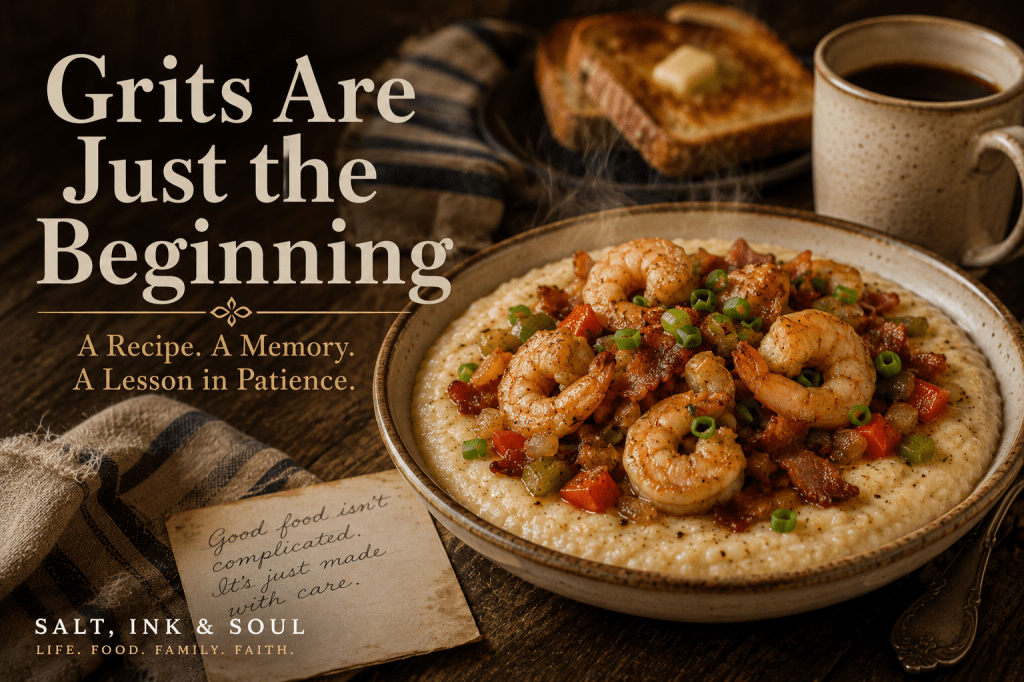
    Grits Are Just the Beginning

    Let’s talk about grits.

    I grew up in the Midwest, and if you asked for grits, there was a good chance they arrived with butter and sugar. That’s how I ate them. That’s how I liked them.

    When I tell people that now, I usually get the same look. The kind of look normally reserved for people who put ketchup on steak or think chili belongs on cinnamon rolls.

    Apparently, I had committed some sort of culinary crime.

    The thing is, nobody told me there were rules.

    To me, grits were breakfast. Warm, simple, and filling. A bowl of comfort before school or work. Butter melting into every corner. Sugar disappearing into the steam.

    Then I moved.

    That’s when I learned grits are really just a foundation.

    Some people eat them with salt and pepper. Some with scrambled eggs folded in. Some with cheese. Some with sausage. Some with whatever happened to be left over from the night before.

    And then I discovered shrimp and grits.

    Though I have to be honest, I think that name is a little misleading.

    Because every truly good plate I’ve had contained a lot more than shrimp and grits.

    There was bacon.

    There were peppers.

    There were onions.

    There were seasonings.

    Somebody was standing over a stove who understood that flavor doesn’t happen by accident.

    These days, shrimp and grits have become my favorite way to eat them.

    And before we go any further, let’s establish one rule.

    No instant grits.

    Take your time.

    Learn how to make them properly.

    I’m not even completely convinced instant grits are real grits. And we won’t even discuss the ones that come in little packets and tell you to use the microwave.

    Some shortcuts are worth taking.

    This isn’t one of them.

    Good grits require patience. Not much. Just enough.

    The reward is worth it.

    Serve them with buttered toast made from homemade bread and a hot cup of coffee, and you’ve got the kind of breakfast that makes you slow down for a few minutes before the world starts making demands.

    Here’s my version.

    Shrimp, Bacon, Pepper & Onion Grits

    For the Grits

    Ingredients

    • 1 cup stone-ground grits
    • 4 cups chicken stock
    • 1 cup whole milk
    • 4 tablespoons butter
    • 1 cup sharp cheddar cheese, shredded
    • 1 teaspoon kosher salt
    • Β½ teaspoon black pepper

    Directions

    1. Bring the chicken stock and milk to a gentle boil in a large saucepan.
    2. Slowly whisk in the grits.
    3. Reduce the heat to low.
    4. Cook for 25–35 minutes, stirring often.
    5. Once creamy, stir in the butter, cheddar cheese, salt, and pepper.
    6. Keep warm while preparing the topping.

    For the Shrimp Topping

    Ingredients

    • 1 pound large shrimp, peeled and deveined
    • 6 slices bacon, diced
    • 1 medium onion, diced
    • 1 bell pepper, diced
    • 2 cloves garlic, minced
    • 1 teaspoon smoked paprika
    • Β½ teaspoon Cajun seasoning
    • Β½ teaspoon black pepper
    • 1 tablespoon butter
    • 2 green onions, sliced

    Directions

    1. Cook the bacon in a large skillet until crisp.
    2. Remove the bacon and set it aside, leaving the drippings in the pan.
    3. Add the onion and bell pepper and cook until softened.
    4. Stir in the garlic and cook for 30 seconds.
    5. Add the shrimp, smoked paprika, Cajun seasoning, and black pepper.
    6. Cook for 2–3 minutes per side until the shrimp are pink and cooked through.
    7. Return the bacon to the skillet.
    8. Stir in the tablespoon of butter.
    9. Remove from heat.

    To Serve

    Spoon the hot grits into a bowl.

    Top generously with the shrimp mixture.

    Scatter sliced green onions over the top.

    Serve with thick slices ofΒ homemade bread, toasted and spread with butter.

    And if someone tells you grits should only be eaten one way, smile politely.

    Then keep eating them however you like.

    A Note From The Cook

    Food has a funny way of following us through life. What begins as a bowl of grits with butter and sugar can become a bowl of shrimp, bacon, peppers, and onions, and a lesson in patience. The ingredients may change. The people around the table may change. But the purpose stays the same.

    To feed the people you care about.

    Kyle J. Hayes

    kylehayesblog.com

    Please like, comment, and share

    Resources for Hard Times

    If you’re looking for practical help, food support, or community resources, you can visit the Salt, Ink & Soul Resources Page.
    πŸ‘‰Β Resources for Hard Times

  • Keto Blueberry Cheesecake

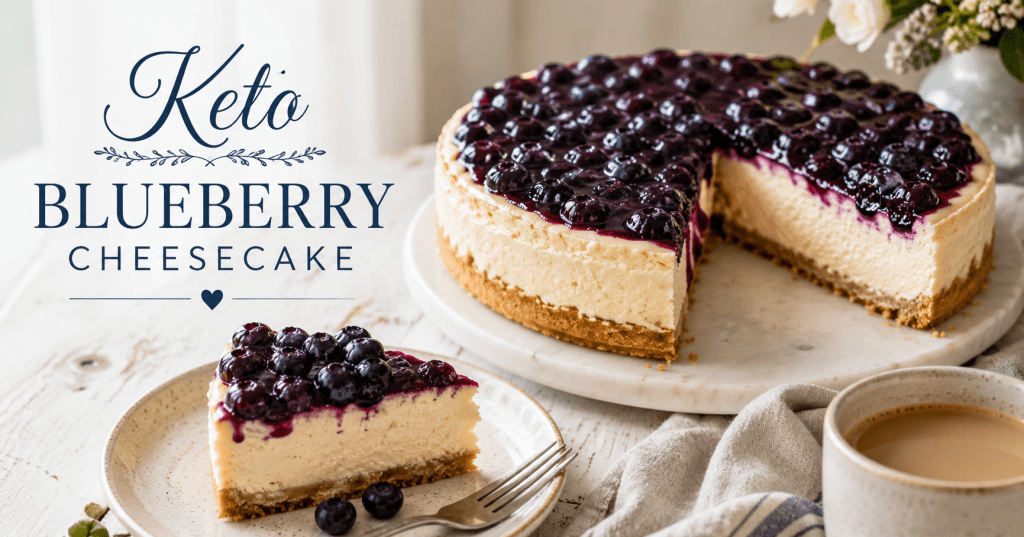
    Keto Blueberry Cheesecake

    It’s just a nice, bright Sunday morning.

    Not the rushing kind of Sunday or the Sunday where you are already thinking about Monday.

    But the quiet one.

    The one where the house is still.

    The coffee is hot.

    The light comes through the window, soft enough to forgive you for moving slowly.

    That is where this cheesecake belongs.

    A cheesecake is not a loud dessert. It does not beg for attention. It waits. It chills overnight. It asks you to be patient. It reminds you that some good things cannot be hurried, no matter how badly we want to taste them.

    And maybe that is part of why I like it.

    This keto blueberry cheesecake is rich, creamy, and low-carb, but it does not feel like punishment. It does not taste like something pretending to be dessert. It has a buttery almond flour shortbread crust, a smooth vanilla cheesecake filling, and a blueberry topping that cooks down into something deep, glossy, and almost old-fashioned.

    The kind of dessert you make when you want something sweet, but you still want to take care of yourself.

    The kind of dessert you cut slowly.

    The kind you serve on a small plate on a Sunday morning, or after Sunday dinner, when the day is almost done, and everyone is just a little quieter than they were before.

    There is something peaceful about that.

    A dessert made with intention.

    A dessert made with restraint.

    A dessert that says sweetness still belongs here.

    Keto Blueberry Cheesecake

    Ingredients

    Shortbread Cookie Crust

    • 1 ΒΌ cupsΒ 140 gΒ blanched almond flour
    • ΒΌ cupΒ 40 gΒ confectioners’ Swerve
    • ΒΌ cupΒ 56 gΒ melted butter
    • 1 teaspoon pure vanilla extract
    • 1 large egg
    • Pinch of salt

    Cheesecake Filling

    • 24 ounces cream cheese, softened
    • ΒΎ cup powdered monk fruit or erythritol sweetener, aboutΒ 140–145 g
    • 3 large eggs, room temperature
    • ΒΎ cup sour cream, aboutΒ 180 g
    • 1 tablespoon pure vanilla extract
    • 1 tablespoon lemon juice
    • 1 teaspoon lemon zest, optional
    • Pinch of salt

    Keto Blueberry Topping

    • 1 bagΒ 16 oz frozen blueberries
    • ΒΌ cup powdered monk fruit or erythritol sweetener
    • 2 tablespoons lemon juice
    • ΒΌ cup water
    • 1 teaspoon pure vanilla extract
    • Pinch of salt
    • ΒΌ to Β½ teaspoon xanthan gum, optional, for thickening

    Use ΒΌ teaspoon xanthan gum for a looser blueberry sauce.

    Use Β½ teaspoon xanthan gum for a thicker, pie-filling-style topping.

    Instructions

    1. Prepare the crust

    Preheat the oven to 325Β°F.

    Toast the almond flour in a dry pan over medium-low heat for a few minutes, stirring often, until lightly golden and fragrant. Watch it closely. Almond flour can go from toasted to burned quickly.

    In a mixing bowl, combine the toasted almond flour, confectioners’ Swerve, melted butter, vanilla extract, egg, and salt.

    Mix until a soft dough forms.

    Line the bottom of a 9-inch springform pan with parchment paper.

    Press the crust mixture evenly into the bottom of the pan.

    Bake the crust for 10–14 minutes, until lightly golden and set.

    Remove it from the oven and let it cool while you prepare the cheesecake filling.

    2. Make the cheesecake filling

    In a large bowl, beat the softened cream cheese until smooth and creamy.

    Add the powdered monk fruit or erythritol sweetener and mix until fully combined.

    Add the eggs one at a time, mixing gently after each egg. Do not overmix. Too much air can cause the cheesecake to crack.

    Add the sour cream, vanilla extract, lemon juice, lemon zest, and salt.

    Mix until the filling is smooth and creamy.

    3. Bake the cheesecake

    Pour the cheesecake filling over the cooled shortbread crust.

    Smooth the top with a spatula.

    Place the springform pan on a baking sheet.

    Bake at 325Β°F for 45–55 minutes, or until the edges are set and the center still has a slight jiggle.

    Turn off the oven, crack the door open, and let the cheesecake rest inside for 45 minutes.

    Remove the cheesecake from the oven and let it cool to room temperature.

    Refrigerate for at least 6 hours, but overnight is best.

    4. Make the blueberry topping

    Add the frozen blueberries, sweetener, lemon juice, water, vanilla extract, and salt to a medium saucepan.

    Cook over medium heat for 8–12 minutes, stirring occasionally, until the blueberries thaw, soften, and release their juices.

    Lightly mash some of the blueberries with the back of a spoon, leaving some whole for texture.

    Let the mixture simmer for another 3–5 minutes, until it reduces slightly.

    For a thicker topping, lightly sprinkle in the xanthan gum while stirring constantly. Do not dump it all at once, or it may clump.

    Simmer for 1–2 more minutes, then remove from the heat.

    Let the topping cool completely before adding it to the cheesecake.

    5. Chill and serve

    Once the cheesecake has fully chilled, spoon the cooled blueberry topping over the whole cheesecake.

    For cleaner slices, keep the topping separate and spoon it over each slice when serving.

    Slice with a sharp knife. Wipe the knife between cuts to keep the edges clean.

    Serve cold.

    And take your time.

    Helpful Notes

    Because the crust contains an egg, it should be pre-baked before adding the cheesecake filling.

    The cheesecake is done when the edges are set, but the center still has a slight jiggle.

    The blueberry topping will thicken more as it cools.

    For the best flavor and texture, chill the cheesecake overnight before serving.

    This cheesecake is rich, so small slices work well.

    It does not need much else. Maybe coffee. Maybe silence. Maybe somebody at the table who understands that food does not have to be complicated to feel like care.

    Sometimes care is a pot on the stove.

    Sometimes it is a crust pressed into a pan.

    Sometimes it is blueberries breaking open slowly in their own juice.

    And sometimes it is choosing sweetness without abandoning yourself.

    Kyle J. Hayes

    kylehayesblog.com

    Please like, comment, and share

    Resources for Hard Times

    If you’re looking for practical help, food support, or community resources, you can visit the Salt, Ink & Soul Resources Page.
    πŸ‘‰Β Resources for Hard Times

  • Learning What Good Tastes Like

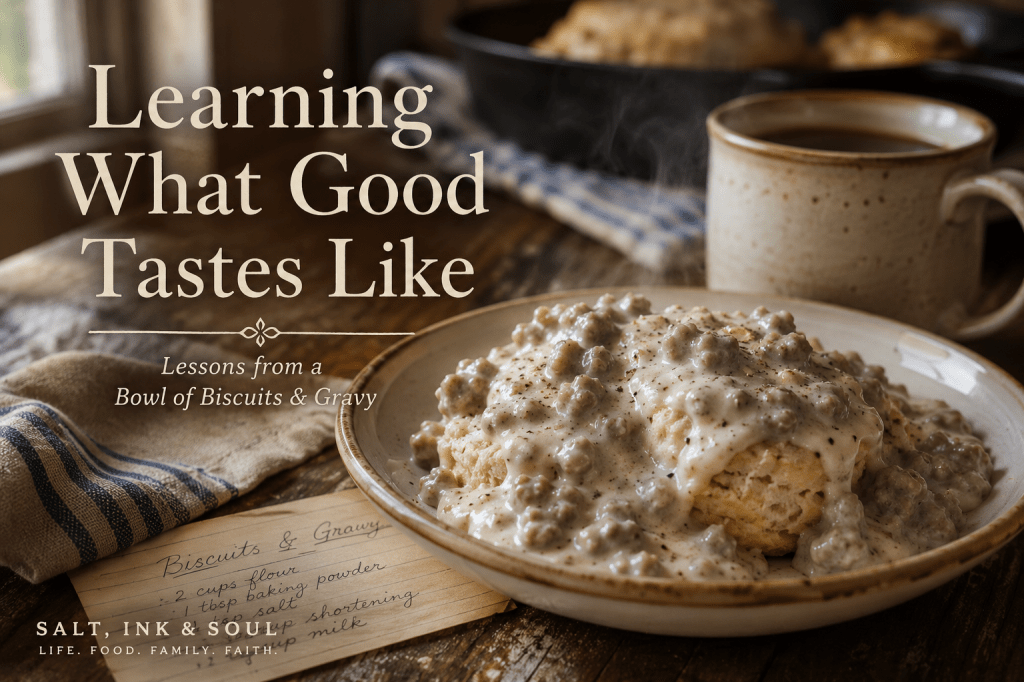
    Learning What Good Tastes Like

    Some foods sneak in through a side door.

    Biscuits and gravy did just that.

    Now, before the South collectively revokes my biscuit privileges, let me explain. Of course, I had heard of biscuits. I had even made them once in a high school cooking class. But somehow, despite growing up in America, I made it all the way to joining the military before I ever sat down in front of a plate of biscuits and gravy.

    I know. It sounds strange.

    The first time I had it, I wasn’t impressed. The biscuits were fine. The gravy was… there. It filled space. It occupied a plate. It tasted like someone had waved a sausage over a pan and called it seasoning.

    Then, a few weeks later, somebody else made it.

    Everything changed.

    The biscuits were still scratch-made, but now they had character. The gravy had pepper. It had flavor. It had purpose. It wasn’t just something poured over bread. It was comfort disguised as breakfast.

    The difference between those two plates was the difference between hearing music through a wall and sitting in the front row of the concert.

    And that’s when I learned one of the great truths of cooking:

    A recipe is only half the story.

    The other half is whether the cook understands seasoning.

    Years later, after leaving the Army, I’d occasionally order biscuits and gravy at restaurants. Sometimes it was fantastic. Other times it tasted suspiciously like the first version I’d ever encounteredβ€”bland, pale, and forgettable.

    Eventually, I decided to learn how to make it myself.

    The biscuits stayed traditional.

    The gravy got some attention.

    And somewhere along the way, I swapped pork sausage for turkey sausage. My heart would thank me later, even if a few Southern grandmothers might shake their heads at me from across the room.

    The result is a breakfast that still feels like comfort food, still feels Southern, but doesn’t leave me needing a nap before noon.

    If you’re looking for a Saturday morning breakfast that fills the kitchen with the smell of fresh biscuits and black pepper gravy, this is the one.

    One of the reasons I love biscuits and gravy is that it proves comfort food doesn’t have to be expensive. Using turkey sausage and basic pantry ingredients, this recipe can typically feed 4 people for around $8–$10, depending on local grocery prices. Sometimes the best meals aren’t the expensive ones. They’re the ones that leave everyone full and happy without leaving your wallet empty.

    Biscuits and Turkey Sausage Gravy

    For the Biscuits

    Ingredients

    • 2 cups all-purpose flour
    • 1 tablespoon baking powder
    • 1 teaspoon salt
    • 1 teaspoon sugar
    • 6 tablespoons cold butter, cubed
    • ΒΎ cup cold buttermilk

    Directions

    1. Preheat oven to 425Β°F.
    2. In a large bowl, whisk together flour, baking powder, salt, and sugar.
    3. Cut in the cold butter until the mixture resembles coarse crumbs.
    4. Pour in buttermilk and stir just until the dough comes together.
    5. Turn onto a lightly floured surface and gently fold the dough several times.
    6. Pat to about 1-inch thickness.
    7. Cut biscuits with a biscuit cutter or drinking glass.
    8. Place on a baking sheet with sides touching.
    9. Bake 12–15 minutes until golden brown.

    Turkey Sausage Gravy

    Ingredients

    • 1 pound turkey breakfast sausage
    • 3 tablespoons butter
    • ΒΌ cup all-purpose flour
    • 3 cups whole milk
    • 1 teaspoon kosher salt
    • 1 teaspoon coarse black pepper
    • Β½ teaspoon garlic powder
    • Β½ teaspoon onion powder
    • ΒΌ teaspoon smoked paprika
    • Pinch of cayenne pepper (optional)

    Directions

    1. Brown the turkey sausage in a large skillet over medium heat.
    2. Add the butter and let it melt.
    3. Sprinkle flour over the sausage and stir continuously for about 2 minutes.
    4. Slowly add milk while whisking to prevent lumps.
    5. Bring to a gentle simmer.
    6. Add salt, black pepper, garlic powder, onion powder, smoked paprika, and cayenne.
    7. Continue cooking until thick and creamy, about 5–7 minutes.
    8. Taste and adjust seasoning as needed.

    To Serve

    Split a warm biscuit in half.

    Spoon a generous amount of gravy over the top.

    Add an extra crack of black pepper.

    Pour yourself a cup of coffee.

    Then do what Saturday mornings were always meant for.

    Sit still for a few minutes.

    The world will be waiting when you’re done.

    The biscuits don’t care about your deadlines.

    The gravy isn’t worried about your inbox.

    For once, sit, relax, and enjoy your food.

    A Note From The Cook

    There is a strange belief that good food has to be expensive. Maybe that’s because we’ve confused luxury with quality. Biscuits and gravy remind me that some of the best meals ever were made by people who didn’t have much money to spare. Good seasoning, a little patience, and a warm kitchen can still turn a few dollars’ worth of ingredients into something worth remembering.

    Kyle J. Hayes

    kylehayesblog.com

    Please like, comment, and share

    Resources for Hard Times

    If you’re looking for practical help, food support, or community resources, you can visit the Salt, Ink & Soul Resources Page.
    πŸ‘‰Β Resources for Hard Times

  • Simple Asparagus Parmesan Egg Bake (Perfect Weekend Brunch)

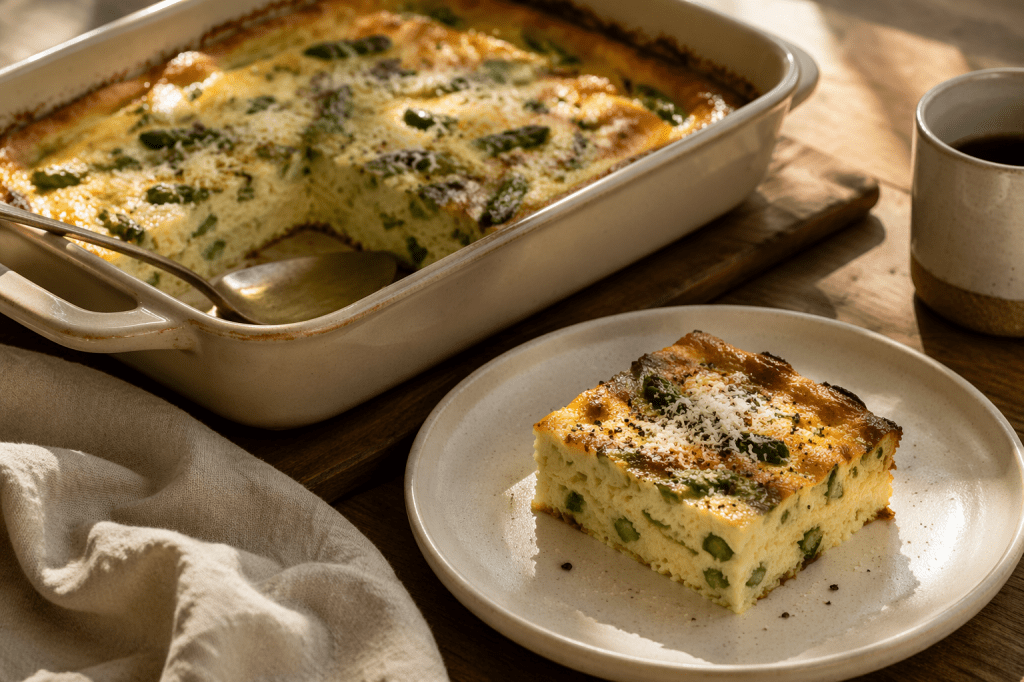
    Simple Asparagus Parmesan Egg Bake (Perfect Weekend Brunch)

    There are mornings you have nothing to do.

    No rush to be somewhere.

    No need to prove anything to anyone.

    Just a little light coming through the window.

    A quiet kitchen.

    And enough time to make something warm.

    This is that kind of dish.

    Not complicated.

    Not dressed up to be more than it is.

    Just eggs, asparagus, and Parmesanβ€”brought together slowly, the way good things tend to come together when you leave them alone long enough.

    Asparagus Parmesan Egg Bake

    There’s a steadiness to this.

    Eggs holding their shape.

    Cream softens the edges.

    Parmesan adds just enough salt to keep everything grounded.

    And asparagusβ€”still green, still present, not lost in the mix.

    Ingredients

    • 2 cups asparagus spears, trimmed and chopped
    • 1 cup grated Parmesan cheese
    • 6 large eggs
    • 1 cup heavy cream
    • Salt and black pepper, to taste
    • Olive oil (for greasing)

    Method

    1. Preheat the oven

    Set to 375Β°F. Let the oven take its time getting there.

    2. Blanch the asparagus

    Bring a pot of water to a boil. Add the asparagus and let it cook just until it turns bright greenβ€”about 2 to 3 minutes.

    Then move it to ice water.

    This keeps the color. Keeps the bite.

    Keeps it from disappearing.

    3. Build the base

    Lightly oil a casserole dish.

    Lay the asparagus evenly across the bottom.

    Scatter the Parmesan over it.

    No need to be exact. Just don’t crowd it.

    4. Bring it together

    Whisk the eggs, cream, salt, and pepper until smooth.

    Pour it slowly over the asparagus and cheese.

    Let it settle. Don’t rush it into place.

    5. Bake

    Place in the oven for 30–35 minutes.

    You’re looking for a center that’s set

    and has a lightly golden top.

    Not overdone. Just finished.

    6. Let it rest

    Give it a few minutes before cutting.

    Some things need a moment to become what they’re supposed to be.

    Notes From My Kitchen

    • If the asparagus is thin, shorten the blanch time slightly
    • A heavier hand with Parmesan brings more depthβ€”but go too far, and it takes over
    • This reheats well, but it’s best the first time, when everything is still soft and warm

    The Table

    This isn’t a brunch built for a crowd.

    It’s for a morning that feels like it’s yours.

    A second cup of coffee.

    A quiet conversation.

    Or no conversation at all.

    Kyle J. Hayes

    kylehayesblog.com

    If this found you at the right time,

    Feel free to like, comment, or share it with someone who might need it too.

    Resources for Hard Times

    If you’re looking for practical help, food support, or community resources, you can visit the Salt, Ink & Soul Resources Page.
    πŸ‘‰Β Resources for Hard Times

  • Keto Lemon Pound Cake

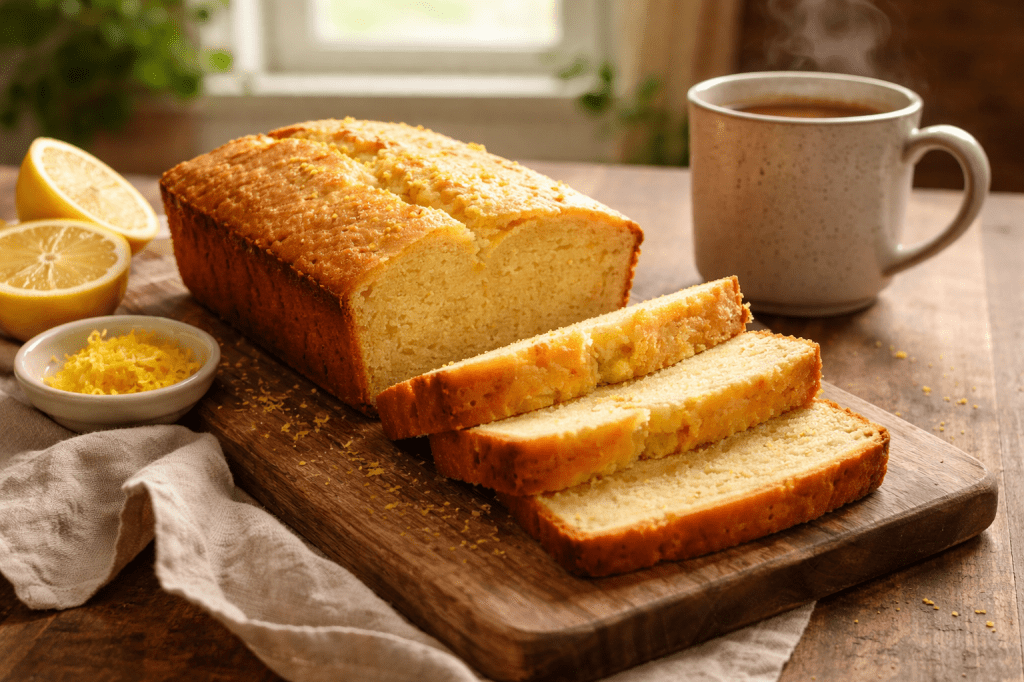
    Keto Lemon Pound Cake

    Bright enough to cut through heaviness. Gentle enough for a quiet morning.

    By now, some of you probably know something about me: I have a sweet tooth.

    Not the loud kind that storms the kitchen cabinets or demands dessert after every meal. Mine is quieter than that. It waits. Patiently. Somewhere in the background of the day. It shows up when the work is done, when the house is still, when a cup of coffee is warming your hands, and the world finally slows down enough for you to notice yourself again.

    For a long time, I thought discipline meant denial. Just stop wanting sweet things. Just remove them entirely.

    But life has a way of teaching softer lessons than that.

    Not every hunger is meant to be silenced. Some are meant to be understood. Adjusted. Given a place that doesn’t undo the rest of the life you’re trying to build.

    That’s part of why so many keto desserts show up in my kitchen. They aren’t about indulgence the way desserts used to be. They’re about balance. A small act of kindness toward yourself without abandoning the discipline you worked hard to build.

    This lemon pound cake is one of those small compromises with myself.

    Bright with lemon. Rich with butter. Just sweet enough to sit beside a Sunday morning cup of coffee while the day wakes up slowly.

    Trust me.

    It works.

    Ingredients

    • 2Β½ cups almond flour
    • Almond flour replaces traditional flour, creating a tender crumb with a slightly nutty flavor.
    • 1 cup erythritol
    • A low-carb sweetener that behaves like sugar in baking without the carb load.
    • 1 teaspoon baking powder
    • Helps the cake rise and stay light despite the absence of gluten.
    • Β½ teaspoon salt
    • The quiet ingredient that makes everything else taste more like itself.
    • 1 cup unsalted butter, softened
    • This is still a pound cake. Butter gives it richness and moisture.
    • 4 large eggs
    • Eggs build the structure of the cake while adding richness.
    • Zest from 2 lemons
    • This is where the cake gets its lemon personality.
    • ΒΌ cup fresh lemon juice
    • Bright acidity that balances the richness of the butter.
    • 1 teaspoon vanilla extract
    • A soft background note that rounds out the flavor.
    • ΒΌ cup unsweetened almond milk
    • Loosens the batter slightly without adding unnecessary carbs.

    Instructions

    1. Preheat and Prepare

    Preheat your oven to 350Β°F (175Β°C).

    Grease a 9×5-inch loaf pan and lightly dust it with almond flour so the cake releases easily later.

    A small step. But it saves a lot of regret.

    2. Mix the Dry Ingredients

    In a medium bowl, whisk together:

    • almond flour
    • erythritol
    • baking powder
    • salt

    Mixing these first ensures the rise and sweetness are evenly distributed.

    3. Cream the Butter and Eggs

    In a separate bowl, cream the softened butter until it becomes light and fluffy.

    This step builds air into the batter, which helps create a better texture.

    Add the eggs one at a time, mixing well after each addition.

    Then stir in:

    • lemon zest
    • lemon juice
    • vanilla extract

    At this point, the batter begins to smell like sunlight.

    4. Combine the Batter

    Gently fold the dry ingredients into the wet mixture.

    Do this slowly. Almond flour doesn’t respond well to aggressive mixing.

    Once combined, stir in the almond milk until the batter becomes smooth and pourable.

    5. Bake

    Pour the batter into the prepared loaf pan and smooth the top.

    Bake for 45–50 minutes, or until:

    • The top is golden
    • A toothpick inserted in the center comes out clean

    Your kitchen will smell bright and warm long before the timer ends.

    6. Cool

    Allow the cake to cool in the pan for 15 minutes.

    Then transfer it to a wire rack to cool completely.

    Patience here keeps the crumb intact.

    Optional Keto Lemon Glaze

    If you’d like an extra touch of lemon:

    Ingredients

    • Β½ cup powdered erythritol
    • 1–2 tablespoons lemon juice

    Whisk together until smooth and drizzle over the cooled cake.

    It’s not necessary.

    But sometimes a little brightness on top feels right.

    Notes from the Kitchen

    • Store covered at room temperature for 2 days or refrigerate up to 5 days.
    • The flavor deepens the next day slightly.
    • A lightly toasted slice with coffee in the morning feels surprisingly indulgent for something this simple.

    Sometimes discipline isn’t about saying no.

    Sometimes it’s about learning how to say yes β€” just a little differently.

    And sometimes that difference looks like a slice of lemon pound cake beside a quiet cup of coffee.

    If you’re wondering what that cup of coffee might look like, I wrote something about that once.

    You can read it here:

    The Quest for The Perfect Cup of Coffee

    Kyle J. Hayes

    kylehayesblog.com

    Please like, comment, and share

    Resources for Hard Times

    If you’re looking for practical help, food support, or community resources, you can visit the Salt, Ink & Soul Resources Page.
    πŸ‘‰Β Resources for Hard Times

  • Rustic Focaccia Bread

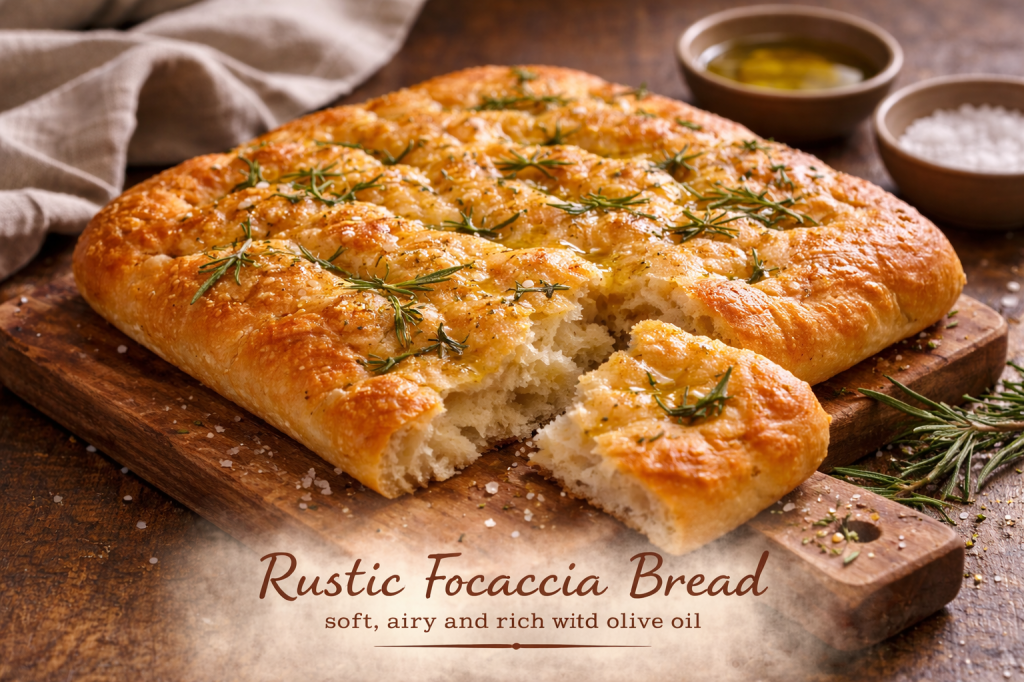
    Rustic Focaccia Bread

    A warm loaf meant for tearing, dipping, and sharing.

    There’s something about bread coming out of the oven that changes the mood of a kitchen.

    The smell alone is enough to make people wander in from other rooms. Someone leans against the counter. Someone else tears off a corner before it has properly cooled.

    Focaccia has always been one of the more forgiving breads. It doesn’t ask for perfection. No elaborate shaping. No delicate scoring. Just Flour, Water, Yeast, olive oil, and a few dimples pressed into the dough with your fingertips.

    It’s the kind of bread that feels alive while you’re making it.

    This particular loaf pairs beautifully with a bright tomato salad or with the Tuscan chicken we shared earlier this week. Something about olive oil, tomatoes, and warm bread feels like it belongs on the same table.

    Simple ingredients.

    A hot oven.

    And a loaf of bread that’s meant to be torn apart while it’s still warm.

    Rustic Focaccia Bread

    Yield: 1 large focaccia or 2 small

    Prep Time: 50 minutes

    Cook Time: 6–10 minutes

    Ingredients

    Plain Flour β€” 400 g

    The bread’s foundation creates a soft interior and crisp edges.

    Warm Water β€” 320 ml

    Warm Water helps activate the Yeast and bring the dough together.

    Salt β€” 8 g

    Salt strengthens the dough and deepens the flavor.

    Sugar β€” 8 g

    Just enough to help the Yeast begin its work.

    Instant Yeast β€” 7 g (1 sachet)

    The quiet engine that lifts the dough.

    Olive Oil β€” 3 tablespoons (for greasing the pan)

    Creates the crisp, golden underside that makes focaccia so satisfying.

    Olive Oil β€” 3 tablespoons (for topping)

    Focaccia loves olive oil. Don’t be shy.

    Sea Salt β€” to taste

    Optional toppings

    β€’ Fresh herbs (rosemary or thyme work beautifully)

    β€’ Garlic granules

    Method

    1. Preheat the oven.

    Preheat your oven to 250Β°C (482Β°F).

    A hot oven is what gives focaccia its golden crust.

    2. Activate the Yeast

    In a food processor, combine:

    • warm Water
    • sugar
    • instant Yeast

    Pulse briefly until the Yeast and sugar dissolve.

    3. Form the Dough

    Add the Flour and salt to the food processor.

    Pulse until the mixture comes together into a rough dough ball.

    It doesn’t need to be perfectly smooth at this stage.

    4. First Rise

    Transfer the dough to a large bowl.

    Fold the dough over itself 3–4 times to tighten it into a compact shape.

    Cover and allow it to rise for 15 minutes.

    5. Prepare the Pan

    Pour 3 tablespoons of olive oil into a baking tray and spread it evenly to grease the surface.

    Place the dough into the tray and gently stretch it toward the edges.

    Cover and let the dough rise for another 10 minutes.

    6. Add Toppings

    Drizzle the remaining 3 tablespoons of olive oil across the surface of the dough.

    Sprinkle with:

    • sea salt
    • herbs (if using)
    • garlic granules (optional)

    Using your fingertips, press dimples across the surface of the dough.

    Those little pockets will catch the olive oil while it bakes.

    7. Final Rise

    Allow the dough to rest for 10–15 minutes.

    You’ll see it soften and puff slightly.

    8. Bake

    Place the tray into the hot oven and bake for 6–10 minutes, until the focaccia turns golden.

    The edges should be crisp while the center remains soft.

    Notes From My Kitchen

    Focaccia is best eaten warm.

    Tear it apart, dip it in the olive oil that collects in the dimples, and don’t worry too much about neat slices.

    It’s the kind of bread that belongs beside simple food.

    A plate of tomatoes.

    A pan of Tuscan chicken.

    Or just a small dish of olive oil and a quiet moment in the kitchen.

    Sometimes the simplest bread is exactly the one you need.

    Kyle J. Hayes

    kylehayesblog.com

    Please like, comment, and share

    Resources for Hard Times

    If you’re looking for practical help, food support, or community resources, you can visit the Salt, Ink & Soul Resources Page.
    πŸ‘‰Β Resources for Hard Times

  • Tomato SaladΒ 

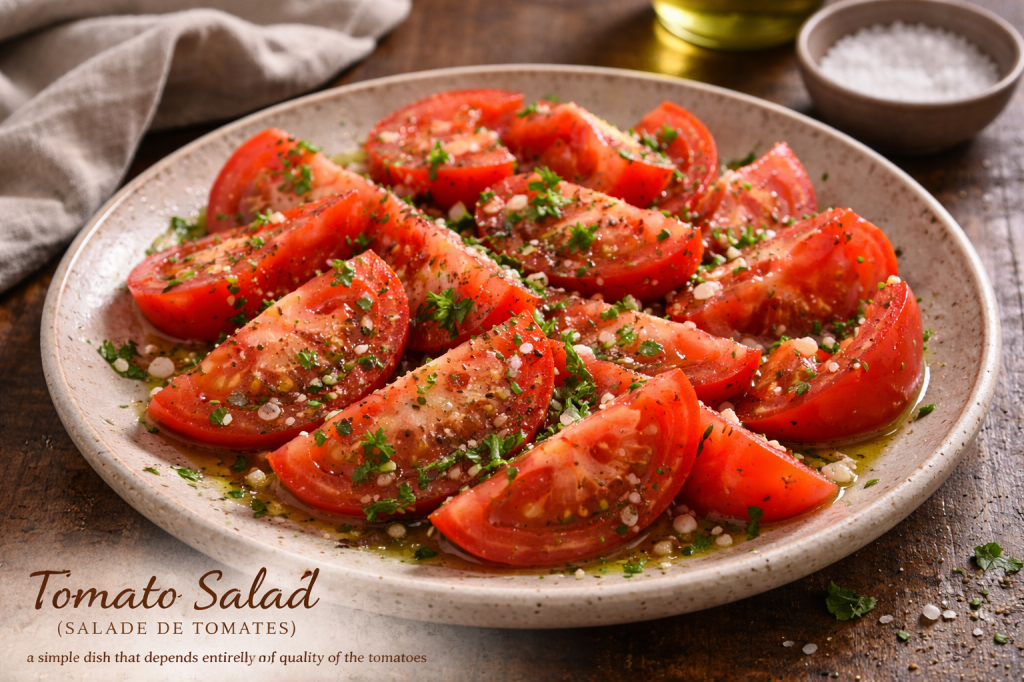
    Tomato SaladΒ 

    A bright, simple dish for warm days.

    You may ask why a salad.

    Fair question.

    Here in New Mexico, the seasons don’t really announce themselves politely. One week, the mornings still carry a little chill, the next the sun is leaning hard against the windows, and suddenly the last thing you want to do is fire up the oven and turn the house into a brick kiln. When that shift happens, a lot of us start cooking differently. We look for meals that don’t demand heat, or patience, or a sweaty kitchen. Food that’s lighter, quicker, but still delivers the flavor you’re after.

    That’s where a dish like this comes in.

    A bright tomato salad. Nothing complicated. Just good tomatoes, a little salt, olive oil, maybe a sharp whisper of shallot and vinegar. The kind of thing that reminds you that sometimes the best meals are the ones that barely require cooking at all.

    Tomorrow I’ll be posting a recipe for focaccia that goes perfectly with this β€” something warm to tear apart and drag through the tomato juices β€” and of course it pairs beautifully with the Tuscan chicken we shared earlier this week.

    Not bad for a plate of tomatoes.

    Tomato Salad 

    Serves: 4

    Ingredients

    Ripe Tomatoes β€” 4–6, sliced into wedges or thick slices

    This dish lives and dies by the tomatoes. Choose the ripest ones you can find.

    Shallot β€” 1 small, very finely minced

    A gentler cousin to the onion, adding sharpness without overpowering the tomatoes.

    Extra-Virgin Olive Oil β€” 2–3 tablespoons

    Good olive oil turns the tomato juices into a dressing.

    Red Wine Vinegar β€” 1 tablespoon

    Just enough acidity to brighten everything.

    Coarse Sea Salt β€” to taste

    Salt wakes the tomatoes up and draws out their natural juices.

    Freshly Ground Black Pepper

    Fresh Flat-Leaf Parsley β€” small handful, chopped

    Method

    1. Arrange the Tomatoes

    Lay the sliced tomatoes across a wide plate or shallow bowl.

    Give them space so their juices have somewhere to collect.

    2. Salt and Let Them Rest

    Season the tomatoes generously with sea salt.

    Let them sit for 5–10 minutes.

    During this time, the salt draws out the tomato juices, creating the beginnings of a natural dressing.

    3. Add the Shallot

    Scatter the minced shallot across the tomatoes.

    It will soften slightly as it mingles with the juices.

    4. Build the Dressing

    Add the red wine vinegar.

    Drizzle the olive oil across the salad.

    Season lightly with freshly ground black pepper.

    5. Finish

    Sprinkle the chopped parsley over the top.

    Just before serving, spoon some of the tomato juices from the bottom of the plate back over the tomatoes.

    Those juices are the best part.

    Notes From the Kitchen

    This dish rises and falls entirely on the quality of the tomatoes.

    If they are ripe, warm from the sun, and full of flavor, this salad will taste like something far greater than the sum of its parts.

    If they are not…

    No amount of olive oil will save them.

    So wait for the right tomatoes.

    They are worth it.

    Tomorrow I’ll share the rustic focaccia that belongs beside a plate of tomatoes like this β€” perfect for soaking up the last of that olive oil and tomato juice.

    Kyle J. Hayes

    kylehayesblog.com

    Please like, comment, and share

    Resources for Hard Times

    If you’re looking for practical help, food support, or community resources, you can visit the Salt, Ink & Soul Resources Page.
    πŸ‘‰Β Resources for Hard Times

  • Blueberry Tea Cake (Keto)

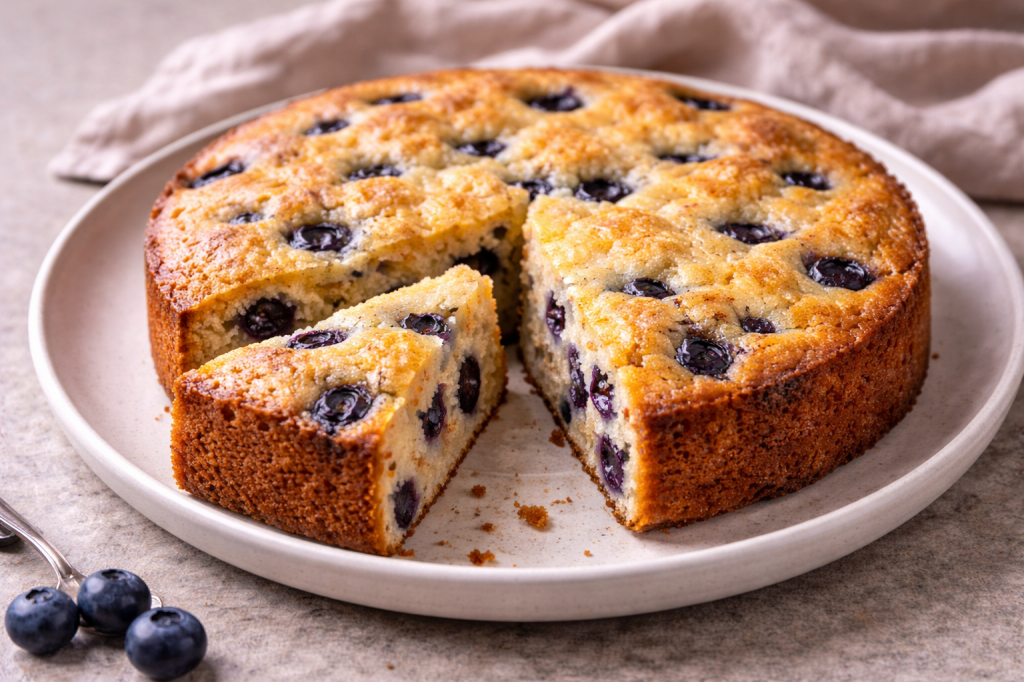
    Blueberry Tea Cake (Keto)

    A quiet answer to a loud craving

    I love sweets.

    They are my weakness.

    If I don’t have something close by to answer that craving, I will go to the store and buy far more than I need. Not because I’m hungry β€” because I’m reaching. Reaching for comfort. For reward. For something easy.

    So I’ve learned to keep something like this around.

    A cake that satisfies without unraveling discipline. Something measured. Something made with intention. Something that understands restraint.

    Tea cake has always lived in the in-between β€” not quite dessert, not quite breakfast. Something you slice in the afternoon when the house is quiet. Something that doesn’t need frosting to feel complete.

    This version keeps that spirit. It trades flour for almond flour. Sugar for monkfruit. It leans into blueberries and a touch of lemon for brightness. It isn’t trying to be indulgent. It’s trying to be enough.

    Sweet. Light. Steady.

    Why This Version Works

    • Low carb without tasting compromised
    • Almond flour keeps it tender
    • Blueberries bring natural sweetness and contrast
    • Lemon zest lifts everything quietly

    This is not a cake that shouts.

    It waits.

    Recipe Details

    Serves: 8

    Prep Time: 10 minutes

    Bake Time: 25–30 minutes

    Total Time: About 40 minutes

    Ingredients

    • 2 cups almond flour
    • ΒΎ cup monkfruit sweetener
    • 1 tsp baking powder
    • Pinch of salt
    • Β½ cup unsalted butter, melted
    • 3 large eggs
    • 1 tsp vanilla extract
    • Β½ cup unsweetened almond milk
    • 1 cup blueberries (fresh or frozen)
    • 1 tbsp lemon zest (optional, but recommended)

    Instructions

    1. Prepare the oven

    Preheat oven to 350Β°F (175Β°C).

    Grease or line an 8-inch cake pan.

    2. Combine the dry ingredients

    In a bowl, whisk together:

    • almond flour
    • monkfruit sweetener
    • baking powder
    • salt

    Set aside.

    3. Mix the wet ingredients

    In a separate bowl, whisk:

    • melted butter
    • eggs
    • vanilla
    • almond milk

    The mixture should look smooth and cohesive.

    4. Bring it together

    Add the wet ingredients to the dry.

    Stir gently until just combined.

    Do not overmix.

    Tenderness lives in restraint.

    5. Fold in the blueberries

    Gently fold in the blueberries and lemon zest.

    Move slowly. Keep the batter light.

    6. Bake

    Pour the batter into the prepared pan and smooth the top.

    Bake for 25–30 minutes, or until the top is lightly golden and a toothpick inserted in the center comes out clean.

    7. Rest

    Let the cake cool in the pan for 10 minutes before transferring to a wire rack.

    Cooling allows the structure to settle.

    To Serve

    Slice simply.

    Serve plain, or with a spoonful of lightly sweetened whipped cream.

    Keep it modest.

    This isn’t cake for spectacle.

    It’s cake for steadiness.

    Notes

    • Frozen blueberries work well β€” do not thaw first
    • If the top browns too quickly, tent loosely with foil
    • Stores covered at room temperature for 2 days or refrigerated up to 5 days

    Kyle J. Hayes

    kylehayesblog.com

    Please like, comment, and share

    Resources for Hard Times

    If you’re looking for practical help, food support, or community resources, you can visit the Salt, Ink & Soul Resources Page.

    πŸ‘‰Β Resources for Hard Times

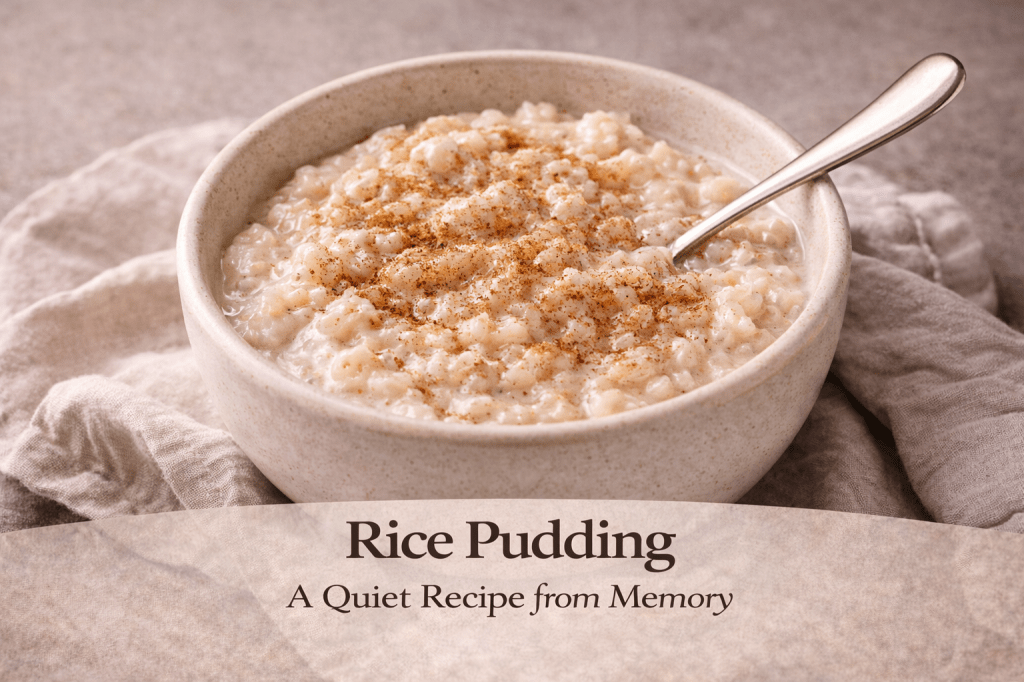
  • Rice Pudding

    Rice Pudding

    A Quiet Recipe from Memory

    I don’t remember my mother making rice pudding.

    I remember my grandmother’s.

    It was simple in the way only practiced hands can manage β€” milk, rice, time β€” and somehow complex enough to take me straight back to childhood with a single spoonful. This is one of those dishes where the old saying still holds: if it isn’t broken, don’t fix it. The recipe doesn’t ask for reinvention. It asks for patience.

    So I share it this way.

    Have a small bowl.

    Take a spoonful.

    Close your eyes.

    Let it take you back.

    Why This Recipe Endures

    • Few ingredients
    • Slow heat
    • No shortcuts

    Rice pudding doesn’t reward impatience.

    It rewards attention.

    Recipe Details

    Serves: 4–6

    Prep Time: 5 minutes

    Cook Time: 40–45 minutes

    Total Time: About 45 minutes

    Ingredients

    • Β½ cup long-grain white rice
    • 4 cups whole milk
    • β…“ cup granulated sugar
    • Pinch of salt
    • 1 tsp vanilla extract
    • Β½ tsp ground cinnamon
    • Optional:
      • Pinch nutmeg
      • Raisins
      • Lemon peel strip (removed before serving)

    Instructions

    1. Begin with patience

    In a heavy-bottomed saucepan, combine:

    • rice
    • milk
    • sugar
    • salt

    Bring to a gentle simmer over medium heat, stirring occasionally to prevent sticking.

    2. Cook slowly

    Lower the heat and cook uncovered, stirring every few minutes, for 35–45 minutes.

    The milk should thicken gradually.

    The rice should soften fully.

    Nothing should rush.

    3. Finish quietly

    Once the pudding is thick and spoonable, remove from the heat.

    Stir in:

    • vanilla
    • cinnamon
    • nutmeg or raisins, if using

    Taste. Adjust sweetness only if needed.

    To Serve

    Serve warm or cold.

    Plain, or with a light dusting of cinnamon.

    Rice pudding doesn’t need dressing up.

    It only asks to be remembered.

    Notes

    • If the pudding thickens too much, loosen it with a splash of warm milk
    • Texture should be creamy, not stiff
    • keeps well refrigerated forΒ 3–4 days

    This is not a dessert meant to impress.

    It’s a dessert meant to return you to the past.

    Kyle J. Hayes

    kylehayesblog.com

    Please like, comment, and share

    Resources for Hard Times

    If you’re looking for practical help, food support, or community resources, you can visit the Salt, Ink & Soul Resources Page.

    πŸ‘‰ Resources for Hard Times

    Other Recommendations:

    • Sweet Cornmeal Pancakes with Honey Butter
    • Bread Pudding
    • The Most Basic Bread Recipe