Tag: albuquerque

  • The Land of Entrapment

    The Land of Entrapment

      I was raised in the Quad-Cities — an area that, to this day, feels suspended in amber. It isn’t just the winters that freeze you to the bone, when the wind whips across the Mississippi and leaves your face raw. It’s the people, the rhythm of life, the way the place still breathes as though the 1980s never ended.

    Factories were our backbone then: John Deere, International Harvester, Caterpillar, The Rock Island Arsenal, and ALCOA. Their names were more than brands; they were birthrights. People clocked in and out not just for paychecks but for identity. Houses were bought once and held onto for a lifetime, just like jobs. Men retired in the same overalls they wore when they started, women retired in the same churches and kitchens that shaped them. It was a life that promised stability. Predictability. A bubble.

    But bubbles keep things in as much as they keep things out.

    I had seen time move differently elsewhere — places that reinvented themselves, cities that shifted, people who didn’t cling so tightly to sameness. And once you see that, once you know the world isn’t fixed in place, it’s impossible to believe that standing still is survival.

      I left Iowa more than once. The first time, it was the military that pulled me out — not a choice so much as a summons. Later, work carried me away. And yet, I came back, each time.

    Coming back felt inevitable, like the bubble had its own gravitational pull. But deep down, I knew I couldn’t keep circling the same orbit. There’s a difference between leaving because the world demanded it and going because you chose to.

    That’s what Albuquerque was for me: a choice.

      On paper, the decision made sense.

    No hurricanes to rip through your home. No earthquakes to split the ground. No volcanoes threatening fire. No endless rain to drown the days. It wasn’t Phoenix, where the heat presses against your chest like a punishment. It wasn’t the overcrowded sprawl of the West Coast. It was manageable. It was human-sized.

    And yes — the racial makeup mattered. I wanted a place where diversity wasn’t a buzzword, where the face of the city itself carried the mark of many histories, not just one.

      When I arrived, I heard the jokes: The Land of Entrapment. Come on vacation, leave on probation. They were said with a smirk, half-warning, half-truth. Albuquerque has its shadows. Addiction, poverty, violence — scars on a city that has seen too much. But to stop there, to see only the flaws, is to miss the marrow of the place.

      I didn’t know I liked landscapes until I saw the Sandias burn pink at sunset, watermelon hues spilling across the horizon like the desert itself was blushing. I didn’t know I needed vast skies until I stood beneath them, their sheer immensity forcing me to recognize how small I was — and how alive.

      Then the culture. The way Catholic feast days blur into Pueblo ceremonies, how murals tell stories, how music leaks from church doors and lowriders in the same breath. The way traditions survive here is not as nostalgia but as living practices, stitched into daily life.

    And the food.

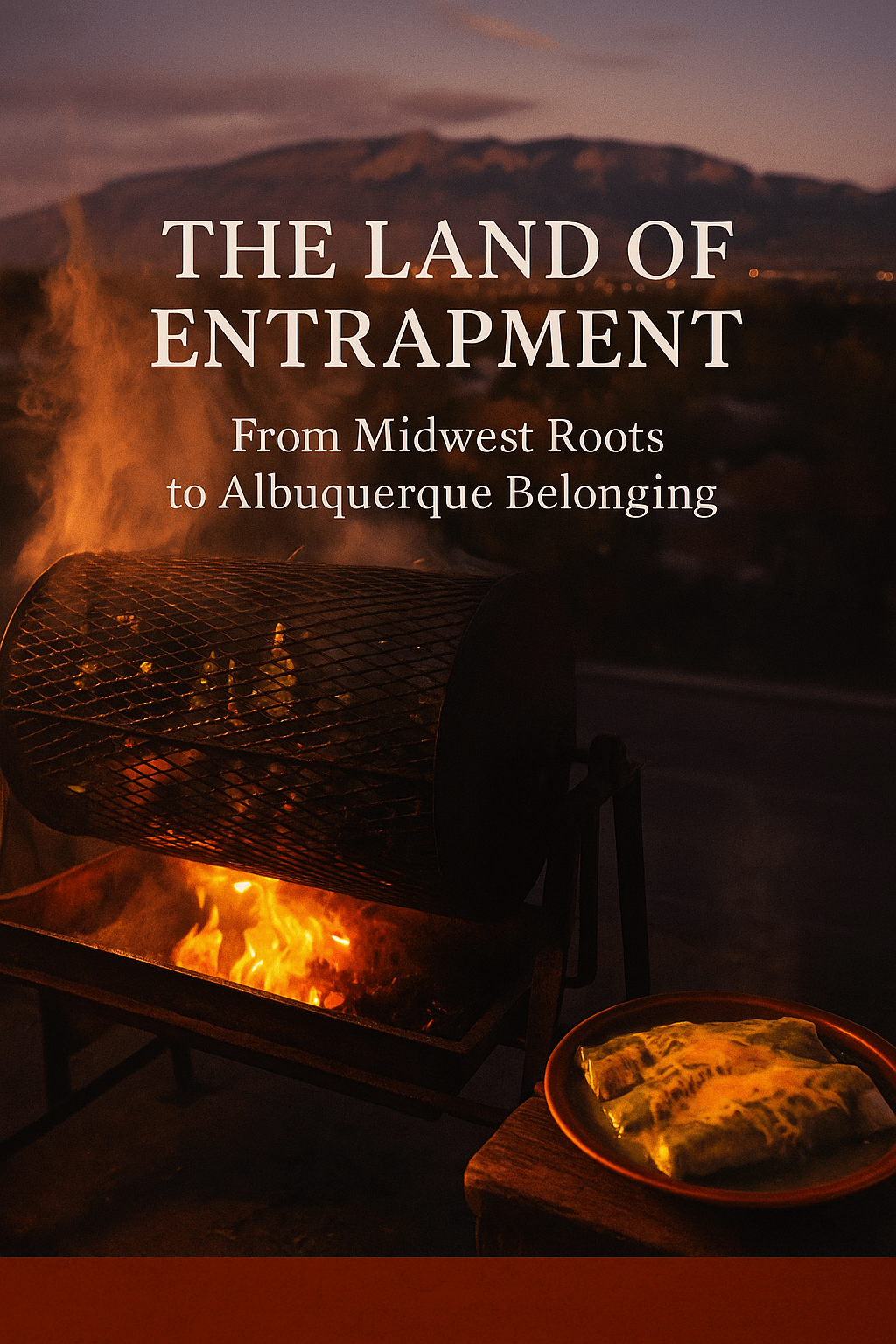
      If the Midwest were pot roast and casseroles, Albuquerque is chile — unapologetic, fiery, alive. Chile roasters appear outside grocery stores in September, flames licking metal drums, smoke curling into the crisp air until the entire city smells like memory. Red or green isn’t a question of preference; it’s a declaration of identity. Enchiladas stacked high and smothered, tamales at Christmas, burritos at the Balloon Fiesta — food here doesn’t just fill you, it binds you.

    I’ve said before that I wasn’t raised on green chile chicken enchiladas. I was raised on soul food, or as most people now know it, “Southern Cuisine”. That food was survival dressed as a celebration. It was what you ate to remember who you were.

      But Albuquerque taught me to make room for new rituals. When I’m sick, I still crave soul food, but I’ve learned to crave enchiladas too. I’ve learned that “red or green?” comes as naturally now as “sweet or unsweetened?” once did. I’ve learned that my hands, though clumsy, can roll tortillas and fold tamales.

      Food, I’ve realized, doesn’t erase what you came from. It layers it.

    Iowa was entrapment too — but of a different kind. Entrapment of sameness, of repetition, of a rhythm so predictable it could suffocate.

    Albuquerque’s entrapment is something else. It seduces. It draws you in with Chile smoke in the fall, with the way the mountains change color by the hour, with a culture that makes you feel like you’re walking through both past and present at once.

      People warn you about it: The Land of Entrapment. But I’ve started to hear it differently, not as a warning, but as an invitation.

      Because here’s the truth: I don’t want to leave.

    What began as a practical choice has become something more intimate, something stitched into me. Albuquerque caught me — with its flaws, its grit, its beauty, its food — and I don’t feel trapped. I feel claimed.

    That could be what home is. Not where you start, not even where you end. But where you finally stop running, because you no longer want to.

    By Kyle J. Hayes

    kylehayesblog.com

    Please like, comment, and share

  • The Taste of Home, The Taste of Here

    The Taste of Home, The Taste of Here

      There are nights when homesickness sneaks up on me. Not the kind that makes you want to book a ticket and run back, but the quieter version — the one that comes when you’re alone in your apartment in Albuquerque and your body aches for food that no one here makes.

      I wasn’t raised on green chile chicken enchiladas. My comfort food wasn’t rolled tortillas smothered in chile sauce, or tamales wrapped in husks and steamed until the masa gives way to tenderness. I was raised on soul food — though these days they like to call it “Southern cuisine,” as if renaming it erases where it really came from.

      I grew up on collard greens cooked until they surrendered, cornbread golden and crumbly, fried chicken with skin that cracked when you bit into it, mac and cheese that clung to your fork like it loved you. Those weren’t just meals; they were testimonies, proof of survival passed down on plates.

    And yet, here I am in New Mexico, learning to find comfort in different flavors.

      When someone offers me tamales now, I don’t hesitate. I ask, “Red or green?” without thinking. At the Balloon Fiesta, I know when I show up, to get in line for a breakfast burrito and a hot coffee to fight the predawn chill.

      I’ve even attempted green chile chicken enchiladas in my own kitchen. I call them “passable,” and that’s being generous. They’re edible, sure, but I know enough to know they don’t hold a candle to the ones made by someone whose hands were taught by generations. Still, they’ve become a ritual. A way of saying to myself: You belong here enough to try.

      Still, when I’m sick, I don’t crave green chile. I crave the food of my childhood. Fried chicken. Collard greens. Sweet potatoes baked down until they bordered on candy. Food that came from a time and a place that shaped me before I even knew it.

      That’s the thing about food — it doesn’t just fill you. It remembers for you. It pulls you back through time, reminds you who held the spoon, who stood at the stove, who called you in from outside when the plates were ready.

      No matter how far you travel, those cravings remain like old ghosts.

    But here’s the surprise: when the homesickness hits hardest, it’s not because I want to return to where I grew up. It’s because I want to return here, to New Mexico.

      That’s the contradiction I live with now. I miss home, yes, but home is no longer the place I left behind. It’s this desert with its endless skies and its Chile smoke drifting outside grocery stores in the fall. It’s the quiet of mornings when the Sandias catch fire with the sunrise. It’s the ritual of learning to love food I didn’t grow up on.

      When I’m away too long, I don’t miss the streets of my childhood. I miss the taste of green chile folded into eggs, the tamales shared at Christmas, the balloon-lit sky at dawn. I miss this place.

      Maybe that’s what it means to belong somewhere new. Not to erase what you came from, but to layer it. To carry collards and cornbread in one hand and green chile enchiladas in the other. To know that your soul food still holds you, but so does this food you had to learn.

    The older I get, the more I realize home isn’t fixed. It shifts. It stretches. It welcomes and demands at the same time. And if you let it, it changes you — until homesickness no longer means going back.

    It means going forward.

    By Kyle J. Hayes

    kylehayesblog.com

    Please like, comment, and share
  • Waiting for Pumpkin Spice

    Waiting for Pumpkin Spice

    I have a sweet tooth no matter the season.

    If you’ve been following my posts for a while, you already know about my disastrous history with cake — failed layers that sank like bad relationships, frosting that slid off like it had somewhere better to be. Cake and I have an uneasy truce: I respect its existence, but I don’t trust it in my kitchen.

    Pie, though — pie is a different matter altogether.

    Pie is forgiving.

    It doesn’t demand perfection; it rewards patience. It lets you work the butter into the flour until it feels right, and enables you to taste as you go. A pie can be rustic, uneven, a little rough around the edges, and still come out beautiful.

    Fall is the season when pie becomes gospel.

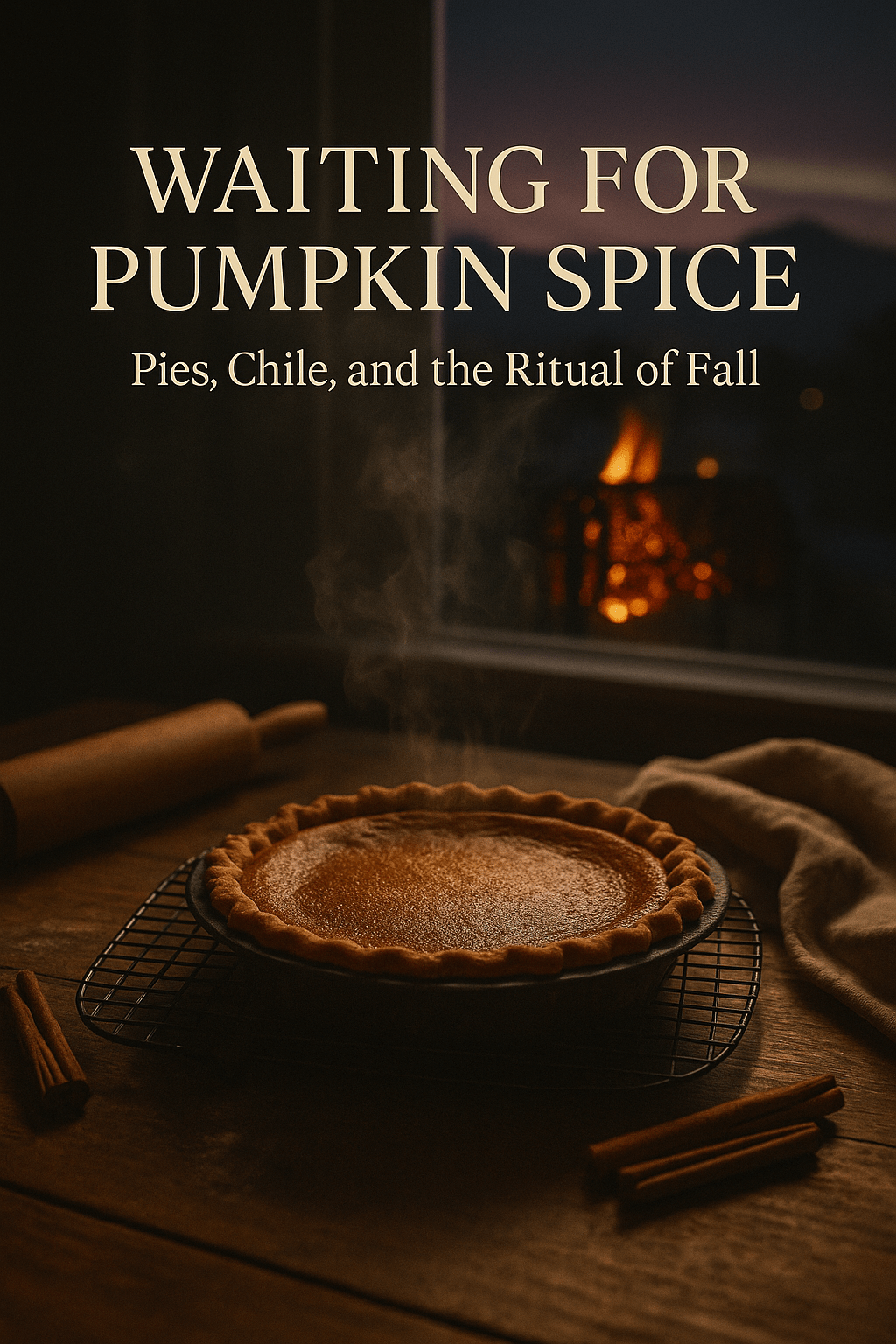
    Pumpkin, of course, with its deep, spiced filling that perfumes the entire house while it bakes. Apple, bubbling over with cinnamon and sugar until it spills onto the oven floor and burns just enough to make the kitchen smell like caramel. Pecan, glossy and rich, is a dessert that feels like a holiday no matter the day. Sweet potato pie, which in the right hands can taste like memory itself.

    This is what I love about pie — that while it bakes, the entire house becomes a sermon about comfort. The smell isn’t sharp or cloying like the sprays you buy in the store. It’s honest. It seeps into the walls, into your clothes, into the way you breathe. It makes you want to put on plaid and furry slippers, sit down with a mug of something hot, and just be still for a while.

      I know Albuquerque doesn’t get many cold days.

    But those few that do come — those rare mornings when the frost laces the windows and the Sandias catch the first light — I savor them. That’s when the heavier blankets come out, when the kitchen becomes a refuge.

    That’s when I want green chile stew simmering on the stove, a pot of pinto beans in the background, and cornbread in the oven. That’s when I make my baked macaroni casserole and lace it with green chile, because everything tastes better with chile when the air is cold.

      If fall is a religion, then chile season is its holiest feast.

    The roasters show up outside grocery stores, filling the air with the sound of the drums turning and the smell of blistering green chile skins. You can’t drive across town without catching the smoke in your nose, without being reminded that it’s time to stock up. Because the fresh green chile sells fast — faster than the weather can catch up.

    Green chile isn’t just for stew. In New Mexico, we put it in everything:

    • Green chile cheeseburgers, smoky and hot, are a state treasure.
    • Green chile chicken enchiladas, stacked or rolled, with a fried egg on top if you’re doing it right.
    • Breakfast burritos, smothered or handheld, are eaten at sunrise with a strong cup of coffee.
    • Rellenos, stuffed and fried until the pepper gives just enough heat to make your eyes water.
    • And yes, even green chile apple pie — sweet and spicy, proof that our chile has no boundaries.

      Some people wait for Christmas.

    I wait for this.

    For chile smoke in the air, for pumpkin spice in my coffee, for pies cooling on the counter, for the kitchen to smell like something worth coming home to. I wait for the few days when I can bundle up, when the air sharpens and the Sandias blush pink, when life feels like it slows down enough for me to notice it again.

    Because fall, for me, is not just a season. It’s a ritual.

    And while the rest of the world counts down to Christmas, I’m here, counting pies, stocking chile, and letting the smell of pumpkin and cinnamon remind me why I love this place, this time, this season.

    By Kyle J. Hayes

    kylehayesblog.com

    Please like, comment, and share

  • When the Air Turns in Albuquerque

    When the Air Turns in Albuquerque

    There’s a moment in Albuquerque when the air shifts and you know — without anyone needing to tell you — that summer is over. It’s not dramatic. There’s no storm to announce it, no hard edge to the sky. But one morning you step outside, and the heat that’s been pressing on you all summer is suddenly gone. The air has a crispness that cuts right through the haze.

    This is the air that makes you breathe a little deeper.

    This is the air that reminds you that fall in New Mexico is something holy.

    You smell it before you see it.

    Outside almost every grocery store, the roasters appear. Metal cages filled with green chile, spinning over open flame, popping and hissing until the skins blister and the air is thick with the smell of heat and earth and smoke.

    That smell is the anthem of autumn here. It gets into your hair, your clothes, the fabric of your car seats. You can’t escape it, and you don’t want to. It is the smell of the harvest, the smell of a city stocking its freezers, the smell of family kitchens about to come alive.

    The Chile roasters feel like a signal: time to slow down, time to gather, time to get serious about food again.

    The mornings turn cool, just enough to make you pull a hoodie over your T-shirt before heading out. The sky is still impossibly blue, but the light is different — softer, angled, as if it’s trying to remind you to look up and notice it before winter comes and steals it away.

    By late afternoon, the air warms just enough to make you consider peeling off that hoodie, but by sundown, you’re glad you didn’t. Nights are cold enough now that you crack the window and wake up with the chill brushing your face, pulling the heavier blankets closer around your shoulders.

    This is when you start taking longer routes home just to watch the Sandias turn that watermelon shade they’re named for.

    Something about this season sends me straight into the kitchen. Maybe it’s instinct — that ancient urge to prepare for the cold, to fill the house with smells that promise comfort.

    I start thinking about posole, about green chile stew, about beans simmering low and slow on the stove all afternoon. About roasts that take hours, about soups that taste better the next day, about meals that make you want to eat them by the window, wrapped in a blanket, with a book you’ve been meaning to finish.

    The coffee gets hotter. Pumpkin spice shows up in the morning routine, not as a gimmick but as a quiet ritual. I start debating pies — apple or pumpkin first? Maybe both. The oven feels less like an appliance and more like a hearth, a place to gather around.

    Fall does something to your insides. Summer is all noise — music from car windows, late-night parties, conversations shouted over the sound of swamp coolers. Fall is quieter. It asks you to turn inward, to sit with yourself a little longer.

    I find myself staying in bed just a little more, not from laziness but from gratitude — for the cool air, for the weight of the blankets, for the chance to just be still before the day starts.

    And I like it.

    I like the way this season invites me to slow down, to cook slower, to eat slower, to let the world grow softer around me.

    Every year, this shift feels both familiar and new — like returning to a house you used to live in and finding the furniture rearranged.

    The Chile roasters spin.

    The blankets come out.

    The hearty meals return.

    The city smells like smoke and earth and promise.

    I don’t know why this happens — why the season has this power over us, why we trade light linens for heavier ones, why we crave soups and pies and longer mornings.

    But I like it all the same.

    And maybe that’s enough: to notice the change, to mark it with food and ritual, to let the air turn you toward the kitchen, toward the table, toward yourself.

    By Kyle J. Hayes

    kylehayesblog.com

    Please like, comment, and share
  • When the Lord Smiles on You (And Brings Soup)

    When the Lord Smiles on You (And Brings Soup)

    I’ve lived in New Mexico for years now. Long enough to know the smell of roasting green chile means autumn and that the line between red and green isn’t just about salsa—it’s about identity. Long enough to pretend I’ve tasted it all.

    But that’s the thing about New Mexico. You never really taste it all.

    This place holds onto its secrets.

    It waits until just the right moment—until your guard is down, until your belly’s empty, and your soul is quiet—

    Then the Lord smiles on you, and someone places a bowl in your hands that changes everything.

    Last year, it was pozole.

    Not the pozole you find at a chain or off some laminated menu.

    This was the real thing.

    Pozole with history. With lineage.

    Pozole, made by my friend’s father-in-law—an old school Mexican, the kind of man who measures time by the slow dance of a simmering pot.

    His skills? Learned not from books or shows or trendy food blogs,

    but from Oaxaca, in the old country.

    Where ingredients are respected, and nothing is wasted.

    Where cooking isn’t a task—it’s an inheritance.

    This man—quiet, steady, always working—has done more than just feed people.

    He’s helped restore and preserve one of Albuquerque’s most beloved spots: El Pinto Restaurant.

    He’s a steward of flavor and tradition who reminds you that real craftsmanship never needs to shout.

    That pozole was a revelation.

    Deep, layered, soulful.

    A bowlful of memory, spice, and heat that reached places no therapy ever has.

    And then, today, the Lord smiled on me again.

    Same friend. Different bowl.

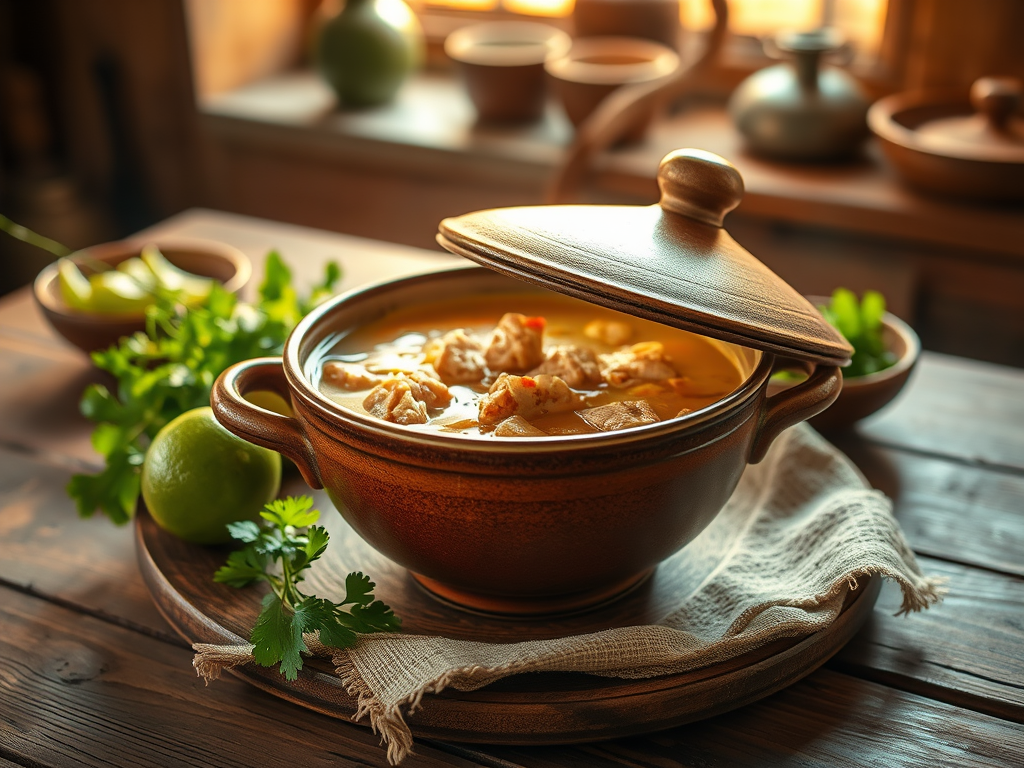
    This time, it was Chicken Caldo.

    No warning.

    No occasion.

    Just the quiet generosity of someone handing you a miracle in a paper bowl.

    Now, if you’ve never had a real caldo de pollo—not the half-hearted version simmered in a rush, but the kind that takes its time—

    let me try, poorly, to explain.

    It’s not just soup.

    It’s comfort liquified.

    Chicken is so tender it gives up.

    Vegetables that still taste like vegetables, not mush.

    And then—the lime.

    That fresh lime, squeezed just right, cuts through the warmth and lifts the flavor.

    Like a prayer whispered into something sacred.

    The taste?

    I won’t pretend I can describe it.

    All I know is that each bite felt like a home I didn’t know I missed.

    I closed my eyes and sat still, and for a few minutes, I was in heaven.

    I still haven’t tried everything New Mexico has to offer.

    Maybe I never will.

    But every now and then, I get lucky.

    And in this place, luck doesn’t come dressed in fine linen or gourmet plating.

    It comes humble, in a shared container,

    from someone who learned to cook in Oaxaca,

    someone who doesn’t care about Michelin stars,

    but who knows that feeding people—truly feeding them—is one of the last honest things we’ve got left.

    So I sit.

    I eat.

    I give thanks.

    And hope the Lord sees fit to smile on me again.

    By Kyle Hayes

  • On Uniforms, Crime, and the Price of Safety

    On Uniforms, Crime, and the Price of Safety

    By Kyle J. Hayes

    They’re calling in the National Guard.

    To Albuquerque, my city.

    Not for a natural disaster, Not to deliver food or clear debris after a storm.

    But to stand beside police officers—in full uniform, rifles slung, boots planted—to “assist” with crime.

    I understand the impulse.

    People are scared.

    They want safety, order, and something that feels like control in a city that has often felt like it’s slipping through the cracks.

    And yes, crime must be stopped.

    Yes, the police need help.

    But at what cost?

    Because when I hear the words National Guard deployed, I don’t think of peace.

    I don’t think of protection.

    I see troops on every corner, unmoving, impersonal.

    I see uniforms that don’t distinguish between law and war.

    I hear the crackle of radios and the soft click of rifles being adjusted in the early morning light.

    I imagine being stopped—not once, not twice, but every day—and asked to present identification to prove who I am, why I’m here, and where I’m going.

    And maybe you don’t see it that way.

    Maybe you see strength.

    Reassurance.

    But I’m a Black man in America.

    And I know—in my bones—that safety is a relative thing.

    What brings comfort to one community often brings fear to mine.

    I’m not romanticizing crime.

    I don’t dismiss what it means to be a victim, to lose your car, your wallet, your home, or worse—your life—to senseless violence.

    We have a problem here.

    We have judges who release the same people over and over, courts that cycle through the mentally ill like it’s just another box to check, another body to process.

    People clearly incapable of caring for themselves are handed bus passes and court dates like it’s a solution.

    And it’s not.

    But what I wonder—what keeps me up at night—is what exactly the troops are going to do about that.

    Will they post up outside the emergency room and intercept the man having a psychotic break before he steps into traffic?

    Will they appear in housing court and argue for more beds, doctors, and treatment?

    Will they stop a broken system from returning the same suffering people onto the same unforgiving streets?

    Or will they patrol the corners?

    Will they monitor “suspicious activity,” which too often means me—or someone who looks like me—walking, talking, breathing in the wrong place at the wrong time?

    Will they demand proof that I belong here?

    Because even if I have the right answers, even if I’ve done nothing wrong,

    I know from experience that sometimes that isn’t enough.

    Where does this end?

    How many steps from here to a society of passes, papers, checkpoints, and curfews?

    How many more emergencies before we normalize soldiers walking through our neighborhoods, not to help, but to enforce?

    To watch.

    To decide.

    And when they leave—if they leave—what have we lost in the meantime?

    Because there’s a difference between order and freedom.

    There’s a difference between law and justice.

    And we’ve walked this road before.

    We’ve seen what happens when we blur those lines too far.

    The uniforms and flags change, but the outcome stays the same.

    So yes, I want safety.

    But not if it means giving up the right to live without fear of my government.

    Not if it means turning my city into something that looks less like a community and more like a checkpoint.

    Because you can’t enforce peace at the barrel of a gun.

    You can only try to build it—patiently, painfully, imperfectly—until the ground beneath your feet feels like home again.

    And that’s what I want for Albuquerque.

    Not a fortress.

    But a home.

    Please comment and subscribe