Tag: American culture

  • They’ll Remember More Than the Score

    They’ll Remember More Than the Score

    Well…

    We didn’t get them this time.

    As someone very new to soccer, I have to admit I was disappointed to see the USMNT’s World Cup journey come to an end. Like so many Americans, I had started believing. Every match pulled me in a little deeper. Every victory made me think, “Maybe this is our year.”

    It wasn’t.

    But if there is one phrase Americans know almost by heart, it’s:

    We’ll get them next time.

    There is hope tucked inside those words.

    Not denial.

    Not pretending we didn’t lose.

    Just the belief that another opportunity is coming.

    Another chance.

    For me, something unexpected happened during this World Cup.

    I didn’t just discover a tournament.

    I discovered a sport.

    A few months ago, I couldn’t have told you much about formations or tactics. Today, I find myself checking match schedules, watching highlights, learning the game’s rhythm, and already looking forward to the next World Cup.

    That feels like a gift.

    One I didn’t know I was missing until someone handed it to me.

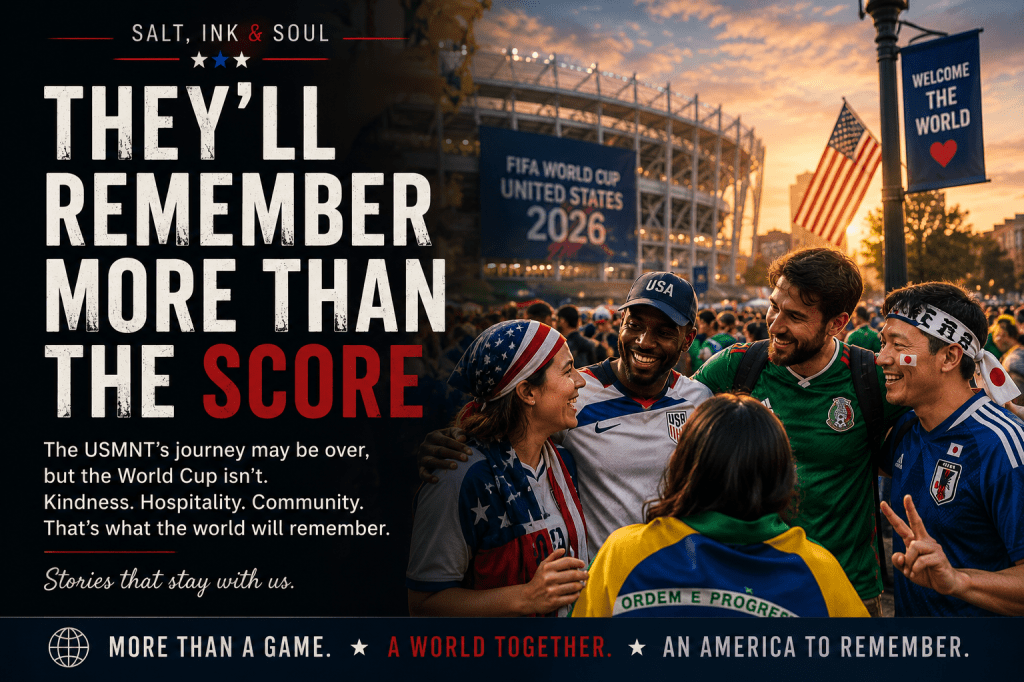
    Even though Team USA is no longer playing, something beautiful is still happening.

    The World Cup is still here.

    The matches continue.

    And so do the people who traveled thousands of miles to experience them.

    Over the past few weeks, I’ve watched countless videos of supporters from Europe, South America, Africa, Asia, and beyond sharing their experiences here in the United States. What struck me wasn’t just their excitement over the matches.

    It was how often they talked about the people.

    The conversations with strangers.

    The restaurant recommendations.

    The unexpected hospitality.

    For all the stories people hear about America before they arrive, many leave talking about something entirely different.

    They leave talking about us.

    Not politicians.

    But People.

    Ordinary Americans.

    The cashier who wished them luck before the match.

    The server who recommended the best local barbecue.

    The family who invited them into a conversation.

    The stranger who pointed them toward the right train.

    The fan who celebrated beside them even though they spoke different languages.

    That is an America I know.

    The America where neighbors wave.

    Where someone stops to help you change a tire.

    Where a plate of food somehow finds its way into your hands if you’ve been around long enough.

    Where we may argue among ourselves, but we still know how to welcome a guest.

    No, we don’t have to go out of our way.

    No one is requiring it.

    But I hope we do anyway.

    Not because we are trying to prove something.

    Because hospitality has always been one of the quiet strengths of ordinary people.

    Governments introduce nations.

    People define them.

    Long after the final trophy is lifted, many of these visitors won’t remember every score.

    But they will remember how they were treated.

    They’ll remember the conversations that made them laugh.

    The meals they shared.

    The cities they explored.

    The strangers who became friends for an afternoon.

    Those memories travel farther than any goal ever could.

    I’m disappointed that Team USA’s run has ended.

    I wanted to see them go farther.

    I wanted to keep cheering.

    But I’m grateful all the same.

    Grateful that this tournament introduced me to a sport I never expected to love.

    Grateful that one conversation opened the door to something new.

    And grateful that the rest of the world still has a chance to experience something that has always existed beyond the headlines.

    The America we know.

    The America we build every day with kindness, generosity, and simple conversations between strangers.

    The world is still watching.

    Let’s give them something beautiful to remember.

    Kyle J. Hayes

    kylehayesblog.com

    Please like, comment, and share

    Resources for Hard Times

    If you’re looking for practical help, food support, or community resources, you can visit the Salt, Ink & Soul Resources Page.
    👉 Resources for Hard Times

  • What are the biggest mistakes people make when visiting your country?

    What are the biggest mistakes people make when visiting your country?

    I think one of the biggest mistakes people make when visiting the United States is believing they have arrived in one place.

    Technically, yes.

    It is one country.

    One flag. One federal government. One name printed across maps and passports. But to move through America as if it is all the same is to miss one of the strangest and most interesting things about it.

    America is not one room.

    It is a house with many rooms.

    And each room has its own temperature.

    It’s own smell.

    Its own music coming from somewhere down the hallway.

    Its own way of speaking, eating, driving, laughing, arguing, welcoming, warning, and remembering.

    You can land in New York and think you understand America because you have seen the tall buildings, the crowded sidewalks, the hurry in people’s steps, the way everyone seems to be late for a life they are already living. New York has its own rhythm. Fast. Sharp. Alive. A place where the food comes from everywhere, and the streets feel like they are always in conversation.

    But New York is not Texas.

    Texas stretches itself out differently. The sky feels larger there. The food speaks in smoke, spice, beef, heat, and pride. The pace changes. The accent changes. The idea of distance changes. A short drive in Texas might be a whole afternoon somewhere else.

    And Texas is not Florida.

    Florida is almost its own world.

    Part Southern, part Caribbean, part retirement dream, part swamp, part beach, part chaos, part beauty. A place where sunshine can feel like paradise in the morning and a warning by afternoon. Florida does not always make sense, but maybe that is part of its personality. It refuses to be only one thing.

    Then there are all the other places people forget when they speak of America too quickly.

    The Midwest, where politeness can be both warmth and code.

    The South, where history sits at the table whether it is invited or not, and where food can taste like memory, labor, grief, celebration, and somebody’s grandmother refusing to measure anything.

    The West Coast, with its ocean edges, wellness language, ambition, earthquakes, reinvention, and strange mixture of freedom and performance.

    The Southwest, with its desert light, green chile, Native presence, Mexican influence, adobe walls, open sky, and a kind of beauty that does not shout but stays with you.

    The Pacific Northwest, gray and green, coffee-warmed, rain-softened, full of trees and quiet moods.

    The Appalachian places.

    The prairie places.

    The border towns.

    The old industrial cities.

    The small towns where everybody knows your truck before they know your name.

    The mistake is thinking America can be understood from one airport, one city, one movie, one accent, one stereotype, or one plate of food.

    It cannot.

    This country is too large for that.

    Too contradictory.

    Too regional.

    Too full of people who share a nation but not always a culture.

    Even the language changes depending on where you are. The same word can be pronounced differently in different mouths. A greeting can be quick and clipped in one place, slow and musical in another. Some people say soda. Some say pop. Some say Coke means almost anything carbonated. Some places put sugar in the tea before you even ask. Some places look at you strangely if you ask for it that way.

    Food may be one of the clearest maps.

    Pizza in New York.

    Barbecue in Texas, Kansas City, Memphis, and the Carolinas, each one ready to defend itself in court if necessary.

    Seafood in Maryland and Louisiana.

    Green chile in New Mexico.

    Cuban sandwiches in Florida.

    Hotdish in Minnesota.

    Gumbo, biscuits, tacos, bagels, burgers, fried chicken, clam chowder, soul food, diner food, food trucks, and gas station food that has no business being as good as it is.

    Every region has its own appetite.

    And appetite tells the truth.

    So if someone is visiting the United States, I would tell them not to come here looking for one America.

    Come here ready to meet many.

    Do not assume Los Angeles explains Chicago.

    Do not assume Miami explains Atlanta.

    Do not assume Boston explains New Orleans.

    Do not assume Las Vegas explains anything except Las Vegas.

    Each place has a story. Each place has a mood. Each place has a history beneath the surface. Some of it is beautiful. Some of it is painful. Some of it is loud. Some of it is buried. But it is there.

    That is the real lesson.

    America is not simple.

    It is not one flavor.

    It is not one accent.

    It is not one kind of person.

    It is a country of regions pretending to be a single idea, and somehow, for better and worse, still trying to hold together.

    So the biggest mistake visitors make is assuming America is all the same.

    It is not.

    America is a collection of different places, foods, accents, histories, and ways of life. That is what makes traveling through it interesting. The best way to experience the United States is to stay curious, pay attention, try the local food, listen to how people speak, and remember that every state has its own story to tell.

    Kyle J. Hayes

    kylehayesblog.com

    Please like, comment, and share

    Resources for Hard Times

    If you’re looking for practical help, food support, or community resources, you can visit the Salt, Ink & Soul Resources Page.

    👉 Resources for Hard Times

  • “The Disappearance and the Dreamers: A Return to Small Town America”

    “The Disappearance and the Dreamers: A Return to Small Town America”

    I could start this in a few ways.

    I could tell you about the beauty of small-town America—how it smells like earth after rain, how it feels like old denim, soft at the edges and worn in all the right places. I could paint a picture of local parades, gas stations where they know your name, and corner stores that sold glass-bottle soda as if they were dealing in gold. I could start there.

    Or I could tell you about the slow death.

    About how it creeps in not with a scream, but with silence. A corner shop goes dark. The comic book store fades into memory. That one spot that always had a single cook and a single delivery guy—hollowed out by time, or worse, by convenience. We didn’t even get to say goodbye. One day it was there, and the next… it was nowhere to be found.

    That’s how I found it, this town that raised me. A shell and a fight. Graying at the temples but still kicking. Still trying.

    I returned home with a chip on my shoulder and an axe to grind. My past visits had been disappointments—full of quiet judgment and half-empty shelves. I began to see the town as Lucy holding the football. I, the fool, forever falling for a nostalgia that never delivered.

    But then I noticed it.

    Not a rebirth exactly. More like resistance. Quiet. Stubborn. And beautiful.

    A locally brewed beer sitting proudly on a shelf next to Budweiser, daring you to taste something made here. A sushi place—yes, sushi—in a town where raw fish used to be called bait with a laugh. A barista pulling espresso in a repurposed mechanic shop, poetry on the walls, and indie jazz in the air. It didn’t look like the town I left, but it was trying to feel like the one I loved.

    The resistance is no longer being led by factory foremen or overtime heroes. It’s the dreamers.

    The artists. The comics shop rebels. The coffee shop philosophers. The chefs, brewers, and boutique owners who aren’t just surviving small-town America—they’re redefining it.

    I keep thinking about that comic book store.

    The one where I spent more time than I did money, though God knows I wanted to spend more. That store helped shape the person I am. Not because of what I bought, but because of what I learned.

    Inside those walls, you weren’t just reading stories—you were being trained in how to dream.

    You met other kids who knew backstories you didn’t, who taught you how a single issue could reframe an entire arc. You learned how to imagine better. To think in color. To expect the impossible and call it plot development.

    Sure, comics still exist. There are still conventions. Online communities. But they don’t replace the bike ride to the store on release day.

    They don’t replace the smell of fresh ink. The thrill of a new issue in your hands. Or seeing the store owner, and knowing him, not as an employee, but as a keeper of stories.

    That’s what we’re losing.

    Not just the stores.

    But there is humanity in the transaction.

    I was prepared to write a eulogy.

    To mourn the death of small-town America.

    But what I found instead… was a kind of defiance.

    Maybe it’s not dying. It could be changing. Perhaps the overgrown trees and cracked sidewalks aren’t signs of decay, but rather Mother Nature is taking her seat at the town hall meeting. Maybe she’s in on the plan.

    And maybe—just maybe—the artists are saving it.

    Not by keeping it the same, but by daring to imagine it differently.

    In this era, I don’t need to fly to the Quad Cities for a box of Lagomarcino’s. It’s a click away. That’s the gift and the curse. Accessibility without presence.

    However, some places still require in-person visits.

    Not for the product, but for the chance. Because on one of those visits, you might notice something new. A new mural. A new flavor. A new owner with an old soul and a dream too stubborn to die.

    So go. Walk the street you used to know.

    The one who forgot your name and then remembered it.

    The one still fighting, in ways you didn’t expect.

    The death of small-town America may still be in progress.

    But so is its reinvention.

    And I’d bet everything on the dreamers.

    By Kyle Hayes

    Please like, Comment, and subscribe.