Tag: Belonging

  • When a Book Makes Room for You

    When a Book Makes Room for You

    I had written before about Pawn of Prophecy being the first grown-up book I truly remember finishing.

    I called it grown-up because, to the boy I was then, grown-up meant weight. It meant no pictures waiting kindly on the page to tell me where to look. It meant more than two hundred pages. It meant holding a book in my hands and realizing that the story was not going to bend down to meet me. I would have to rise toward it.

    That book pulled me into fantasy.

    It showed me that reading could be more than an assignment, more than an obligation, more than something adults told children was good for them in the same dry voice they used for vegetables and bedtime. It showed me that a book could be a door. That worlds were waiting behind paper. That some maps were printed in ink, and some were built in the mind.

    But years later, another book did something different.

    It did not pull me in gently.

    It made me work.

    The author was Isaac Asimov.

    The book was Foundation.

    I had read his work before. I had read I, Robot. I knew, at least a little, the clean machinery of his imagination. I knew he could take a question and dress it in steel, logic, and circuitry until it became something larger than a question. But Foundation was different.

    Foundation did not feel like a story at first.

    It felt like being dropped into a room where every adult was already deep in conversation.

    Empire. Decay. Mathematics. Religion. Trade. Politics. Psychology. Civilization. Collapse.

    These were not the words of childhood.

    Not really.

    They were the words of men in quiet rooms deciding the shape of history. Words spoken over maps. Words carried inside institutions. Words sharpened by people who understood that power does not always arrive with a raised fist. Sometimes power arrives as a theory. Sometimes as a doctrine. Sometimes as a prediction. Sometimes, as a sentence, it is so cold and precise that it seems to have no human being behind it at all.

    I remember reading it and feeling the pressure.

    The book gave me a headache.

    Not in the way a bad book gives you a headache. Not from boredom. Not from confusion alone. It was the headache of being stretched too thin. The ache that comes when the mind is trying to grow faster than comfort allows. The ache of climbing stairs two at a time because something above you is calling, and pride will not let you turn around.

    So I kept a dictionary nearby.

    That detail matters to me now.

    A dictionary beside a child reading science fiction is a small altar to hunger.

    It says: I do not understand yet, but I want to.

    It says: I will not let this word turn me away.

    It says: there is something in here worth reaching for.

    I would come across a word I did not know, and the sentence would stop. The whole machinery of the book would halt in front of me. I could have skipped over it. Children do that. Adults do it too. We learn to walk around what we do not understand and pretend the gap did not matter.

    But I wanted to understand what I had gotten myself into.

    That is the phrase that stays with me.

    What had I gotten myself into?

    Not just a book.

    A different kind of thinking.

    With fantasy, I had entered a world of quests, prophecies, chosen people, ancient evils, and hidden destinies. That world had its own difficulty, its own language, its own inheritance. But Foundation asked something else of me. It did not ask me to believe in magic. It asked me to consider history as a force. It asked me to imagine that civilizations could be studied the way storms are studied. That human beings, in great masses, might move with patterns they could not see from inside their own lives.

    That is a heavy thing for a child to hold.

    Because children already live inside systems they cannot name.

    Family systems. School systems. Neighborhood systems. Money systems. Race systems. Silence systems. The strange laws of who gets listened to and who gets dismissed. Who is allowed to be brilliant and who is merely told to behave? Who gets called gifted? Who gets called difficult? Who is encouraged to dream, and who is warned early about the cost of dreaming too loudly.

    A child may not know the vocabulary.

    But he knows the feeling.

    Maybe that was why Foundation troubled me so much.

    The words were difficult, yes. But beneath the words was something I recognized before I could explain it. The book understood that people are not only people. They are also citizens, believers, workers, rulers, servants, merchants, cowards, visionaries, tools, threats, memories, and ghosts inside the body of history.

    It understood that a person could be swallowed by a time.

    And maybe some part of me already feared that.

    Maybe some part of me knew that being lost was not always a matter of direction. Sometimes you are lost because the world around you has already decided where you belong, and you have not yet learned the language to argue back.

    So I learned words.

    Not all at once.

    Slowly.

    One page at a time.

    I looked them up. I went back to the sentence. I read it again. Sometimes I understood. Sometimes I only understood enough to keep going. But enough is not nothing. Enough is how many of us survive the beginning of anything.

    And then, something changed.

    The book got easier.

    Or maybe I did.

    That is one of the quiet miracles of reading. You enter a book as one person and, if the book does its work and you do yours, you leave as someone slightly altered. Not healed. Not completed. But changed in some small interior way.

    At first, the world of Foundation felt like a locked room.

    Then the words began to open.

    The unfamiliar became familiar. The machinery of empire began to hum in a language I could follow. The names no longer felt distant. The ideas no longer stood over me. I started to move inside the book instead of standing outside it, knocking.

    And once I could understand the words, I began to feel something I did not expect.

    I felt welcomed.

    That sounds strange, maybe.

    A book about the fall of a Galactic Empire is not warm in the usual sense. It is not a grandmother’s kitchen. It is not a pot on the stove with steam rising and somebody telling you to sit down before your plate gets cold. It is not soft light, clean linen, or a hand on the shoulder.

    And yet I felt welcomed.

    Not because the book made itself easy.

    Because it allowed me in after I did the work.

    There is a particular dignity in that.

    Some doors open because somebody loves you enough to unlock them.

    Some doors open because you learn how the lock works.

    Both matter.

    I think about that boy with the dictionary now, and I feel tenderness for him. I see him sitting there, probably more stubborn than confident, refusing to let the book defeat him. I see him reaching for meaning. I see him being humbled and strengthened at the same time.

    He did not know then that he was doing more than reading.

    He was training.

    Training his patience.

    Training his attention.

    Training his ability to sit with difficulty without mistaking difficulty for rejection.

    That is not a small lesson.

    Too many people are taught that if something is hard, it must not be for them. They meet a closed door and assume the house was never meant to hold them. They meet a word they do not know and hear the old voices rise up: this is not your place, this is not your level, this is not your world.

    But sometimes difficulty is not a warning.

    Sometimes it is an invitation with teeth.

    Sometimes the book is not saying ‘ leave.

    Sometimes it says, “Come closer.

    Bring your dictionary.

    Bring your confusion.

    Bring your headache.

    Bring the part of you that is tired of standing outside rooms where meaning is being made.

    Come closer anyway.

    I have spent much of my life trying to understand that difference. The difference between a thing that excludes you and a thing that challenges you. The difference between a gate built to keep you out and a mountain that asks whether you are willing to climb.

    As a child, I did not have those words.

    I only had the book.

    I only had the dictionary.

    I only had the ache behind my eyes and the strange hunger that kept me turning pages.

    But I know now that something important happened there.

    A boy who had once learned that fantasy could be fun began to learn that reading could also be demanding, serious, even disciplinary. Not punishment. Discipline. The kind that teaches you to stay. The kind that asks you to become worthy of your own curiosity.

    And that, maybe, is one of the hidden gifts of difficult books.

    They do not simply give us stories.

    They give us evidence.

    Evidence that we can grow.

    Evidence that confusion is not the end.

    Evidence that language, no matter how intimidating, can be approached. Studied. Broken open. Claimed.

    There is power in learning a word.

    There is power in refusing to be embarrassed by not knowing.

    There is power in saying, quietly, even as a child: I am going to understand this.

    That kind of hunger becomes part of you.

    It follows you into adulthood.

    It follows you into the books you later write, the essays you later shape, the memories you later return to with older hands and a more wounded heart. It follows you into all the rooms where you still sometimes feel like you do not belong. It reminds you that belonging is not always given at the beginning.

    Sometimes, belonging is built.

    Page by page.

    Word by word.

    Looked up.

    Read again.

    Carried forward.

    I think that is why Foundation stayed with me. Not only because of its ideas, though the ideas were enormous. Not only because of its scope, though the scope was vast. It stayed with me because it made me participate in my own becoming.

    It did not entertain me passively.

    It required me.

    And there is a strange love in being required by something worthy.

    A book that is too easy may comfort you. There is nothing wrong with that. We need those books too. We need the ones that meet us when we are tired, when the world has scraped too much from us, when we need to be held instead of tested.

    But some books arrive like a teacher who does not raise his voice.

    They place the work in front of you.

    They trust that you can do it.

    They do not flatter you.

    They do not simplify themselves to spare you discomfort.

    They wait.

    And if you stay long enough, they open.

    That was Foundation for me.

    A headache.

    A dictionary.

    A locked room.

    A world.

    And then, eventually, a welcome.

    I did not know then how much of my life would be shaped by that pattern. How many times I would stand before something difficult and wonder whether it was beyond me. How many times I would have to decide whether to walk away or reach for the dictionary, whatever form the dictionary took.

    A book.

    A memory.

    A conversation.

    A silence.

    A wound.

    A history.

    A self I did not yet understand.

    Maybe all of us carry dictionaries of one kind or another.

    Tools for translating the parts of life that first arrive unreadable.

    We use them to understand grief. Love. Race. Family. Masculinity. Faith. Failure. Hunger. Loneliness. Hope. We use them to name what once only hurt. We use them to walk back into the sentence of our lives and read it again with more mercy.

    That boy reading Foundation did not know he was practicing for all that.

    He just wanted to understand the book.

    But maybe that is how becoming often begins.

    Not with a grand declaration.

    Not with destiny.

    Not with anyone telling you who you are.

    Just a child, alone with a difficult page.

    Kyle J. Hayes

    kylehayesblog.com

    Please like, comment, and share

    Resources for Hard Times

    If you’re looking for practical help, food support, or community resources, you can visit the Salt, Ink & Soul Resources Page.
    👉 Resources for Hard Times

  • Time, Distance, and the Things We Call Family

    Time, Distance, and the Things We Call Family

    It doesn’t take much to realize how far we’ve drifted.

    Not in miles.

    Not even in years.

    In the quiet spaces

    where we used to sit together.

    We move now.

    We relocate.

    We begin again in other places.

    And somewhere in that movement, something else moves too.

    Something harder to name.

    The habit of being known.

    Our families are not always close.

    Sometimes that’s geography.

    Sometimes it isn’t.

    You can live down the street from someone

    and still feel like a stranger to them.

    So we tell ourselves the past was different.

    That families were closer.

    That people showed up more.

    But was it?

    Or do we remember what we need to?

    Memory softens things.

    It keeps the warmth.

    Let the rest fade.

    And maybe that’s how we survive.

    But it leaves us with a question—

    What do we really mean when we say family?

    Because family is supposed to be more than a relation.

    More than shared blood or a last name.

    It’s supposed to be the place

    where your existence isn’t negotiated.

    The room where you don’t have to prove your worth.

    The table where your presence is enough.

    It’s supposed to be a shelter.

    Not just from the world—

    But from the weight of it.

    A place you can arrive tired, uncertain, and undone…

    and still be received.

    Not fixed.

    Not judged.

    Received.

    It’s supposed to be people who remember you

    without holding you hostage to who you used to be.

    People who let you grow.

    Who makes room for who you’re becoming?

    People who don’t keep score.

    Who shows up with what they have—

    a meal, a call, a ride, a hand on your back—

    and remind you that you’re not alone.

    That’s what family is supposed to mean.

    But supposed to is a heavy phrase.

    Because for many,

    that wasn’t the truth.

    For some, family was distant.

    Or silence.

    Or something that looked like love

    but never felt like safety.

    And if we’re honest,

    people come and go.

    We accept that with friends.

    But is family really different?

    Sometimes it is.

    Sometimes it isn’t.

    People leave.

    Through distance.

    Through time.

    Through things we don’t always say out loud.

    And sometimes the ones who stay

    are the ones who choose to.

    Not because they have to.

    Because they want to.

    Friendship has done the work

    we were told only family could do.

    Showing up.

    Holding space.

    Staying.

    Which means maybe the question isn’t

    who we’re related to.

    It could be simpler than that.

    Who shows up?

    Who makes room?

    Who tells the truth gently.

    Who lets you be more than who you used to be?

    That might be family.

    And it might not always look the way we were taught it should.

    Time and distance don’t just pull people apart.

    They reveal things.

    Who was there out of habit.

    And who was there out of care?

    Who can survive the space

    and still come back with something human?

    And who only knew how to love you

    when you were close enough to reach.

    Family isn’t about perfection.

    Or permanence.

    Maybe it’s about home.

    The people who let you set something down.

    The people who don’t make you smaller to stay.

    The people who can sit with you

    after everything has shifted…

    and still recognize you.

    If you have that, hold it.

    If you didn’t,

    That absence isn’t your fault.

    And if you’re still looking—

    remember this:

    Family has always been more than blood.

    Kyle J. Hayes

    kylehayesblog.com

    If this found you at the right time,

    Feel free to like, comment, or share it with someone who might need it too.

    Resources for Hard Times

    If you’re looking for practical help, food support, or community resources, you can visit the Salt, Ink & Soul Resources Page.
    👉 Resources for Hard Times

  • Who Gets to Be an Expert?

    Who Gets to Be an Expert?

    Somewhere along the way, the word expert got dressed up.

    It put on a clean apron and started speaking in polished sentences. It learned how to name every acid, every cut, and every technique, the way some people learn scripture—precise, rehearsed, confident. It started arriving with credentials. With ratings. With a camera angle. With a voice that sounds like it already knows it’s right.

    And I’m not here to mock skill. Skill is real. Craft matters. Discipline matters. There’s beauty in someone who has spent years learning a thing until their hands don’t have to think about it anymore.

    But I’ve been watching how authority gets handed out.

    Who gets to hold it?

    Who gets ignored?

    Because I know cooks whose food will stop you mid-bite—not because you’re analyzing anything, not because you’re performing appreciation the way you were taught to, but because something inside you goes quiet for a second.

    Not silence like politeness.

    Silence like recognition.

    That’s the kind of moment I trust.

    My own belief is simple, even if it’s heavy: the people who get to determine who is an expert are the ones who eat and feel that all-encompassing satisfaction and gratitude. The ones who take a spoonful or a bite, and it stops them—not because they’re dissecting ingredients, but because it has touched their soul. Their spirit. Those parts that make us truly us.

    It satisfied their hunger.

    And it blessed their spirit.

    To me, those are the ones who get to decide.

    Not the loudest voice in the room.

    Not the person with the best lighting.

    Not the one who can turn dinner into a performance review.

    The ones at the table.

    Because food, at its honest center, is not a debate. It’s a communion. It’s a small, daily miracle that too many people are forced to negotiate with—money, time, fatigue, scarcity, stress—all of it pressing down like weather. And then someone makes something anyway. Something warm. Something that holds.

    If a meal can do that—if it can steady a person, if it can return them to themselves, if it can make their shoulders drop in relief—what are we really supposed to call the one who made it?

    An amateur?

    A “home cook,” said the way people say less than?

    We live in a world that mistakes visibility for validity. If you can describe what you did in the right vocabulary, you’re treated like an expert. If you can plate it like a magazine cover, you’re treated like an expert. If you can turn the meal into content, into a brand, into a series—then the world hands you the title and nods as if that settles the matter.

    But plenty of the best food I’ve ever encountered wouldn’t survive that kind of spotlight.

    It wasn’t made to impress strangers.

    It was made to take care of somebody.

    And that kind of care has its own standards.

    The best cooks I know aren’t always chasing innovation. Sometimes they’re chasing enough. Sometimes they’re chasing right. Sometimes they’re trying to make sure the child who didn’t eat at school gets something in their belly before bedtime. Sometimes they’re trying to make Sunday feel like Sunday, even when the week has been cruel.

    That’s not romantic. That’s real.

    And if you want to talk about expertise, you have to talk about repetition. The kind that doesn’t look glamorous but builds a person into someone you can trust.

    There is expertise in making the same dish fifty times until you understand its moods.

    Until you know the difference between heat and impatience.

    Until you can tell, by smell alone, when something is about to cross the line.

    There is expertise in cooking with what you have and still making it taste like dignity.

    There is expertise in a kitchen where nobody measures, but nothing is careless.

    And for us—especially in Black kitchens—this is not new.

    Our culture has always carried genius in ordinary containers. We didn’t always have the luxury of experimentation for fun. We had to make the function taste like joy. We had to turn “not much” into “enough” and sometimes into a feast, not because we were trying to impress, but because we were trying to remain human under conditions that kept insisting we were disposable.

    That’s expertise.

    Not the kind that needs to announce itself.

    The kind that survives.

    So when I ask who gets to be an expert, I’m not asking for a title to hand out. I’m asking a quieter question:

    Who do we trust?

    Do we trust the person with the cleanest story, the best branding, the most followers?

    Or do we trust the one whose food has carried people through real life?

    I think about the moment a person tastes something, and their eyes shift—not wide for show, not performative, just… softened. Like the body recognizes safety. Like the spirit exhales. Like something inside them says, I remember this. Even if they’ve never had this exact dish before.

    That’s the moment I mean.

    That moment is a kind of witness.

    And witnesses matter.

    Because food is not only fuel. It’s memory. It’s mood. It’s belonging. It’s how we tell people, in the simplest language we have, I see you.

    If the world wants to measure expertise by technique alone, it will keep missing the point.

    Technique can be learned.

    But the ability to feed someone in a way that makes them feel held?

    That takes attention.

    That takes empathy.

    That takes a kind of spiritual accuracy that can’t be faked.

    And yes, I know—people will say this is sentimental. Too soft. Too unscientific.

    But I don’t trust a world that treats satisfaction like something shallow. I don’t trust a world that turns eating into analysis and forgets that the body is not a machine. The body is a living story, carrying stress and grief and history. Sometimes the most skilled thing you can do is make a meal that lets somebody come home to themselves for a moment.

    So here’s where I land:

    The expert is not always the one who explains the food best.

    The expert is the one who makes you stop mid-bite—not to evaluate, but to feel grateful. The one who satisfies hunger and blesses the spirit. The one whose food doesn’t just taste good, but makes you feel less alone inside your own life.

    And the people who know that—the people who have felt that—those are the ones who get to decide.

    Not because they’re critics.

    Because they’re human.

    Because they are the reason cooking matters at all.

    And if the world never hands that cook a title, the table still will.

    Quietly.

    In the only way that counts.

    Kyle J. Hayes

    kylehayesblog.com

    Please like, comment, and share

    Resources for Hard Times

    If you’re looking for practical help, food support, or community resources, you can visit the Salt, Ink & Soul Resources Page.
    👉 Resources for Hard Times

  • The Weight of Staying

    The Weight of Staying

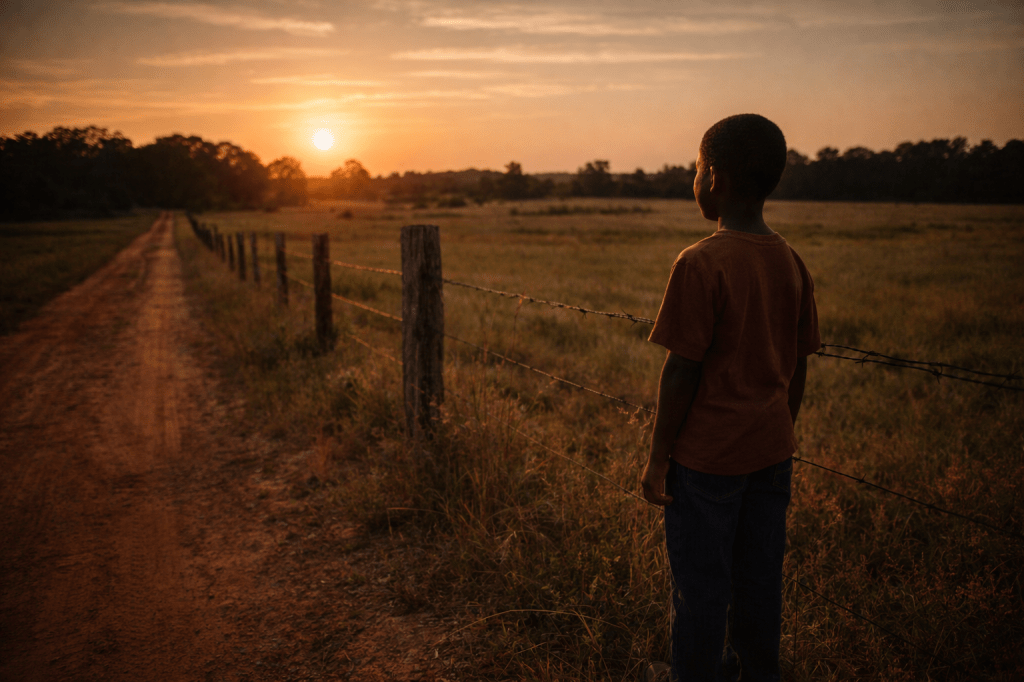
    Kofi lived in the low, breathing cradle of a Southern town where the sun didn’t just rise—it pressed.

    It leaned into the red dirt and the wooden porches, into the backs of people who worked outside because that’s what their lives required.

    The town wasn’t large. It didn’t need to be.

    Every face carried history.

    Every house leaned a little with age, like it had listened to too many stories and decided to rest into them.

    The land itself felt watched over, not owned—held carefully, as something fragile and sacred is.

    Kofi spent his days moving through open fields and fence lines, helping his family tend what little they had: a few animals, a garden, the kind of labor that teaches a boy where his strength ends and his patience must begin.

    He learned the rhythm of the place—the slow insistence of heat, the way time stretched instead of rushed.

    His father was a quiet man.

    Not the kind who filled rooms with speeches, but the kind whose words stayed with you because they were never wasted.

    “To live right,” his father told him once, leaning against a fence post worn smooth by generations of hands, “is to stand straight even when nobody’s watching.

    Especially then.”

    One afternoon, a stranger came into town.

    He arrived in a clean truck that looked too new for the road it traveled, carrying papers instead of tools. He spoke of opportunity. Of development. Of progress.

    He pointed at maps and lines drawn where lives already existed.

    He talked about money the way some people talk about salvation.

    The town gathered.

    Some listened closely.

    Some crossed their arms.

    Everyone felt the weight of the moment, even if they didn’t yet know how to name it.

    The land he wanted wasn’t empty. It was layered—with memories, with loss, with people who had already been moved once before in stories their grandparents told quietly.

    Kofi stood at the edge of the crowd, absorbing more than anyone realized.

    The stranger noticed him.

    Later, away from the others, the man crouched down and handed Kofi something small and shining.

    A token.

    A promise wrapped in metal.

    “Just tell them it’s good,” the man said softly. “They’ll listen to you.”

    Kofi felt the pull of it—the way temptation doesn’t shout but suggests.

    The way it pretends to be harmless.

    He remembered his father’s voice.

    Calm.

    Certain.

    Unbending.

    When the moment came, Kofi stepped forward.

    His hands trembled, but his feet held.

    “This land,” he said, his voice carrying farther than he expected, “isn’t just dirt. It’s where our people learned how to stay. It’s where they buried what they lost and planted what they hoped for.

    You can’t sell something that’s still holding us up.”

    The town grew quiet.

    Not shocked.

    Not dramatic.

    Just still—like something important had been named out loud.

    The stranger gathered his papers.

    He left the same way he came, promises evaporating in the heat.

    Kofi didn’t feel proud the way stories sometimes pretend you should.

    He felt steady.

    Anchored.

    As if he had chosen to belong rather than to escape.

    That evening, his father sat beside him without speaking for a long while.

    Then he nodded once.

    Integrity, Kofi learned, wasn’t loud.

    It didn’t glitter.

    It didn’t offer shortcuts.

    It was the decision to stay rooted when leaving looked easier.

    To speak truth even when silence offered comfort.

    And as Kofi grew, the town grew with him—not richer, not shinier—but intact.

    Still standing.

    Kyle J. Hayes

    kylehayesblog.com

    Please like, comment, and share

    Resources for Hard Times

    If you’re looking for practical help, food support, or community resources, you can visit the Salt, Ink & Soul Resources Page.

    👉 Resources for Hard Times

  • The Shared Table – Eating Together in Hard Times

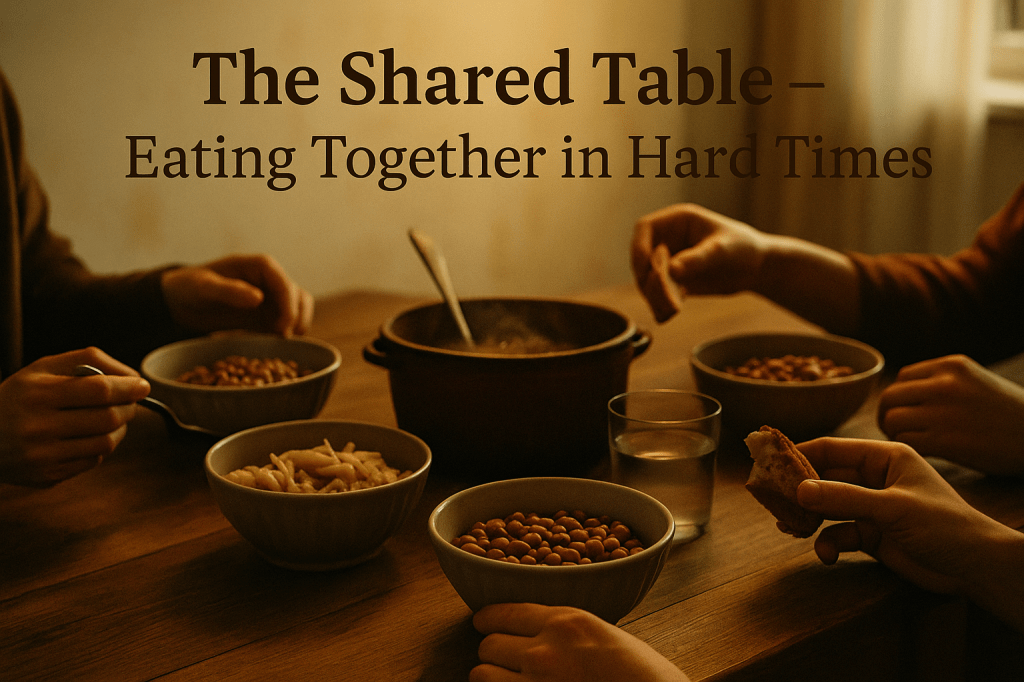
    The Shared Table – Eating Together in Hard Times

      I’ve written before about family-style restaurants, about Sunday dinners, and the long-lost art of staying at the table after the plates are cleared. The way the conversation lingers even after the food is gone. The way silence settles differently when you’re not alone.

    But the older I get, the more I realize there are seasons in life when once a week isn’t enough. When being with family or people who feel like family isn’t just tradition — it’s survival.

    There are cultures where no one ever really leaves. Even after marriage, generations live under the same roof. They eat together, pray together, argue in the hallway, and make up around the stove. Grandparents pass down stories across the dinner table, not through group chats. Aunties and uncles drift in and out like weather systems. There’s always somebody home, always another chair, always another plate.

    From the outside, we look at those households and say, “Too crowded. Too dependent.”

    But they thrive anyway.

    Children grow up knowing they’re held by more than one pair of hands.

    Elders age, knowing they are still seen, still needed.

    Nobody has to pretend they’re an island.

    Is that really so bad?

    Here in the United States, we’re taught to crave distance like oxygen. We can’t wait to get out on our own, can’t wait to prove we’re independent, self-sufficient, “grown.” We call it freedom, and some of it is. There is something sacred about carving out your own life. But somewhere along the way, we confused independence with isolation. We decided that to stand tall, we had to stand alone.

    In our thirst for independence, a lot of us burned the bridges back home. We said things we can’t unsay. Rolled our eyes one too many times. Took the help, then resented the hands that gave it. Some parents, carrying their own ghosts, pushed their kids out into the world with a kind of hard love: sink or swim. Some kids, desperate to prove themselves, jumped before they could walk steadily.

    Some landed on their feet. The parents took the credit.

    Others didn’t land at all. They slipped through the cracks — a missed paycheck here, a bad relationship there, a layoff at the worst possible time. Some ended up in shelters, while others slept in cars, bounced from couch to couch, or lived on the street with their whole life zipped into a backpack.

    We tell ourselves that’s just how it goes. That everyone has a choice. That if they really wanted to, they’d “get back on their feet.”

    But people don’t fall apart all at once.

    They unravel slowly, thread by thread, often in silence.

    I understand this better than most.

    I was one of those people — feeling unwelcome in my own family home, trying to breathe in a house that felt too tight, too tense, too full of things nobody would say out loud. At seventeen, I signed my name on a line and left for the Army with no real plan, no sense of direction — just a vague conviction that I had to go. I didn’t know what I was chasing. I only knew what I was running from.

    I’ve been on my own ever since, making my own decisions. Some good, some bad, some I still feel in my bones. I burned bridges, too. Spoke out of anger. Walked away instead of talking it through. Convinced myself I didn’t need anyone. That needing people was a weakness.

    You tell yourself stories like that long enough, and they start to sound like the truth.

    Now I work with people who have quietly invited me into their lives.

    Co-workers. Friends. Families who say, “Come over, we’re having dinner,” and mean it.

    I’ve sat at their tables — fork in hand — watching the choreography of people who have stayed close to one another. Kids interrupting adults. Adults interrupting each other. Someone’s cousin is laughing too loudly. A grandmother fussing over whether you’ve eaten enough.

    And in those moments, I am both present and somewhere else. I’m looking at the food, but I’m also looking at the thing beneath it — the web of relationships, the unspoken history, the familiar arguments, the small forgivenesses that happen without a word.

    And what would it have been like to have that with a family of my own?

    Not just a Sunday call.

    Not just a holiday visit.

    But the everyday kind of belonging — the weeknight dinners with nothing to celebrate except the fact that you’re together.

    I wonder who I might have been if I had grown up with more chairs around the table, more chances to stay instead of run.

    That wondering doesn’t come from regret.

    It comes from recognition.

    Recognition of what connection can do — how it steadies you, how it humbles you, how it reminds you that you were never meant to go through life alone.

    The shared table is one of the last places in this country where we still practice that truth.

    When times get hard — when prices climb, when paychecks shrink, when systems fail — the table becomes a kind of refuge. It’s where someone decides to make a large pot of something that can be shared and enjoyed over time. Where cousins and neighbors and strays-who-became-family show up with whatever they have: a dish, a drink, a story, their tired selves. It’s where nobody asks for a résumé, just whether you’re hungry.

    I’ve written about food banks, church kitchens, and community centers — places where people line up for a hot meal and leave with more than calories. They leave with eye contact. With their name spoken kindly. With the knowledge that, at least for today, they were not invisible.

    Hunger isolates.

    But eating together does the opposite.

    Screens are always on, but doors often stay closed.

    We scroll through a thousand dinners while our own table stays dark.

    Meanwhile, someone in your neighborhood — maybe even someone you know — would show up if they knew you needed a place to sit.

    But somewhere along the way, we stopped knocking on doors.

    We stopped saying, “Come eat with us.”

    I wish I knew how to fix all of this — the homelessness, the hungry children, the broken families, the pride that keeps us apart. I don’t. I don’t have a blueprint for repairing what this culture has spent decades tearing down.

    What I do have is a small, stubborn belief in the power of the shared table.

    Maybe the first step isn’t policy or program — but an invitation.

    Maybe it’s offering help without attaching shame.

    Maybe it’s calling the kid you pushed out too soon and saying, “Do you want to come home for dinner?”

    Maybe it’s reaching out to the parent you’ve avoided and whispering, “Can we try again over a meal?”

    Maybe it’s rebuilding a bridge you thought was ash — not because you’re guaranteed a reunion, but because you believe someone might want to come back one day.

    One thing I do believe, deeply and without hesitation, is this:

    Families are better together.

    Whether they’re the ones we come from or the ones we gather along the way.

    The table won’t fix everything.

    It won’t erase history, won’t undo every mistake, won’t silence every hurt.

    But it is a place to start.

    A place where pride softens.

    Where hunger — for food, for belonging, for forgiveness — can finally speak.

    The table doesn’t have to be full to matter.

    It just has to be real.

    It just has to be offered.

    It just has to be shared.

    Kyle J. Hayes

    kylehayesblog.com

    Please like, comment, and share

    Related Reading:

    The Taste of Home,The taste of here

    Resources for Hard Times

    If you’re looking for practical help, food support, or community resources, you can visit the Salt, Ink & Soul Resources Page.
    👉 Resources for Hard Times

  • Chasing Balloons, Chasing Time

    Chasing Balloons, Chasing Time

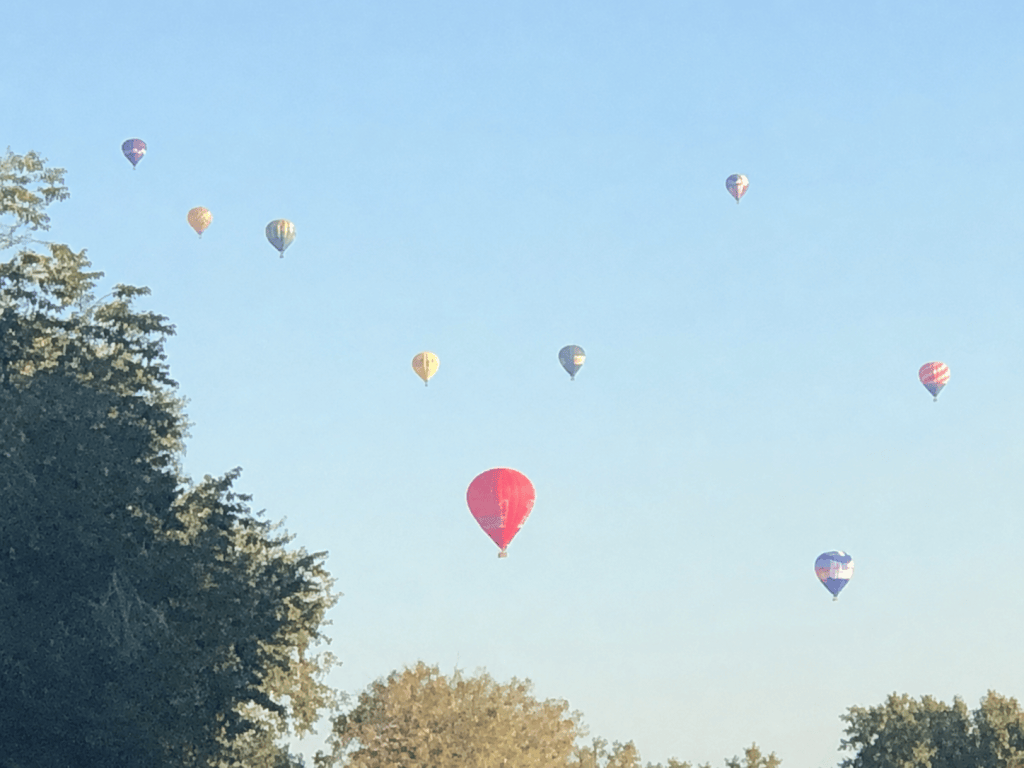
    In October, I step outside and my neck betrays me. It tilts. It’s a reflex now, a habit stitched into the muscle: look up. I’ve lived in Albuquerque for years and still, when the air is cool and the light is clean, I search the sky for color. I tell myself I won’t take more pictures—I have too many already, crooked and overexposed—but I do. I raise the phone anyway. Because a balloon drifting over a familiar street makes the world feel briefly unfamiliar, blessed, less ordinary. It’s hard not to look up when something is gently urging you to do so.

    But you cannot spend all your time with your eyes in the clouds. Others are looking up, too—looking for different reasons. Those are the crews. The chasers. They scan the same sky, but they are reading it. They are mapping a moving target, listening to radios crackle with wind reports and altitude changes, translating the invisible into action. Where I see spectacle, they see a set of decisions unfolding minute by minute.

    How the Chase Works

    The pilot calls down their altitude, drift, and plan. In the basket: a burner, a few tanks, and nerve. On the ground: the crew vehicle, a map app with layers of roads and arroyos, a stack of known landing spots, and the experience to know when to ignore them all. A good crew doesn’t just follow; they “lead from behind.” They stay downwind and look ahead, anticipating the arc of the flight, not tailgating the balloon but shadowing its intention.

    They read the day the way a cook reads heat. A small helium “piball” might have been launched before dawn to trace the low-level winds; the pilot tests layers by climbing or sinking—thirty feet, three hundred, three thousand—finding slight changes that turn the craft, teasing out a path. From the ground, the chase watches power lines and private land, traffic and fences, the geometry of a field that will forgive a landing. When the pilot radios, “Looking good to set down,” the crew hustles to the far side, positioning themselves where the envelope will finally touch down against the earth.

    The landing looks quiet from a distance. Up close, it’s choreography. Someone grabs the crown line to steady the top of the balloon. Someone else works the deflation port when the pilot says the word. Burners hush. Heat thins. The nylon slacks, then it lay down like a tired animal. Hands spread across fabric, smoothing, gathering, rolling. The envelope is folded and fed back into its bag—this miraculous, airborne thing turned back into luggage. The basket is tipped, the rigging coiled, the tanks stowed. Strangers wave from sidewalks. Kids ask if they can help push. Photos are taken. A little dust on the cuffs. The radio goes quiet.

    It isn’t glamorous. It is a practiced tenderness, the way a team returns something fragile to the ground without bruising it.

    The Metaphor We’re All Living

    This is where I stop pretending the chase is only about balloons. The longer I live here, the more I know: life is mostly pursuit. We chase the moments we cannot keep. We follow after brief, beautiful things—youth, luck, a parent’s laugh, a friend’s forgiveness—knowing they will descend somewhere we can’t reasonably predict. We listen for small signals. We study the currents. We get into the truck and try to be there—downwind, ready—when whatever we love returns to earth.

    Impermanence isn’t a flaw in the design. It is the design. Ballooning admits what we try to deny: everything rises; everything comes down. Beauty isn’t proof of permanence; it is evidence of grace while it lasts. You accept that, or you live angry at gravity. The crews seem to know this. They are at peace with the terms. They’ll chase again tomorrow.

    “If flying is the miracle, catching is the mercy.”

    Who We Chase With

    What saves all of this from loneliness is how many people do it together. Balloons make families out of strangers. Some have been crewing for decades—grandparents in fleece vests, their kids in ballcaps, their kids’ kids holding the crown line with serious faces, learning the work. Friends who met in a field at dawn are now godparents to each other’s children. Out-of-towners come from great distances—Wisconsin, Japan, South Africa, and Bristol—and are adopted for a week, handed gloves and a thermos, and told where to stand and when to pull. The language barrier disappears the moment the envelope tugs, and everyone leans in the same direction.

    I’ve seen reunions happen between baskets and tailgates, the kind only a shared ritual can produce. People who fly together once a year but text all year long. People who plan entire vacations around a wind pattern. People who teach their children to cheer not just when the balloon rises, but when the crew in the dust makes the landing gentle. There are potlucks at rented casitas, toasts at brewery patios, quiet walks along the bosque when the morning debrief is done. A city of chasers, binding themselves to a season and, in doing so, to each other.

    What the Chase Teaches

    It would be easy to romanticize this, to pretend it is always a postcard. It isn’t. Sometimes the wind is wrong, the traffic snarls, a landing field vanishes into a “No Trespassing” sign, the radio fritzes, the plan collapses. Sometimes you arrive on time, and sometimes you don’t. Sometimes you watch the balloon settle two streets over, and all you can do is wave and keep moving. There is a lesson in missing, too: you cannot own what you love; you can only accompany it faithfully.

    Still, when it works—when the crew turns down the last dirt road and the basket kisses the earth softly—something inside unclenches. Relief, yes. But also recognition. The craft came back, and so did you. The chase isn’t only a pursuit; it’s a return.

    The Last Act

    By late morning, the city shrugs back into itself. On a block near an arroyo, a crew kneels in the grass, palms flat, as they push the final folds of nylon into a bag. Someone cinches the strap. Someone else pulls the zipper home. A kid ties a knot and grins like they invented rope. Tank valves are checked. The basket is loaded. A pilot thanks the landowner for the use of the field. Phones trade photos. Numbers are saved. Promises are made for next year.

    They pile into the truck, and the radio is silent now, not because the day is over but because the work has moved inside them. Another memory stored. Another morning added to the ledger. Albuquerque is good at this—turning weather into ritual, strangers into companions, a week in October into a reason to belong.

    Closing Reflection

    Suppose Origins was about our first attempts to rise, and Dawn Patrol was about the discipline of hope in the dark. In that case, the chase is their echo in daylight—the acceptance of impermanence, the grace of pursuit, and the belonging we find in catching together what can never be kept alone.

    I still look up when I step outside. I still take too many pictures. But I’ve learned to love the ground as much as the sky: the chase, the coordination, the imperfect arrivals. The balloon rises; we give chase; it lands; we fold it carefully and carry it out. We do not pretend it will last forever. We honor it because it won’t.

    That is the heart of this city’s October. Impermanence accepted, beauty in pursuit. We chase what can’t be kept, and in chasing together, we become the kind of people who know how to let go—gently, gratefully—and still remember where to meet again when the winds turn kind.

    By Kyle J. Hayes

    kylehayesblog.com

    Please like, comment, and share