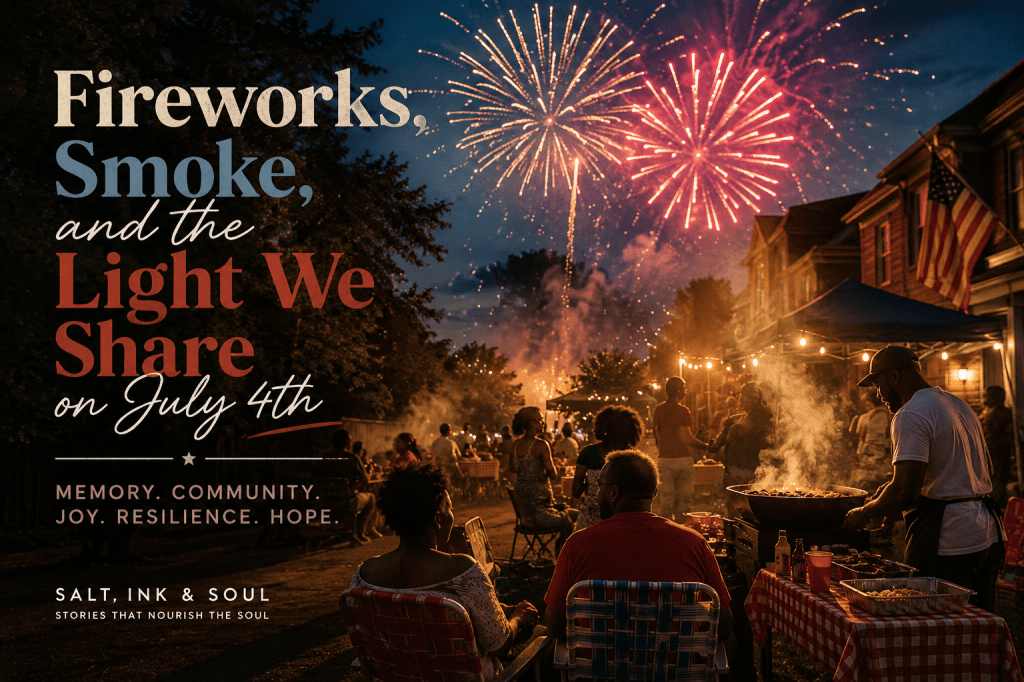
I remember the Fourth of July first through the body.
Not through history books.
Not through speeches.
Not through the careful language of founding documents.
I remember it through smoke.
Smoke rising from grills in backyards. Smoke drifting over alleyways. Smoke clinging to shirts and hair and folding itself into the memory of summer. I remember children running with sparklers, paper plates bending under ribs, baked beans, deviled eggs, and potato salad that everybody quietly judged but still ate.
I remember laughter louder than the cheap fireworks we lit off in the alley.
We did not talk much about the Declaration of Independence. We did not sit around quoting Jefferson. We talked about who cooked what. Who brought the good ice. Who made the punch too sweet. Who showed up with store-bought chicken and tried to pass it off like they had been standing over grease all morning.
But we were celebrating something.
Maybe not the country in the way textbooks wanted us to.
Maybe not independence in its cleanest form.
Maybe what we celebrated was presence.
The gift of still being here.
The gift of people gathered close enough to call your name across a yard.
The gift of neighbors who knew your mother, your children, your business, and sometimes your middle name.
As I grew older, the smoke stayed the same, but the fire changed.
Sparklers became firecrackers. Firecrackers became bottle rockets. Bottle rockets became whole nights spent standing outside, daring the sky to answer us. Later, it became more organized. City festivals. Parades. Firework shows over rivers, stadiums, parks, and fairgrounds.
You would drive somewhere with a blanket, a cooler, and just enough patience to sit in traffic afterward. Then the first burst would open above you, and for a moment, everybody stopped pretending to be separate.
We all looked up.
Together.
That was always the part that mattered most to me.
Not just the color.
Not just the sound.
But the shared looking.
The brief agreement that something beautiful was happening above us, and we were willing to be quiet long enough to receive it.
Now, I often watch the fireworks on television.
I sit in the quiet of a home I work hard to keep. The sound comes through speakers. The colors fill the screen. There is no smoke in the room. No uncle yelling, “Don’t blow your fingers off.” No cousin running too close to the grill. No auntie guarding the good aluminum foil pans like national treasure.
And some years, I have wondered what the Fourth of July is supposed to mean.
I have wondered how to celebrate a nation that has so often complicated celebration.
I have wondered how to hold joy in one hand and history in the other without dropping either one.
Because for Black folks, America has always asked a strange thing of us.
It has asked us to love a house we helped build while reminding us which rooms were never meant for us.
It has asked us to sing while carrying memory.
It has asked us to wave flags that did not always wave for us.
And yet, somehow, we kept making room for joy.
We made room around tables.
We made room in church basements.
We made room on porches, in parks, on folding chairs, beside grills, under trees, and in the middle of neighborhoods the world too often misunderstood.
That is no small thing.
To still find laughter, cook, dance, gather, and still look up.
Please like, comment, and share
Resources for Hard Times
If you’re looking for practical help, food support, or community resources, you can visit the Salt, Ink & Soul Resources Page.

 Salt,Ink, & Soul