For T.S. — my sister, and the Neighborhood Mom to so many.
Every neighborhood had her.
Not appointed.
Not elected.
Not funded.
But known.
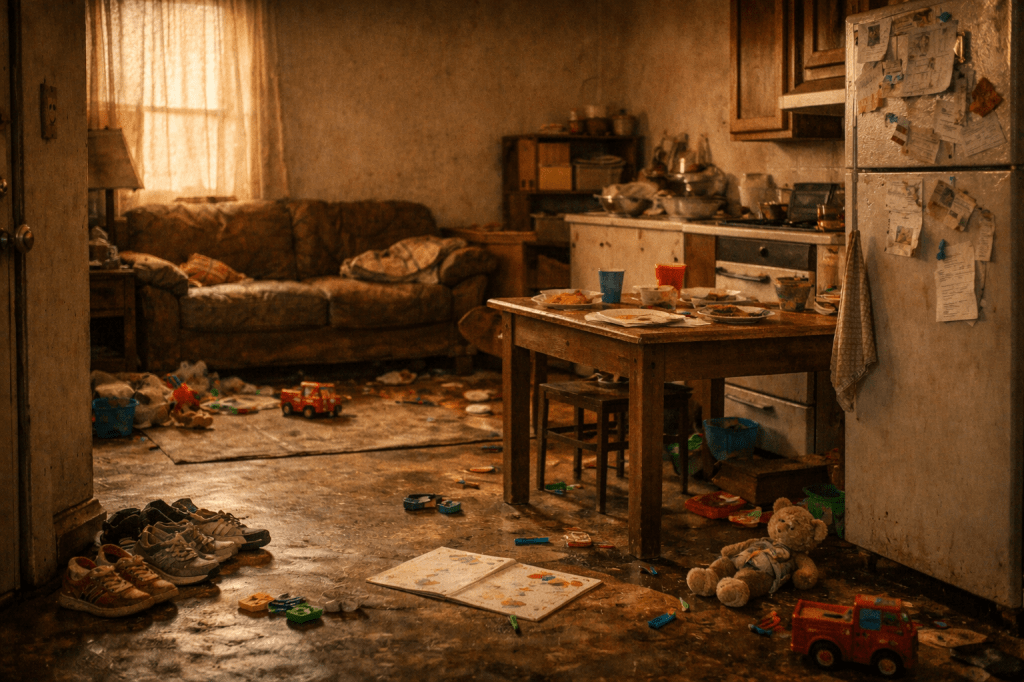
She didn’t live in the biggest house. Most of the time, it was the opposite. Paint tired. Couch worn thin. The kitchen light was buzzing like it had something to say. The kind of home that didn’t look like much from the sidewalk — but felt like oxygen once you stepped inside.
We didn’t call her a social worker.
We didn’t call her a guardian.
We didn’t call her a saint.
We just knew: if things got bad, you could go there.
I remember walking into a house like that once and being startled — not by silence, but by the opposite. Children everywhere. Some on the floor. Some on couches. Some are half-asleep with homework still open. Shoes by the door that didn’t all belong to the same family. A pot on the stove that seemed to stretch itself every night to feed one more mouth than it should have been able to handle.
It looked chaotic if you didn’t understand it.
But if you stayed long enough, you saw the pattern.
You saw the safety.
She wasn’t rich. Sometimes she was barely holding her own household together. Bills late. Refrigerator thinner than she would admit. You could tell by the way she portioned things that she knew how to stretch. How to make a little feel like enough. How to season scarcity until it didn’t taste like embarrassment.
How she fed so many on so little is still a mystery to me.
But she did.
Plates appeared. Clean shirts appeared. Towels were shared. Soap was rationed but never withheld. And at night — no matter how crowded it was — there was always a space cleared for someone who didn’t have one.
Some of those children came because home was loud in the wrong way.
Some came because home was silent in the wrong way.
Some came because there was no home at all.
She didn’t interrogate the reason.
She made space.
In neighborhoods where systems were underfunded and futures were over-policed, women like her were infrastructure. They were the unofficial institutions. The gap-fillers. The quiet counterweights to chaos.
You could write a thousand policy papers about community stabilization and still miss the fact that sometimes it was one woman’s kitchen table doing the heavy lifting.
She didn’t have a nonprofit.
She had a heart that wouldn’t let her turn children away.
And that kind of heart is not soft.
It is disciplined.
Because compassion without discipline collapses under pressure. But she kept showing up. Every day. Every week. Every time a new pair of eyes looked at her from the doorway with that question in them:
Can I stay?
And she almost always said yes.
What we didn’t understand as children was the cost.
We didn’t see the arithmetic she was doing in her head.
We didn’t hear the sighs she swallowed.
We didn’t know how tired she was.
We only saw the outcome:
We were clean.
We were fed.
We were safe.
And in neighborhoods where safety was not guaranteed, that was no small thing.
It’s easy to celebrate the visible heroes — the ones with microphones, the ones whose names are etched in textbooks. But communities are often held together by people whose names never leave the block.
The neighborhood mom.
She was not perfect. She had her rules. Her voice could rise when it needed to. She knew who was lying before the lie finished forming. She demanded respect not because she craved control, but because order was the only way love could function in a crowded house.
That house was not just a shelter.
It was a rehearsal.
It taught children what stability felt like, even if only for a season. It modeled what adulthood could look like when responsibility wasn’t optional. It showed that care is not about abundance. It’s about commitment.
I think about her sometimes when conversations turn to “community breakdown” or “youth crisis.” People talk about statistics. Funding gaps. Cultural decline.
And you can measure many things.
But you can’t easily measure the woman who refuses to let children sleep outside.
You can’t quantify the moral gravity of a person who says, “You can stay here,” when she barely has enough for herself.
That is not charity.
That is architecture.
She built invisible scaffolding around young lives until they were strong enough to stand on their own.
And maybe the most powerful part is this:
She did not do it for applause.
She did not do it for legacy.
She did it because her heart would not let her do otherwise.
There are people whose goodness is not strategic.
It is instinctive.
The neighborhood mom was one of them.
As adults, we sometimes look back and realize something uncomfortable:
We survived partly because of someone else’s quiet sacrifice.
Because somewhere along the way, a woman with too little decided to stretch herself further.
And now the question isn’t just about honoring her.
It’s about becoming her in whatever way we can.
Not necessarily by opening our homes to a dozen children — though some still do.
But by asking:
Where is the open space in my life?
What safety do I need to provide?
How can I make “a little” feel like enough for someone else?
In a world obsessed with visibility, the neighborhood mom practiced invisible greatness.
She did not trend.
She endured.
Kyle J. Hayes
Please like, comment, and share
Resources for Hard Times
If you’re looking for practical help, food support, or community resources, you can visit the Salt, Ink & Soul Resources Page.
 Salt,Ink, & Soul