Tag: blog

  • The Weight of Staying

    The Weight of Staying

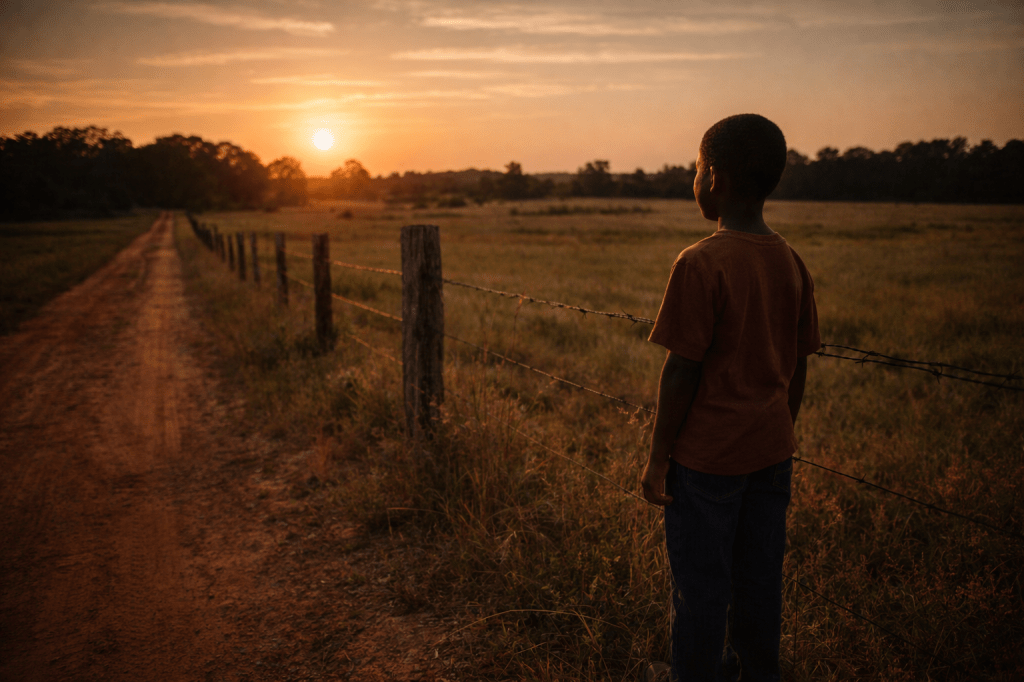
    Kofi lived in the low, breathing cradle of a Southern town where the sun didn’t just rise—it pressed.

    It leaned into the red dirt and the wooden porches, into the backs of people who worked outside because that’s what their lives required.

    The town wasn’t large. It didn’t need to be.

    Every face carried history.

    Every house leaned a little with age, like it had listened to too many stories and decided to rest into them.

    The land itself felt watched over, not owned—held carefully, as something fragile and sacred is.

    Kofi spent his days moving through open fields and fence lines, helping his family tend what little they had: a few animals, a garden, the kind of labor that teaches a boy where his strength ends and his patience must begin.

    He learned the rhythm of the place—the slow insistence of heat, the way time stretched instead of rushed.

    His father was a quiet man.

    Not the kind who filled rooms with speeches, but the kind whose words stayed with you because they were never wasted.

    “To live right,” his father told him once, leaning against a fence post worn smooth by generations of hands, “is to stand straight even when nobody’s watching.

    Especially then.”

    One afternoon, a stranger came into town.

    He arrived in a clean truck that looked too new for the road it traveled, carrying papers instead of tools. He spoke of opportunity. Of development. Of progress.

    He pointed at maps and lines drawn where lives already existed.

    He talked about money the way some people talk about salvation.

    The town gathered.

    Some listened closely.

    Some crossed their arms.

    Everyone felt the weight of the moment, even if they didn’t yet know how to name it.

    The land he wanted wasn’t empty. It was layered—with memories, with loss, with people who had already been moved once before in stories their grandparents told quietly.

    Kofi stood at the edge of the crowd, absorbing more than anyone realized.

    The stranger noticed him.

    Later, away from the others, the man crouched down and handed Kofi something small and shining.

    A token.

    A promise wrapped in metal.

    “Just tell them it’s good,” the man said softly. “They’ll listen to you.”

    Kofi felt the pull of it—the way temptation doesn’t shout but suggests.

    The way it pretends to be harmless.

    He remembered his father’s voice.

    Calm.

    Certain.

    Unbending.

    When the moment came, Kofi stepped forward.

    His hands trembled, but his feet held.

    “This land,” he said, his voice carrying farther than he expected, “isn’t just dirt. It’s where our people learned how to stay. It’s where they buried what they lost and planted what they hoped for.

    You can’t sell something that’s still holding us up.”

    The town grew quiet.

    Not shocked.

    Not dramatic.

    Just still—like something important had been named out loud.

    The stranger gathered his papers.

    He left the same way he came, promises evaporating in the heat.

    Kofi didn’t feel proud the way stories sometimes pretend you should.

    He felt steady.

    Anchored.

    As if he had chosen to belong rather than to escape.

    That evening, his father sat beside him without speaking for a long while.

    Then he nodded once.

    Integrity, Kofi learned, wasn’t loud.

    It didn’t glitter.

    It didn’t offer shortcuts.

    It was the decision to stay rooted when leaving looked easier.

    To speak truth even when silence offered comfort.

    And as Kofi grew, the town grew with him—not richer, not shinier—but intact.

    Still standing.

    Kyle J. Hayes

    kylehayesblog.com

    Please like, comment, and share

    Resources for Hard Times

    If you’re looking for practical help, food support, or community resources, you can visit the Salt, Ink & Soul Resources Page.


    👉 Resources for Hard Times

  • What Stayed With Me This Month

    What Stayed With Me This Month

    January didn’t arrive with fireworks for me.

    It didn’t kick open the door and demand a reinvention.

    It sat down quietly and waited to see what I would do.

    Every year, January carries a certain pressure—the sense that you’re supposed to emerge from the holidays renewed, corrected, aimed in a better direction. As if surviving December isn’t an accomplishment in itself. As if rest only counts if it’s followed immediately by improvement.

    But this month didn’t ask that of me.

    And because it didn’t ask, I noticed more.

    What stayed with me wasn’t a resolution.

    It wasn’t a plan.

    It wasn’t the sudden clarity people like to perform this time of year.

    What stayed with me were smaller things.

    A kind of tired that didn’t feel like failure.

    The difference between being exhausted and being empty.

    The relief of realizing that not every ache is a problem to solve—some are just signals asking for care.

    What stayed with me was food that did its job without announcing itself.

    Meals that didn’t impress anyone but left me steady.

    Soup that didn’t look fancy.

    Chicken and cabbage in a single pan.

    Breakfast made from what was already there.

    There’s a particular kind of trust that builds when you stop chasing novelty and start paying attention to what actually holds you together. January reminded me that nourishment doesn’t need a spotlight. It needs consistency.

    What stayed with me were the stories meant for children that told the truth anyway.

    Felix learning that rest comes before effort.

    That nourishment matters more than appearance.

    That hard work has meaning when it serves something larger than ego.

    That staying—being present—is sometimes the bravest choice.

    Writing those stories reminded me that lessons don’t stop being true just because we age out of picture books. We just pretend we don’t need them anymore.

    What stayed with me was the question of work—the kind that doesn’t announce itself.

    The work of restraint.

    The work of not becoming what you oppose.

    The work of continuing without applause.

    Honoring Dr. King’s birthday this month brought that into sharper focus. Not the polished version of his legacy, but the disciplined one. The version that understood anger but refused to let it drive. The version that knew the dream was unfinished and chose responsibility anyway.

    That stayed with me.

    And maybe most of all, what stayed with me was permission.

    Permission to arrive slowly.

    Permission to trust what feeds me.

    Permission to stop fixing things that aren’t broken just because the calendar flipped.

    January didn’t make me new.

    It reminded me of what’s already working.

    As the month closes, I’m not carrying forward any goals. I’m carrying forward awareness. Attention. A quieter sense of direction.

    Not everything needs to be upgraded.

    Not everything needs to be optimized.

    Some things just need to be noticed—and kept.

    Kyle J. Hayes

    kylehayesblog.com

    Please like, comment, and share

    Resources for Hard Times

    If you’re looking for practical help, food support, or community resources, you can visit the Salt, Ink & Soul Resources Page.

    👉 Resources for Hard Times

  • What Would He Think of the Dream Now?

    What Would He Think of the Dream Now?

    Today, we celebrate the birthday of a man who gave so much of himself that there was nothing left to take.

    A man who understood—long before the rest of us were ready to admit it—that speaking the truth in a country built on denial comes with a cost. A man who seemed to know, on some level, where the road he was walking would end, and chose to walk it anyway.

    As I look around today, I find myself wondering what he would think.

    Not in a ceremonial way.

    Not in a quote-for-the-day way.

    But honestly.

    Would he still have the same dream?

    Would he look at his people—their survival, their brilliance, their contradictions, their victories, and their wounds—and feel pride? Relief? Concern? All of it braided together?

    Would he believe the dream survived him?

    Or would he recognize it for what it has always been: unfinished work.

    What many people forget—or choose not to remember—is that his vision was never narrow. He did not fight for a single group at the expense of others. He fought for all who were crushed beneath unfair systems: Black and white, poor and working, seen and ignored. He stood against injustice itself, not just the version that wore familiar faces.

    That kind of fight costs more than slogans admit.

    As I sat wondering what to write today, I found myself at a loss. Not because there was nothing to say, but because the weight of the man and the moment does not lend itself easily to neat paragraphs. So I went back and learned again.

    I learned again about the discipline of nonviolence—not the softened version we like to remember, but the demanding one. The kind that requires you to absorb blows without letting your spirit turn brittle. The kind that asks you to restrain your hand even when your body is screaming to defend itself.

    That kind of restraint does not come naturally.

    It has to be practiced.

    I learned again how often he was arrested. How frequently he was removed from the streets not because he was wrong, but because he was effective. How some of his most enduring words were written while confined—stripped of movement, forced into stillness.

    Something is sobering about that.

    A reminder that confinement has never stopped truth from finding its way onto paper. That history’s sharpest insights are often written by people who were told to sit down and be quiet.

    And while others preached more aggressive paths—paths that made sense, paths that spoke directly to rage—he held to peace. Not because he was unfamiliar with anger, but because he understood what it could become if left unguided.

    That choice cost him credibility with some. It cost him patience with others. It cost him comfort. And eventually, it cost him his life.

    Which brings me back to the question I can’t quite put down:

    What would he think now?

    Would he be encouraged by the doors that have opened?

    Would he be troubled by the ones that quietly closed behind us?

    Would he recognize progress—and still point out how uneven it remains?

    I don’t believe he would be surprised by our divisions. He knew human nature too well for that. And I don’t think he would be shocked by our impatience either. When you’ve waited generations for justice, patience becomes a complicated request.

    But he would ask us something uncomfortable.

     Are you angry?

    But what are you building with that anger?

     Have you suffered?

    But have you learned how to keep your suffering from hardening your heart?

    Because the dream was never about perfection.

    It was about direction.

    About bending the arc—not snapping it in half. About insisting on dignity even when the world refuses to recognize it. About believing that the measure of a society is not how loudly it celebrates its heroes, but how faithfully it carries their work forward when they are gone.

    Today, we celebrate his birth. But birthdays are not only about candles and remembrance. They are about legacy—about what continues because someone once chose courage over safety.

    So the better question isn’t what he would think of us.

    The question is what we think of ourselves in light of what he gave.

    Are we still committed to fairness when it is inconvenient?

    Are we still willing to restrain ourselves from becoming what we oppose?

    Are we still able to imagine a future that extends beyond our own survival?

    Nonviolence, at its core, was never passive.

    It was active care.

    Care for the soul of a people.

    Care for the future they would have to live in.

    Care for the possibility that justice, pursued without hatred, might actually last.

    That kind of care is exhausting.

    And maybe that is why his life still speaks.

    Because it reminds us that change does not come from comfort. That the work is never finished. That the dream was not a destination, but a responsibility handed forward.

    Today, on his birthday, we are not asked to rehearse his words or turn his life into a symbol we can safely admire from a distance. We are asked something more complex and more honest: to sit with the cost of what he chose, to recognize that nonviolence was not comfort but discipline, not silence but intention.

    To consider whether we are still willing to be shaped by a dream that demands more than applause.

    A dream like that does not survive on remembrance alone. It survives only if someone, somewhere, decides—quietly and without cameras—to carry it forward.

    Kyle J. Hayes

    kylehayesblog.com

    Please like, comment, and share

    Resources for Hard Times

    If you’re looking for practical help, food support, or community resources, you can visit the Salt, Ink & Soul Resources Page.

    👉 Resources for Hard Times

  • Sweet Cornmeal Pancakes with Honey Butter

    Sweet Cornmeal Pancakes with Honey Butter

    These pancakes sit somewhere between breakfast and memory. Cornmeal gives them texture and weight — not heavy, just honest. They’re the kind of pancakes that don’t collapse under syrup, that hold warmth a little longer, that feel like something meant to last through a slow morning.

    Cornmeal stretches what you have. It always has. And here, it does so quietly, turning a simple batter into something worth lingering over.

    Recipe Details

    Serves: 4

    Prep Time: 10 minutes

    Cook Time: 15 minutes

    Total Time: About 25 minutes

    Ingredients

    Pancakes

    • 1 cup cornmeal
    • 1 cup all-purpose flour
    • 2 tbsp sugar
    • 2 tsp baking powder
    • 1½ cups milk or buttermilk
    • 1 large egg
    • 2 tbsp oil or melted butter

    Honey Butter (for serving)

    • Softened butter
    • Honey
    • Pinch of salt

    Instructions

    1. Mix the dry ingredients

    In a large bowl, whisk together:

    • cornmeal
    • flour
    • sugar
    • baking powder

    Whisk until evenly combined.

    2. Mix the wet ingredients

    In a separate bowl, whisk together:

    • milk (or buttermilk)
    • egg
    • oil or melted butter

    3. Make the batter

    Add the wet ingredients to the dry ingredients.

    Stir gently just until combined.

    The batter should be thick but pourable.

    If it feels too stiff, add a splash more milk.

    4. Cook the pancakes

    Heat a lightly oiled skillet or griddle over medium heat.

    Pour about ÂĽ cup batter per pancake onto the hot surface.

    Cook until bubbles form, and the edges begin to set, about 2–3 minutes.

    Flip and cook another 1–2 minutes, until golden and cooked through.

    5. Serve

    Serve warm with a pat of honey butter melting over the top.

    Honey Butter (Quick Mix)

    Stir together:

    • softened butter
    • honey
    • pinch of salt

    Adjust sweetness to taste.

    Budget Tip

    Cornmeal adds texture and stretches the flour — a small shift that feeds more people with the same pantry. Leftover batter can be poured into muffin tins and baked for quick cornbread muffins later in the week.

  • One-Pan Chicken Thighs with Cabbage & Onion

    One-Pan Chicken Thighs with Cabbage & Onion

    Some meals don’t need improvement.

    They just need time, heat, and a little trust.

    This one-pan dinner is built from ingredients that have fed people quietly for generations—chicken thighs, cabbage, and onions. Nothing fancy. Nothing rushed. Everything is doing the work it knows how to do.

    It’s the kind of meal you make when you stop chasing what’s supposed to be better and start listening to what actually sustains you.

    🕰️ Time & Yield

    • Prep Time: 10 minutes
    • Cook Time: 40–45 minutes
    • Total Time: About 55 minutes
    • Serves: 2–3

    đź§‚ Ingredients

    • 4 bone-in, skin-on chicken thighs
    • ½ medium green cabbage, sliced into thick ribbons
    • 1 large yellow onion, sliced
    • 2 tablespoons olive oil
    • 1 teaspoon kosher salt (plus more to taste)
    • ½ teaspoon black pepper
    • 1 teaspoon paprika (optional, for warmth)
    • 2 cloves garlic, smashed (optional)

    🔥 Instructions

    1. Preheat the oven
    2. Set your oven to 400°F (205°C).
    3. Prepare the vegetables
    4. In a large roasting pan or rimmed baking sheet, toss the sliced cabbage and onion with olive oil, salt, pepper, and paprika if using. Spread into an even layer.
    5. Season the chicken
    6. Pat the chicken thighs dry. Season both sides generously with salt and pepper.
    7. Assemble the pan
    8. Nestle the chicken thighs skin-side up on top of the cabbage and onions. Tuck the garlic cloves around the pan if using.
    9. Roast
    10. Place the pan uncovered in the oven. Roast for 40–45 minutes, until the chicken skin is deeply golden and crisp, and the cabbage is soft and lightly caramelized.
    11. Rest and serve
    12. Let the pan rest for 5 minutes before serving. Spoon the cabbage and onions onto plates and top with a chicken thigh.

    🍽️ Serving Notes

    This meal doesn’t ask for much on the side.

    It’s enough on its own.

    If you want something extra, a simple piece of bread or a spoonful of mustard on the plate is more than sufficient.

    📝 Kitchen Notes

    • Chicken thighs stay tender even if you leave them in a few extra minutes—this is forgiving food.
    • The cabbage sweetens as it cooks; resist the urge to stir too much.
    • This reheats well and tastes even better the next day.

    🌱 A Quiet Thought

    There’s confidence in cooking food you don’t have to explain.

    Ingredients that know their job.

    A pan that does most of the work.

    This is nourishment without performance—food you can trust to carry you through the evening.

  • Keto Beef & Broccoli Stir-Fry

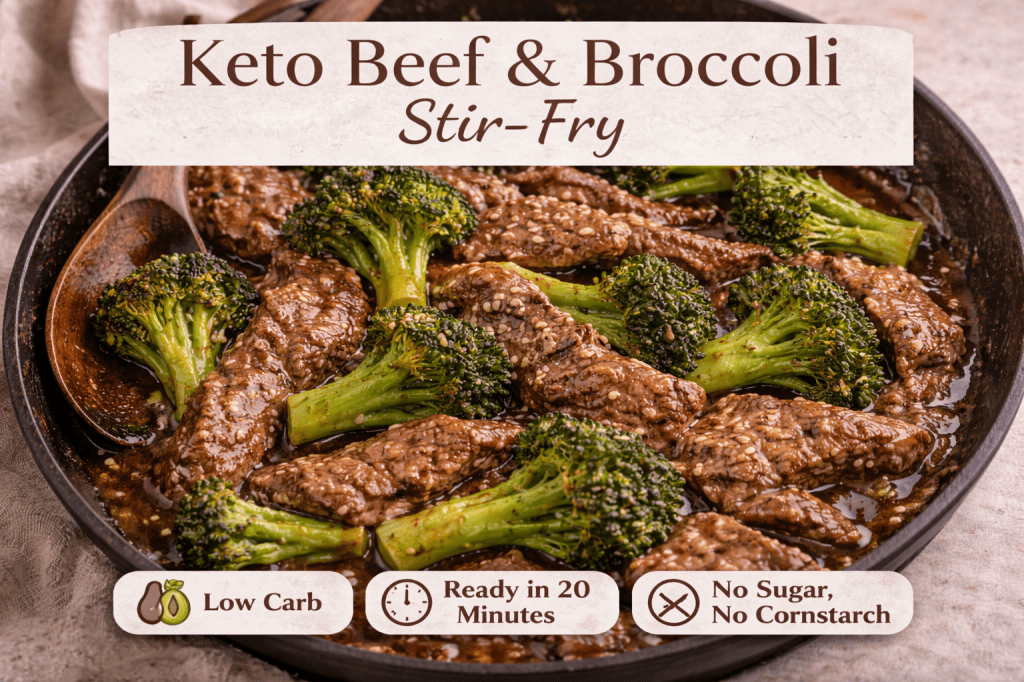
    Keto Beef & Broccoli Stir-Fry

    Serves: 2–3

    Cook Time: 20 minutes

    Style: Simple Skillet • Keto • Low-Carb

    Ingredients

    Beef & Broccoli

    • 1½ lbs flank steak or sirloin, thinly sliced against the grain
    • 4 cups broccoli florets
    • 2 tbsp avocado oil (or other high-heat oil)
    • Salt and black pepper, to taste

    Stir-Fry Sauce

    • ÂĽ cup soy sauce or coconut aminos
    • 2 tbsp beef broth or water
    • 1 tbsp sesame oil
    • 1 tbsp rice vinegar or apple cider vinegar
    • 1–2 tsp keto-friendly sweetener (optional)
    • 3 cloves garlic, minced
    • 1 tsp fresh grated ginger (optional)
    • ½ tsp xanthan gum (optional)

    Instructions

    1. Prepare Ingredients
    2. Slice beef thinly against the grain.
    3. Cut broccoli into bite-sized florets.
    4. Cook Beef
    5. Heat 1 tbsp oil in a skillet or wok over medium-high heat.
    6. Season the meat lightly with salt and pepper.
    7. Cook in batches, searing 2–3 minutes per batch until just browned.
    8. Remove and set aside.
    9. Cook Broccoli
    10. Add remaining oil to the skillet.
    11. Add broccoli with ÂĽ cup of water.
    12. Cover and steam 2–3 minutes until tender-crisp.
    13. Uncover and let excess moisture cook off.
    14. Make Sauce
    15. Whisk together all sauce ingredients.
    16. Sprinkle xanthan gum in while whisking, if using.
    17. Combine
    18. Return the beef to the skillet with the broccoli.
    19. Pour sauce over and toss to coat.
    20. Simmer 2–3 minutes until glossy and thickened.
    21. Serve
    22. Serve immediately.

    Notes

    • No sugar, flour, or cornstarch
    • Keeps 3–4 days refrigerated
    • Reheats best in a skillet
    • Serve alone or over cauliflower rice
  • Nothing Is Required of You Yet

    Nothing Is Required of You Yet

    The year has barely opened its eyes, and already it’s being shouted at.

    Everywhere you turn, somebody is trying to sell you a clean slate. A new body. A new mindset. A new you—freshly scrubbed, perfectly organized, and somehow untouched by everything that happened before midnight.

    And maybe that works for some people.

    But for a lot of us, the first week of January doesn’t feel like a beginning.

    It feels like the aftermath.

    It feels like walking through your own house after a party you didn’t really want to host—cups in the sink, wrapping paper in the corner, a tiredness in your bones you can’t quite explain without sounding ungrateful. You made it through the holidays. That phrase is said casually, as if it’s just a calendar fact. But anyone who’s lived it knows the truth: the holidays can be a full-body experience.

    Even if you love the season.

    Even if you love the lights, the music, the movies, and the idea of togetherness.

    There’s still the stress. The logistics. The family history that shows up uninvited. And if you’re honest, you might have added pressure to your own back—trying to make it perfect, trying to make yourself perfect inside it.

    So if January feels less like a launch and more like a long exhale, let me say something that might sound almost wrong:

    Nothing is required of you yet.

    The Myth of the Immediate Reinvention

    January arrives with a checklist dressed up as encouragement.

    Start fresh.

    Fix yourself.

    Prove you learned something.

    But a year isn’t a courtroom.

    You don’t have to stand trial on January 1st for everything you didn’t do last year. You don’t owe the calendar a performance just because it turned the page.

    Many people enter January already tired—recovering from emotional labor, grief, loneliness, expectation, and survival. And then the world says, Now improve.

    That isn’t motivation.

    That’s pressure with better lighting.

    Permission to Arrive Slowly

    The first week of January is not for everyone to become their best self.

    Sometimes it’s for becoming yourself again.

    Slowness is not failure. Slowness can be wisdom. It can be how you tell your body, I’m listening.

    If you haven’t planned the year, that’s okay.

    If your goals aren’t mapped, that’s okay.

    If you already missed the version of yourself January promised you’d be—that’s okay too.

    Anything built on shame will eventually collapse.

    Rest as Foundation

    Rest isn’t something you earn after becoming impressive.

    Sometimes rest is repair.

    Sometimes it’s the quiet work of putting yourself back together after a season that took more than it gave.

    You don’t have to sprint into January to prove you deserve the year. The year will come either way. Your job is not to outrun it—but to meet it with your feet under you.

    A Softer Beginning

    If you want a beginning, start small.

    A glass of water.

    A walk around the block.

    A meal made slowly.

    One room made livable.

    Small is how trust is rebuilt—with your body, with your life, with yourself.

    Let the Year Be Young

    The most important things don’t begin with explosions. They begin with breath.

    If you’ve made it to this first week of January, you’ve already done something meaningful.

    So maybe the most radical thing you can do right now is let yourself arrive.

    Nothing is required of you yet.

    Not because you’re giving up—but because you’re giving yourself a chance.

    Let the year be young.

    Let it be quiet.

    Let it meet you where you are.

    Kyle J. Hayes

    kylehayesblog.com

    Please like, comment, and share

    Resources for Hard Times

    If you’re looking for practical help, food support, or community resources, you can visit the Salt, Ink & Soul Resources Page.
    👉 Resources for Hard Times

    Want to Go Deeper?

    If you’d like to spend more time with these themes, my books explore food, memory, resilience, and emotional truth in greater depth.

    👉 [Explore the books here →] Felix book collection

  • A Quiet Thank You at Year’s End

    A Quiet Thank You at Year’s End

    There are twenty of you here—readers who chose to subscribe, to return, and to spend time with this blog over the past year. That number may look small from the outside, but it doesn’t feel small to me. It means that twenty people, in a world that’s moving faster every day, chose to slow down and read words without being in a hurry.

    This year, Salt, Ink & Soul became a place I didn’t fully understand until I was already inside it. A place where food could carry memory without needing to justify itself. Where children’s stories could sit beside reflections on grief, resilience, and the quiet weight of being human. Where the idea of “enough” could be asked gently, without demanding an answer right away.

    Some of you read every post.

    Some of you arrive when a title catches something familiar.

    Some of you read quietly, without ever commenting or leaving a trace.

    All of that is welcome here.

    What I’ve learned this year is that writing doesn’t have to shout to be heard. It only has to be honest. Showing up—again and again—even when the words come slowly, even when the questions remain unfinished, has felt like its own kind of discipline. And knowing readers are willing to sit with that uncertainty has meant more than I can adequately say.

    If you’re reading this as a subscriber, thank you for choosing to stay. Thank you for trusting this space enough to let it arrive in your inbox. Your presence—steady, patient, unassuming—has helped shape what this place is becoming.

    And if you’re reading this for the first time, know this: this is a quiet corner. A place for stories about food, memory, children, and the small moments that often get overlooked. You’re welcome here, whether you pass through once or decide to stay awhile.

    As the year turns, I don’t have grand promises. What I do have is intention. I’ll keep writing. I’ll keep paying attention. I’ll keep trying to make this space feel warm, thoughtful, and human—a place where reflection can breathe.

    Thank you for being here at the beginning. Thank you for reading slowly. Thank you for taking the time to read words written with care.

    If there’s a story you’re still waiting for, or a question you carry quietly, I hope you’ll continue to walk through this space with me. There will be more stories ahead, more moments to sit with, more chances to pause together—and I’m grateful for every reader who chooses to return.

    With gratitude and hope

    Kyle Hayes

    Salt, Ink & Soul

    If you’d like to spend more time with these themes, my books explore food, memory, resilience, and emotional truth in greater depth.

    Explore the books here → Felix collections or on Amazon

  • Lemon Garlic Butter Chicken with Asparagus

    Lemon Garlic Butter Chicken with Asparagus

    Serves: 1–2

    Cook Time: 20 minutes

    Style: Reset Cooking • Simple Skillet • Low-Carb

    Ingredients

    • 1–2 boneless chicken thighs or breasts
    • 1 bunch asparagus, ends trimmed
    • 2 tbsp butter
    • 1 tbsp olive oil
    • 2 cloves garlic, minced
    • Zest of ½ lemon
    • Fresh lemon juice, to taste
    • Salt and cracked black pepper

    Optional:

    • Grated parmesan
    • Splash of heavy cream

    Instructions

    1. Season Chicken
    2. Season chicken generously with salt and cracked black pepper.
    3. Sear Chicken
    4. Heat olive oil in a skillet over medium heat.
    5. Cook chicken 5–7 minutes per side until golden and cooked through.
    6. Remove from the skillet and set aside.
    7. Make Garlic Butter
    8. Lower the heat slightly. Add butter to the skillet.
    9. Once melted, add garlic and cook gently until fragrant (30–60 seconds).
    10. Cook Asparagus
    11. Add asparagus to the skillet.
    12. Sauté 3–5 minutes until tender but still firm.
    13. Finish
    14. Add lemon zest and a squeeze of lemon juice.
    15. Return the chicken to the skillet and spoon the butter sauce over everything.
    16. Optional:
      • Add parmesan for depth
      • Add cream for extra richness
    17. Serve Immediately

    Notes

    • Asparagus provides ~2g net carbs per cup
    • Works well for meal prep (3–4 days refrigerated)
    • Pairs well with cauliflower rice or sautĂ©ed greens
  • If You’re Going to Be Something, Be the Best

    If You’re Going to Be Something, Be the Best

    When I was young, my mother used to say things that felt like knives wrapped in wisdom. Sharp. Precise. And always cutting a little too close to the bone.

    “If you’re going to be something,” she said once, “be the best. If you’re going to be a thief, be the best thief.”

    I remember sitting there, seething—convinced she was calling me a failure in advance, like she saw a mugshot waiting in my future. I was a dramatic child, sure. But I also heard the world louder than most, and in her tone I thought I heard the echo of disappointment.

    It took years—decades, really—for me to understand that she wasn’t predicting my downfall.

    She was warning me about mediocrity.

    About sleepwalking through life.

    About the quiet tragedy of wasting whatever small fire was burning inside me.

    Craft, Seen and Unseen

    My Uncle Michael understood this before I did.

    He was the janitor at my elementary school—a man whose name most kids probably never knew. But I knew him. I knew the way his shirts were always pressed, his shoes always were always shined, the faint smell of Pine-Sol that followed him like a badge of honor.

    He wasn’t just cleaning floors.

    He was restoring order to chaos, one hallway at a time.

    That school gleamed. The floors reflected the ceiling lights like calm water. Even as a kid, I could tell that he took pride in what most people never noticed.

    Years later, I heard he started his own cleaning company. Built something from nothing. Took what the world might have dismissed and made it into a craft.

    That’s the word that sticks with me now.

    Craft.

    Learning to Show Up

    I didn’t realize it at the time, but when I sat alone in my room scribbling stories, I was chasing the same truth my uncle had already mastered.

    The art of showing up.

    The quiet dignity of repetition.

    The beauty of care.

    I thought I was just escaping—drawing worlds because the real one felt too heavy. But now I see it.

    Every sentence was me learning how to hold a broom, so to speak.

    Every paragraph, another hallway swept clean of doubt.

    My mother’s words echo differently now.

    If you’re going to be something—be all the way in.

    Don’t just stand at the doorway of your own potential, waiting for someone else to invite you through.

    Keep Showing Up

    Because the world will always give you a reason to stop.

    It’ll whisper that you’re too late.

    Too tired.

    Too small.

    Too unimportant.

    But the work—your work—doesn’t care about any of that.

    It only asks that you keep showing up.

    So this is what I tell myself now:

    If you’re going to be something, be the best.

    If you’re going to write, write until your fingers hurt and your heart feels seen.

    If you’re going to clean, make the floor shine like truth.

    If you’re going to live, live like the world is watching—even when it’s not.

    Somewhere between my mother’s harsh tone and my uncle’s quiet excellence, I found my own reflection.

    And maybe that’s what this whole life is about—not becoming what they wanted you to be, but becoming what they were trying to show you all along.

    Not perfection.

    Just presence.

    Just care.

    Just the craft.

    Kyle J. Hayes

    kylehayesblog.com

    Please like, comment, and share

    Resources for Hard Times

    If you’re looking for practical help, food support, or community resources, you can visit the Salt, Ink & Soul Resources Page.

    👉 Resources for Hard Times

    Want to Go Deeper?

    If you’d like to spend more time with these themes, my books explore food, memory, resilience, and emotional truth in greater depth.

    👉 [Explore the books here →] Felix book collection