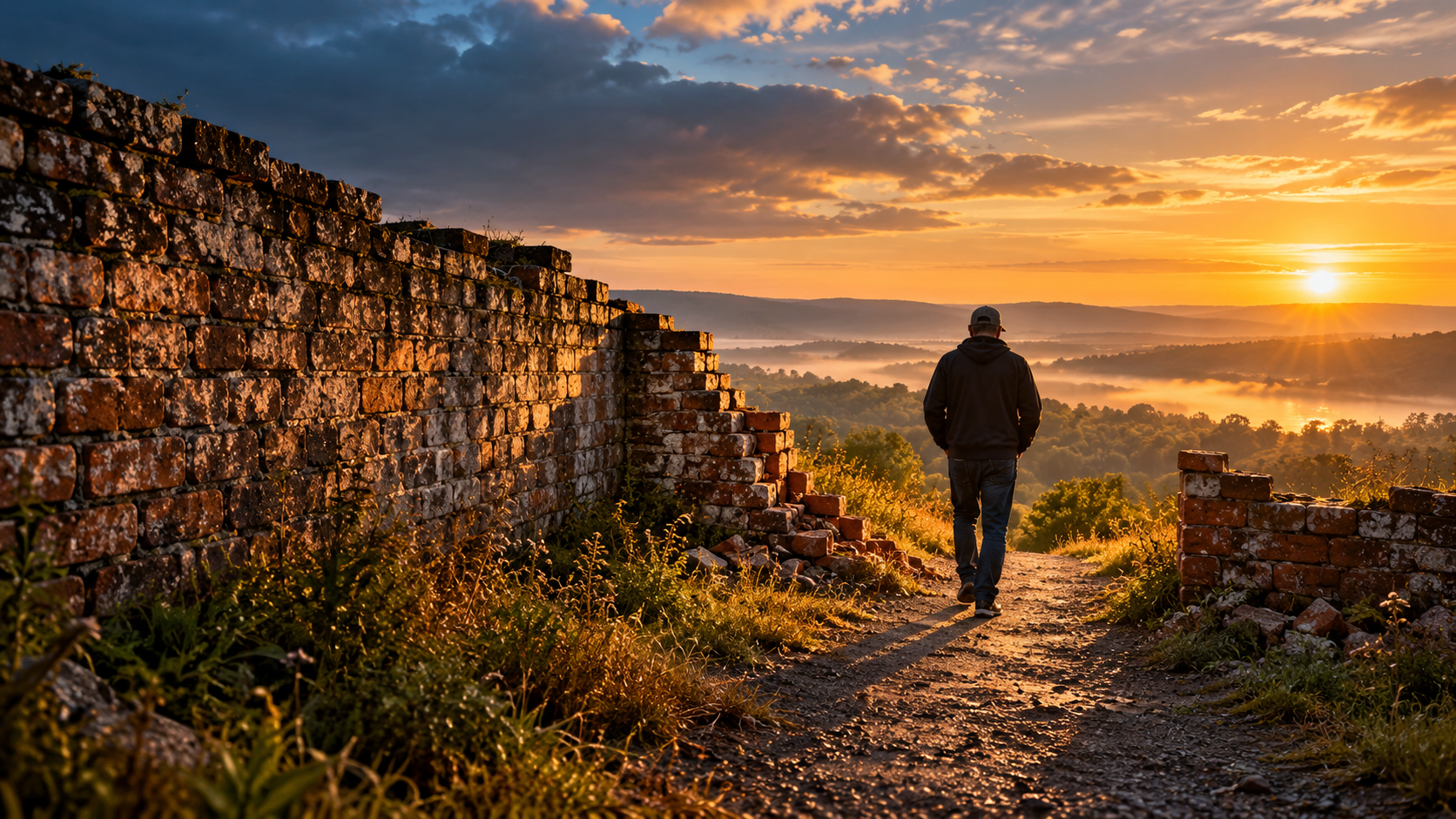
I was out getting my steps in this morning when a song from Pink Floyd’s The Wall came through my headphones.
I cannot even remember what playlist I had been listening to.
I remember stopping it.
Some albums you listen to; others wait for you.
I had heard The Wall many times before. I had watched the movie many times before. When I was a teenager, people used to joke that you had to be under the influence of one substance or another to truly understand it.
Maybe we had that backward.
Maybe you just had to live long enough.
So I stopped the playlist and started the album from the beginning.
And somewhere along my walk, I understood the wall differently.
Not as this strange, theatrical thing belonging to somebody else’s tortured imagination.
I understood the bricks.
Your mother hurts you.
A brick.
Someone you love betrays you.
Another brick.
Someone humiliates you.
Another.
You trust somebody who teaches you that perhaps you shouldn’t.
Another.
You are frightened, disappointed, rejected, abandoned, embarrassed. You learn that showing pain sometimes invites more pain, so you decide you won’t show it anymore.
Brick.
Mortar.
Brick.
Mortar.
Eventually, what started as protection begins to look like architecture.
And there you are, standing behind something you built yourself.
Safe.
Maybe.
But alone.
That was the part I understood this morning in a way I don’t think I could have understood as a teenager.
Because I have built walls of my own.
For years, when something bothered me, I often wouldn’t say anything. If I was hurt, I kept it to myself. If I was angry, I swallowed it. If somebody crossed a line, I sometimes moved it and convinced myself that keeping quiet meant I was handling it.
I thought silence was control.
It wasn’t.
It was storage.
And storage eventually reaches capacity.
Sometimes everything I had refused to say came out at once. Anger became rage. Something that might have deserved a sentence received an explosion instead.
Then came the embarrassment.
The regret.
The knowledge that whatever legitimate reason I had for being angry was now buried beneath the way I had expressed it.
So what did I do?
I added another brick.
I became quieter.
More guarded.
More determined not to let it happen again.
Which meant I returned to the very thing that helped create the problem in the first place.
Silence.
That is the cruelty of some walls. They convince us that the cure for what is hurting us is simply more wall.
I eventually began talking to someone.
Even now, it feels strange to admit that I needed another person to teach me something that sounds almost ridiculously simple:
You are allowed to say you are angry.
Not scream it.
Not throw it.
Not make another person afraid of it.
Just say it.
“I am very angry about what happened.”
“That bothered me.”
“What you said hurt me.”
“I don’t like the way you treated me.”
Simple sentences.
I spent years carrying entire storms because I never learned to announce that it was raining.
There is a difference between feeling anger and surrendering yourself to it. There is a difference between expressing pain and weaponizing it. Learning the first may help prevent the second.
That is part of what I heard differently in The Wall this morning.
I heard a person building protection around wound after wound until there was almost nowhere left for the wounded person to go. And when everything finally burst through, I heard something familiar—not an excuse for cruelty or destruction, but the terrible sound of emotions with nowhere healthy to live.
Maybe that is one of the dangers of emotional walls.
We imagine that the wall keeps everything outside.
But it keeps things inside, too.
The anger stays.
The grief stays.
The humiliation stays.
The conversations we never had stay.
The sentences we swallowed stay.
And eventually we may discover that we haven’t built a fortress at all.
We’ve built a pressure cooker.
I am still learning this.
I still get angry.
I still get hurt.
I still have moments when the old instinct tells me to say nothing, swallow it, keep moving, not make trouble, and not let anybody see that they got to you.
I am not perfect.
But I haven’t had one of those episodes in a long time.
That matters to me.
Not because I believe I have arrived somewhere, but because I know how far I have walked.
And maybe healing sometimes looks less dramatic than we imagine.
Maybe sometimes healing is simply catching yourself before you reach for another brick.
Maybe it is saying, “That hurt me,” while the hurt is still small enough to name.
Maybe it’s letting someone trustworthy stand beside you while you figure out why you started building the wall in the first place.
And maybe strength isn’t proving that nobody can get through.
Maybe strength is realizing that you need a door.
This morning, I started my walk trying to get my steps in.
Somewhere along the way, I found myself thinking about all the bricks I have carried.
Some were handed to me.
Some I picked up myself.
Some probably saved me when I didn’t yet know another way to protect myself.
I don’t hate the person who built them.
He was doing what he knew how to do.
But I know something now that he didn’t.
I don’t have to keep building.
One day at a time, I can learn to put the bricks down.
And perhaps that is what growing older sometimes gives us.
Not the chance to go back and live without wounds.
The chance to finally understand what we built around them.
And the courage to leave an opening.
Please like, comment, and share
Resources for Hard Times
If you’re looking for practical help, food support, or community resources, you can visit the Salt, Ink & Soul Resources Page.