Tag: CommunityCare

  • The Neighborhood Mom

    The Neighborhood Mom

    For T.S. β€” my sister, and the Neighborhood Mom to so many.

    Every neighborhood had her.

    Not appointed.

    Not elected.

    Not funded.

    But known.

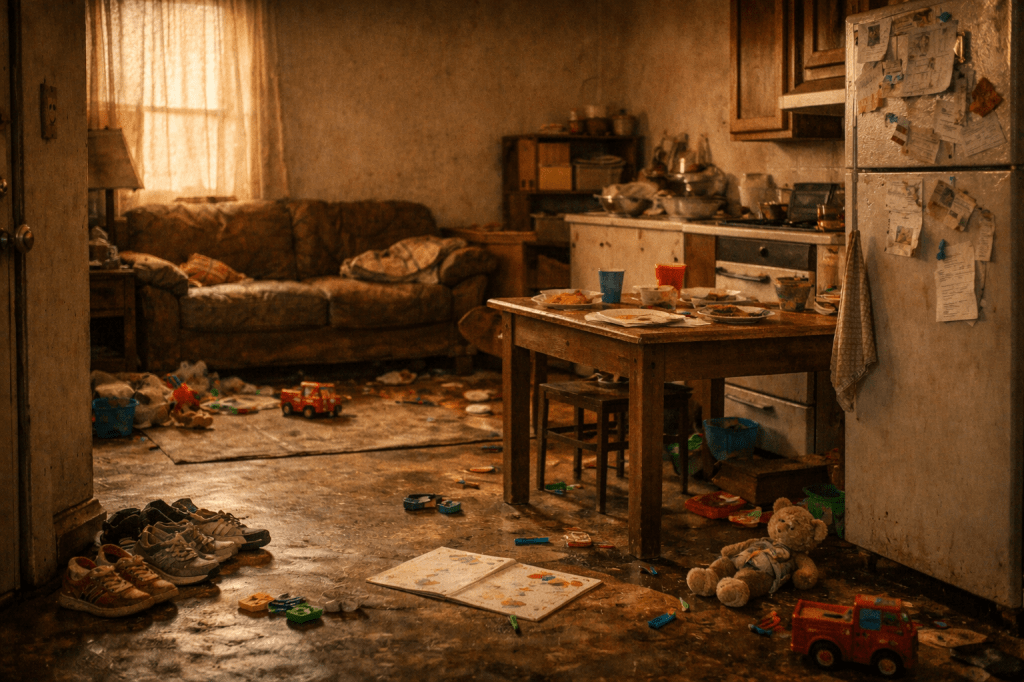
    She didn’t live in the biggest house. Most of the time, it was the opposite. Paint tired. Couch worn thin. The kitchen light was buzzing like it had something to say. The kind of home that didn’t look like much from the sidewalk β€” but felt like oxygen once you stepped inside.

    We didn’t call her a social worker.

    We didn’t call her a guardian.

    We didn’t call her a saint.

    We just knew: if things got bad, you could go there.

    I remember walking into a house like that once and being startled β€” not by silence, but by the opposite. Children everywhere. Some on the floor. Some on couches. Some are half-asleep with homework still open. Shoes by the door that didn’t all belong to the same family. A pot on the stove that seemed to stretch itself every night to feed one more mouth than it should have been able to handle.

    It looked chaotic if you didn’t understand it.

    But if you stayed long enough, you saw the pattern.

    You saw the safety.

    She wasn’t rich. Sometimes she was barely holding her own household together. Bills late. Refrigerator thinner than she would admit. You could tell by the way she portioned things that she knew how to stretch. How to make a little feel like enough. How to season scarcity until it didn’t taste like embarrassment.

    How she fed so many on so little is still a mystery to me.

    But she did.

    Plates appeared. Clean shirts appeared. Towels were shared. Soap was rationed but never withheld. And at night β€” no matter how crowded it was β€” there was always a space cleared for someone who didn’t have one.

    Some of those children came because home was loud in the wrong way.

    Some came because home was silent in the wrong way.

    Some came because there was no home at all.

    She didn’t interrogate the reason.

    She made space.

    In neighborhoods where systems were underfunded and futures were over-policed, women like her were infrastructure. They were the unofficial institutions. The gap-fillers. The quiet counterweights to chaos.

    You could write a thousand policy papers about community stabilization and still miss the fact that sometimes it was one woman’s kitchen table doing the heavy lifting.

    She didn’t have a nonprofit.

    She had a heart that wouldn’t let her turn children away.

    And that kind of heart is not soft.

    It is disciplined.

    Because compassion without discipline collapses under pressure. But she kept showing up. Every day. Every week. Every time a new pair of eyes looked at her from the doorway with that question in them:

    Can I stay?

    And she almost always said yes.

    What we didn’t understand as children was the cost.

    We didn’t see the arithmetic she was doing in her head.

    We didn’t hear the sighs she swallowed.

    We didn’t know how tired she was.

    We only saw the outcome:

    We were clean.

    We were fed.

    We were safe.

    And in neighborhoods where safety was not guaranteed, that was no small thing.

    It’s easy to celebrate the visible heroes β€” the ones with microphones, the ones whose names are etched in textbooks. But communities are often held together by people whose names never leave the block.

    The neighborhood mom.

    She was not perfect. She had her rules. Her voice could rise when it needed to. She knew who was lying before the lie finished forming. She demanded respect not because she craved control, but because order was the only way love could function in a crowded house.

    That house was not just a shelter.

    It was a rehearsal.

    It taught children what stability felt like, even if only for a season. It modeled what adulthood could look like when responsibility wasn’t optional. It showed that care is not about abundance. It’s about commitment.

    I think about her sometimes when conversations turn to “community breakdown” or “youth crisis.” People talk about statistics. Funding gaps. Cultural decline.

    And you can measure many things.

    But you can’t easily measure the woman who refuses to let children sleep outside.

    You can’t quantify the moral gravity of a person who says, “You can stay here,” when she barely has enough for herself.

    That is not charity.

    That is architecture.

    She built invisible scaffolding around young lives until they were strong enough to stand on their own.

    And maybe the most powerful part is this:

    She did not do it for applause.

    She did not do it for legacy.

    She did it because her heart would not let her do otherwise.

    There are people whose goodness is not strategic.

    It is instinctive.

    The neighborhood mom was one of them.

    As adults, we sometimes look back and realize something uncomfortable:

    We survived partly because of someone else’s quiet sacrifice.

    Because somewhere along the way, a woman with too little decided to stretch herself further.

    And now the question isn’t just about honoring her.

    It’s about becoming her in whatever way we can.

    Not necessarily by opening our homes to a dozen children β€” though some still do.

    But by asking:

    Where is the open space in my life?

    What safety do I need to provide?

    How can I make “a little” feel like enough for someone else?

    In a world obsessed with visibility, the neighborhood mom practiced invisible greatness.

    She did not trend.

    She endured.

    Kyle J. Hayes

    kylehayesblog.com

    Please like, comment, and share

    Resources for Hard Times

    If you’re looking for practical help, food support, or community resources, you can visit the Salt, Ink & Soul Resources Page.
    πŸ‘‰Β Resources for Hard Times

  • Alternatives to Thanksgiving β€” Rewriting the Holiday

    Alternatives to Thanksgiving β€” Rewriting the Holiday

    There comes a moment in late November when the air shifts not just in temperature but in expectation. The world begins rehearsing its yearly performance β€” the food, the family, the football, the familiar script repeated so often it feels carved into the country’s memory.

    And if you fit neatly into that script, it can feel warm, grounding, like returning to a language you somehow still remember fluently.

    But for others, the holiday arrives like an old story they no longer belong to.

    Most people don’t talk about those who feel the season coming like a weight. The people who look at the calendar and feel their chests tighten. The ones who know that the hardest holidays aren’t always the ones filled with chaos, but the ones filled with quiet.

    The kind of quiet that makes you hear yourself.

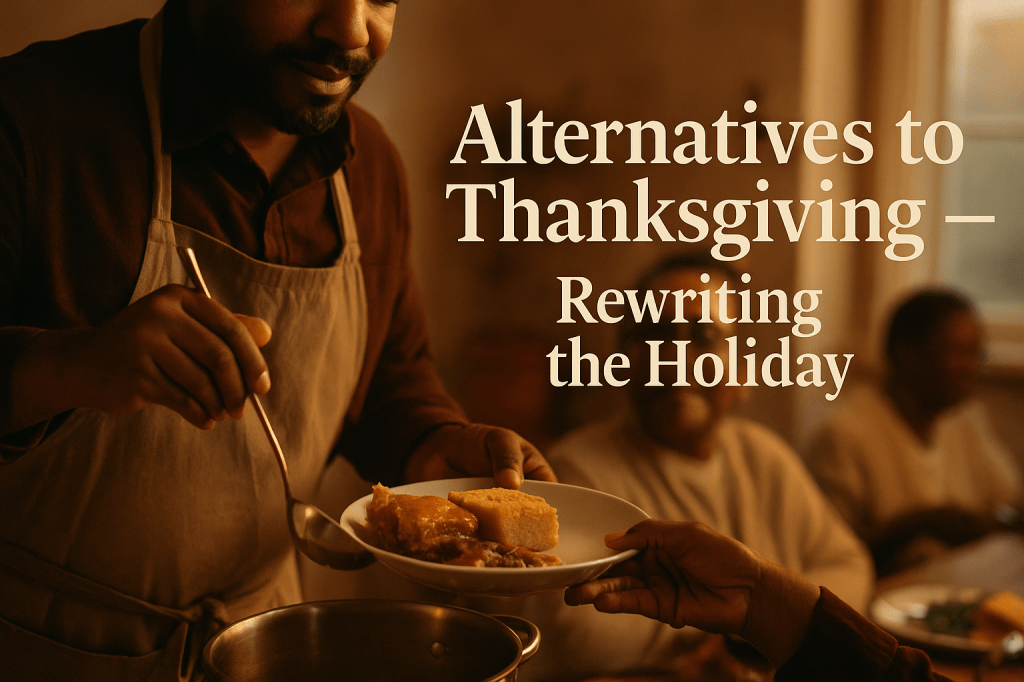
    Some people try to rewrite the holiday in small, quiet ways β€” making it about something more than the expected trinity of food, family, and football. They find their gratitude not at a crowded table, but standing in the fluorescent light of a food pantry, handing out turkeys and canned goods with a soft smile, hoping no one sees the ache behind it.

    For them, volunteering isn’t charity. It’s survival.

    A way of turning their loneliness into something useful, something human, something that means they didn’t spend the day hiding from the world.

    Because expecting yourself to shoulder a season of loneliness β€” to sit through a holiday full of painful memories β€” isn’t strength. It’s a self-inflicted exile.

    And exile is not a tradition worth keeping.

    The truth is this:

    The holiday season is one of the hardest times of year to be single, estranged, rebuilding, recovering, or simply alone.

    The world keeps offering images of togetherness, and it’s easy to forget that they’re curated, staged, and performed. That countless people sitting at those big tables are hurting too, just more quietly.

    But being alone does not mean you must be lonely.

    Humans are built for community. For congregating. For creating small pockets of belonging wherever we can find them. We weren’t designed for isolation β€” the world simply taught us how to perform it.

    So some people start the slow, brave work of rewriting the holiday.

    Not erasing it β€” rewriting it.

    It may mean opening your home to friends who don’t have anywhere else to be.

    It could mean joining a community meal where the only rule is kindness.

    It may mean spending the morning volunteering, feeding people who understand hunger in more ways than one.

    Maybe it means choosing a different ritual altogether β€” a long walk, a favorite movie, a personal tradition unburdened by expectation.

    It could look like sitting with a small plate you prepared for yourself, not out of sadness, but out of intention β€” honoring your own company instead of apologizing for it.

    It could look like surrounding yourself with people who understand the quiet parts of you.

    It could look like helping someone else survive the holiday so you don’t have to face your own reflection all day long.

    It might take courage.

    Let go of the script you were handed as a child.

    It might take admitting that the table you grew up sitting at wasn’t always a place of warmth but a place of wounds.

    Traditions are beautiful until they become burdens.

    Holidays are comforting until they become cages.

    And sometimes the bravest thing you can do is step outside of both.

    Rewriting the holiday doesn’t mean you’re rejecting the past.

    It means you’re learning to honor the present β€” your present β€” even if it looks nothing like what you were taught to expect.

    This year, if your table is empty, build another.

    If the memories are heavy, reshape them.

    If the day threatens to swallow you whole, step outside of it.

    Make something new.

    Make something honest.

    Make something that doesn’t hurt to hold.

    Because you don’t have to feel lonely just because you are alone.

    And you don’t have to disappear just because the world expects you to stay quiet.

    You can choose connection β€” even in small doses.

    You can choose a community β€” even if you have to build it from scratch.

    You can choose gratitude β€” even if it isn’t wrapped in tradition.

    Rewriting the holiday is not an act of rebellion.

    It’s an act of survival.

    An act of self-respect.

    An act of saying:

    I deserve a holiday that makes room for me.

    Sometimes that means sitting at a new table.

    Sometimes it means opening a door for someone else.

    Sometimes it means starting over.

    But always β€” always β€” it means choosing yourself.

    And that kind of choice?

    That is something to be grateful for.

    Kyle J. Hayes

    kylehayesblog.com

    Please like, comment, and share

    Resources for Hard Times

    If you’re looking for practical help, food support, or community resources, you can visit the Salt, Ink & Soul Resources Page.
    πŸ‘‰Β Resources for Hard Times

  • Budget Thanksgiving β€” Making EnoughΒ 

    Budget Thanksgiving β€” Making EnoughΒ 

      There’s a moment each year β€” usually sometime in the second week of November β€” when people start looking at the grocery flyers a little differently.

    Not with excitement.

    Not with the old holiday anticipation.

    But with calculation.

    We used to joke about Thanksgiving being the one meal that knocked you into a food coma, the sacred tradition of overeating as if it were part of the liturgy. But these days, there are families out there just trying to get by β€” and they’re not thinking about turkey naps or stuffing round two. They’re thinking about the numbers. They’re thinking about the bill.

    They’re thinking, How do I make a holiday out of what I can barely make a Tuesday out of?

    And if you listen closely β€” not to the news, not to the politicians, but to the people β€” you’ll hear a quiet truth humming beneath everything:

    It’s not that we don’t want the feast.

    It’s that the money we have says something different.

    I’ve walked through enough store aisles to know that holiday displays can feel like a taunt when your pockets aren’t lined the same way they used to be. The mountain of canned cranberry sauce. The towers of boxed stuffing. The frozen turkeys, which appear to be sagging inside their plastic, as if exhausted from waiting for a family that can afford them.

    And behind those shelves, somewhere in line, is a parent calculating the cost of every side dish.

    Someone is silently deciding between a whole bird and a pack of legs.

    Someone choosing between dessert and a few extra days of groceries.

    There is a shame that creeps in when the holiday table doesn’t look like the commercials β€” a quiet ache, the kind you don’t talk about.

    But I want to tell you something that the world doesn’t say loud enough:

    You can still have a good Thanksgiving.

    Even when money is tight.

    Even when the table looks different.

    Even when the feast you imagined is scaled down into something far smaller, far simpler β€” far more honest.

    It might not knock you into a coma.

    It might not leave leftovers for three days.

    It might not impress anyone scrolling past your photos.

    But it can give you something else.

    Something quieter.

    Something deeper.

    Something people forget to be thankful for.

    It can give you presence.

    It can give you a connection.

    It can give you the kind of memory that doesn’t need gravy to feel full.

    I’ve eaten my fair share of big meals β€” the kind that leave you leaning back, hands on your stomach, laughing because there’s nothing left to do but submit to gravity. But I’ve also eaten the small ones, the humble plates made from what a household could scrape together. And here’s what I’ve learned watching families stretch a dollar and a dream across a table:

    The memories that stay with you aren’t always the ones built from abundance.

    Sometimes they’re carved from scarcity.

    Sometimes they’re shaped from the simple miracle of still being together.

    A roasted chicken instead of a turkey.

    Cornbread instead of rolls.

    Canned green beans dressed up with whatever you had in the pantry.

    A pie made with Cool Whip because heavy cream was too high this year.

    Small things.

    Humble things.

    Real things.

    People think a holiday is about the menu β€” but Thanksgiving, at its best, has always been about survival.

    About making it through another year.

    About holding close the people who made the hard days bearable.

    About honoring the hands that cooked, even when the fridge was nearly empty.

    There are families right now who are living that truth, whether they wanted to or not.

    So if this year your table is smaller…

    If the plates are fewer…

    If the meal is simpler…

    If the turkey is swapped for something that fits the math…

    Please know this:

    You still deserve Thanksgiving.

    Not the performance of it β€” the heart of it.

    There is dignity in doing the best you can with what you have.

    There is grace in making enough when resources are scarce.

    There is courage in deciding that gratitude doesn’t have to be extravagant to be real.

    When you sit down to your meal β€” whether it’s a feast or a handful of comfort foods β€” take a breath. Look around. Feel the moment. Let it be enough. Let your presence be enough.

    Because long after the leftovers are gone, long after the dishes are washed, you won’t remember the price of the turkey.

    You’ll remember who sat with you.

    You’ll remember who you held close.

    You’ll remember that you made something out of nearly nothing β€” and that, in times like these, is its own kind of victory.

    This year, let Thanksgiving be less about the coma and more about the connection.

    Less about excess and more about enough.

    Less about the cost of the meal and more about the worth of the moment.

    When money is tight, meaning becomes easier to see.

    Sometimes that’s the gift we didn’t know we needed.

    Kyle J. Hayes

    kylehayesblog.com

    Please like, comment, and share

    Related Reading:

    The Most Basic Bread

    Nothing Wasted – The Grace Of Leftovers

    Resources for Hard Times

    If you’re looking for practical help, food support, or community resources, you can visit the Salt, Ink & Soul Resources Page.

    πŸ‘‰Β Resources for Hard Times

  • The Shared Table – Eating Together in Hard Times

    The Shared Table – Eating Together in Hard Times

      I’ve written before about family-style restaurants, about Sunday dinners, and the long-lost art of staying at the table after the plates are cleared. The way the conversation lingers even after the food is gone. The way silence settles differently when you’re not alone.

    But the older I get, the more I realize there are seasons in life when once a week isn’t enough. When being with family or people who feel like family isn’t just tradition β€” it’s survival.

    There are cultures where no one ever really leaves. Even after marriage, generations live under the same roof. They eat together, pray together, argue in the hallway, and make up around the stove. Grandparents pass down stories across the dinner table, not through group chats. Aunties and uncles drift in and out like weather systems. There’s always somebody home, always another chair, always another plate.

    From the outside, we look at those households and say, “Too crowded. Too dependent.”

    But they thrive anyway.

    Children grow up knowing they’re held by more than one pair of hands.

    Elders age, knowing they are still seen, still needed.

    Nobody has to pretend they’re an island.

    Is that really so bad?

    Here in the United States, we’re taught to crave distance like oxygen. We can’t wait to get out on our own, can’t wait to prove we’re independent, self-sufficient, “grown.” We call it freedom, and some of it is. There is something sacred about carving out your own life. But somewhere along the way, we confused independence with isolation. We decided that to stand tall, we had to stand alone.

    In our thirst for independence, a lot of us burned the bridges back home. We said things we can’t unsay. Rolled our eyes one too many times. Took the help, then resented the hands that gave it. Some parents, carrying their own ghosts, pushed their kids out into the world with a kind of hard love: sink or swim. Some kids, desperate to prove themselves, jumped before they could walk steadily.

    Some landed on their feet. The parents took the credit.

    Others didn’t land at all. They slipped through the cracks β€” a missed paycheck here, a bad relationship there, a layoff at the worst possible time. Some ended up in shelters, while others slept in cars, bounced from couch to couch, or lived on the street with their whole life zipped into a backpack.

    We tell ourselves that’s just how it goes. That everyone has a choice. That if they really wanted to, they’d “get back on their feet.”

    But people don’t fall apart all at once.

    They unravel slowly, thread by thread, often in silence.

    I understand this better than most.

    I was one of those people β€” feeling unwelcome in my own family home, trying to breathe in a house that felt too tight, too tense, too full of things nobody would say out loud. At seventeen, I signed my name on a line and left for the Army with no real plan, no sense of direction β€” just a vague conviction that I had to go. I didn’t know what I was chasing. I only knew what I was running from.

    I’ve been on my own ever since, making my own decisions. Some good, some bad, some I still feel in my bones. I burned bridges, too. Spoke out of anger. Walked away instead of talking it through. Convinced myself I didn’t need anyone. That needing people was a weakness.

    You tell yourself stories like that long enough, and they start to sound like the truth.

    Now I work with people who have quietly invited me into their lives.

    Co-workers. Friends. Families who say, “Come over, we’re having dinner,” and mean it.

    I’ve sat at their tables β€” fork in hand β€” watching the choreography of people who have stayed close to one another. Kids interrupting adults. Adults interrupting each other. Someone’s cousin is laughing too loudly. A grandmother fussing over whether you’ve eaten enough.

    And in those moments, I am both present and somewhere else. I’m looking at the food, but I’m also looking at the thing beneath it β€” the web of relationships, the unspoken history, the familiar arguments, the small forgivenesses that happen without a word.

    And what would it have been like to have that with a family of my own?

    Not just a Sunday call.

    Not just a holiday visit.

    But the everyday kind of belonging β€” the weeknight dinners with nothing to celebrate except the fact that you’re together.

    I wonder who I might have been if I had grown up with more chairs around the table, more chances to stay instead of run.

    That wondering doesn’t come from regret.

    It comes from recognition.

    Recognition of what connection can do β€” how it steadies you, how it humbles you, how it reminds you that you were never meant to go through life alone.

    The shared table is one of the last places in this country where we still practice that truth.

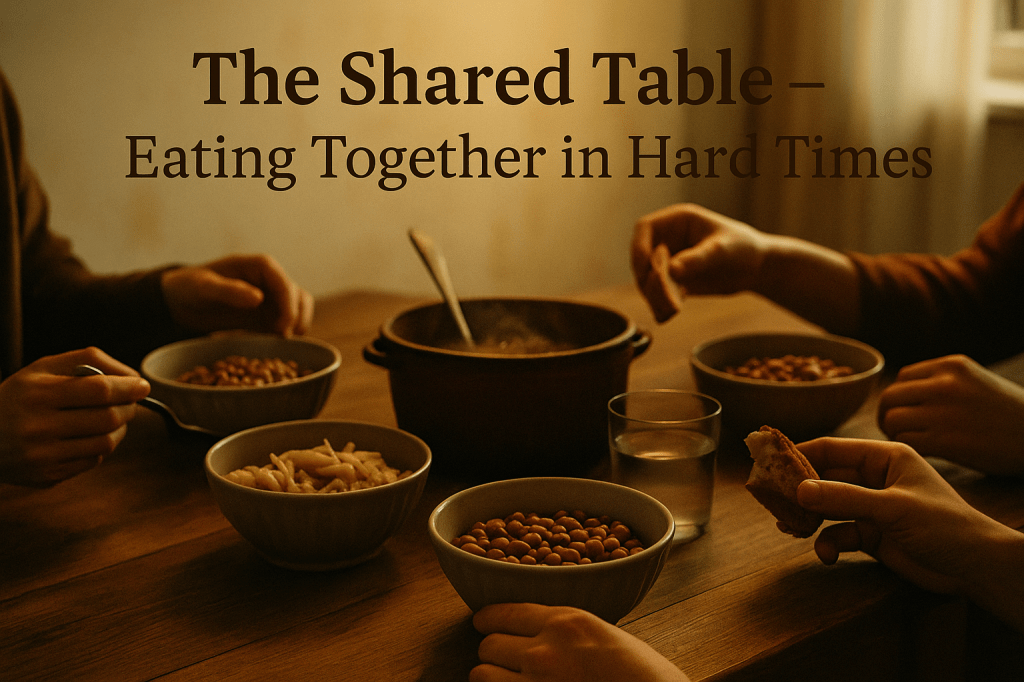
    When times get hard β€” when prices climb, when paychecks shrink, when systems fail β€” the table becomes a kind of refuge. It’s where someone decides to make a large pot of something that can be shared and enjoyed over time. Where cousins and neighbors and strays-who-became-family show up with whatever they have: a dish, a drink, a story, their tired selves. It’s where nobody asks for a rΓ©sumΓ©, just whether you’re hungry.

    I’ve written about food banks, church kitchens, and community centers β€” places where people line up for a hot meal and leave with more than calories. They leave with eye contact. With their name spoken kindly. With the knowledge that, at least for today, they were not invisible.

    Hunger isolates.

    But eating together does the opposite.

    Screens are always on, but doors often stay closed.

    We scroll through a thousand dinners while our own table stays dark.

    Meanwhile, someone in your neighborhood β€” maybe even someone you know β€” would show up if they knew you needed a place to sit.

    But somewhere along the way, we stopped knocking on doors.

    We stopped saying, “Come eat with us.”

    I wish I knew how to fix all of this β€” the homelessness, the hungry children, the broken families, the pride that keeps us apart. I don’t. I don’t have a blueprint for repairing what this culture has spent decades tearing down.

    What I do have is a small, stubborn belief in the power of the shared table.

    Maybe the first step isn’t policy or program β€” but an invitation.

    Maybe it’s offering help without attaching shame.

    Maybe it’s calling the kid you pushed out too soon and saying, “Do you want to come home for dinner?”

    Maybe it’s reaching out to the parent you’ve avoided and whispering, “Can we try again over a meal?”

    Maybe it’s rebuilding a bridge you thought was ash β€” not because you’re guaranteed a reunion, but because you believe someone might want to come back one day.

    One thing I do believe, deeply and without hesitation, is this:

    Families are better together.

    Whether they’re the ones we come from or the ones we gather along the way.

    The table won’t fix everything.

    It won’t erase history, won’t undo every mistake, won’t silence every hurt.

    But it is a place to start.

    A place where pride softens.

    Where hunger β€” for food, for belonging, for forgiveness β€” can finally speak.

    The table doesn’t have to be full to matter.

    It just has to be real.

    It just has to be offered.

    It just has to be shared.

    Kyle J. Hayes

    kylehayesblog.com

    Please like, comment, and share

    Related Reading:

    The Taste of Home,The taste of here

    Resources for Hard Times

    If you’re looking for practical help, food support, or community resources, you can visit the Salt, Ink & Soul Resources Page.

    πŸ‘‰Β Resources for Hard Times