Tag: Cooking Philosophy

  • The Salad That Doesn’t Compete

    The Salad That Doesn’t Compete

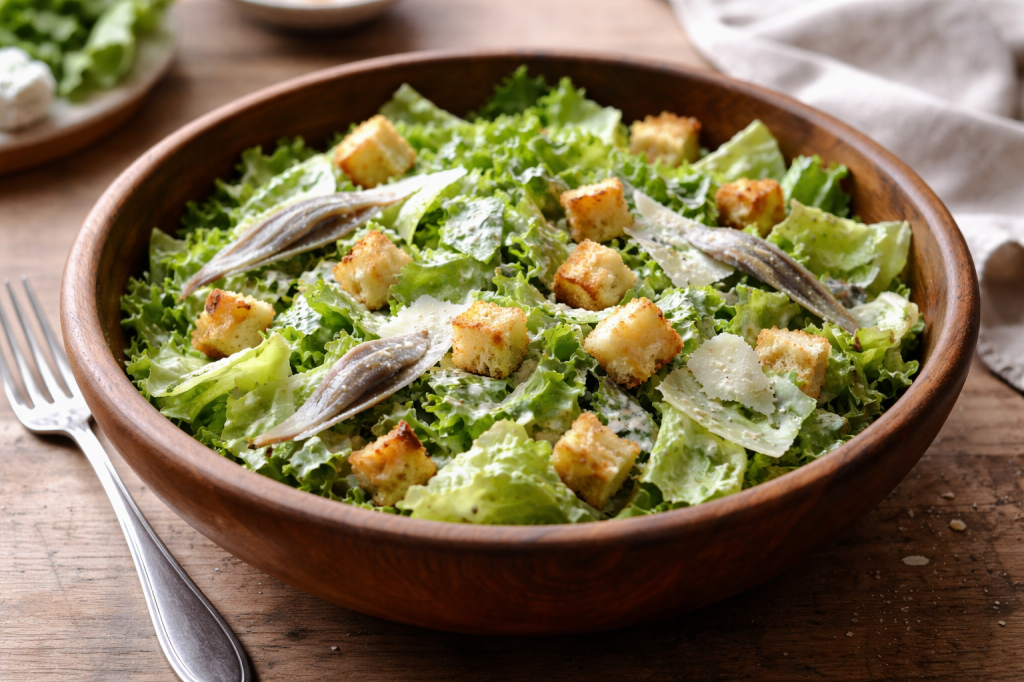
    Caesar Salad (As It Was Meant to Be)

    There’s a misunderstanding that follows certain dishes.

    Caesar salad is one of them.

    Somewhere along the way, it became something else.

    Covered. Overloaded. Turned into a platform for whatever someone felt like adding that day. Chicken most of all—placed on top like it needed saving, like it wasn’t enough on its own.

    But it was always enough.

    It was never meant to be heavy.

    Never meant to carry the whole meal.

    It was meant to support.

    To balance.

    To bring something sharp and clean to a plate that needed it.

    That may be why it belongs here.

    Next to something rich.

    Something warm.

    Something like jalapeño popper chicken.

    Because not everything on the plate needs to speak loudly.

    Some things just need to be right.

    Caesar Salad

    Serves 4 to 8

    Ingredients

    For the Croutons

    • 1 cup extra-virgin olive oil (from total below)
    • 4 oil-packed anchovies, drained
    • 2 garlic cloves, peeled and smashed
    • 6 slices of white sandwich bread, cut into ¾-inch cubes
    • ¼ cup finely grated Parmigiano-Reggiano
    • Salt and freshly ground black pepper

    For the Dressing

    • Remaining 1½ cups extra-virgin olive oil
    • 6 oil-packed anchovies, drained
    • 2 garlic cloves, finely chopped
    • 1 teaspoon Dijon mustard
    • Juice of 1 lemon (about 2 tablespoons)
    • ½ teaspoon Worcestershire sauce
    • Dash of Tabasco
    • 3 egg yolks
    • Salt and freshly ground black pepper

    For the Salad

    • 1 large or 2 small heads of romaine lettuce, washed, chilled, and coarsely chopped
    • ¾ cup finely grated Parmigiano-Reggiano
    • Boquerones (optional, for garnish)

    Instructions

    1. Make the Croutons

    In a wide pan, heat 1 cup of olive oil over medium-low heat.

    Add anchovies and smashed garlic, letting them slowly dissolve into the oil.

    Not rushed. Not forced.

    Increase the heat slightly and add the bread cubes.

    Toss until golden on all sides.

    Remove and transfer to a bowl.

    Toss gently with parmesan, salt, and pepper.

    Let them rest.

    2. Build the Dressing

    In a food processor or blender, combine:

    • anchovies
    • chopped garlic
    • mustard
    • lemon juice
    • Worcestershire
    • Tabasco
    • egg yolks

    Blend until smooth.

    Slowly drizzle in the remaining olive oil.

    Let it come together gradually.

    Taste. Adjust.

    This is where it becomes yours.

    3. Bring It Together

    In a large bowl, add the lettuce.

    Toss with dressing—just enough to coat.

    Not drown.

    Add the remaining parmesan.

    Toss again, gently.

    Plate it simply.

    This salad was made to sit beside something richer.

    Something warm. Something with weight.

    Like the Jalapeño Popper Chicken.

    Notes from the Kitchen

    • This salad is meant to balance, not compete.
    • Keep it clean. Keep it intentional.
    • The anchovies matter.
    • They don’t make it “fishy”—they make it complete.
    • Use enough dressing to coat, not overwhelm.
    • There’s a difference between flavor and excess.
    • And leave the chicken off.
    • It already has its place on the plate.

    A Quiet Understanding

    There’s something honest about a dish that knows what it is.

    It doesn’t try to become more.

    Don’t try to carry everything.

    It just does its job well.

    And next to something rich—

    something heavy with flavor and warmth—

    This salad reminds you that balance isn’t subtraction.

    Its intention.

    Not everything needs to stand alone.

    Some things are meant to stand beside one another.

    And when they do…

    The whole plate makes sense.

    Kyle J. Hayes

    kylehayesblog.com

    If this found you at the right time,

    Feel free to like, comment, or share it with someone who might need it too.

    Resources for Hard Times

    If you’re looking for practical help, food support, or community resources, you can visit the Salt, Ink & Soul Resources Page.
    👉 Resources for Hard Times

  • Cooking Without Panic

    Cooking Without Panic

    What Mise en Place Taught Me About Preparation, Presence, and Respect

    I’ve talked about this before.

    And I’m saying it again.

    Not because I enjoy repeating myself. But because some lessons don’t land the first time you hear them. They settle slowly. They wait for you to live long enough to recognize them when they show up again.

    The more I cook, the more I understand this:

    Preparation is not optional.

    It is the difference between peace and panic.

    And nothing reveals that truth faster than the day of a big meal.

    There’s a moment that comes. Always.

    Something is already on the stove. Heat is rising. Time has started moving in a way that doesn’t allow for hesitation. And then—you realize something is missing.

    Not something dramatic.

    Something small.

    Garlic. Butter. An onion you thought you had.

    Now you’re standing there, caught between what’s already begun and what you forgot to prepare. Keys in your hand. Mind racing. Trying to decide if you can leave without losing everything you’ve started.

    I’ve been there.

    More than I care to admit.

    And what I’ve learned is this—those moments don’t come from bad luck. They come from skipping the quiet work.

    When I first started cooking, everything I did lived in that space.

    Chaos.

    Not the kind people romanticize. Not the version that looks like passion from a distance. I mean the real kind. Drawers open. Utensils everywhere. Every pan is dirty. Knives in places they didn’t belong.

    I read recipes while I cooked.

    Not before.

    During.

    Steam in my face. Oil snapping at me like it had something to prove. Words like simmer and boil feel less like guidance and more like pressure.

    I was always catching up.

    And still… the food came out.

    Not great. Not something I would remember.

    But it fed me.

    And at that time, that mattered.

    Because cooking wasn’t about mastery. It was about survival, trying to become something more. It was effort. It was care. Even if it was scattered.

    A love letter written too fast. But still real.

    Then I learned something that didn’t look like much at first.

    Mise en place.

    Everything in its place.

    It sounded simple. Too simple, honestly. Like one of those things people say when they’ve already figured it out.

    But over time, I realized it wasn’t about control.

    It was about respect.

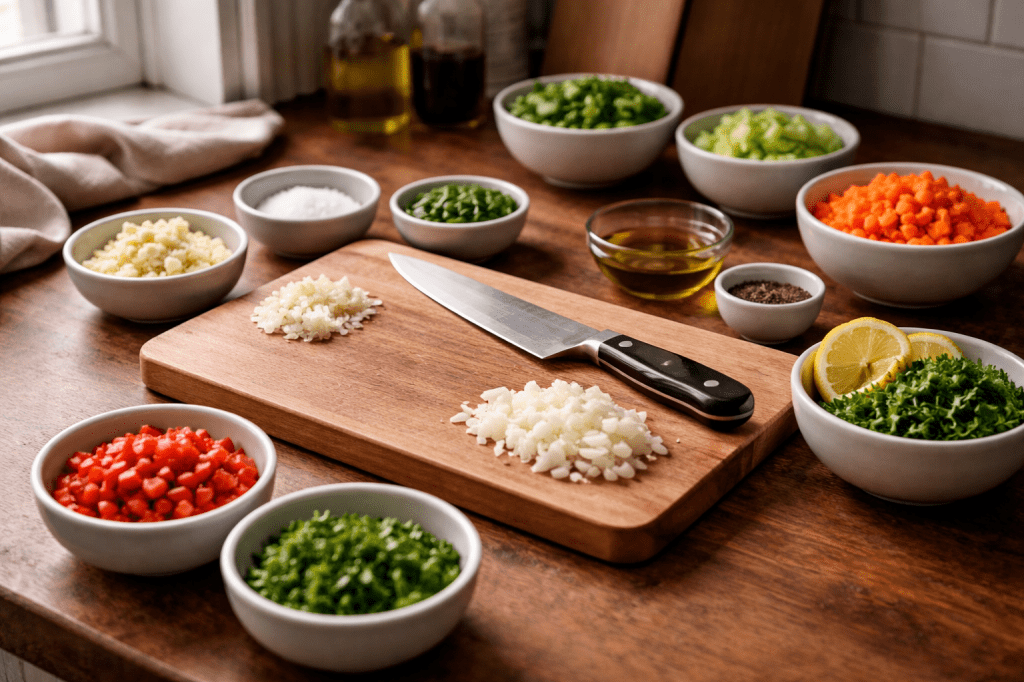
    You start by reading the recipe.

    All of it.

    Not just the parts you think you need.

    Because understanding what’s coming changes how you move.

    Then you gather.

    Everything.

    The obvious ingredients. The small ones. The things you assume you won’t forget—until you do.

    Because you will.

    Then you prepare.

    You chop before the heat starts. You measure while your mind is still clear. You take your time while time still belongs to you.

    And in doing that, something shifts.

    You’re no longer reacting.

    You’re deciding.

    Then you separate. You organize. You place.

    And what you begin to notice is that the space around you starts to feel different.

    Clearer.

    Quieter.

    More intentional.

    Because a cluttered space doesn’t just slow your hands.

    It scatters your thinking.

    And most of us, if we’re honest, didn’t learn how to move through life in an organized way.

    Some of us learned to move quickly.

    To adapt.

    To figure things out in motion because there wasn’t another option.

    So we bring that with us.

    Into the kitchen. Into our work. Into the way we handle pressure.

    That urgency.

    That feeling of being just a step behind.

    Mise en place doesn’t erase that.

    But it offers you another way.

    I recognized this before I understood it.

    In another role. Another environment.

    Setting things up the same way every time. Same tools. Same order. Same rhythm.

    Not because everything would go smoothly.

    But because it wouldn’t.

    Because when pressure rises, your thoughts don’t always arrive the way you need them to.

    But your preparation does.

    Your hands remember.

    The kitchen asks for the same thing.

    Now, when I know I’m about to cook something that matters—a meal that will stretch across days, or one meant to be shared—I don’t wait until the moment begins.

    I start the night before.

    I chop. I portion. I set things aside.

    I make sure everything I need is already there.

    No last-minute store runs.

    No 3-leaving a pot on the stove while I go searching for something I should have already had.

    No panic.

    Just movement.

    Steady. Intentional. Present.

    And the food reflects that.

    Not just in how it tastes.

    But in how it feels to make it.

    Because cooking, when you allow it to be, is a form of care.

    And care does not rush.

    I know people get tired of hearing this.

    They want the shortcut. The quicker way. The version that skips the preparation and still delivers the result.

    But it doesn’t work like that.

    Not in the kitchen.

    Not in anything that matters.

    There are things you can rush.

    Clarity is not one of them.

    Mise en place teaches you that.

    It teaches you that preparation is not wasted time.

    That slowing down is not falling behind.

    That respect—for the process, for what you’re working with, for yourself—changes the outcome in ways you can’t always measure, but you can always feel.

    And maybe that’s why I keep coming back to it.

    Because it’s not just about cooking.

    It’s about choosing not to live in constant reaction.

    It’s about creating space before things begin.

    It’s about giving yourself a chance to meet the moment with something steadier than panic.

    Everything in its place.

    Not because life is perfect.

    But because you’re learning how to move through it with intention.

    And sometimes…

    That’s enough to change everything.

    Kyle J. Hayes

    kylehayesblog.com

    If this found you at the right time,

    Feel free to like, comment, or share it with someone who might need it too.

    Resources for Hard Times

    If you’re looking for practical help, food support, or community resources, you can visit the Salt, Ink & Soul Resources Page.

    👉 Resources for Hard Times