The quiet discipline of preparation, the pleasure of cooking, and why a little order can make life in the kitchen so much better.
I’ve talked about this before. And chances are, I’ll talk about it again.
Not because I’ve run out of things to say, but because some lessons are worth repeating until they become habits.
There was a phrase I heard when I was much, much, much younger. One of those sayings that sticks with you long after you’ve forgotten who said it first.
Proper preparation prevents piss-poor performance.
Six words, all beginning with the same letter, delivering a lesson that has served me well for most of my life.
I didn’t know much about French cooking back then. I certainly wasn’t standing in a professional kitchen wearing a white chef’s coat. But I understood what those words meant.
Get yourself together before you get started.
Years later, I discovered that the French had a much more elegant way of expressing something remarkably similar.
Mise en place.
And while it sounds considerably more sophisticated than the phrase I grew up hearing, the principle isn’t all that different.
Preparation matters.
Not just in cooking, either.
In just about everything.
The Things We Used to Teach
There’s another reason I’m writing about this again, and I think it’s worth mentioning.
There was a time when many high schools offered home economics classes, and cooking was part of what students learned.
You didn’t graduate from those classes as a chef. Nobody expected you to walk into a professional kitchen and begin preparing five-course meals.
But you learned the basics.
How to read a recipe.
How to measure ingredients.
How to follow instructions in the proper order.
How to use kitchen equipment, work safely, keep your cooking area clean, and prepare a meal without turning the entire process into a small disaster.
These were practical skills, the sort of things that might not have seemed particularly important when you were young but became increasingly valuable once you were responsible for feeding yourself.
Now, I’m not suggesting that every school offered these classes, or that everyone who attended them walked away knowing how to cook. And I’m certainly not suggesting that the past was perfect.
But I do believe there was value in teaching young people the fundamentals of taking care of themselves.
Today, a great deal of cooking instruction happens online.
YouTube, TikTok, Instagram, and countless food websites have made recipes more accessible than ever before. And I think that’s a wonderful thing.
You can watch someone prepare a dish from halfway around the world, learn about ingredients you’ve never encountered, and discover cooking techniques that might otherwise have remained unfamiliar.
I’ve learned things online myself.
But I’ve noticed something.
Many cooking videos teach you how to make a particular dish without necessarily teaching you everything you should know before you begin.
The ingredients appear neatly measured. The vegetables are already chopped. The equipment is ready, and the person demonstrating the recipe seems to move effortlessly from one step to the next.
What you don’t always see is the preparation that made that possible.
Nobody necessarily explains why the ingredients were measured beforehand, why the vegetables were cut a certain way, why the workstation was organized, or why the cook isn’t stopping every few minutes to search for something.
You see the cooking.
But you don’t always see what came before it.
And for someone who never had the opportunity to learn those fundamentals, that missing information can make all the difference.
Now, I understand that this doesn’t apply to everyone. Plenty of people learned to cook from parents, grandparents, relatives, friends, or simply through years of experience. Others have found excellent teachers online who take the time to explain every step.
But not everyone had someone standing beside them in the kitchen, showing them what to do.
Some people are learning entirely on their own.
And there’s nothing wrong with that.
But sometimes, people need more than a recipe.
They need a little direction.
They need someone to explain not only what to do, but why they’re doing it.
That’s what this piece is about.
I’m not attempting to turn anyone into a professional chef. I’m certainly not claiming to be one myself.
I simply want to share something that has made cooking easier, cleaner, more efficient, and considerably more enjoyable for me.
Because if understanding one basic principle helps someone feel more comfortable preparing a meal, then I believe it’s worth taking the time to explain.
And that brings us back to those three French words.
Mise en place.
What Exactly Is Mise en Place?
The French expression mise en place translates to “putting in place” or “everything in its place.”
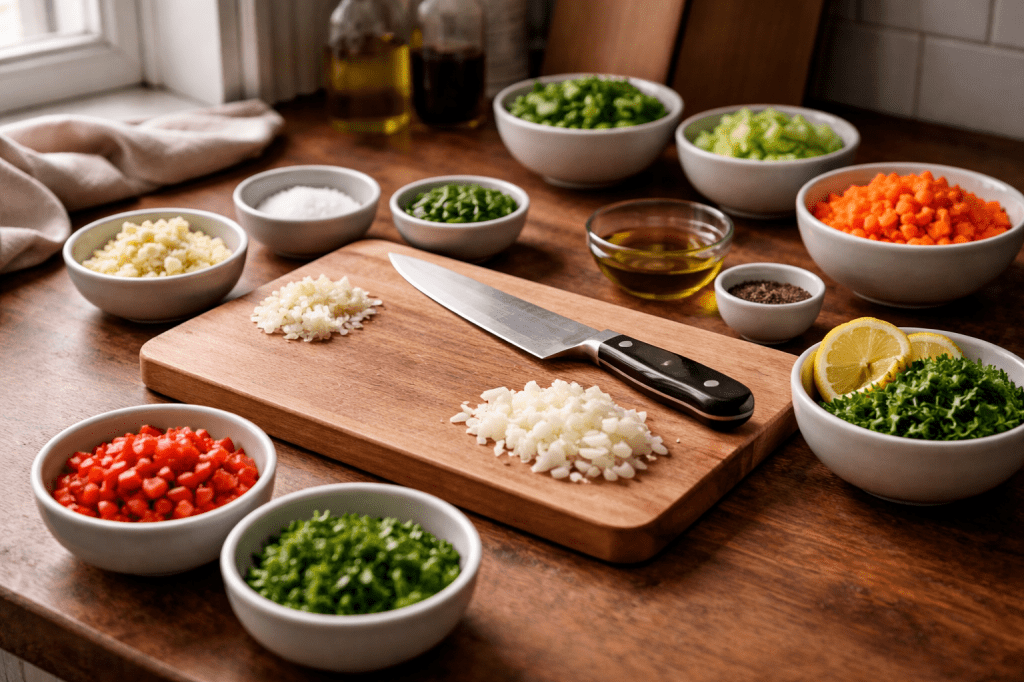
In professional kitchens, it describes gathering, measuring, cutting, organizing, and arranging the ingredients and equipment needed before cooking begins.
It’s one of the foundational principles taught in culinary training, and for good reason.
A professional kitchen depends on timing, organization, consistency, and efficiency. When orders start coming in, there’s little room to go looking for the garlic, discover the onions haven’t been chopped, or realize halfway through preparing a dish that you’re missing an important ingredient.
Everything needs to be ready.
But here’s something I believe gets overlooked.
You don’t have to be a professional chef to benefit from professional habits.
You don’t need an expensive kitchen, a collection of matching stainless-steel bowls, or a countertop large enough to land a small aircraft.
You need a little space, a little planning, and a willingness to slow down before you speed up.
That’s really where it begins.
The Kitchen Shouldn’t Feel Like a Race Against Time
I’ve watched people cook as though they’re participating in some kind of emergency.
The pan is heating. The onions are burning. Someone is digging through the refrigerator looking for butter. A cabinet door is hanging open, the cutting board is buried beneath vegetable scraps, and somewhere in the confusion, a bottle of seasoning has disappeared.
Meanwhile, the person cooking is becoming increasingly frustrated.
By the time dinner reaches the table, they’re exhausted.
And the kitchen looks like it lost an argument.
Now, don’t misunderstand me. I’ve had my share of kitchen disasters. I’ve forgotten ingredients, misjudged cooking times, and occasionally wondered why I thought trying something new was such a good idea.
Cooking will humble you.
But I’ve also learned that much of the frustration people associate with cooking doesn’t necessarily come from the cooking itself.
It comes from being unprepared.
When you’re constantly stopping to search, wash, chop, measure, or clean something you should have handled earlier, cooking becomes a series of interruptions.
Mise en place changes that.
It lets you focus on what’s happening in the pan instead of worrying about what’s missing from the counter.
And that changes the entire experience.
The Benefits of Having Everything in Its Place
Professional kitchens rely on mise en place for practical reasons, and those benefits carry over beautifully into the home kitchen.
First, it saves time.
Now, that might seem strange because preparing everything before cooking means spending additional time at the beginning.
But you’re not necessarily adding work. You’re organizing work that would otherwise be scattered throughout the cooking process.
Instead of washing your hands, searching for ingredients, chopping vegetables, checking the recipe, and repeatedly stopping what you’re doing, you move through the cooking process with fewer interruptions.
Second, it makes cooking cleaner.
This is one of my favorite benefits.
When you trim and chop vegetables before cooking, you can discard or collect their scraps immediately. You can rinse measuring utensils or place them in the dishwasher. You can put away packaging and return ingredients to their proper places.
You begin cooking with an organized workspace rather than creating a growing mountain of clutter.
And because you’re no longer rushing from one task to another, you’re less likely to spill things, knock things over, or leave unnecessary messes behind.
Third, it improves consistency.
When you measure and prepare ingredients before cooking begins, you’re less likely to accidentally leave something out or add too much.
You can also cut ingredients into reasonably uniform pieces, helping them cook more evenly.
Fourth, it makes cooking safer.
A clean, organized workspace reduces unnecessary reaching, searching, and moving around hot cookware.
It also makes it easier to keep raw meat, poultry, and seafood separate from foods that are ready to eat.
Of course, being organized doesn’t replace proper food safety. You still need to wash your hands, clean equipment, prevent cross-contamination, and refrigerate perishable ingredients when necessary.
But organization makes those practices easier to maintain.
And finally, there’s something that doesn’t get discussed nearly enough.
Mise en place can make cooking enjoyable again.
When the ingredients are ready, the tools are within reach, and the workspace is clean, there’s a certain pleasure in simply cooking.
You can pay attention to the sound of onions hitting a warm pan.
The aroma of garlic as it begins to soften.
The way spices bloom in oil.
The transformation of individual ingredients into something that will eventually become a meal.
Instead of rushing through the experience, you get to participate.
And when cooking becomes less frustrating and more satisfying, you’re considerably more likely to want to do it again.
That’s important, especially for those of us trying to eat better, spend less money dining out, or prepare more of our meals at home.
My Approach: Setting Up the Kitchen Before Cooking
You don’t have to make this complicated.
In fact, the whole purpose of mise en place is to make things simpler.
Here’s a basic approach anyone can follow.
Step One: Read the Entire Recipe
Not just the ingredient list.
The whole recipe.
Read through the instructions from beginning to end before you take anything out of the refrigerator.
You want to know what you’re making, how long it will take, which ingredients need preparation, and whether anything needs to marinate, rest, thaw, or cook separately.
Pay attention to when ingredients are needed.
There’s a difference between a recipe that says to add garlic immediately and one that calls for adding it after the onions have softened.
Understanding the sequence prevents unnecessary surprises.
And while you’re reading, make sure you actually have everything the recipe requires.
There’s nothing quite like discovering you’re out of an important ingredient after you’ve already committed yourself to dinner.
Step Two: Clear and Clean Your Workspace
Before you bring out the ingredients, make room for them.
Put away unnecessary items. Clear the countertop. Wipe down the preparation area and make sure your cutting board is clean and stable.
Empty the sink if necessary.
I also like having the dishwasher ready to receive dirty utensils as I work.
You don’t need a spotless showroom kitchen.
You need a functional space where you can move comfortably without constantly rearranging things.
Step Three: Gather Your Equipment
Now bring out the tools you’ll need.
That might include:
- A cutting board and sharp knife
- Measuring cups and spoons
- Mixing bowls or small containers
- Your skillet, saucepan, Dutch oven, or casserole dish
- A spatula, wooden spoon, whisk, or tongs
- A colander, grater, or other specialty tool
- A clean kitchen towel and a container for food scraps
Having the proper tools ready eliminates the need to search through drawers while something is cooking.
And remember, you don’t need a bowl for every single ingredient.
Ingredients added at the same time can often share a container, as long as doing so doesn’t create a food safety problem.
The objective is efficiency, not making additional dishes to wash.
Step Four: Gather and Check Your Ingredients
Take inventory.
Bring together the vegetables, seasonings, oils, canned goods, and other ingredients needed for the recipe.
Check quantities and expiration dates where appropriate. Open cans or packages when it makes sense.
If you’re cooking with frozen ingredients, make sure they’ve been properly thawed when the recipe requires it.
Keep ingredients that need refrigeration cold until you need them. Mise en place doesn’t mean leaving raw chicken or other perishables sitting on the counter while you spend an hour preparing everything else.
It means having a plan for when each ingredient should come out.
Step Five: Wash, Chop, Measure, and Organize
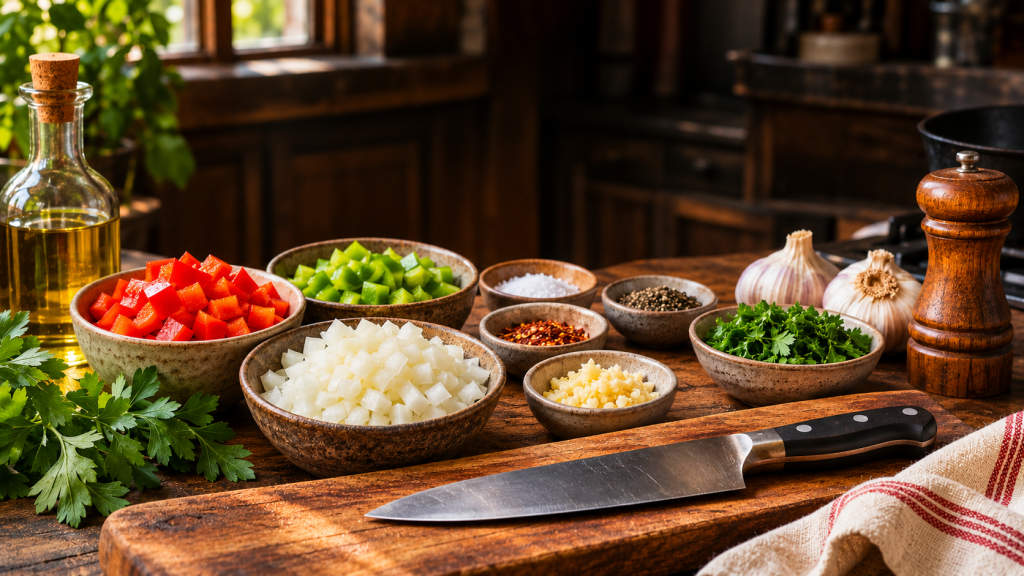
This is what most people picture when they hear the words mise en place.
Vegetables being chopped.
Spices measured into small bowls.
Ingredients arranged in neat little groups, waiting to be transformed into dinner.
Start by washing your produce.
Then peel, trim, slice, dice, or mince ingredients according to the recipe.
Measure your dry seasonings, liquids, and other ingredients, so they’re ready when needed.
Keep everything organized in the approximate order you’ll use it.
If you’re preparing a skillet meal, for example, you might arrange your ingredients like this:
- Oil or other cooking fat
- Meat or protein
- Onions, peppers, and other vegetables
- Garlic and seasonings
- Broth, sauce, or other liquids
- Finishing ingredients and garnishes
The exact order depends on the recipe, but the principle remains the same.
Everything should be ready when its moment arrives.
And remember to use separate equipment for raw meat and ready-to-eat ingredients, or thoroughly clean and sanitize equipment between uses.
Step Six: Organize Your Cooking Station
Now that everything is prepared, arrange it where you can work comfortably.
Keep ingredients you’ll use first within easy reach.
Move ingredients needed later to the side.
Have your utensils nearby, along with a place to set a hot lid or a used spoon.
Make sure the pan fits comfortably on the burner, and that handles aren’t extending into walkways.
If something needs to go into the oven, check that it’s ready at the appropriate time.
This is also a good moment to review the cooking instructions once more.
Once the heat is on, things can start moving quickly.
Step Seven: Cook, and Clean as You Go
Now comes the enjoyable part.
The preparation is finished.
The ingredients are ready.
The kitchen is organized.
You can actually concentrate on cooking.
As you finish using bowls, utensils, and measuring equipment, move them to the sink or dishwasher when it’s safe to do so.
Wipe up spills promptly. Put away ingredients you no longer need. Keep countertops clear.
Don’t sacrifice food safety or abandon a hot pan just to wash something. Cleaning as you go should support cooking, not distract from it.
Ideally, by the time dinner is ready, most of the unnecessary clutter is already gone.
And there’s something deeply satisfying about sitting down to a good meal knowing you don’t have a mountain of dishes waiting afterward.
A Simple Example: My One-Pot Meals
If you’ve followed Salt, Ink & Soul for any length of time, you’ve probably noticed that I prepare quite a few one-pot meals, casseroles, and skillet dishes.
Part of that is convenience.
I cook for myself, and meal prep makes it easier to have something good waiting in the refrigerator instead of constantly deciding what to eat or spending money on takeout.
But one-pot cooking also illustrates why mise en place works so well.
Take a simple smoked sausage and cabbage skillet.
Before I turn on the stove, I can slice the sausage, chop the cabbage, dice the onions and bell peppers, measure the seasonings, and gather everything else I need.
Once the skillet is hot, the process becomes straightforward.
I’m not trying to chop a bell pepper while the sausage is browning too quickly.
I’m not rummaging through the cabinet looking for paprika while the onions begin to burn.
And I’m not discovering that I forgot to prepare the cabbage after everything else is already cooking.
I can concentrate on building flavor.
Because that’s where my attention belongs.
The preparation has already been taken care of.
The Less Obvious Benefit: Confidence
Something happens when you become comfortable in your kitchen.
You stop approaching cooking as a chore you’re hoping to survive.
You begin to trust yourself.
You become more willing to try unfamiliar recipes because you know how to organize the work.
You become more comfortable making adjustments because you can see your ingredients and understand what you’re working with.
You make fewer avoidable mistakes, and when something doesn’t turn out exactly as planned, you’re better able to understand what happened.
Over time, that confidence grows.
And confidence makes a difference.
People who enjoy cooking are more likely to make time for it. People who feel capable in the kitchen are more willing to experiment. And people who know they can prepare a satisfying meal at home have another option when the temptation to order takeout comes calling.
Not every meal needs to be elaborate.
Sometimes dinner is nothing more than a good skillet of vegetables, a little protein, and the right seasonings.
But even simple Food deserves a little care.
Especially when you’re the one eating it.
Mise en Place Beyond the Kitchen
This is where I return to that phrase from my younger years.
Proper preparation prevents piss-poor performance.
I’ve found that the same principle applies to much of life.
When I sit down to write, I work better when I know what I’m trying to say and have gathered the information I need.
When I’m planning meals, it’s easier if I’ve looked through the refrigerator and pantry before going grocery shopping.
When I have something important to accomplish, I find that a little preparation helps prevent unnecessary frustration.
Of course, no amount of planning can guarantee that everything will go smoothly.
Life has a remarkable talent for introducing complications nobody ordered.
But preparation gives you a better starting point.
It lets you spend less energy reacting to avoidable problems and more energy focusing on what matters.
And perhaps that’s why I’ve come to appreciate mise en place as more than a cooking technique.
It’s a way of respecting your time.
Your effort.
Your resources.
And, in a small but meaningful way, yourself.
Salt, Ink & Soul
If something here speaks to you, please like, comment, and share.
Support Salt, Ink & Soul
The stories, recipes, and reflections continue beyond the page. Visit the Salt, Ink & Soul Store to explore merchandise inspired by Food. Memory. Meaning.
👉 Visit the Salt, Ink & Soul Store
Resources for Hard Times
For practical help, food support, or community resources, visit the Salt, Ink & Soul Resources Page.