Tag: CookingasCare

  • The Bright Edge at the End

    The Bright Edge at the End

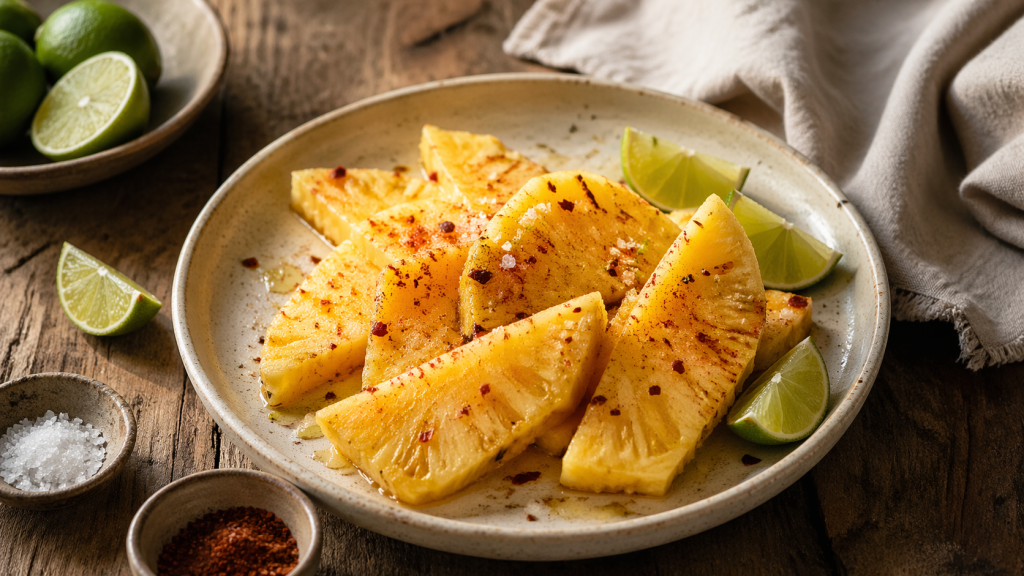
    Pineapple with Lime & Chili

    Some desserts try too hard.

    Too much sugar. Too much weight. Too much insistence that the meal end in indulgence, as if sweetness alone is enough to make something memorable. But after a summer meal built on balance, that kind of ending feels like somebody shouting after a conversation was already finished.

    This is not that kind of dessert.

    This is the kind that wakes the table back up.

    By the time you get here, the meal has already done its work. The Lemon Herb Grilled Chicken with Garlic Butter brought warmth, char, and richness. The Watermelon, Feta & Mint Salad cooled everything down, sharpened the edges, and gave the plate room to breathe again. What is left now is not heaviness. What is left is the last note.

    That is where pineapple comes in.

    Sweet, yes. But not soft. Not passive. Pineapple has a little bite to it even before the lime hits. Then the citrus steps in and tightens everything. The chili follows behind it, not to punish, but to wake the mouth back up. A pinch of salt reminds you that sweetness is never the whole story. And if the fruit needs it, a little honey can smooth the corners, though most of the time it does not.

    That is the point here.

    The goal is contrast, not sugar.

    A dessert like this does not drag the meal down. It leaves it standing. Bright at the edges. A little sharp. A little alive. The kind of ending that feels right in warm weather, when the evening is still holding heat and the last thing anybody wants is something heavy sitting in their chest like a bad decision.

    Sometimes the best dessert is not the richest one.

    Sometimes it is the one that reminds you, gently but clearly, that you are still here. Still tasting. Still paying attention. Still awake to the hour, the season, the people at the table, and the quiet fact that enough was already enough.

    Pineapple with Lime & Chili

    This is where the meal comes back to life.

    Not heavy. Not sweet for the sake of it.

    Just enough sharpness to remind you you’re still here.

    Ingredients

    • Fresh pineapple, sliced or cut into spears
    • Juice of 1 lime
    • Chili powder or Tajín-style seasoning
    • Pinch of sea salt
    • Optional: drizzle of honey

    Method

    Arrange the pineapple simply on a plate.

    Squeeze the lime lightly over the top.

    Sprinkle with chili and a pinch of sea salt.

    Add a drizzle of honey only if needed.

    That is all.

    The goal is not to bury the fruit. The goal is to let the sweetness meet acid, heat, and salt in the right proportions. Enough contrast to keep the dessert honest.

    At the table with it

    This dessert finishes the summer meal that began with Lemon Herb Grilled Chicken with Garlic Butter and opened up further with

    Watermelon, Feta & Mint Salad. It is the last note on the plate—bright, sharp, and just alive enough to stay with you a little longer.

    Kyle J. Hayes

    kylehayesblog.com

    If this found you at the right time,

    Feel free to like, comment, or share it with someone who might need it too.

    Resources for Hard Times

    If you’re looking for practical help, food support, or community resources, you can visit the Salt, Ink & Soul Resources Page.
    👉 Resources for Hard Times

  • The Cold Edge of Summer

    The Cold Edge of Summer

    Watermelon, Feta & Mint Salad

    Not every part of a meal is supposed to do the same work.

    Some dishes are there to carry the weight of the plate. To bring the warmth. To hold the center. That was the job of the Lemon Herb Grilled Chicken with Garlic Butter—fire, citrus, herbs, and just enough richness to make the meal feel grounded.

    But every good meal needs contrast.

    It needs something cold against the heat. Something sharp against the butter. Something that cuts through the richness instead of trying to outmuscle it. That is where this salad comes in.

    Watermelon is easy to underestimate. People taste sweetness and think that is the whole story. But sweetness on its own rarely holds attention for long. It needs tension. A little salt. A little freshness. Something to wake it up and make it feel complete.

    That is what the feta is doing here.

    That is what the mint understands.

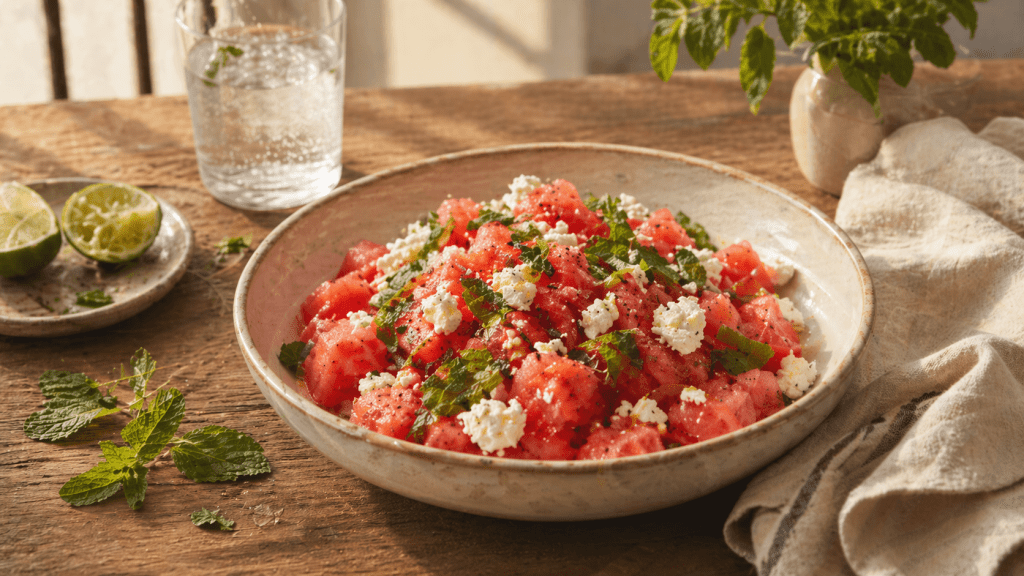
    This is not a salad built on complication. It is built on restraint. Cold watermelon. Crumbled feta. Fresh mint. A little olive oil. Maybe a touch of balsamic if you want a darker note running underneath it all. Nothing heavy-handed. Nothing overdressed. Just a bowl full of ingredients that know enough not to get in each other’s way.

    Set next to the chicken, it does exactly what it should. It cools the plate down. It gives the meal shape. It lets the warm, charred edges of the main dish feel deeper by offering something bright and clean beside them.

    And if you stay with the meal a little longer, there is still one more note to come. On Saturday, I’ll be sharing Pineapple with Lime & Chili—a dessert that does what summer desserts ought to do: leave the table bright at the edges, with a little sweetness, a little heat, and enough contrast to make you remember it.

    Good summer meals do not have to be heavy to feel complete.

    They just have to know what each part is there to do.

    Watermelon, Feta & Mint Salad

    Cold against the warmth of the main dish.

    Sweet, but not alone.

    Balanced by salt. Lifted by mint.

    Ingredients

    • 3 cups watermelon, cubed
    • 1/2 cup feta cheese, crumbled
    • Fresh mint leaves
    • 1 tablespoon olive oil
    • Optional: light drizzle of balsamic glaze

    Method

    Gently combine the watermelon, feta, and mint in a bowl.

    Drizzle with olive oil.

    Add a touch of balsamic glaze for a little more depth.

    Do not overmix. Let each bite be slightly different. Some sweeter. Some saltier. Some are carrying more mint than they did last time. That is part of the point.

    At the table with it

    This salad sits beside the Lemon Herb Grilled Chicken with Garlic Butter, bringing the cool, sharp contrast the meal needs. And on the coming day, the last piece of the table will follow: Pineapple with Lime & Chili on Saturday, the kind of dessert that ends a summer meal with brightness and a little fire.

    Kyle J. Hayes

    kylehayesblog.com

    If this found you at the right time,

    Feel free to like, comment, or share it with someone who might need it too.

    Resources for Hard Times

    If you’re looking for practical help, food support, or community resources, you can visit the Salt, Ink & Soul Resources Page.
    👉 Resources for Hard Times

  • A Summer Meal That Doesn’t Ask Too Much

    A Summer Meal That Doesn’t Ask Too Much

    There was a time when a meal had to prove something.

    Plates piled high. Too many sides. Too much noise around the table. Food built like testimony, as if abundance itself could stand in for tenderness. As if the weight of a plate could settle every doubt about whether love had shown up.

    And sometimes it did.

    But summer has a way of cutting through all that performance. Heat does that. Long light does that. A hot kitchen reminds you quickly that not every meal needs to be an event. Not every act of care has to arrive dressed in ceremony. Some days, what matters most is that something good was made. Something real. Something that asks very little of you, but still gives something back.

    That is this kind of meal.

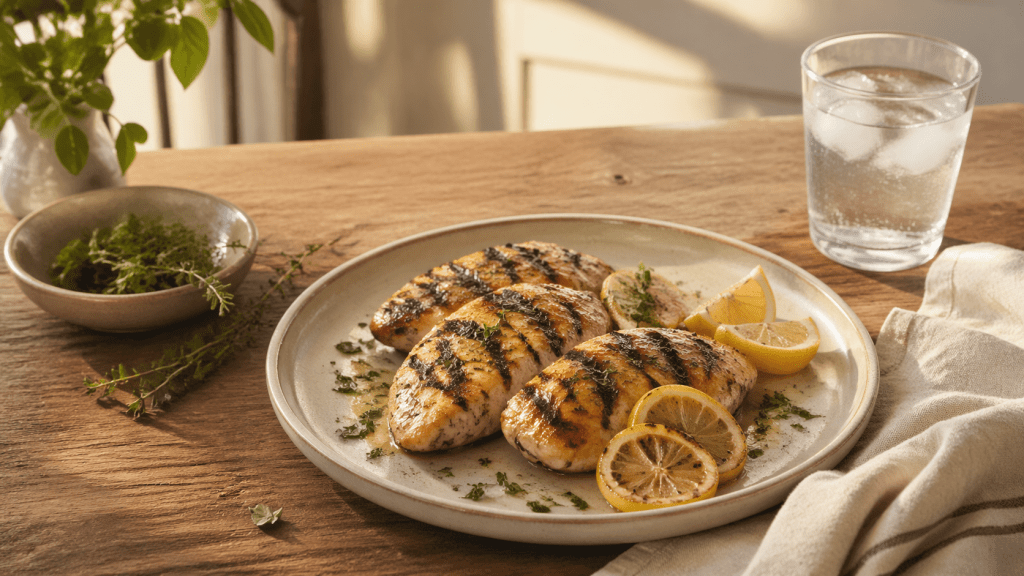
    Not flashy. Not precious. Not trying to be the centerpiece of anybody’s personal mythology. Just grilled chicken with lemon, herbs, garlic, and butter—the kind of food that makes sense the second it hits the plate. Bright, savory, a little charred around the edges, rich without being heavy. The kind of meal you eat at a table still warm from the day, maybe with the blinds half open, maybe with the sound of a distant lawn mower or somebody’s music floating in from down the block.

    It is not trying to impress anybody.

    It is trying to feed you.

    And there is dignity in that. A quiet kind. The kind summer understands well.

    Lemon Herb Grilled Chicken with Garlic Butter

    There is something dependable about grilled chicken done right.

    Not the dry, joyless kind, people force themselves to eat in the name of discipline. Not the bland punishment-food version, either. I mean real grilled chicken. Chicken with a little color. A little smoke. A little life. Chicken that tastes like somebody paid attention.

    That is the whole game here: attention.

    Lemon brings the brightness. Garlic does what garlic has always done—shows up strong and necessary. Thyme gives it that earthy backbone. Butter rounds it all out at the end, because sometimes the difference between decent and satisfying is just knowing when to finish with a little grace.

    This is not complicated food.

    That is part of its value.

    Ingredients

    • 2 to 4 chicken breasts or thighs
    • 2 tablespoons olive oil
    • Juice of 1 lemon
    • 3 cloves garlic, minced
    • 1 teaspoon dried thyme, or fresh thyme if you have it
    • Salt, to taste
    • Black pepper, to taste
    • 2 tablespoons butter

    Method

    In a bowl or shallow dish, combine the olive oil, lemon juice, garlic, thyme, salt, and black pepper. Add the chicken and turn it until it’s well coated. Let it sit for at least 30 minutes. Longer is better if you have the time. The flavor settles in deeper that way.

    Heat a grill or a skillet over medium-high heat. Cook the chicken until it is done through, and the outside picks up a little color. You want that light char. Not enough to bully the meat. Just enough to remind you that fire was involved.

    While the chicken rests, melt the butter. Spoon it over the top just before serving. If you have fresh herbs, throw a little on there. If you do not, it will still be good.

    Because that is the point.

    It does not need much.

    Just balance. A little brightness. A little richness. A little char. Nothing loud. Nothing showing off. Nothing on the plate is competing for your attention like a drunk guy at the end of the bar.

    Just a simple meal, made honestly, which is sometimes the best kind there is.

    At the table with it

    This meal does not end with the chicken. In the coming days, I’ll be sharing the pieces that round it out—a Watermelon, Feta & Mint Salad on Friday, cold and sharp, where the chicken is warm and rich, and Pineapple with Lime & Chili on Saturday, the kind of dessert that leaves the meal bright at the edges.

    Kyle J. Hayes

    kylehayesblog.com

    If this found you at the right time,

    Feel free to like, comment, or share it with someone who might need it too.

    Resources for Hard Times

    If you’re looking for practical help, food support, or community resources, you can visit the Salt, Ink & Soul Resources Page.

    👉 Resources for Hard Times

  • I Cook. I Am Not a Chef.

    I Cook. I Am Not a Chef.

    I Cook.

    I say that carefully, almost defensively, the way someone says I write but refuses the title that would make it sound like a performance. I cook, but I am not a chef. Not because I lack skill, but because I reject what that word has come to mean—at least in the way it’s been packaged, televised, plated, and praised.

    Turn on a screen or scroll long enough and you’ll find yourself staring at a meal made by someone with a coat, a pedigree, and an accent—something arranged with tweezers, built from ingredients you have to Google, let alone locate. The lighting is perfect. The language around it is reverent. The price is astronomical.

    And somewhere in the middle of all that spectacle, a quiet question tries to form:

    Does this feed anyone?

    Not the ego. That’s already been fed.

    Not the reputation. That’s the point.

    I mean the body. The soul. The tired person who’s been chewed up by the world and needs something warm, steady, and honest to bring them back to themselves.

    What Food Is Supposed to Do

    Food is meant to do two things at once.

    It should send you out into the world strong, grounded, nourished, capable of standing upright in whatever waits for you. And it should welcome you home, comforting you after the world has taken its cut.

    A good meal says, Sit down. You made it. You’re safe here for a moment.

    Too much of what passes for “great food” today does neither.

    Some of these five-star, white-tablecloth experiences leave you not with fullness, but with confusion. You spend the first five minutes asking how you’re supposed to eat it. The next five are asking what it even is. And the last few wondering, was that it?

    A smear.

    A foam.

    A reduction of something that once had a spine.

    You leave with a taste and a question mark. No warmth. No grounding. No sense that your body was actually consulted in the process.

    When Difficulty Gets Mistaken for Care

    Then come the reviews.

    Long, florid essays written by people who seem less interested in being fed than in proving they understood the meal. As if complexity itself were nourishment. As if difficulty were virtue. As if decoding were the same thing as being cared for.

    Sometimes I suspect those reviews exist not to describe the food, but to inflate it—to stretch a small experience into something larger than it was. To reassure the diner, the chef, and the culture that the emperor’s plate is, in fact, wearing clothes.

    About That Word “Chef”

    Maybe the problem starts with the word chef itself.

    At its root, a chef is a person trained in traditional French cooking. That’s not an insult. It’s a definition. But definitions matter—especially when they quietly turn into hierarchies.

    And here’s where I say the thing that makes people uncomfortable:

    I do not believe the French know how to cook.

    Not in the way that matters to me.

    They drown everything in sauce, then congratulate themselves for having learned how to drown properly. Technique over instinct. Presentation on nutrition. Control over generosity. The dish becomes a demonstration rather than an offering.

    The sauce isn’t always there to enhance. Sometimes it’s there to hide—to obscure the fact that without it, the food has nothing to say.

    What troubles me more is how that tradition looks down on everything that didn’t come from Europe—especially the cuisines built without academies, without written rules, without approval. The foods made by people who cooked because they had to. People who turned scraps into sustenance. Who learned flavor not from textbooks, but from hunger, memory, and survival.

    The Truth Told by Bread

    Ironically, the best thing to come out of France isn’t a sauce at all.

    It’s bread.

    The baguette.

    The food of the poor.

    Flour. Water. Yeast. Time. Crisp crust. Soft interior. No performance. No confusion. No question about what it is or what it’s for.

    You tear it.

    You eat it.

    You’re fed.

    Perfect in its simplicity.

    And that tells the truth the rest of the cuisine tries to avoid.

    The Lineage I Claim

    The true food of any people comes from those who make something out of nothing. From those who cook not to impress, but to sustain. From kitchens where the question isn’t Is this innovative? But will this carry us through the night?

    That’s the lineage I claim.

    I cook food meant to hold you together. Food that understands fatigue. Food that doesn’t need a narrator. Food that respects the eater enough not to turn them into an audience.

    When I cook, I’m not trying to challenge you.

    I’m trying to care for you.

    I want the meal to say, You don’t have to think so hard right now. I want it to meet you where you are—hungry, worn down, hopeful, human.

    Good food doesn’t leave you with questions.

    It leaves you with strength.

    It leaves you with comfort.

    It leaves you ready to go back out into the world—or prepared to rest from it.

    So no, I’m not a chef.

    Cooking is an act of hospitality, not hierarchy. An offering, not a performance. A quiet declaration that survival deserves pleasure—and pleasure doesn’t need permission.

    And if that means my food will never be plated with tweezers or praised in paragraphs, so be it.

    The people I cook for don’t need convincing.

    They just need to be fed.

    Kyle J. Hayes

    kylehayesblog.com

    Please like, comment, and share

    Resources for Hard Times

    If you’re looking for practical help, food support, or community resources, you can visit the Salt, Ink & Soul Resources Page.

    👉 Resources for Hard Times