Tag: cultural memory

  • The Hat, the Swimmer, and the Chair

    The Hat, the Swimmer, and the Chair

    How an afternoon in Montgomery became Black American folklore.

    On August 5, 2023, a confrontation on the Montgomery, Alabama riverfront became something larger in Black American memory. Three years later, I find myself wondering how we might tell the story when today’s children have grandchildren of their own.

    I sometimes wonder if, years from now, little Black children will sit at the feet of their grandfather and ask him to tell the story again.

    Not one of the heavy stories.

    Not tonight.

    They will know those already.

    They will have heard about marches and bridges. About dogs and hoses. About people who walked into places where they were not wanted and sat down anyway. They will know there were times when being Black in America required a particular kind of courage just to make it home.

    But tonight they want the funny one.

    “Grandpa,” one of them will say, already smiling, “tell us about the Hat, the Swimmer, and the Chair.”

    And Grandpa will lean back.

    He will pretend he doesn’t know which story they mean.

    “The what?”

    “The Chair!”

    “Ohhh,” he’ll say.

    That story.

    He will tell them that the story has many names.

    Some called it the Montgomery Riverfront Brawl.

    Some called it the Alabama Boat Brawl.

    Some called it the Alabama Sweet Tea Party.

    Some called it Chairteenth.

    But Grandpa?

    Grandpa always preferred Fade in the Water.

    And the children will laugh before the story has even begun.

    Grandpa will tell them it happened a long time ago, on August 5, 2023, down in Montgomery, Alabama.

    And because the children know their history, they will understand that Montgomery is not just another American city.

    History has walked those streets before.

    Rosa Parks walked them.

    Dr. King walked them.

    Black people whose names never made it into textbooks walked them.

    And running beside the city is the Alabama River.

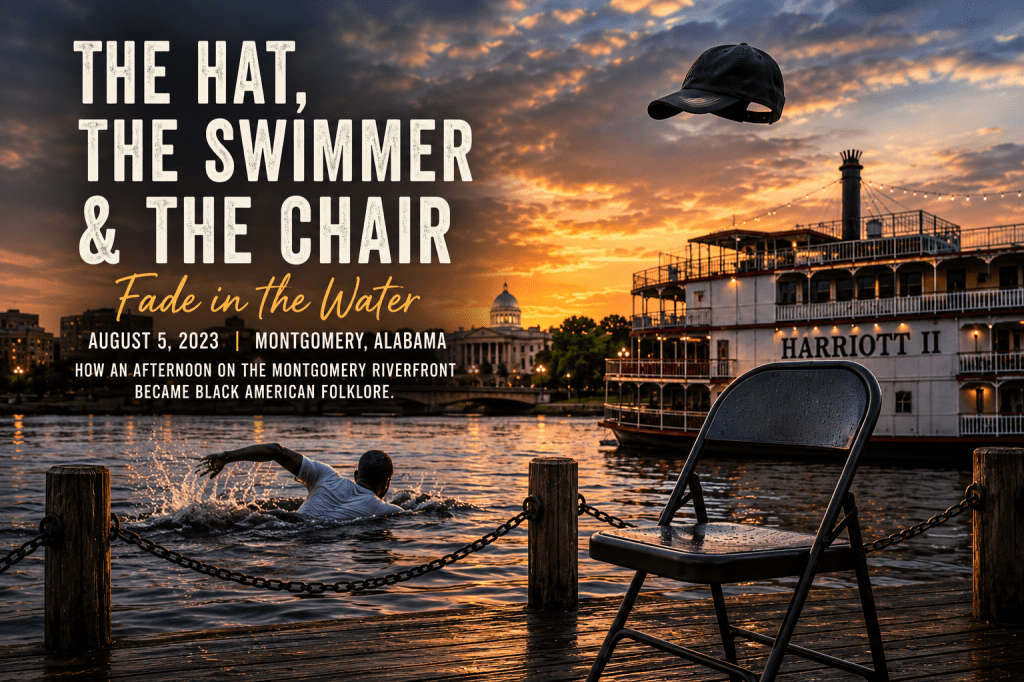
    That afternoon, a riverboat called the Harriott II was trying to return to its usual docking place.

    But another boat was sitting where it wasn’t supposed to be.

    The crew asked the people responsible for it to move.

    They wouldn’t.

    They asked again.

    Still nothing.

    Grandpa will pause here, because every good storyteller knows you cannot rush trouble.

    Eventually, a Black riverboat co-captain went ashore to deal with the situation.

    There were words.

    Then came a blow.

    And suddenly several people were upon him.

    Now, children, Grandpa will say, this is where the story begins to become something else.

    Because somewhere in those first moments, the man’s hat came off.

    And eventually that hat went into the air.

    There are moments in history whose meaning nobody gets to choose beforehand.

    A bell rings.

    A door opens.

    A hand goes up.

    A hat flies through the Alabama sky.

    Nobody held a meeting.

    Nobody formed a committee.

    Nobody sent out an agenda.

    But Black folks saw what was happening.

    And they started coming.

    Brothers answered.

    People ran toward the dock.

    And then came The Swimmer.

    A young man aboard the riverboat looked across the Water and saw what was happening.

    Apparently, this young brother decided that stairs, sidewalks, docks, and all other conventional methods of transportation were taking entirely too long.

    So he jumped.

    Fully dressed.

    Into the Alabama River.

    Grandpa will insist upon this detail.

    Fully.

    Dressed.

    Because some things deserve historical accuracy.

    Into the river he went, swimming toward the dock.

    Years later, the children will know him only by the name the people gave him:

    Aquamayne.

    Maybe Grandpa will tell them some of the other names too.

    Black Aquaman.

    Michael B. Phelps.

    Whatever name makes the children laugh hardest.

    Because that was part of what happened afterward.

    Black people saw something frightening, something that could have become another painful story, and somehow we also found room for laughter.

    Then more people arrived.

    The balance shifted.

    The man who had been alone was no longer alone.

    And just when future historians might have thought the symbolism was complete, somebody picked up a folding chair.

    Grandpa will become very serious here.

    The children will become quiet.

    Because they know what comes next.

    The Chair.

    Not an elegant weapon.

    Not particularly majestic.

    The same kind of chair you might find at a cookout, church basement, family reunion, repast, graduation party, backyard barbecue, or somebody’s grandmother’s house when twelve people arrive and there are only eight dining-room chairs.

    The humble folding chair.

    Black America’s reserve seating.

    And on that afternoon in Montgomery, somebody raised one.

    By then, the battle was effectively decided.

    Grandpa will tell the children that the chair did not really win the fight.

    People did.

    People who decided that they would not stand by and watch someone be overwhelmed.

    That distinction matters.

    Because beneath all the jokes, memes, nicknames, T-shirts, reenactments, songs, and laughter was something that many Black Americans recognized almost immediately.

    He was not left there alone.

    Maybe that is why the story stayed with us.

    We have inherited so many stories where help did not arrive.

    We know stories where someone called, and nobody came.

    Where somebody disappeared.

    Where somebody was hurt.

    Where witnesses looked away.

    Where justice arrived late, if it arrived at all.

    Our history contains too many photographs of Black people standing alone before crowds.

    But this picture was different.

    This time people came running.

    One came across the dock.

    Another came from the boat.

    One apparently looked at the Alabama River and thought:

    I can swim that.

    There was something almost absurdly beautiful about it.

    Not the violence.

    That part deserves no romance.

    People could have been seriously hurt. And the actual human beings involved were more complicated than the characters they eventually became online.

    Grandpa will make sure the children understand that.

    Folklore has a way of sanding down the edges of real events.

    But what people choose to remember tells us something too.

    We remembered the hat.

    We remembered the Swimmer.

    We remembered the chair.

    Most of all, I think we remembered the arrival.

    Maybe that is why we gave the day so many names.

    Naming things is something people do when ordinary language feels insufficient.

    Chairteenth.

    The Alabama Sweet Tea Party.

    Fade in the Water.

    We turned a riverfront fight into folklore almost before the sun went down.

    That is a particular kind of cultural alchemy.

    We have been doing versions of it for generations.

    Taking something painful and finding humor without denying the pain.

    Taking fear and making a story from it.

    Taking an ordinary object and turning it into a symbol.

    Taking a moment when one person appeared to be alone and remembering instead the moment when everybody else showed up.

    Years from now, those grandchildren may not understand why Grandpa laughs when he talks about a folding chair.

    They may wonder why an old man gets a little quieter when he tells them about a hat flying into the air.

    Perhaps that will be a good thing.

    Because maybe they will have grown up in a world where seeing someone who looks like them surrounded and attacked does not awaken something ancient in their chest.

    I hope they don’t immediately understand that part.

    I hope Grandpa has to explain it.

    And when he finishes, perhaps one of those children will ask the question children always ask when they sense there is something beneath the story adults aren’t saying.

    “Grandpa, is that really what happened?”

    Grandpa will smile.

    “Well…”

    Because by then, history and folklore will have been sitting beside each other for a long time.

    The facts will belong to historians.

    The jokes will belong to the internet.

    But the memory will belong to us.

    And maybe Grandpa will finally tell them the part that mattered most.

    A man stood alone.

    His hat went into the air.

    His people saw him.

    And they came.

    Some ran.

    One swam. And somebody brought a chair.

    Kyle J. Hayes

    kylehayesblog.com

    Please like, comment, and share

    Resources for Hard Times

    If you’re looking for practical help, food support, or community resources, you can visit the Salt, Ink & Soul Resources Page.
    👉 Resources for Hard Times

  • Thriller Was Never Gone

    Thriller Was Never Gone

    There are some things the world rediscovers only because it has forgotten how long they have been living inside it.

    That is how I feel watching people circle back to Thriller now, with all this renewed attention around Michael Jackson because of the movie, the trailers, the conversations, the clips, the younger people discovering what some of us never lost. The biopic “Michael” has brought his name back into the center of popular conversation, though for many of us, his name never really left. His music has continued to find new ears, new dance floors, new bedrooms, new cookouts, new children standing in front of mirrors, trying to make their feet obey something their spirit already understands. Even now, Jackson’s catalog keeps returning to the charts and to public memory in fresh ways. 

    But Thriller is different.

    I can keep this short, but that would feel dishonest. Thriller is not simply an album I admire. It is one of those cultural monuments that sits so deeply in the landscape that people sometimes stop seeing how large it is. It becomes weather. It becomes background. It becomes one of those things everyone knows, and because everyone knows it, we risk forgetting how impossible it once was.

    There are albums, and then there are events.

    Thriller was an event.

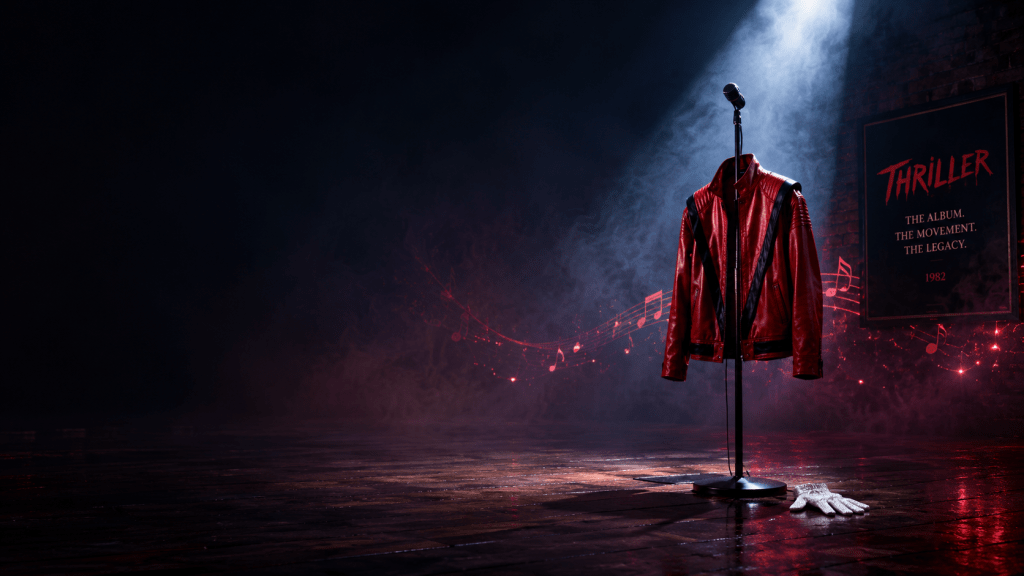
    Not just a release date. Not just a collection of songs pressed into vinyl, cassette, and memory. It was a door being kicked open with polished shoes, a red jacket, a white glove, and a sound so precise it felt engineered by lightning. Released in 1982, it became the kind of record that did not merely dominate its time. It bent time around itself. It went on to become widely recognized as the best-selling album of all time. It was later preserved by the Library of Congress for its cultural, historical, and aesthetic significance. 

    But numbers only tell part of the story.

    Numbers can count sales.

    They cannot count the way a room changes when “Billie Jean” begins.

    They cannot measure the way the bass line walks in before the man does. That quiet, dangerous pulse. That sound of suspicion dressed as elegance. That feeling that something has entered the room wearing a fedora and secrets.

    They cannot count how many children ruined socks trying to moonwalk across kitchen floors.

    They cannot count how many shoulders moved before permission was granted.

    They cannot count the first time somebody saw him lean forward at an angle that seemed to argue with gravity itself and realized that the human body, under the right command, could become punctuation.

    Thriller was music, yes.

    But it was also proof.

    Proof that Black artistry did not need to be translated into something smaller to be understood by the world. Proof that soul, funk, pop, rock, theater, horror, dance, precision, and spectacle could sit at the same table and not fight for space. Proof that a Black artist could become the center of the machine, not as a guest, not as a novelty, not as someone grateful to be let in, but as the reason the doors had to be widened.

    That part matters.

    It mattered then, and it matters now.

    Because there was a time when the industry loved Black sound but feared Black centrality. It loved the rhythm, the invention, the sweat, the church, the moan, the hips, the hunger, the heat. It loved what we made, but not always us standing in the bright middle of it. And then came Michael, not asking permission so much as revealing that permission had always been too small a thing for what he carried.

    He did not just cross over.

    He made the crossing look foolish.

    He made the border disappear.

    That is one of the reasons Thriller remains so difficult to reduce. It was not merely “Black music” becoming acceptable to white audiences. It was Black excellence arriving so fully formed, so undeniable, so complete in its craft, that the old categories began to buckle. The album did not abandon Blackness to become universal. It showed that Blackness had always contained the universal.

    That is the thing some people still struggle to understand.

    The universal does not always begin in the middle.

    Sometimes it begins in Gary, Indiana.

    Sometimes it begins in Motown rehearsal rooms.

    Sometimes it begins in gospel phrasing, James Brown feet, street-corner rhythm, Sunday-morning ache, and the discipline of a child who learned too early that applause could be both love and labor.

    And that is where the beauty of Thriller becomes complicated.

    Because when we talk about Michael Jackson, we are never only talking about music. We are talking about genius and cost. We are talking about what America does to its brightest children, especially the ones it wants to consume. We are talking about the strange bargain of being loved by the world and still somehow being alone inside yourself.

    There is joy in Thriller, but there is also pressure.

    You can hear the perfectionism.

    You can hear the reach.

    You can hear a man trying to become larger than every room that ever tried to contain him.

    Maybe that is why the album still feels alive. It is polished, but not empty. It is immaculate, but not bloodless. Even at its most dazzling, there is something haunted running beneath it. “Billie Jean” is not a party song, though people dance to it. “Wanna Be Startin’ Somethin’ moves like celebration, but it carries anxiety in its bones. “Beat It” has the muscle of rock, but the wisdom of survival. Even “Thriller,” with its monsters and choreography and graveyard theater, knows something serious about fear: that sometimes the only way to face it is to dance directly in front of it.

    That is the secret.

    The album moves because it understands movement as more than entertainment.

    Movement is escape.

    Movement is resistance.

    Movement is testimony.

    Movement is a child saying, “Look what I can do.”

    Movement is a man saying, “You will not look away.”

    And we did not look away.

    We still have not.

    The visuals changed everything. “Billie Jean” helped push Michael onto MTV at a time when Black artists were not being given the same access to that new visual marketplace. The “Thriller” short film took the music video and stretched it into cinema, into an event, into a ritual. After that, a song was no longer just something you heard. It could be something you entered. Something you watched. Something you wore. Something you practiced in the mirror until your body began to remember what your mind could not explain. 

    The red jacket became scripture.

    The glove became a symbol.

    The loafers became instruments.

    The choreography became a language passed down without formal instruction.

    Nobody had to explain it to us. We saw it once, and the body understood.

    That is rare.

    That is not marketing.

    That is culture.

    And culture, real culture, does not stay where it is placed. It travels. It leaks under doors. It crosses oceans. It lands in countries where people do not speak the language but know exactly when to throw their shoulders back. It becomes a wedding reception, a school talent show, a Halloween party, a family reunion, a halftime routine, a child alone in a hallway trying to spin without falling.

    That is why I smile a little when people say Michael Jackson is “back.”

    Back from where?

    He has been in the grocery store aisle.

    He has been in the skating rink.

    He has been at the cookout.

    He has been in the DNA of every pop star who has ever learned that the body could sell the song as much as the voice.

    He has been in the architecture field.

    The truth is, some artists do not disappear. The world only changes its volume.

    For those of us who lived with the music, Thriller was never a relic. It was never just nostalgia. It was not trapped in the 1980s with the jackets, the hair, the posters, the television specials, the moonwalk, and the glow of a world beginning to understand the power of images. It kept breathing. It kept showing up, generation after generation, because great work does not ask permission to survive.

    It survives because it is useful.

    It gives people joy.

    It gives people movement.

    It gives people memory.

    And maybe that is what I return to most when I think about Thriller: memory.

    I think about how music marks us. How a song can become a room. How a bass line can bring back a floor, a television set, a cousin, a summer, a mother’s voice from another room. I think about how the records we love become part of the family even when we do not say it that way. They sit with us. They raise us a little. They teach us rhythm, confidence, drama, and escape. They teach us that ordinary life can suddenly become cinematic if the right song comes on.

    That is what Thriller did.

    It made the world feel bigger.

    It made possibility feel visible.

    It made a Black boy from Indiana into a global language.

    And it did so with craft.

    That part should never be forgotten. The magic was not accidental. Quincy Jones and Michael Jackson built that album with care, discipline, taste, and hunger. Nothing feels wasted. Every song knows what it is doing. Every groove has a purpose. Every silence has shape. The album is joyful, but it is not careless. It is smooth, but not soft. It is commercial, but not hollow. It is accessible without being simple.

    That is a hard thing to do.

    To make something everybody can enter, without making it cheap.

    To make something polished enough for the whole world, but still alive enough to sweat.

    That is why the greatness of Thriller is not really up for debate.

    People may debate Michael.

    People may debate legacy, celebrity, myth, memory, pain, and all the complicated human wreckage that surrounds a life lived too publicly.

    But Thriller?

    The work stands.

    It stands because the work still works.

    Drop the needle. Press play. Let the first few seconds hit. Watch what happens.

    The body answers before the mind can form an argument.

    And maybe that is the final proof.

    Not the sales.

    Not the awards.

    Not the records.

    Not even the history.

    The proof is in the involuntary response.

    The foot taps.

    The shoulders loosen.

    The room wakes up.

    Somebody smiles before they mean to.

    That is not just an album.

    That is inheritance.

    That is architecture.

    That is a force of nature dressed in melody and leather.

    That is Thriller.

    Kyle J. Hayes

    kylehayesblog.com

    Please like, comment, and share

    Resources for Hard Times

    If you’re looking for practical help, food support, or community resources, you can visit the Salt, Ink & Soul Resources Page.

    👉 Resources for Hard Times

  • The Death of the Family Reunion

    The Death of the Family Reunion

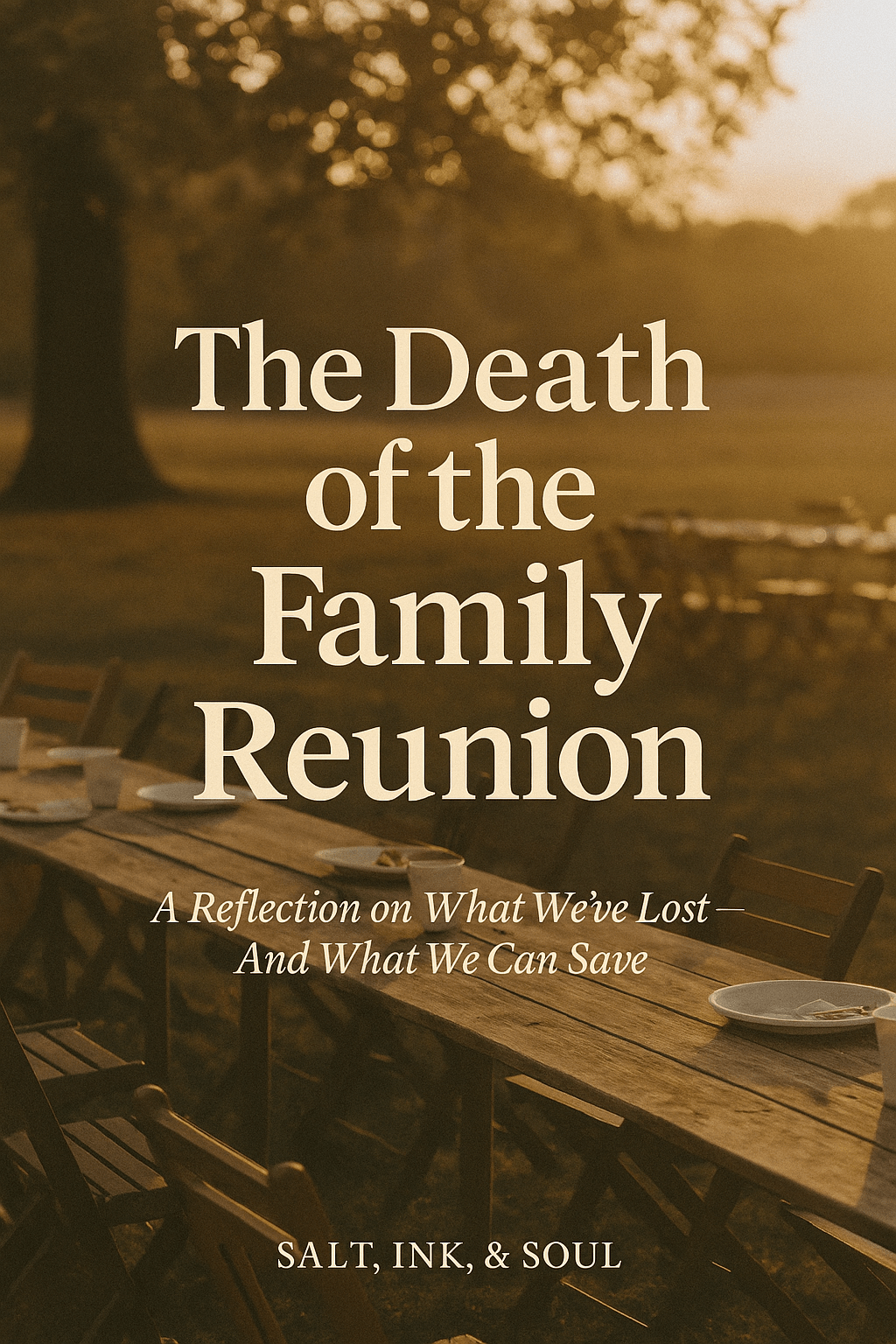
       There was a time when the family reunion was a sovereign nation. It was its own country—borderless, sprawling, stitched together by folding chairs and potato salad, the language of inside jokes and side-eyes, the music of Stevie Wonder & Michael Jackson playing under the shade of Pine trees. A time when cousins you hadn’t seen in three summers ran up to you like the years hadn’t passed at all. When your great-aunt sat in the middle of the picnic like a tribal elder, commanding respect simply by being.

    But those days are dying.

    Today, we still have the cookout, but it’s smaller—more intimate. Just mama and them, maybe a stray cousin or two, whoever was close enough to text the night before. The sprawling tree has been pruned down to a sapling. Third and fourth cousins have become strangers. The great-aunts and uncles who used to hold court, the ones who could make feuding relatives hug just long enough for the picture—they are passing on. And no one has stepped up to replace them.

    The family reunion wasn’t just a party. It was a performance of survival. It was where the family came to bear witness to itself. You’ve got to see the uncles who hadn’t spoken in years sitting at the same table, grunting through peace for a few hours because Big Mama asked them to. You saw your cousins—those living testaments to the places your blood had wandered—The Quad-Cities, St. Louis, Albuquerque—all gathered in one place. You saw what your people had endured. The reunion was a history lesson with Kool-Aid and pound cake.

    And then there were the secrets. Every family has them—the ones you whisper about in the kitchen when you think the kids aren’t listening. The reunion was where those secrets were kept, not because they were shameful, but because they were binding. The elders held them like scrolls, as if they were holy texts. They knew which stories to tell and which to carry to their graves, and somehow that discipline kept the family whole.

    Now, the elders are gone. The scrolls are scattered. The secrets have slipped into the wind, sometimes aired out in group chats, other times left to die in silence. And without the keepers of the covenant, we are drifting.

    We live in an era of curated distance. We say “family” but mean it like a password, not a promise. The younger ones, the ones raised on social media and soft boundaries, have little appetite for gathering with people who once judged them, who might still hold the memory of their worst mistakes. The old guard could make you come anyway—make you show up, make you sit in the heat, make you pass the potato salad to the cousin you swore you’d never speak to again. They could force you to remember that family is not optional.

    And yet, here we are—choosing.

    There is grief in this. Grief not just for the elders who are gone, but for the version of ourselves that was possible when we stood together. Grief for the messy, complicated love that once kept us tethered.

    But there may also be a call. We may have to decide whether the reunion dies with them or is reborn through us. It’s our turn to be the ones who hold the secrets, who call the roll, who get the feuding cousins to show up just long enough to remember that they still share a name.

    The family reunion is not gone. It is waiting—like a pot on the back burner, simmering slow, hoping someone remembers to stir it.

    The question is whether we will.

    By Kyle J. Hayes

    kylehayesblog.com

    Please like, comment, and share

    Thinking of Family Reunions makes me wonder, what’s your favorite dish to eat or to bring? Please leave a comment.