Tag: cultural reflection

  • Are We Waking Up?

    Are We Waking Up?

    I heard someone say recently that alcohol makes you stupid.

    That was it.

    Nothing profound.

    It was said almost casually, a quick explanation for the behavior of some people sitting around drinking. The kind of sentence you hear, maybe laugh at, and forget before the conversation moves on.

    Except I didn’t forget it.

    It followed me.

    Because the more I thought about it, the less ridiculous it sounded.

    Alcohol does not actually make a person stupid. Intelligence doesn’t disappear into the bottom of a glass.

    But alcohol does remove things.

    Judgment.

    Restraint.

    Inhibition.

    Patience.

    Sometimes fear.

    Sometimes shame.

    Sometimes that little voice inside us that says:

    Maybe don’t do that.

    We even have language for what happens afterward.

    “He wasn’t himself.”

    “She had too much to drink.”

    “I don’t remember what happened.”

    “I would never have done that sober.”

    We say these things because somewhere inside them is an understanding that alcohol can interfere with some of the machinery we use to govern ourselves.

    And I started wondering about that.

    Not just about drinking.

    About anesthesia.

    About what happens when numbness becomes ordinary.

    Because there is another side to alcohol that doesn’t get talked about nearly as much.

    Sometimes people aren’t drinking because they want to become wild.

    Sometimes they are drinking because they are tired.

    Sometimes they want the world to become quiet for a few hours.

    The bills are still sitting on the table.

    The marriage is still failing.

    The job still hurts.

    The loneliness will still be waiting tomorrow morning.

    The grief hasn’t gone anywhere.

    But for a little while, something poured into a glass can soften the edges.

    I understand that.

    I think most of us can understand wanting relief.

    Some days, being fully awake to your own life can feel like work.

    And that is where my thoughts became uncomfortable.

    Because alcohol has never existed outside history.

    European colonists brought large quantities of distilled alcohol into Native communities and made it part of trade. Historical research describes traders discovering that alcohol could give them an advantage in negotiations. It became tangled with commerce, diplomacy, land, exploitation, and the larger machinery of colonization.

    And then something familiar happened.

    The people living with the consequences eventually became the stereotype.

    The story became about the “drunken Indian” instead of everything that had happened around the drinking.

    That distinction matters.

    Because sometimes we look at people coping with devastation and blame them for the way they learned to survive it.

    Black America knows something about that too.

    Walk through enough poor Black neighborhoods, and you begin noticing what is available.

    Liquor stores.

    Convenience stores.

    Fast food.

    Cheap calories.

    Cheap intoxication.

    And sometimes precious little of what actually nourishes a human being.

    People have been saying for years that in some neighborhoods it can feel easier to find a cold beer than fresh fruit and vegetables.

    Think about what that means.

    Not as a conspiracy.

    Not as an excuse.

    Just as geography.

    What a neighborhood makes easy tells you something.

    So does what it makes difficult.

    And alcohol is remarkably easy.

    There are bottles for celebration.

    Bottles for heartbreak.

    Bottles after work.

    Bottles at the cookout.

    Bottles at the funeral.

    A drink because we won.

    A drink because we lost.

    A drink because somebody was born.

    A drink because somebody died.

    A drink because it is Friday.

    Sometimes we don’t even ask what we are trying to escape.

    That question may be too expensive.

    So we order another round.

    But lately I have been noticing something else.

    People seem to be drinking less.

    I thought perhaps it was only something I was seeing until I came across a USA Today article about Gen Z and Millennials changing their relationship with alcohol.

    The research behind the article came from the Bank of America Institute. It found alcohol spending as a share of household budgets hovering near a forty-year low. Even more interesting to me, government data examined in the report showed that there were nearly 3.9 million fewer binge drinkers between the ages of 21 and 34 in 2024 than there had been a decade earlier.

    The researchers described some of the change as moving from “barstools to barbells.”

    Young people working out more.

    Drinking less.

    Finding different ways to socialize.

    And it isn’t only young people.

    Gallup reported in 2025 that 54 percent of American adults said they drank alcohol, the lowest level in nearly ninety years of its polling.

    Something is changing.

    What I don’t know is what that something means.

    Because at roughly the same time, I find myself watching people questioning more things.

    Organizing.

    Reading.

    Marching.

    Building.

    Arguing.

    Documenting.

    Demanding receipts.

    Asking who owns what.

    Asking who benefited.

    Asking why their neighborhoods look the way they do.

    Asking why their parents accepted certain things.

    Asking why their grandparents had to.

    Maybe the two have absolutely nothing to do with each other.

    But I sometimes wonder.

    What if we are watching people decide they would rather feel everything than continue feeling nothing?

    What if we are tired of being numb?

    Something is frightening about sobriety when you think about the word beyond alcohol.

    To become sober is to see clearly.

    And seeing clearly carries responsibility.

    Once you see the crack in the wall, you cannot pretend the wall is whole.

    Once you understand how something happened, ignorance becomes harder to retreat into.

    Once you recognize injustice, you have to decide what your knowledge requires of you.

    That is the difficult part.

    Awareness doesn’t always feel good.

    Sometimes awareness makes you angry.

    Sometimes it makes you ashamed.

    And sometimes you discover that something you believed your entire life wasn’t true.

    Maybe that is why every society has invented ways of escaping itself.

    Alcohol.

    Drugs.

    Food.

    Television.

    Shopping.

    Work.

    Phones.

    Endless scrolling.

    Different bottles.

    Same promise.

    You don’t have to think about it right now.

    And perhaps that is the question that has been bothering me since I heard that crude little sentence.

    Not whether alcohol makes us stupid.

    That is too easy.

    The better question is what happens when enough people decide they no longer want to be anesthetized.

    What happens when people want their judgment back?

    Their memory back?

    Their anger back?

    Their attention back?

    What happens when somebody who has spent years trying not to feel finally decides that feeling is necessary?

    Maybe nothing.

    Maybe declining alcohol consumption and what I perceive as growing social awareness are two completely separate things that happen to occupy the same moment.

    I am willing to accept that.

    But I still find myself wondering.

    Because power has rarely had much to fear from people who are asleep.

    Awake people ask questions.

    Awake people remember.

    Awake people notice who is missing from the photograph.

    Who wrote the history.

    Who owns the building.

    Who gets paid.

    Who gets arrested.

    Who gets forgiven.

    Who gets forgotten.

    Awake people can become inconvenient.

    And maybe something beautiful is happening beneath all of this.

    Not purity.

    Not prohibition.

    Not some judgment of the person sitting at the end of the bar trying to survive a Wednesday.

    I have no interest in condemning them.

    Life can hurt.

    Sometimes terribly.

    And human beings have always searched for ways to make the hurting quieter.

    I understand that.

    But there is a difference between understanding why we seek numbness and pretending numbness doesn’t cost us anything.

    Maybe the question isn’t whether drinking is good or bad.

    Maybe the question is simpler.

    What are we trying not to feel?

    And what might happen if, for once, we allowed ourselves to feel it?

    The grief.

    The anger.

    The history.

    The dissatisfaction.

    The possibility.

    Maybe we would discover that some of what we have been trying to numb was never weakness at all.

    Maybe some of it was information.

    Something inside us saying:

    This hurts.

    This isn’t right.

    This needs to change.

    There are worse things than being uncomfortable.

    Sometimes discomfort is how the body tells us to move our hand away from the flame.

    Sometimes anger is how the soul tells us something precious has been violated.

    And sometimes clarity begins with the decision to stop looking away.

    I don’t know if we are becoming a more sober people.

    But I wonder if we are becoming a more awake one.

    And if we are—

    I hope we stay awake.

    Kyle J. Hayes

    kylehayesblog.com

    Please like, comment, and share

    Resources for Hard Times

    If you’re looking for practical help, food support, or community resources, you can visit the Salt, Ink & Soul Resources Page.
    👉 Resources for Hard Times

  • The Sky Belongs to Balloons

    The Sky Belongs to Balloons

      It’s the time of year when the desert begins to remember the cold. The mornings bite a little sharper, the light shifts from golden to amber, and in Albuquerque, the rhythm of fall comes with rituals all its own. The State Fair folds up its tents and carnival lights, and before the dust has even settled, the sky gives itself to balloons.

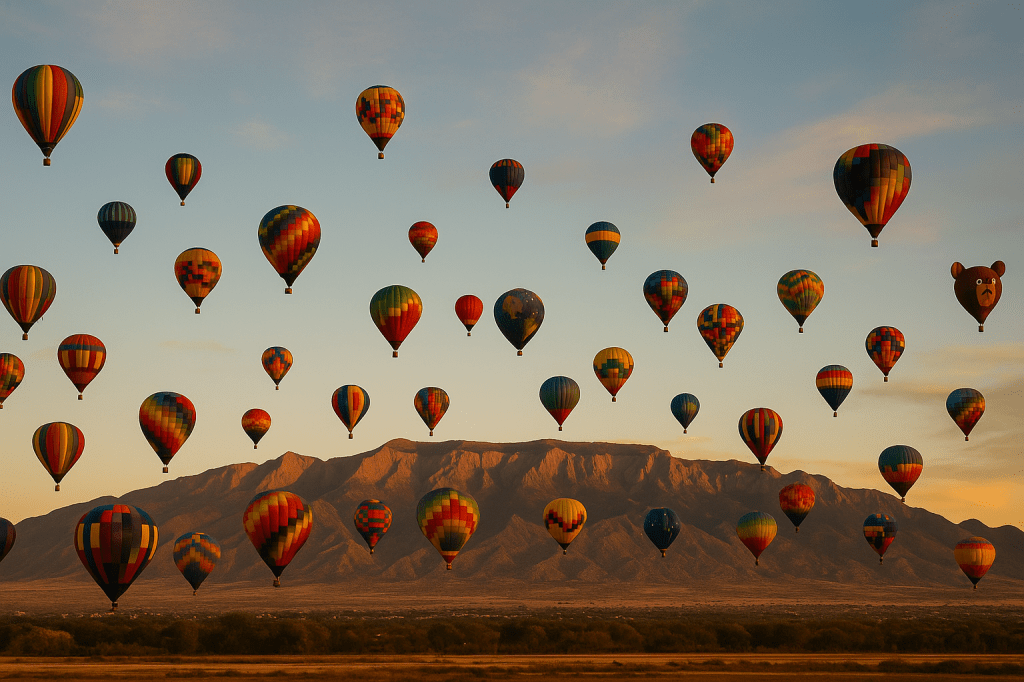
    The Albuquerque International Balloon Fiesta is not just an event here; it is a season. The largest gathering of hot air balloons in the world, and every year, it pulls tens of thousands of people into its orbit. It rewrites the city’s mornings. Commutes pause. Joggers stop mid-stride. Children tug their parents toward the sidewalk, phones raised, because a balloon — shaped like a cow or a stagecoach or just a simple rainbow stripe — has drifted so low it seems ready to brush the rooftops.

    And then the chase crews arrive, pickup trucks trailing, men and women moving quickly, packing away the canvas like a secret folded back into itself. You see this enough, you could call it ordinary. But I’m still too new here, not jaded enough, because every time I look up and catch sight of one, it feels like the sky has been interrupted by wonder.

      There’s a madness in waking at 3:30 a.m. just to stand in the cold. Yet thousands of us do it, year after year. The roads snake toward Balloon Fiesta Park in the dark, headlights lined up like a procession. Coffee cups steam in cup holders, blankets drape over shoulders, and conversations hum with anticipation.

    When you arrive, the field is still hushed, waiting. Crews shuffle around baskets, propane tanks hiss faintly, and in the distance you hear murmurs, laughter, the rustle of nylon being unfurled. The night sky holds onto its stars a little longer.

    And then — the Dawn Patrol.

    A handful of balloons rise first, lighting their burners in unison, glowing like lanterns against the indigo dark. The sound is unmistakable: the sudden whoosh of flame, the gasping exhale of fire against the silence of morning. The crowd breathes with them, every burst of light pulling eyes upward. For a moment, it feels less like a spectacle and more like a ceremony.

    And then the Mass Ascension begins.

    Dozens, then hundreds, then more than you can count. Balloons rising in waves until the sky is littered with color — a slow unfurling of the surreal, so vast and so improbable that it borders on disbelief. You look up and the horizon is gone, erased by canvas and flame.

      There’s a peculiar intimacy in standing with thousands of people you don’t know, all of you bundled against the same chill, sipping coffee, biting into breakfast burritos, sharing a collective awe. You don’t need names. You don’t need history. For a few hours, you are kin to anyone whose head tilts back in wonder.

    Children squeal at the “special shapes” — bees holding hands, Darth Vader and Yoda, cows larger than houses. Photographers kneel, point, capture. Tourists beam into news cameras, their voices shaky with joy, telling reporters this was a lifelong dream.

    And I wander among it all, part of the throng but also apart, notebook in my pocket, questions in my head. What does it mean that people travel across the world just to stand in this field and look up? What does it mean that beauty, when shared, feels almost like communion?

      By mid-morning, the sky begins to empty. Balloons scatter, floating toward the mesa, toward neighborhoods, toward open lots where chase crews wait to claim them. The field thins out, tourists drift toward vendors selling chile and frybread, and traffic snarls for miles.

    You sit in it, inching forward, the high of the morning giving way to the dull grind of engines and exhaust. The burrito is gone, the coffee cold. Reality asserts itself.

    And yet, even in that crawl, I find myself replaying the moment of lift. The quiet between burner blasts. The way balloons floated like prayers, drifting wherever the wind allowed. My fear of heights keeps me on the ground, tethered by gravity, but still — I wonder what it must be like to surrender that control. To look down on this desert city not as blocks and intersections but as a sprawl of lives stitched together under the watch of mountains and sky.

    Part of the gift of the Fiesta is this: that you don’t need to rise to feel lifted. Wonder has its own gravity, and it doesn’t care whether you leave the earth or not.

      Living here, you learn to get used to things. Chile roasters set up outside grocery stores in September, flames spitting, smoke curling into the air until the whole city smells like survival. The Sandias are turning pink at dusk, like the mountains are reminding you that the day is theirs to close. Balloons dotting the sky in October, so common they could be dismissed as background.

    But used to doesn’t mean unmoved by.

    Maybe that’s the secret of Albuquerque — that it can hold the extraordinary and the ordinary at the same time without letting either collapse the other. It teaches you that wonder isn’t about distance but attention. That staying, not leaving, sometimes brings you closer to beauty.

    The Balloon Fiesta comes and goes, the crowds depart, the fields go quiet again. But for one week, every year, the sky itself becomes a canvas — and it belongs to balloons.

    And that’s what keeps me here. Not the spectacle, not the scale, not even the food or the music or the culture, as rich as all of that is. It’s the reminder that beauty doesn’t always come from someplace else. Sometimes it rises right in front of you, again and again, until you learn to stop, to look up, to hold still in the presence of wonder.

    By Kyle J. Hayes

    kylehayesblog.com

    Please like, comment, and share

  • The Taste of Home, The Taste of Here

    The Taste of Home, The Taste of Here

      There are nights when homesickness sneaks up on me. Not the kind that makes you want to book a ticket and run back, but the quieter version — the one that comes when you’re alone in your apartment in Albuquerque and your body aches for food that no one here makes.

      I wasn’t raised on green chile chicken enchiladas. My comfort food wasn’t rolled tortillas smothered in chile sauce, or tamales wrapped in husks and steamed until the masa gives way to tenderness. I was raised on soul food — though these days they like to call it “Southern cuisine,” as if renaming it erases where it really came from.

      I grew up on collard greens cooked until they surrendered, cornbread golden and crumbly, fried chicken with skin that cracked when you bit into it, mac and cheese that clung to your fork like it loved you. Those weren’t just meals; they were testimonies, proof of survival passed down on plates.

    And yet, here I am in New Mexico, learning to find comfort in different flavors.

      When someone offers me tamales now, I don’t hesitate. I ask, “Red or green?” without thinking. At the Balloon Fiesta, I know when I show up, to get in line for a breakfast burrito and a hot coffee to fight the predawn chill.

      I’ve even attempted green chile chicken enchiladas in my own kitchen. I call them “passable,” and that’s being generous. They’re edible, sure, but I know enough to know they don’t hold a candle to the ones made by someone whose hands were taught by generations. Still, they’ve become a ritual. A way of saying to myself: You belong here enough to try.

      Still, when I’m sick, I don’t crave green chile. I crave the food of my childhood. Fried chicken. Collard greens. Sweet potatoes baked down until they bordered on candy. Food that came from a time and a place that shaped me before I even knew it.

      That’s the thing about food — it doesn’t just fill you. It remembers for you. It pulls you back through time, reminds you who held the spoon, who stood at the stove, who called you in from outside when the plates were ready.

      No matter how far you travel, those cravings remain like old ghosts.

    But here’s the surprise: when the homesickness hits hardest, it’s not because I want to return to where I grew up. It’s because I want to return here, to New Mexico.

      That’s the contradiction I live with now. I miss home, yes, but home is no longer the place I left behind. It’s this desert with its endless skies and its Chile smoke drifting outside grocery stores in the fall. It’s the quiet of mornings when the Sandias catch fire with the sunrise. It’s the ritual of learning to love food I didn’t grow up on.

      When I’m away too long, I don’t miss the streets of my childhood. I miss the taste of green chile folded into eggs, the tamales shared at Christmas, the balloon-lit sky at dawn. I miss this place.

      Maybe that’s what it means to belong somewhere new. Not to erase what you came from, but to layer it. To carry collards and cornbread in one hand and green chile enchiladas in the other. To know that your soul food still holds you, but so does this food you had to learn.

    The older I get, the more I realize home isn’t fixed. It shifts. It stretches. It welcomes and demands at the same time. And if you let it, it changes you — until homesickness no longer means going back.

    It means going forward.

    By Kyle J. Hayes

    kylehayesblog.com

    Please like, comment, and share