Tag: culture

  • What Are We Rehearsing?

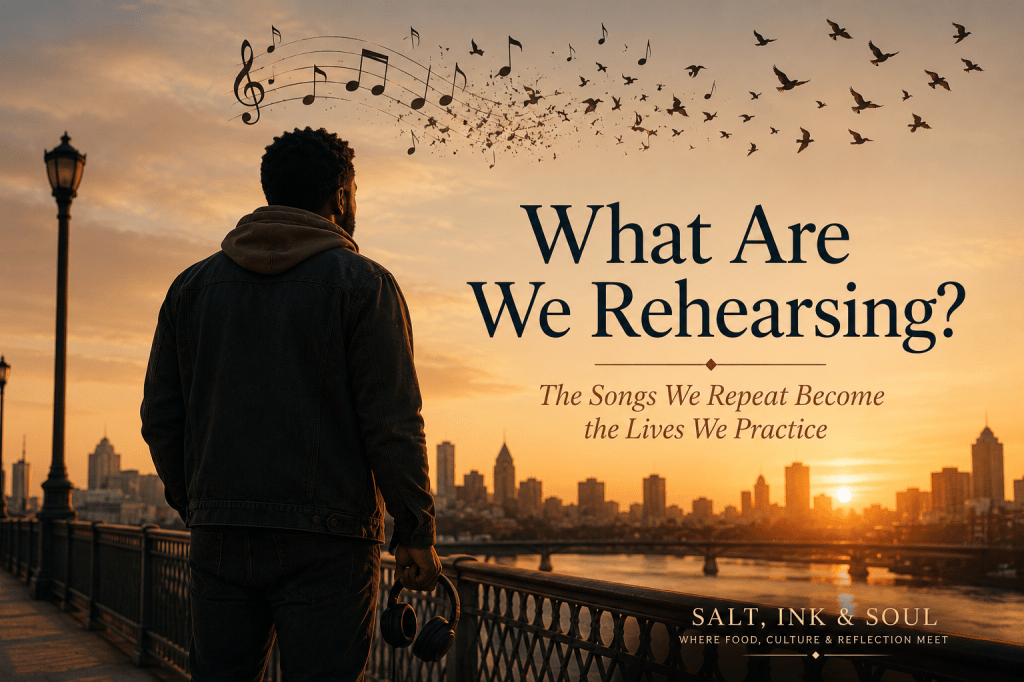
    What Are We Rehearsing?

    Sometimes another person’s question stays with you longer than their answer.

    This week, I found myself thinking about a conversation sparked by singer India Arie. She wondered aloud what it means when the songs we celebrate become the stories we live by. She was not asking for censorship. She was not asking anyone to stop making music. She was asking whether what we repeatedly consume eventually begins to shape us.

    That question has followed me around.

    Maybe I’m seeing too much.

    Or maybe I’m finally paying attention.

    I have been thinking about repetition.

    Not just in music, but in every part of life.

    A basketball player takes thousands of jump shots until the movement becomes instinct.

    A pianist practices scales until the fingers no longer ask permission from the mind.

    A grandmother makes cornbread so many times that measuring cups become unnecessary.

    We call it practice.

    We call it discipline.

    We call it muscle memory.

    We already understand that repetition changes the body.

    So why do we become uncomfortable when someone asks whether repetition might also shape the heart?

    Long before neuroscience gave us language like neural pathways and habit formation, people understood that words carried power. Communities repeated prayers because they believed repetition strengthened faith. Parents repeated lessons because they hoped they would become character. Freedom songs were sung over and over because they reminded weary people that they were more than the conditions surrounding them.

    Some people called those rituals sacred.

    Others believed repeated words could become something darker.

    They believed that speaking certain things over and over invited them into your life.

    Whether we call it ritual, conditioning, or simply human psychology, perhaps they were all reaching toward the same truth.

    What we practice eventually begins to feel natural.

    That thought has stayed with me as I watch our culture.

    Not just Black culture.

    All culture.

    We live in an age where algorithms have become our DJs.

    They decide what rises.

    They decide what repeats.

    They decide what millions of people hear before breakfast.

    I am not interested in arguing that music alone determines the future of a community.

    It doesn’t.

    No song can explain generations of segregation, economic inequality, underfunded schools, broken public policy, or the many burdens that Foundational Black Americans have carried across centuries. To pretend otherwise would ignore history.

    But I also refuse to believe music is powerless.

    If songs had no influence, companies would not spend millions of dollars making sure certain ones reach our ears.

    Advertising exists because repetition works.

    Political campaigns exist because repetition works.

    Religious liturgy exists because repetition works.

    Education itself depends on repetition.

    Why would we imagine music is somehow exempt?

    This is not about blaming any one artist.

    Every generation has created music that unsettled the one before it.

    Hip-hop, like jazz before it, has given voice to neighborhoods that were often ignored. It has documented struggle, celebrated creativity, challenged power, and preserved stories that might otherwise have disappeared.

    Some of the greatest poetry I have ever heard arrived wrapped in a beat.

    That deserves respect.

    But every art form also contains choices.

    Some songs call us toward dignity.

    Others celebrate revenge.

    Some remind us that love requires sacrifice.

    Others convince us that commitment is weakness.

    Some tell young people they are worth more than what the world has offered them.

    Others invite them to build an identity around excess, exploitation, or self-destruction.

    Those differences matter.

    What troubles me even more is not that those songs exist.

    Art has always reflected both light and shadow.

    What troubles me is what gets amplified.

    There are artists creating music about healing.

    About fatherhood.

    About faith.

    About perseverance.

    About accountability.

    About joy that does not require someone else’s humiliation.

    They exist.

    Yet they rarely seem to receive the same machinery behind them.

    That should make us curious.

    Not angry.

    Curious.

    Why do stories that flatter our impulses often travel farther than stories that challenge us to grow?

    Why does outrage outperform wisdom?

    Why is self-control so difficult to market while excess is endlessly profitable?

    Those are questions worth asking.

    Especially for those of us who are descendants of people who once sang their way through unimaginable suffering.

    Our ancestors understood something about repetition.

    They sang hope until hope became endurance.

    They repeated Scripture until it became courage.

    They gathered around kitchen tables and church pews, telling the same family stories until children understood they belonged to something larger than themselves.

    Those songs did not erase injustice.

    But they strengthened people enough to survive it.

    I wonder what songs we are teaching ourselves now.

    Not because I believe every lyric becomes destiny.

    But because I know that what surrounds us eventually begins to sound like home.

    And what sounds like home eventually becomes normal.

    The most dangerous ideas are rarely the loudest.

    They become dangerous because they stop sounding unusual.

    They become ordinary.

    That is how repetition works.

    It does not always convince.

    Sometimes it simply familiarizes.

    And familiarity is powerful.

    I think about food often.

    Anyone who has spent time reading Salt, Ink & Soul knows that.

    A single meal will not make you healthy.

    Neither will a single meal make you sick.

    But years of eating eventually shape the body you live in.

    Perhaps the soul works the same way.

    Perhaps one song changes very little.

    But thousands of repetitions…

    Thousands of rehearsals…

    Thousands of small invitations toward the same vision of success, love, relationships, wealth, and identity…

    Perhaps those leave fingerprints we cannot always see.

    This is not a call to fear music.

    It is not a call to silence artists.

    It is certainly not a call to stop creating.

    It is a call to become more intentional listeners.

    To ask ourselves a simple question before we press play.

    What am I rehearsing?

    Because every day we are practicing something.

    Compassion or contempt.

    Discipline or indulgence.

    Hope or cynicism.

    Dignity or degradation.

    None of us escapes rehearsal.

    The only choice we have is deciding what kind of life we want to become fluent in.

    Maybe I’m seeing too much.

    Or maybe I have simply reached an age where I understand that nothing enters the soul without leaving something behind.

    If that is true, then perhaps one of the quietest acts of freedom is choosing carefully what we allow to echo there.

    Kyle J. Hayes

    kylehayesblog.com

    Please like, comment, and share

    Resources for Hard Times

    If you’re looking for practical help, food support, or community resources, you can visit the Salt, Ink & Soul Resources Page.

    👉 Resources for Hard Times

  • “What We Remember, We Keep-Alive”

    “What We Remember, We Keep-Alive”

    I had been working on the newest book in my Culinary Crossroads series, where Jamaal was supposed to return home—to the States and the old South.

    I thought it would be simple.

    A return to where it all began.

    A pilgrimage from the polished kitchens of Manila to the front porches, fields, and kitchens that shaped so many of us long before we ever touched a passport.

    I thought I was writing about food.

    But the deeper I dug, the more I realized that it was never just food.

    It was survival.

    It was remembrance.

    It was resistance disguised as Sunday dinner.

    I read everything I could find.

    The recipes were there, sure.

    But what kept catching me, snagging me like thorns on an old fence line, were the traditions.

    Not just what we ate but how we ate.

    Why we seasoned the way we did.

    Why were our celebrations, mourning, and rituals around food and music crafted in ways no cookbook could fully explain?

    It started long before we were “we” in any way we would recognize now—

    on the plantations,

    where bits and pieces of fading memories were passed down by those brought here, enslaved, stolen, stripped, but not erased.

    They blended what they remembered with what little they had.

    Cornmeal. Greens. Off-cuts and castoffs.

    They made necessity taste like something more than survival.

    They made it taste like home.

    And over generations, through sheer will and stubborn brilliance, we built something uniquely ours.

    Not just in the food but in the music,

    the way we buried our dead,

    the way we married our loved ones,

    and the way we danced when the sun went down and the cotton fields emptied.

    These traditions aren’t static.

    They are not museum pieces under glass.

    They are living and breathing things—regional and even tribal, depending on where your people ended up.

    That phrase kept echoing in my mind:

    “Where your people from.”

    The old folks would ask you that when they met you.

    After you named whatever city you lived in now—Detroit, Chicago, Kansas City—they’d look deeper, waiting for the real answer.

    They were talking about the South.

    Not the city, but the state.

    The county.

    The plantation.

    The place that owned your ancestors.

    It was a question about roots.

    (Writing that even now feels like swallowing glass.)

    The place that owned your ancestors.

    So many years later, and it’s still hard to say.

    Still hard to look at without flinching.

    And then came the “Great Migration,” or as some called it, “The Great Exodus.”

    We left with almost nothing.

    No land. No wealth. No easy road.

    But we took what mattered.

    We carried our recipes.

    We carried our songs.

    We carried the parts of ourselves that they could not steal, whip out of us, or erase.

    And for decades, it sustained us.

    Soul Food. Soul Music.

    Names born not in marketing rooms but in living rooms, storefront churches, and kitchens where steam and sorrow rose together.

    And now?

    Now, the word “Soul” feels almost quaint.

    Almost forgotten.

    Funny, isn’t it?

    What slavery couldn’t kill, freedom quietly erased.

    In chasing new beginnings, we risk losing the old songs.

    The taste of real cornbread.

    The sound of a mother’s hum in the kitchen.

    The wisdom tucked into the folds of a handwritten recipe card.

    As I write Jamaal’s story, I realize I’m writing my own.

    Our own.

    The story of a people who carried more than pain.

    We carried genius.

    We carried grace.

    We carried soul.

    And it’s on us—not the history books, not the tourists looking for “authenticity”—to remember what we made from nothing.

    And to keep making it while we still can.

    Before the last song fades.

    Before the last plate is cleared.

    Before the last story goes untold.

    By Kyle Hayes

    Please Like, comment, and subscribe.

    #BlackVoices #MemoryAndLegacy #WeAreOurAncestorsDreams #StorytellingMatters

  • The Family Table

    The Family Table

    By Kyle J. Hayes

    Family-style food.

    Most people hear that, and they think of big tables, long benches, and a group of people laughing too loud over plates passed back and forth. But that’s not what I’m talking about. Not today.

    I’m talking about restaurants run by families.

    It is not some faceless corporate chain where recipes are born in a test kitchen, engineered by marketing teams to maximize shelf life and “mouthfeel.”

    I’m talking about food with history, with bloodlines, with stories.

    Food where the recipe doesn’t come from a corporate memo but from someone’s grandmother.

    Food brought over from the old country—whether that country is Mexico, Korea, Vietnam, or somewhere in between—served with the kind of pride you can taste in every bite.

    Albuquerque happens to be one of the best cities in America for this.

    A city that has kept its soul intact, where authentic New Mexican cuisine still sits at the center of the table, smothered in red and green chile. Where you can find Mexican food served out of family-run spots that have no PR teams, no focus groups—just a sign out front and a kitchen that runs out of beef tongue tacos because they’re that good.

    Places that don’t need Instagram filters or foodie influencers because their customers already know.

    And don’t even get me started on the Asian spots—Orchid Thai, my quiet little secret I hate to share because I know what happens when the wrong people find out.

    I’ve seen it before.

    Take Coda Bakery, my go-to for an excellent banh mi. I always order the #1. It used to be a hidden gem until the word got out.

    Then came the food bloggers.

    Then came the Food Network.

    Now, I stand in line with tourists, waiting for something that once felt like mine alone.

    But that’s how it goes.

    The best things, once discovered, never stay secret.

    And in a way, that’s okay.

    The beauty of family-run restaurants isn’t just that they make the best food you’ve ever had—they make it proudly, and they’ll make it for everyone.

    The recipe doesn’t change when the line gets longer.

    The taste doesn’t shift to accommodate Yelp stars or branded merch.

    What you’re eating is still the same dish someone’s auntie made years ago, the same soup someone’s father learned to perfect, the same bread someone’s mother kneaded in the early morning hours.

    It’s real.

    And real food leaves a mark.

    Most of the time, I’m not one to go out. I don’t care much for the noise, the scene, the crowd.

    I get my food to-go, bring it home, eat in peace.

    But occasionally, when I need to remind myself why it matters, I’ll go.

    I’ll sit.

    Order a beer.

    And try to guess what I should get.

    Yes, it helps that I know the owners.

    But friendship only gets you so far.

    The food does the rest.

    That’s family style.

    Not the furniture.

    Not the gimmick.

    But the food—and the love—you’ll never find in a chain.

    And the family that keeps serving it anyway.

    Please Like and comment