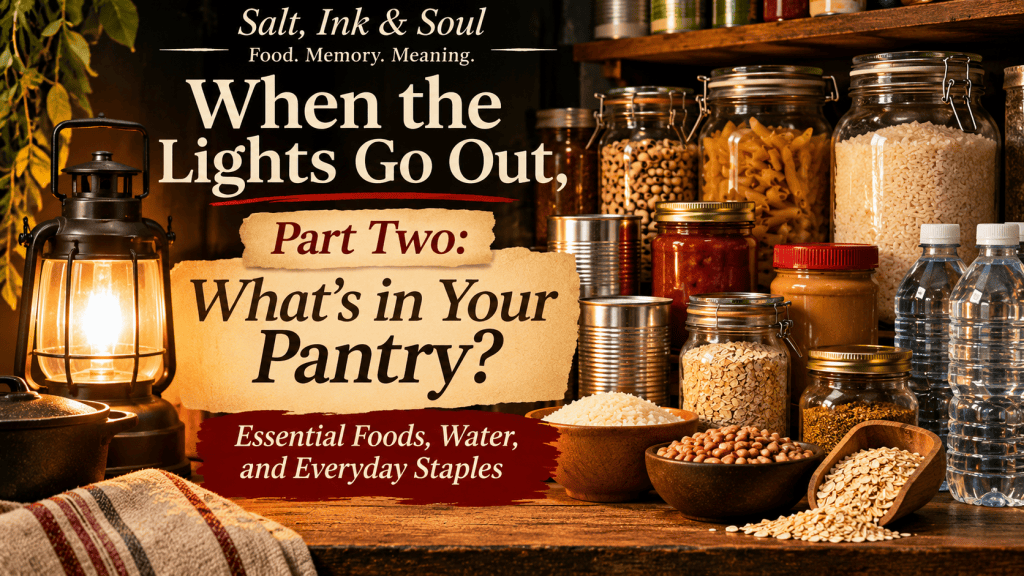
Because a little preparation goes a long way, even when the rumors turn out to be nothing.
In my last post, I talked about the possibility of a widespread blackout and some of the basic kitchen tools I believe everyone should have on hand.
Let me start by saying my position hasn’t changed.
I’m still not convinced that some mysterious nationwide blackout is coming.
But I also know that electricity doesn’t require a conspiracy theory to stop working.
A storm can knock it out. Equipment can fail. A transformer can blow. Sometimes the lights go out for reasons nobody could have predicted, and we’re left standing in the kitchen, wondering how long it’ll be before everything starts working again.
And while a good manual can opener, a cast-iron skillet, and a flashlight are certainly useful, there’s something else worth considering.
What exactly are you planning to eat?
Because there’s not much point in having all the tools necessary to prepare a meal if there’s nothing in the pantry to prepare.
Now, I’m not suggesting we all run to the nearest warehouse store and purchase enough Food to survive the next six months.
For one thing, that’s expensive.
For another, I don’t particularly care to turn my home into a miniature grocery store simply because somebody on the internet has convinced themselves that civilization is about to collapse.
What I am suggesting is considerably simpler.
Keep enough basic food and drinking water on hand to get through a few uncomfortable days without depending on a functioning refrigerator, an electric stove, or a trip to the grocery store.
And here’s the best part.
Most of the things I’m about to recommend are items you can use in your everyday cooking.
Nothing fancy. Nothing mysterious.
Just a pantry that makes sense.
First Things First: Water
Before we talk about Food, we need to talk about water.
Because while you can get creative with a can of beans and a bag of rice, there’s no substitute for having safe drinking water.
A reasonable starting point is one gallon of water per person, per day, for at least three days.
That’s for drinking and basic sanitation, not necessarily for every household water need. If you have the storage space and can afford it, keeping a larger supply is even better.
And remember, some people may need more, particularly during hot weather, illness, or increased physical activity.
Don’t forget the pets, either.
For a single person, three gallons is a starting point. For a household of four, that’s twelve gallons.
Suddenly, those cases of bottled water don’t seem quite so excessive.
Personally, I would recommend keeping a combination of commercially bottled water and larger containers designed for safe drinking-water storage.
Keep them in a cool place, away from direct sunlight and household chemicals. Rotate your supply as needed.
If you fill your own containers, use food-grade containers and follow proper cleaning and storage procedures.
And don’t assume that because water is coming out of the faucet, it’s necessarily safe after a major emergency. Pay attention to local advisories.
Water isn’t exciting.
Nobody is going to invite the neighbors over to admire their emergency water collection.
But if the need arises, it’s likely to be the most valuable thing you have stored.
1. Canned Beans: The Humble Pantry Workhorse
I have always appreciated beans.
Black beans, pinto beans, kidney beans, chickpeas, and just about every other variety.
They’re affordable, filling, and versatile.
A can of beans can become a simple meal with very little effort. Many commercially canned beans are fully cooked and can be eaten straight from the can if necessary.
Add a little seasoning, perhaps some canned vegetables, and suddenly you’ve got something resembling a proper meal.
Dried beans are also worth keeping around, but there’s a distinction worth remembering.
Dried beans require water, time, and a reliable way to cook them.
Canned beans don’t.
And when you’re preparing for a situation where electricity may not be available, that difference matters.
My recommendation?
Keep both for everyday cooking, but make sure your emergency supply includes ready-to-eat canned beans.
2. Canned Meat and Fish
Now, before anyone starts turning up their nose, let me remind you that canned meat has been feeding people for generations.
Tuna, salmon, chicken, sardines, and other shelf-stable proteins can be surprisingly useful.
They don’t require refrigeration until opened, as long as the containers are intact and stored properly.
You can eat many of them directly from the package or combine them with crackers, beans, or vegetables.
And while a freshly prepared chicken dinner would certainly be preferable, we’re talking about being practical.
Not auditioning for a cooking competition.
One suggestion: purchase smaller cans or pouches when possible.
Without refrigeration, leftovers become a problem, so it makes sense to buy portions you can finish.
3. Rice, Pasta, and Other Dry Staples
Anyone who follows my recipes knows I appreciate a meal that stretches.
Rice and pasta have been helping families do that for generations.
They’re inexpensive, easy to store, and useful in dozens of recipes.
I’d suggest keeping:
- White rice
- Pasta
- Instant rice
- Couscous
- Quick-cooking oats
- Instant mashed potatoes
Notice that I’ve included several quick-cooking options.
There’s a reason.
If your ability to cook is limited, you don’t need to spend forty minutes trying to prepare something that could be ready in five.
Just remember that these items still require safe water and, in many cases, a heat source.
Keep some food that requires absolutely no cooking.
That’s an important distinction.
4. Canned Fruits and Vegetables
Fresh fruits and vegetables are wonderful.
I use plenty of them myself.
But when the power goes out, the contents of your refrigerator won’t necessarily remain usable indefinitely.
That’s where canned fruits and vegetables earn their place in the pantry.
Green beans, carrots, peas, corn, spinach, peaches, pears, and fruit packed in juice are all reasonable choices.
Most commercially canned vegetables and fruits can be eaten without heating, as long as the packaging is intact and the Food is safe.
And while they may not have the texture of fresh produce, they still provide useful nutrients.
I would also keep some unsweetened applesauce in individual containers.
It’s convenient, requires no preparation, and doesn’t create leftovers.
5. Peanut Butter and Other Nut Butters
If I were putting together a short list of foods that offer convenience, calories, and versatility, peanut butter would be near the top.
It requires no cooking.
It provides protein and fat.
And you can eat it with crackers, bread, or a spoon if necessary.
No judgment from me.
I’ve certainly been known to eat peanut butter directly from the jar without a blackout as an excuse.
Choose a shelf-stable variety that doesn’t require refrigeration before opening, and follow the label’s storage instructions.
For anyone with a peanut allergy, sunflower seed butter or another appropriate alternative may work.
6. Crackers, Crispbread, and Shelf-Stable Bread
Bread is one of those things we tend to take for granted.
Until we don’t have any.
Fresh bread has a limited shelf life, but crackers, crispbread, tortillas with suitable shelf lives, and other packaged bread alternatives can be useful.
They pair well with canned meats, nut butters, and shelf-stable spreads.
I’d recommend keeping a few different varieties rather than purchasing a mountain of one particular kind.
Because after three days of eating the same crackers, you may begin to understand why variety matters.
7. Shelf-Stable Milk and Milk Alternatives
Refrigerated milk can become a problem fairly quickly during a power outage.
Shelf-stable milk offers another option.
Look for unopened UHT milk, shelf-stable almond milk, soy milk, or other varieties that can be stored at room temperature until opened.
Powdered milk is another possibility, provided you have safe water for preparation.
I recommend buying smaller containers.
Once opened, many of these products require refrigeration, and that may not be available.
There’s little sense in opening a large carton if you can only safely use a fraction of it.
8. Soups, Stews, and Ready-to-Eat Meals
This is where convenience can genuinely become a blessing.
Canned soups, chili, stews, ravioli, and similar shelf-stable meals can provide something substantial without requiring much effort.
Many commercially canned meals are fully cooked and safe to eat without reheating, although I would certainly prefer them warm.
Check the labels, because not every packaged meal is ready to eat.
And choose a mixture of foods you actually enjoy.
There’s no point in storing twelve cans of something you wouldn’t willingly eat on an ordinary Tuesday.
An emergency pantry shouldn’t become a collection of food nobody likes.
9. Nuts, Seeds, and Dried Fruits
These are some of the easiest items to keep on hand.
Almonds, walnuts, peanuts, sunflower seeds, raisins, dried cranberries, and other dried fruits require little preparation.
They’re useful for snacking and can provide energy without cooking.
Trail mix is another convenient choice.
I would avoid buying enormous quantities unless you regularly eat them. Nuts contain oils that can go rancid over time, especially when stored in warm conditions.
Buy what you use.
Replace what you eat.
That’s the simplest approach to pantry management.
10. Oatmeal, Breakfast Bars, and Ready-to-Eat Cereals
Breakfast doesn’t have to become complicated simply because the electricity isn’t working.
Dry cereal, breakfast bars, granola, and shelf-stable protein bars can make mornings easier.
Instant oatmeal is useful when hot water is available, but it shouldn’t be your only breakfast option.
I would keep a mix of items you can eat as they are.
And if you’re a coffee drinker, don’t forget the coffee.
Instant coffee may not be everyone’s favorite, but under the right circumstances, it can feel like a small luxury.
Tea bags are another good addition.
Just remember that both require safe water, and preferably a safe way to heat it.
11. Cooking Oil, Salt, Sugar, and Seasonings
One thing I’ve noticed about some emergency food lists is that they seem to forget people might still want their Food to taste good.
Perhaps that’s just the cook in me.
But I believe a little seasoning can make an ordinary meal considerably more enjoyable.
I’d keep reasonable quantities of:
- Salt and black pepper
- Garlic powder and onion powder
- Dried herbs
- Chili powder or red chile powder
- Cooking oil
- Sugar or another preferred sweetener
- Honey
- Bouillon powder or cubes
These are everyday pantry staples, not items you need to buy exclusively for an emergency.
And for those of us living in New Mexico, I suspect the red chile would find its way onto the list whether there was a blackout or not.
Keep in mind that cooking oils have limited shelf lives, bouillon can be high in sodium, and not every condiment stays safe at room temperature after opening.
Read the labels.
12. A Few Foods That Feel Like Home
This one may not appear on every emergency preparedness list, but I believe it deserves consideration.
Keep a few things that bring you comfort.
Maybe it’s a favorite snack.
Perhaps a particular kind of cookie, a jar of honey, a favorite tea, or something sweet you don’t normally allow yourself.
I’m not suggesting turning an emergency pantry into a candy store.
But Food has always been about more than nutrition.
It offers familiarity.
Comfort.
A sense of normalcy when things around us don’t feel particularly normal.
And if there’s one thing I’ve learned through cooking, it’s that a simple meal can sometimes do more for the spirit than we give it credit for.
What About Everything in the Refrigerator and Freezer?
This is where a little knowledge becomes especially important.
When the electricity goes out, our first instinct is often to open the refrigerator and start checking everything.
Don’t.
Keep the doors closed as much as possible.
According to federal food-safety guidance:
- An unopened refrigerator generally keeps Food safe for approximately four hours.
- A full freezer can maintain safe temperatures for approximately 48 hours.
- A half-full freezer generally provides about 24 hours.
These are estimates, not guarantees. The actual safety of the Food depends on its temperature.
If an outage lasts four hours or longer and there’s no alternative cold source, refrigerated perishables such as meat, milk, eggs, and leftovers generally need to be discarded.
Food kept at temperatures above 40°F for more than two hours may be unsafe. Frozen Food can sometimes be cooked or refrozen if it still contains ice crystals or measures 40°F or below.
Use appliance thermometers, follow food-safety guidance, and never taste questionable Food to determine whether it’s safe.
I know throwing Food away can be painful.
Especially considering what groceries cost these days.
But food poisoning is considerably more expensive than replacing a package of chicken.
And nobody wants to spend a blackout dealing with that particular problem.
How Much Food Should You Actually Keep?
Here’s where I believe common sense should prevail.
For most households, I’d start with at least three days’ worth of nonperishable Food and water.
If space and finances allow, gradually build toward a week or two.
Not because I believe we’re facing some impending catastrophe.
Because having a little extra food in the pantry can be useful for all kinds of reasons.
Bad weather.
Unexpected expenses.
Illness.
Car trouble.
Or simply discovering that you don’t feel like going to the grocery store.
And you don’t have to buy it all in one trip.
Add a few extra items during your regular grocery shopping.
If canned beans are on sale, perhaps purchase two instead of one.
If you regularly use canned tomatoes, keep an extra couple of cans.
The goal isn’t to accumulate as much as possible.
It’s to create a dependable reserve of foods you already know how to use.
The Pantry That Takes Care of Itself
There is one practice I particularly recommend.
Eat what you store, and replace what you eat.
It’s sometimes called rotating your pantry.
The idea is simple.
When you purchase new groceries, place them behind the older items. Use the older items first, and replace them during your regular shopping trips.
Periodically check the dates and condition of the packaging.
Keep everything in a cool, dry location.
Avoid storing Food near household chemicals or in areas that become excessively hot.
And don’t assume every canned or packaged product lasts forever.
A pantry is only useful if the Food inside it remains safe to eat.
There’s also no reason to purchase an expensive emergency food package if an ordinary collection of shelf-stable groceries meets your needs.
You can build a practical pantry without turning preparedness into another monthly payment.
What Our Grandparents Understood About a Full Pantry
I find myself thinking again about the kitchens of earlier generations.
The bags of flour.
The jars of sugar.
The rice, beans, cornmeal, canned vegetables, and other staples that always seemed to have a place on the shelves.
There wasn’t necessarily an emergency attached to any of it.
It was simply how many households operated.
You kept what you needed.
You used what you had.
You learned how to turn simple ingredients into something that could feed the people sitting around your table.
And perhaps most importantly, you understood that having a little extra wasn’t necessarily about having more than somebody else.
Sometimes it was about making certain there would be enough tomorrow.
I think there’s something worth remembering in that.
We live in a time when almost anything can be delivered to our front door, sometimes within hours.
But convenience has a way of making us forget that the systems supporting it aren’t infallible.
Trucks get delayed.
Stores close.
Electricity fails.
And while I appreciate modern convenience as much as anyone, I don’t particularly want my ability to feed myself to depend entirely on whether an app is functioning.
Prepared, Not Afraid
I want to make one thing clear.
This isn’t an endorsement of the blackout rumors circulating online.
I haven’t seen convincing evidence that a nationwide blackout is imminent, and I don’t believe people should make financial decisions based on fear.
But I do believe in being reasonably prepared.
In keeping a few extra groceries.
In having safe drinking water available.
In knowing how to put together a meal without requiring every appliance in the kitchen.
And in understanding that preparedness doesn’t have to look like panic.
It can look like an extra can of beans.
A few gallons of water.
A bag of rice.
A box of crackers.
A pantry stocked a little more thoughtfully than it was yesterday.
Because if the lights never go out, you’ve still got groceries.
And if they do?
You may not be able to cook the elaborate dinner you had planned.
But at least you won’t be standing in a dark kitchen, staring into an empty cabinet, wondering what you’re supposed to eat.
And if you remembered the peanut butter and crackers?
Well, you’ve already got the beginning of a meal.
Salt, Ink & Soul
If something here speaks to you, please like, comment, and share.
Support Salt, Ink & Soul
The stories, recipes, and reflections continue beyond the page. Visit the Salt, Ink & Soul Store to explore merchandise inspired by Food. Memory. Meaning.
👉 Visit the Salt, Ink & Soul Store
Resources for Hard Times
For practical help, food support, or community resources, visit the Salt, Ink & Soul Resources Page.

