I have written before about my air fryer and its role in my ongoing battle against kitchen heat.
When it is hot outside, I have very little interest in making it hotter inside.
There are meals worth suffering for.
There are also days when I don’t particularly feel like suffering for dinner.
The air fryer became one of my weapons in that fight. It lets me cook something good without turning on the oven and making the kitchen feel like somewhere I immediately regret being.
But lately, I have recruited another appliance.
My rice cooker.
The funny thing is, it was already here.
It had been sitting on top of my kitchen cabinets for who knows how long, quietly watching me complain about the heat while apparently knowing it could have helped the entire time.
I just wasn’t really using it.
I had always thought of a rice cooker as exactly what the name says it is.
You put rice in.
You put water in.
You push a button.
Rice comes out.
Useful, certainly.
Exciting, not particularly.
Then the YouTube algorithm did what the YouTube algorithm does.
You watch one video.
Then another appears.
Then another.
Before long, I started seeing people making entire meals in rice cookers.
Not just rice.
Chicken.
Vegetables.
Seasonings.
Sauces.
Everything going into one pot and coming out as dinner.
I looked up at the top of my cabinets.
Apparently, I had been underestimating an employee.
The Beauty of One Pot
There is something deeply appealing to me about a meal that doesn’t require much ceremony.
Maybe that comes from getting older.
Maybe it comes from cooking enough meals to understand that good food doesn’t always need to announce how hard you worked to make it.
Sometimes you want to chop a few things, put them into a pot, push a button, and go about your business.
Especially when it is hot.
And especially when you are meal prepping.
That was the other thing that caught my attention.
One cup of uncooked rice becomes roughly three cups once cooked. Add a chicken breast, some seasoning, and green onion, and suddenly I have about three portions of food without dirtying three pans or spending an hour standing over the stove.
There is something satisfying about that kind of efficiency.
Not the efficiency of eating something you don’t particularly want simply because it is convenient.
The efficiency of making actual food convenient.
I think there is a difference.
I still want dinner to taste like somebody cared about it.
Even when the somebody is me.
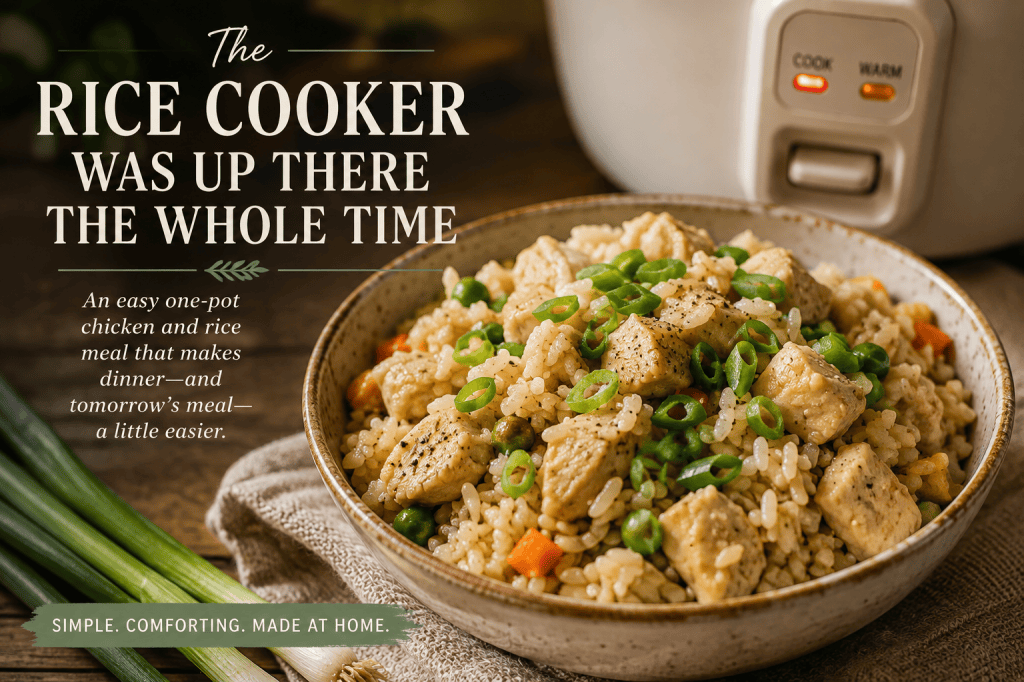
Rice Cooker Chicken & Rice with Green Onion
Makes approximately 3 servings
This is deliberately simple.
It isn’t supposed to be the kind of recipe that sends you searching three grocery stores for an ingredient you will use once and then discover in the back of the cabinet two years from now.
Most of this is probably already somewhere in the kitchen.
Ingredients
- 1 cup uncooked white rice, rinsed
- 1 boneless, skinless chicken breast, cut into small bite-size pieces
- 2 cups chicken broth or water (or the amount recommended on your rice package)
- 1 tablespoon soy sauce
- 1 teaspoon sesame oil
- 1 teaspoon honey or brown sugar, optional
- ½ teaspoon garlic powder
- ¼ teaspoon onion powder
- ½ teaspoon ground ginger, optional
- Black pepper to taste
- 2 green onions, thinly sliced
- ½–1 cup frozen peas and carrots, optional
Directions
1. Prepare the green onions.
Slice the green onions and separate the white and light-green portions from the darker green tops.
Add the lighter portions to the rice cooker. Save those beautiful dark-green pieces for the end.
2. Make the sauce.
Pour the chicken broth into the rice cooker.
Add the soy sauce, sesame oil, honey or brown sugar, garlic powder, onion powder, ginger, and a little black pepper.
Give everything a quick stir.
3. Add the rice.
Add the rinsed rice to the liquid and gently stir it once so everything is evenly distributed.
4. Add the chicken.
Spread the uncooked chicken pieces evenly over the rice.
Sprinkle the white and light-green portions of the green onions over everything.
Close the lid.
5. Push the button.
Use your rice cooker’s normal white-rice setting.
Then leave it alone.
This may actually be the most difficult part of the recipe.
There is a temptation when cooking to keep looking at things.
To stir.
To check.
To interfere.
Resist it.
The machine knows what it is doing.
6. Make sure the chicken is done.
When the rice cooker finishes, check one of the largest pieces of chicken with a food thermometer.
The chicken needs to reach an internal temperature of 165°F (74°C).
If it hasn’t reached that temperature, continue cooking until it does.
7. Finish with the green onions.
Fluff the chicken and rice together.
Stir in some of the dark-green onion tops and sprinkle the rest over each serving.
If you are adding frozen peas and carrots, stir them into the piping-hot chicken and rice, close the lid again, and let everything sit for about five minutes, or until the vegetables are thoroughly heated.
Taste.
If it needs a little more soy sauce, add it now.
Then eat.
Or, if you are meal prepping like I am, divide everything into three containers.
Tomorrow’s dinner has already been handled.
Use What You Already Have
I think there may be a small lesson hiding somewhere in all of this.
We accumulate things with good intentions.
Appliances.
Books.
Tools.
Ideas.
We tell ourselves we are going to use them.
Then life happens.
They sit there.
And sometimes all it takes is seeing an old thing differently.
My rice cooker hasn’t changed.
I stopped seeing it as something that only makes rice and started seeing what else it could do for me.
It gives me another way to cook without heating up the kitchen.
It makes meal prep easier.
It gives me three meals from one pot.
There is less cleanup.
Less standing over the stove.
Less thinking about what I am going to eat tomorrow.
And most importantly, it still allows me to eat something that feels like dinner.
Something made at home.
I think that matters.
Because convenience has somehow become associated with not caring.
Fast food.
Frozen dinners.
Something eaten standing over the sink because we don’t feel like making anything.
But convenience doesn’t have to mean neglect.
Sometimes convenience can be another form of care.
It can mean making things a little easier for the person you’ll be tomorrow.
The person who will open the refrigerator, tired and hungry, and discover that someone already thought about dinner.
Even if that someone was you yesterday.
Cook’s Note: Rice varieties and rice cookers can behave differently. The rice I used calls for 2 cups of liquid for every 1 cup of uncooked rice. I initially tried less and ended up with rice that was undercooked and burned in places. Check the directions on your rice package and adjust the liquid if necessary.
Please like, comment, and share
Resources for Hard Times
If you’re looking for practical help, food support, or community resources, you can visit the Salt, Ink & Soul Resources Page.