Tag: emotional healing

  • The Foot and the Flower

    The Foot and the Flower

    This is a longer reflection than I usually share. I allowed it the space it needed because some wounds cannot be understood in a few sentences.

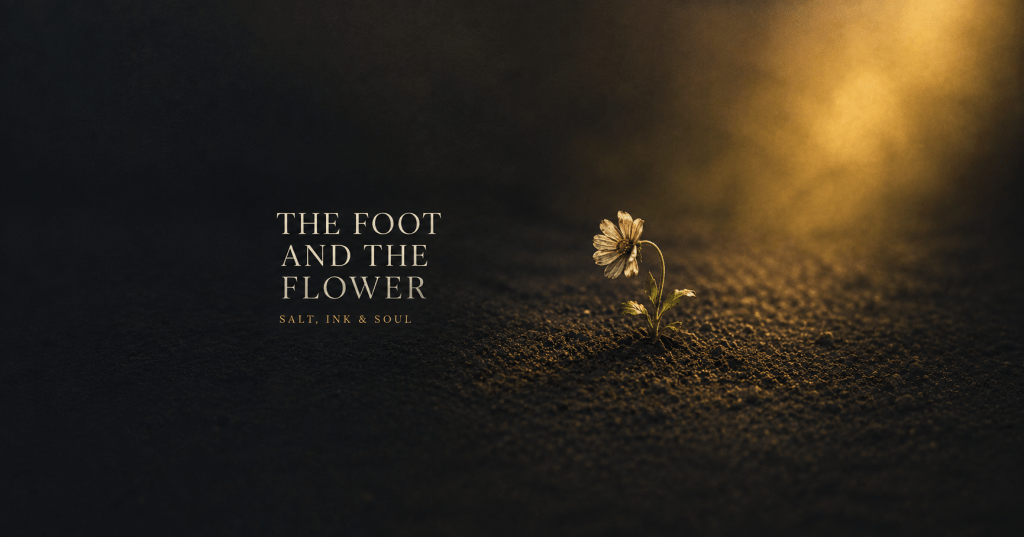
    For weeks now, I have been thinking about a flower.

    Not a particular kind. No rose or sunflower. 

    Just an ordinary flower trying to grow.

    Every morning, someone steps on it.

    Not hard enough to kill it. Just enough pressure to bend the stem. To bruise what has begun to open. To make the flower spend its strength recovering instead of growing.

    Then, after enough days have passed, the same person looks down and asks why it did not bloom properly.

    Why are you so small?

    Why do you lean that way?

    Why are your petals damaged?

    Why can’t you grow like the others?

    I have not been able to let that image go.

    Perhaps because I know what it feels like to be the flower.

    As a Black man, I have watched criticism presented as a form of love for most of my life. I have seen people embarrassed in front of others and told it was for their own good. I have heard jokes sharpened into weapons, then dismissed with the familiar accusation that the person wounded was too sensitive.

    We call it keeping someone humble.

    Keeping their head from getting too big.

    Making sure they don’t start thinking they are better than everyone else.

    Preparing them for the world.

    There is always a reason given for the foot.

    We are told that the world will not be gentle with us, so there is no point in being gentle with one another. We tell ourselves that ridicule builds a thick skin. That public embarrassment creates discipline. That if we cut someone down before the world gets the chance, perhaps they will be less surprised when it happens outside the safety of home.

    But I have begun to wonder what kind of safety requires us to imitate the danger.

    What kind of love practices the cruelty it claims to be preparing us to survive?

    The world has rarely needed our help hurting Black people.

    It has been remarkably capable on its own.

    I understand the value of correction. None of us should move through life surrounded by people too afraid to tell us when we are wrong. We need honesty. We need accountability. We need someone willing to say that we have fallen short, that our choices caused harm, or that the work we offered was not yet our best.

    But honesty does not require humiliation.

    Correction does not need an audience.

    Love does not have to leave a person smaller than it found them.

    Somewhere along the way, we began confusing humility with humiliation.

    Humility teaches us that we are not above anyone.

    Humiliation teaches us that we are beneath everyone.

    One keeps the ego from becoming a throne.

    The other convinces the spirit it does not deserve a chair.

    They are not the same.

    I have heard stories that some of this behavior may have roots in slavery. Stories of Black people hiding the intelligence, strength, skill, or beauty of someone they loved because being noticed by those who controlled their lives could be dangerous. An exceptional ability might attract attention. Attention could lead to exploitation, separation, or sale.

    I cannot say exactly how often it happened in that way.

    But I understand the fear beneath the story.

    There were times when being seen was dangerous for us.

    There were times when a person’s ability did not belong to them but became another thing someone else could profit from.

    Perhaps, under those conditions, love sometimes learned to hide itself.

    Perhaps protection sometimes sounded like criticism.

    Perhaps people made their children appear smaller because the world had made Black excellence unsafe.

    Survival can require strange disguises.

    But survival habits do not always disappear when the original danger changes.

    Sometimes they remain long after the people who first needed them are gone.

    A shield carried for generations can become too heavy to lift.

    A behavior created to protect the flower can eventually become the foot that keeps stepping on it.

    That is the question troubling me now.

    What are we protecting one another from today when we mock someone for being intelligent?

    What good are we creating when we ridicule a person for speaking differently, dressing differently, dreaming differently, or wanting more than the people around them were taught to expect?

    We excuse much of this by saying it is part of the culture.

    But culture is not an excuse.

    Culture is an inheritance.

    And like every inheritance, it must be examined.

    Much of what we carry is beautiful.

    But we have also carried wounds.

    Some have been passed down so carefully that we began mistaking them for traditions.

    Loving our culture does not require defending everything within it.

    Sometimes love means looking at what we inherited and asking whether it still serves us.

    Sometimes love means admitting that something once born from survival has become another source of pain.

    Not everything that survived deserves to lead us.

    I think of how often Black children are taught not to think too highly of themselves.

    There is wisdom in teaching a child that they are no better than anyone else.

    But there is danger in teaching them they are nothing special.

    The world will offer that lesson often enough.

    A child should not have to receive it first from home.

    How many young people have hidden their intelligence because achievement separated them from the group?

    How many have learned to pronounce words incorrectly so no one would accuse them of trying to sound white?

    How many sensitive boys learned to harden themselves because tenderness attracted ridicule?

    How many girls learned to dim their confidence so others would not call it arrogance?

    We tell ourselves we are keeping people grounded.

    Sometimes we are burying them.

    A particular expectation is placed on Black men.

    We are supposed to take it.

    The joke.

    The insult.

    The criticism.

    The public embarrassment.

    We are expected to remain still while someone cuts into us and then laugh to prove the blade was not sharp.

    If we admit that something hurt, we are called weak.

    If we object, we are told we cannot take a joke.

    So we learn to laugh.

    Sometimes we laugh before everyone else does.

    We make ourselves the joke so no one can accuse us of being unable to take one.

    We wound ourselves publicly and call it confidence.

    But laughter is not always evidence that something was harmless.

    Sometimes laughter is the sound a person makes while trying not to bleed in front of everyone.

    I have wondered how much of myself this shaped.

    How many times did I make myself smaller before entering a room?

    How often did I question my own thoughts because someone had taught me that confidence invited punishment?

    How often did I speak less clearly than I could have, not because I lacked the words, but because I did not want anyone to think I believed I belonged among those who used them?

    After being stepped on long enough, the foot no longer has to be present.

    You begin doing the work yourself.

    You criticize the idea before sharing it.

    You diminish the accomplishment before anyone can accuse you of pride.

    You reject the opportunity before someone else can tell you that you are not ready.

    You hide enthusiasm because joy makes you visible.

    You keep your expectations low and call it realism.

    That may be the cruelest part.

    The person who once harmed you can leave, but the voice remains.

    Then one day, you look at the life you have built and wonder why so much of it was shaped by fear of becoming visible.

    I do not believe the answer is empty praise.

    Flowers do not grow because we stand over them and tell them they are perfect.

    They need light, water, room, and care.

    Sometimes they need pruning.

    Care is not the absence of correction.

    Care is correction offered in service of growth.

    There is a difference between telling someone the truth and making them ashamed of being alive.

    There is a difference between preparing someone for difficulty and becoming one more source of it.

    There is a difference between helping someone grow and demanding that they prove they can survive being crushed.

    I wonder what would happen if we learned that difference.

    What might our communities look like if encouragement did not make us suspicious?

    What if we could watch someone rise without needing to remind them of every place they once fell?

    What if we understood that celebrating another person’s light does not dim our own?

    Perhaps more of us would reach adulthood without needing to rebuild the parts of ourselves that were dismantled at home.

    Perhaps excellence would feel less lonely.

    Perhaps a gifted child would not have to choose between belonging and becoming.

    Perhaps the young person who seems strange would be allowed enough time to discover that strangeness is a gift before the world has found a name for it.

    We often praise the person who grows through hardship.

    We admire the flower breaking through concrete.

    We photograph it.

    We turn it into a symbol of resilience.

    But we rarely ask why the flower had to fight concrete in the first place.

    Strength born from suffering is still strength.

    But suffering should not receive credit for everything a person became despite it.

    Pain may teach us.

    That does not mean pain was the only possible teacher.

    The flower that survived beneath the foot might have grown taller without it.

    It might have bloomed earlier.

    It might have spent less of its life healing from injuries others insisted were lessons.

    We may never know.

    That uncertainty carries its own sorrow.

    I cannot change every moment when I was cut down.

    I cannot recover every piece of myself I learned to hide.

    But I can decide what kind of person I will be when I stand near someone else who is beginning to grow.

    I do not want to be the foot.

    I do not want to wound them and then congratulate myself for making them stronger.

    I want to learn how to tell the truth with care.

    I want to recognize potential before it becomes achievement.

    I want to encourage people while they are still uncertain, not only after the world has permitted me to believe in them.

    I want to say:

    I see something in you.

    Keep going.

    You do not have to shrink to make me comfortable.

    Your gift does not threaten mine.

    That is how a culture changes.

    Not all at once.

    Not through speeches or declarations.

    Perhaps it begins with small acts of refusal.

    Refusing to laugh when the joke is meant to reduce someone.

    Refusing to mistake cruelty for honesty.

    Refusing to pass down a wound merely because it was handed to us.

    Perhaps it begins when we stop asking how much pressure a person can endure and start asking what they might become with the right care.

    A flower does not need to be stepped on to learn how to grow.

    It already knows to reach for the light.

    Our responsibility is not to test how much damage it can survive.

    It is to stop blocking the sun.

    Kyle J. Hayes

    kylehayesblog.com

    Please like, comment, and share

    Resources for Hard Times

    If you’re looking for practical help, food support, or community resources, you can visit the Salt, Ink & Soul Resources Page.
    👉 Resources for Hard Times

  • Things That Shape Us

    Things That Shape Us

    I have often wondered whether we become who we are because of something already inside us, or because of everything life places in our path.

    The older I get, the more I believe our experiences shape us.

    Before we learn to trust, someone has to give us a reason to.

    Before we become cautious, someone usually gives us one of those too.

    Every conversation, every disappointment, every unexpected kindness leaves something behind. We carry those moments longer than we realize. They become the lens through which we see the world, often without our permission.

    Our experiences influence who we trust. They affect how we speak to strangers, how quickly we forgive, and how willing we are to believe in people we have just met. They determine the places that feel like home and the ones we never want to return to. They shape what makes us feel safe, what makes us nervous, and what makes us hopeful.

    Even the smallest moments matter.

    A teacher who believed in us when no one else did.

    A friend who stayed.

    A parent who listened.

    A stranger who offered kindness on a day we desperately needed it.

    Just as those moments shape us for the better, so do the painful ones. Betrayal teaches caution. Loss teaches gratitude. Failure teaches resilience. Heartbreak can teach compassion, because once you’ve carried that kind of weight, you begin to recognize it in someone else.

    That doesn’t mean we are trapped by our experiences.

    I believe we always have a choice.

    We can decide that someone else’s bitterness will not become our own. We can choose to offer patience in response to impatience. We can become the kindness we wished someone had shown us years ago.

    Maybe that is where character is truly found.

    Not in pretending our experiences never happened, but in deciding what we will do with them.

    Because every experience leaves its fingerprint on us.

    Some become scars.

    Some become wisdom.

    And if we’re fortunate, the hardest moments don’t simply change who we are.

    They help us become someone worth becoming.

    Kyle J. Hayes

    kylehayesblog.com

    Please like, comment, and share

    Resources for Hard Times

    If you’re looking for practical help, food support, or community resources, you can visit the Salt, Ink & Soul Resources Page.
    👉 Resources for Hard Times

  • What’s the Best Way to Deal with Negative Thoughts?

    What’s the Best Way to Deal with Negative Thoughts?

    The best way to deal with negative thoughts is not to pretend they are not there.

    I know that because I have tried.

    I have tried to push them down.

    Tried to laugh them off.

    I tried to tell myself I was fine when I knew I wasn’t 

    It worked for a while.

    Until it didn’t.

    It could be anything: a word, a look, clutter, anything 

    A moment that should not have mattered as much as it did.

    And suddenly all those buried thoughts, all that hurt, all that anger, all that disappointment came rushing out at once. Sometimes toward someone who did not deserve to receive what I had refused to deal with.

    That is the danger of burying things.

    They do not stay buried.

    Negative thoughts are not always the enemy. Sometimes they are messengers. Sometimes they are telling us there is something we have not faced, something we have not grieved, something we have not forgiven, something we have been carrying too long without admitting how heavy it has become.

    The first step is to deal with them.

    Not while you are in the middle of the fire.

    Not while your emotions are loud and your judgment is clouded.

    But when you can sit with yourself honestly.

    When you can ask, Why did that hurt me? Why did that thought come back? What am I afraid of? What am I still holding onto?

    There is strength in being able to sit alone with your thoughts.

    But there is also wisdom in knowing when not to sit with them alone forever.

    There is nothing wrong with talking to someone.

    For me, it took A counselor.

    Someone safe enough to hear you without making you feel small.

    I know sometimes that sounds like a lot. Especially when you are used to keeping things to yourself. Especially when silence has become a kind of armor. But silence can also become a prison if we never let anything out.

    Negative thoughts are like poison when they stay trapped inside you.

    They change you

    They make love feel suspicious.

    They make peace feel temporary.

    So the best way I know to deal with negative thoughts is to stop pretending they are harmless just because no one else can see them.

    Name them.

    Sit with them.

    Let the emotion pass long enough for you to think clearly.

    Then deal with what is underneath.

    And when it becomes too heavy, talk to someone.

    That is not a weakness.

    That is maintenance of the soul.

    Kyle J. Hayes

    kylehayesblog.com

    Please like, comment, and share

    Resources for Hard Times

    If you’re looking for practical help, food support, or community resources, you can visit the Salt, Ink & Soul Resources Page.

    👉 Resources for Hard Times

  • Another Year, Still Becoming

    Another Year, Still Becoming

    There is something strange about a birthday when you are no longer young enough to believe that time is endless, but not yet old enough to stop asking what can still be made from what remains.

    Another year has gone by.

    Usually, those words pass through me with a familiar feeling. A small accounting. A quiet glance backward. A brief pause before returning to the ordinary rhythm of the days. But this year feels different. Not louder. Not grander. Not wrapped in some sudden revelation or clean transformation.

    Just different.

    Quieter.

    Closer to the truth.

    I have been slowly becoming the person I once hoped I might be. Not in the polished way people talk about change when they want it to sound easy. Not in the clean language of motivation, where every wound becomes a lesson, and every loss becomes fuel. Real becoming is messier than that. It does not always arrive with applause. Sometimes it looks like sitting alone with a thought you used to run from. Sometimes it looks like writing one honest sentence and feeling your chest tighten because the page now knows something you were trying not to admit.

    For a long time, I carried things instead of naming them.

    Pain. Sorrow. Anger. Disappointment. The old ache of being misunderstood. The quiet exhaustion of trying to explain yourself to people who had already decided who you were.

    I kept too much inside.

    That is a dangerous kind of storage. The body becomes a basement. The mind becomes a locked room. The heart becomes a pantry full of old things nobody has touched, but everybody can smell. You think you are protecting yourself by not opening the door. But silence does not preserve pain. It ferments it.

    People say writing helps.

    I had heard that for years.

    Write it down. Get it out. Put it on the page.

    It sounded too simple to be true. Too soft. Too neat. The kind of advice people offer when they do not know what else to say. But this year, I learned there is a difference between hearing something and finally understanding it in your bones.

    Writing does help.

    Not because the page fixes everything. It does not. The page is not a miracle worker. It will not reach backward and undo what happened. It will not make childhood kinder, grief lighter, or disappointment less sharp. But the page gives the pain a place to stand outside of you.

    That matters.

    There are things I have written that no one will ever see. Things too private for public life. Things that belong only to me and the silence that held me while I wrote them. And maybe that is the point. Not everything has to be published to be powerful. Not every wound has to become content. Not every confession needs an audience.

    Some writing is not for the world.

    Some writing is how you survive yourself.

    This year, I learned how to write without holding back. Or at least, I began to learn. I started putting down the things I had been carrying in secret. The thoughts that came in the dark. The old sorrows with familiar faces. The questions that do not have clean answers.

    And somehow, in putting them down, I left some of them behind.

    Not all.

    I know better than that now.

    Healing is not a dramatic exit. It is not the door slamming shut behind pain while you walk into the sunlight reborn. Sometimes healing is smaller than that. Sometimes it is realizing that a memory no longer controls the whole room. Sometimes it is noticing you can speak of something that once broke you without breaking again. Sometimes it is simply waking up and discovering that yesterday’s sorrow did not take all of today.

    There are pains I have left behind.

    There are sorrows I no longer feed.

    I can now look at old versions of myself with compassion instead of shame.

    That is no small thing.

    We live in a world that loves measurement. Numbers. Milestones. Income. Followers. Weight lost. Books sold. Goals achieved. Proof, proof, proof. We are told to become better, but usually in ways that can be photographed, posted, monetized, or turned into a lesson for strangers.

    But some of the most important growth is invisible.

    No one claps when you stop hating yourself in one small area.

    No one sends flowers when you choose patience instead of anger.

    No one gives you a certificate for writing the truth in a private notebook and choosing not to drown in it.

    Still, these things count.

    They may be the only things that truly count.

    I still have goals. I still want to write better. I still want my work to reach people. I still want the sentences to carry more truth, more weight, more tenderness. I still want to build something that lasts beyond me, something my descendants might one day hold and say, He was here. He tried to tell the truth. He tried to leave a light on.

    But my goals feel different now.

    Less like a punishment.

    Less like a whip.

    Less like a scoreboard I use against myself.

    My current goal is simple.

    To be better.

    A better writer.

    A better person.

    That sounds plain, almost too plain. But there is depth in plain things. A pot of beans. A clean table. A quiet morning. A sentence that does not lie. The older I get, the more I trust what does not need decoration.

    To be better does not mean to become perfect.

    I am not interested in that kind of performance.

    Perfect people are usually hiding something. Or selling something. Or both.

    To be better means to be more honest than I was. More patient. More disciplined. More willing to listen. More willing to admit when I am wrong. More willing to soften without becoming weak. More willing to stand firm without becoming cruel.

    It means learning that strength is not always volume.

    It means understanding that manhood is not the absence of tenderness.

    It means knowing that pain may have shaped me, but it does not have to govern me.

    And it means accepting that none of this happens overnight.

    There is a kindness in that realization. A mercy. We are not finished products. We are not machines waiting for the correct program. We are living things. We grow unevenly. We bend toward light when we can. We carry damage in our rings like old trees. Some seasons produce fruit. Some seasons only teach the roots to hold.

    This year, I think I learned something about roots.

    I learned that private work matters.

    The unseen work matters.

    The quiet effort made when no one is watching matters.

    The sentence was written and deleted. The memory faced and survived. The apology is considered. The old anger questioned. The small promise kept. The day endured without giving up on yourself.

    These are not small things.

    They are the architecture of becoming.

    So this birthday does not feel like a celebration in the usual sense. I do not need noise. I do not need spectacles. I do not need the day to prove my worth through attention.

    What I want is quieter.

    A good meal.

    A little music.

    A clean room.

    A page.

    A moment to look at the man I was, the man I am, and the man I am still trying to become.

    And maybe that is enough.

    Maybe another year is not just a reminder that time is passing.

    Maybe it is also evidence.

    Evidence that I stayed.

    Evidence that I changed.

    Evidence that some part of me, even in the worst seasons, kept reaching toward the life I had not yet learned how to live.

    I am still becoming.

    Not quickly.

    Not perfectly.

    But honestly.

    And this year, that feels like a gift.

    Kyle J. Hayes

    kylehayesblog.com

    Please like, comment, and share

    Resources for Hard Times

    If you’re looking for practical help, food support, or community resources, you can visit the Salt, Ink & Soul Resources Page.

    👉 Resources for Hard Times