Tag: Emotional Resilience

  • What Could Have Been

    What Could Have Been

    Thoughts on the life I escaped.

    Maybe escaped is too much. There was no dramatic chase. No single door kicked open. No heroic music swelling in the background while a man heads to the southwest with all his wounds packed neatly in the trunk.

    It was quieter than that.

    It was the kind of escape that happens after years of feeling the walls move closer and closer until one day you realize the room has been shrinking around you. Not because anyone touched the walls. Not because anyone admitted what was happening. But because the life around you had already decided its limits for you, and if you were not careful, you would mistake those limits for destiny.

    I come from the Quad Cities.

    I say that with no hatred.

    A place can wound you and still feed you. A place can raise you and still not have room for you to become. A place can know your name and still never know what lives inside you.

    That is the complicated truth of home.

    People from the outside sometimes imagine the Midwest as simple. Quiet. Polite. Decent. Hardworking. Neighborly. They imagine front porches, snow shovels, church fish fries, factory shifts, Friday night bars, and grocery stores where everybody knows somebody’s cousin.

    And some of that is true.

    But truth is rarely clean.

    The Midwest has a way of hiding its knives in soft cloth.

    The racism was not always loud.

    That was part of the trouble.

    It did not always come wearing a hood or shouting from the street. It came smiling. It came with a handshake. It came with a joke you were supposed to laugh at if you wanted to keep the peace. It came in the silence after you spoke too well. It came in the promotion you were never quite right for. It came in the form of people making you feel grateful for being tolerated.

    Polite racism is a special kind of poison.

    It asks you to pretend you have not been poisoned.

    It asks you to be reasonable. Professional. Mature. Understanding. It asks you to bow your head and call it patience. It asks you to keep working, keep smiling, keep proving, keep swallowing. And because jobs are few and far between, because opportunity is treated like a chair in a crowded room, once you get a seat, you are expected to sit there and be thankful, no matter how hard the wood cuts into you.

    That is how a life gets built smaller than the soul.

    One concession at a time.

    You get a job and keep it.

    Good or not.

    Fair or not.

    Respectful or not.

    You keep it because there may not be another one waiting. You keep it because rent does not care about dignity. Groceries do not care about dreams. The light bill does not lower itself because your spirit is tired. So you learn the mathematics of survival. You calculate the insult against the paycheck. You measure humiliation against health insurance. You teach yourself to be quiet because quiet pays on Friday.

    And then one day, the quiet becomes you.

    That is the thing I fear most when I think about what might have been.

    Not poverty.

    Not struggle.

    Not even failure.

    I fear becoming quiet.

    I fear being a man who learned to live without asking what living was supposed to mean.

    There is a version of me who stayed.

    I can see him sometimes.

    He is not a bad man. That may be the saddest part. He is not foolish. He is not weak. He is not lazy. He is smart. Maybe too smart for the room and too tired to do anything about it.

    He works because work is what men are told to do. He buys the house he can afford because that is what responsibility looks like from the outside. He keeps his head down. He takes the jokes. He lets certain comments pass through him like winter air through an old window.

    He tells himself this is adulthood.

    He tells himself everybody compromises.

    He tells himself dreams are for people with softer lives.

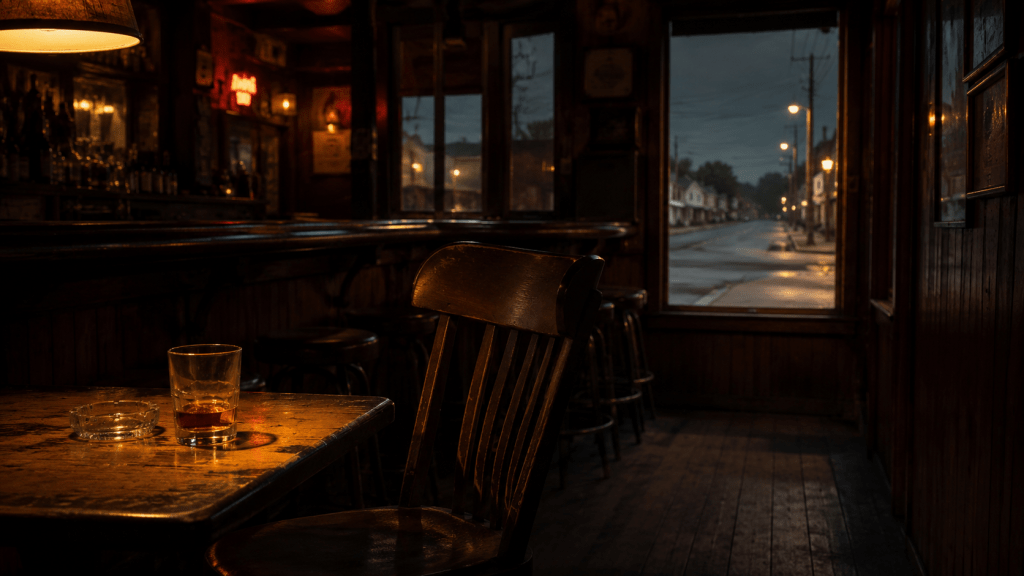
    And every evening, maybe he ends up in some corner bar where the same songs from the eighties keep playing like time got drunk and forgot to leave.

    Maybe Springsteen comes through the speakers, singing about glory days, and everybody smiles because they know the words. They know the rhythm. They know the ache, even if they would never call it grief.

    But I never wanted to become that man.

    The man sitting under the dim light, nursing a drink, telling the same stories about who he used to be because the present has become too small to speak of. The man who once had promise, once had fire, once had some bright and dangerous thing inside him, but somewhere along the way learned to trade becoming for remembering.

    That was the life I feared.

    Not the bar itself.

    Not the music.

    Not even nostalgia, because memory can be holy when handled with care.

    What I feared was getting trapped there. Becoming fluent in the language of almost.

    Almost left.

    Almost wrote.

    Almost tried.

    Almost became.

    A man with intelligence enough to know the cage had a lock, but not enough courage left to reach for the door.

    Which is to say, a man dying of recognition in a room too small for his questions.

    That is no life.

    Not because bars are bad.

    Not because familiar music is bad.

    Not because staying in your hometown is a failure.

    Some people stay and build beautiful lives. Some people remain and become pillars. There are people whose roots run deep enough to turn the soil around them into fertile ground.

    But for me, staying would have been a kind of burial.

    I know that now.

    The Quad Cities are not ignorant. That is one of the lies people tell about places like that. People are educated there. People read. People think. People work hard. People earn degrees. But a degree is not the key if every door in the city is already full of people waiting for the same narrow opening.

    I have seen baggers at local stores with college degrees.

    That image stays with me.

    Not because honest work is shameful. There is dignity in all work done with care. But there is something brutal about a place where education does not always become movement. Where intelligence gets folded into survival. Where ambition learns to speak softly because there is nowhere for it to go. The local economy can make a person feel ridiculous for wanting more than what is available.

    You learn to lower your voice around your own dreams.

    You stop saying certain things out loud.

    Writing would have been one of those things.

    Writing, in that life, would have sounded absurd. Not because writing is absurd, but because harsh places train people to distrust anything that does not immediately pay the bills. Art becomes suspicious. Expression becomes indulgence. A man saying he wants to write sounds like a man saying he wants to starve beautifully.

    So the dream would have been crushed.

    Not all at once.

    Crushed slowly.

    Under overtime.

    Under politeness.

    Under fatigue.

    Under the need to be practical.

    Under the look people give you when you reveal some secret part of yourself, and they do not know whether to laugh or feel sorry for you.

    I might have stopped writing before I ever truly began.

    That thought troubles me.

    Because now I know what writing has become for me.

    It is not a hobby.

    It is not decoration.

    It is not some charming little side project meant to make me feel interesting.

    Writing is the place where I tell the truth before the world edits it. It is where I gather the broken pieces and make them speak. It is where I take what hurt me and refuse to let it die without meaning.

    But in the life I escaped, meaning might have had to wait.

    And wait.

    And wait.

    Until one day, it forgot my name.

    That is what small lives can do when they are not chosen freely. They do not always destroy you by violence. Sometimes they destroy you by routine. You wake up. You work. You endure. You pay. You sleep. You repeat. You become reliable. You become respected in the acceptable ways. You become the kind of man people point to and say, “He’s doing all right,” while something sacred inside you sits in the dark, starving.

    I could have become that man.

    That is why I do not speak of leaving lightly.

    Leaving was not only about geography.

    Leaving was disobedience.

    It was a refusal to let the place that shaped me become the place that sealed me shut. It was me saying, perhaps before I even had the language, that survival was not enough if survival required the death of everything tender, strange, creative, and true inside me.

    New Mexico did not make me from nothing.

    I brought myself here.

    I brought the scars, the questions, the intelligence, the anger, the hunger, the ache. I brought the boy who read because books were doors. I brought the man who wanted more but did not always believe more was allowed. I brought the Midwestern discipline, the working-class suspicion of easy promises, the memory of what it means to keep going when nothing romantic is happening.

    But New Mexico gave me room.

    And room can feel like grace when you come from a place where every dream had to crouch.

    Here, the sky does not crouch.

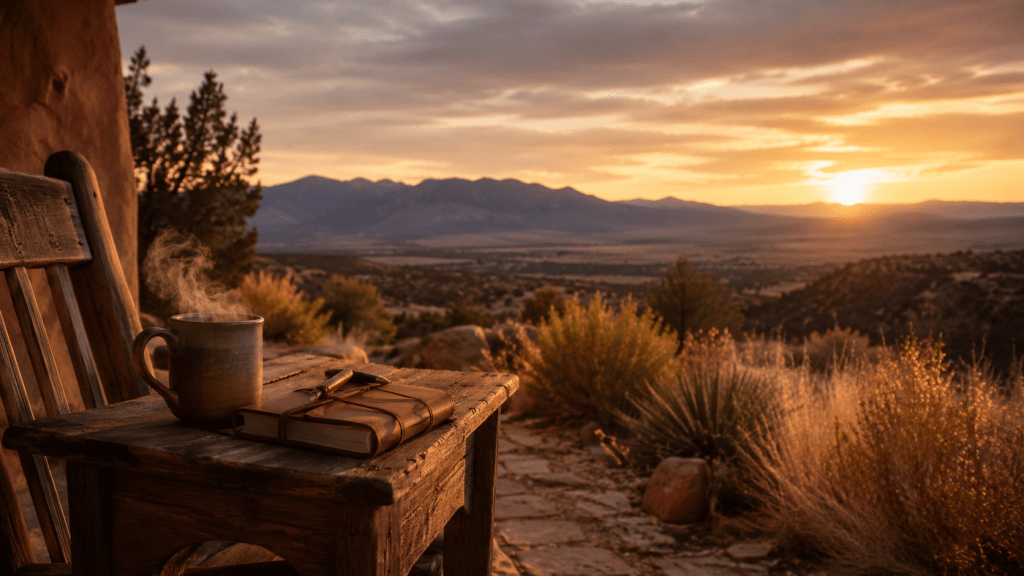
    The land stretches out like it is daring you to unclench. The mountains do not ask you to justify your existence. The light falls on everything with a kind of ancient indifference that somehow feels merciful. You can be small here without being erased. You can be quiet without disappearing. You can be alone without being trapped.

    And somehow, in that space, the writing came.

    The life that might have been still visits me sometimes.

    I see the house I could have bought because it was affordable, not because it held my future. I see the job I would have kept because leaving felt too dangerous. I see the polite insults swallowed whole. I see the younger men at the bar becoming older men at the same bar, telling the same stories under the same neon signs while the same songs play and the years pass without asking permission.

    I see myself there.

    And I feel grief.

    Not superiority.

    Grief.

    Because there are many brilliant people trapped in lives too narrow for them. Many gifted people never leave because leaving requires money, courage, timing, madness, or some combination of all four. There are many dreams buried under good sense. Many books have never been written. Many songs have never been sung. Many meals were never made. Many paintings were never painted. Many selves never met.

    The world calls that reality.

    Sometimes it is.

    But sometimes, reality is just a cage everybody’s gotten used to.

    I do not want to romanticize leaving. It costs. It takes things from you. It makes you a stranger. It removes the comfort of being easily understood. It teaches you that reinvention is not clean. There are lonely nights in new places. There are moments when the old life, for all its limits, looks warm simply because it is known.

    But I would rather be lonely in the direction of becoming than comfortable in the direction of disappearance.

    That is the truth I keep returning to.

    If I had stayed, maybe I would have been fine.

    That is the haunting part.

    Fine is a dangerous word.

    Fine can hide a thousand funerals.

    Fine can mean the bills are paid, but the soul has gone quiet. Fine can mean nobody worries about you because you have learned to maintain stability. Fine can mean the dream died so politely that even you forgot to mourn it.

    I did not want to be fine.

    I wanted to be alive.

    Not loud.

    Not famous.

    Not untouched by pain.

    Alive.

    Aware of my own mind. Responsible for my own becoming. Free enough to write badly until I wrote honestly. Free enough to tell the truth. Free enough to sit with the anger and ask whether it was protecting me or imprisoning me. Free enough to discover that I was more than the smartest man in a room I had outgrown.

    That is what New Mexico gave me.

    Or helped me claim.

    A life where writing became possible.

    A life where the old bitterness began to lose its authority.

    A life where the boy who once dreamed in silence could finally put words on the page and let them breathe.

    And maybe that is why New Mexico feels less like a place I moved to and more like the land that let me become. Because I know the life I might have stayed long enough to inherit. I know the man I might have become. And I know, with a gratitude I still cannot fully explain, that I was given room before the dream went quiet.

    I do not hate the place I came from.

    I carry it.

    The Quad Cities are in me. The Midwest is in me. The gray winters. The modest houses. The factory logic. The polite cruelty. The educated frustration. The bars with old songs playing. The people are doing their best with what the place allows. The aching knowledge that intelligence does not always become freedom.

    All of it is in me.

    But it is not over me.

    Not anymore.

    And maybe that is what escape really means.

    Not that you outrun the past.

    But that you live long enough, and choose bravely enough, to stop letting the past decide the size of your future.

    There is a life I did not stay long enough to become.

    I mourn him sometimes.

    I honor him, too.

    Because he reminds me of what was at stake.

    He reminds me that every page I write is not merely a page. It is evidence.

    Evidence that the dream survived the harshness.

    Evidence that the man did not bow his head forever.

    Evidence that the corner bar did not become the whole world.

    Evidence that I left.

    Kyle J. Hayes

    kylehayesblog.com

    Please like, comment, and share

    Resources for Hard Times

    If you’re looking for practical help, food support, or community resources, you can visit the Salt, Ink & Soul Resources Page.
    👉 Resources for Hard Times

  • The Lessons I Wish Someone Had Taught Me Sooner

    The Lessons I Wish Someone Had Taught Me Sooner

    There’s a certain kind of teaching that doesn’t happen at a chalkboard.

    It happens later in the quiet. When you’re old enough to look back at the boy you were and realize he didn’t need tougher lessons—he needed better language for what he was already carrying. He needed someone to name the weight, not just tell him to lift it. He needed instructions that didn’t feel like shame.

    I write children’s stories, and if you look closely, there’s a lesson tucked inside each one like a warm note in a pocket. People sometimes think that’s cute. Sometimes it is. But it’s also a confession.

    Because the truth is: I’m not only writing for children.

    I’m writing for the younger version of me.

    I’m writing for the boy who kept hearing “you’ll learn the hard way” like it was a rite of passage. Like pain was a badge you earned. Like wasted time was the price of admission. Like you had to bleed to be considered real.

    And maybe that’s the oldest lie we tell boys—that the only education that counts is the kind that bruises.

    I grew up in a world that didn’t always teach feelings the way it taught survival. It taught stamina. It taught silence. It taught the art of looking fine. It taught you how to swallow your own questions whole so nobody would see you chewing.

    And then, later—when you’re old enough to know you’ve been living with a hunger you couldn’t name—you realize what you were missing wasn’t toughness.

    It was guidance.

    The kind that says: Here’s how to be human without hardening into a weapon.

    So I started writing the lessons I wish had been offered to me without the threat attached.

    Not sermons. Not lectures. Just small stories.

    A fox who checks on his friends.

    A quiet day that gives permission to rest.

    A soup that doesn’t look fancy but still warms the room.

    A cloud that doesn’t stay forever but leaves growth behind.

    These aren’t just plots.

    They’re repairs.

    They’re me trying to do something with what I’ve learned, instead of letting it sit inside me as regret.

    Because I’ve learned the hard way. I’ve paid for the information for years. With missteps. With stubborn pride. With the kind of loneliness that doesn’t announce itself—it just rearranges your life until you forget what joy used to sound like.

    There’s a particular kind of waste that hurts the most—not wasted money or missed chances, but wasted time becoming. The years you spend thinking you’re broken, or behind, or unworthy of gentleness. The years you spend trying to earn what should have been given freely: permission to grow.

    That’s why the lessons keep showing up in my stories.

    Not because I believe children are empty and need to be filled, but because children are already full—full of questions, full of fear, full of hope they don’t yet know how to protect. And too often they inherit a world that tells them their softness is a flaw.

    So I write to tell them the opposite.

    I write to tell them that kindness is not weakness. That asking for help is not failure. That being unseen isn’t proof you don’t matter. That the quiet parts of you deserve a home.

    That you can be strong without being cruel.

    That you can become a good man without becoming a hard one.

    And I write to tell the adults reading over their shoulders something too: it’s not too late to offer yourself the lesson you never got. It’s not too late to sit beside the younger version of yourself and say, I see what you went through. You didn’t deserve to go through it alone.

    People sometimes assume empathy is just a personality trait, like eye color. But I think empathy is often the leftover heat from a life that could have gone colder. It’s what happens when you’ve been hurt and decide—quietly, stubbornly—that you don’t want to hand that hurt forward.

    That’s what my stories are.

    My refusal to hand it forward.

    I don’t write because I’m better than anyone. I write because I know what it costs when we don’t have maps. I know what it costs when boys are told that confusion is weakness and tenderness is something to outgrow.

    I know how easy it is to turn “learned the hard way” into an identity instead of a warning.

    I’m trying to offer a different inheritance.

    Not perfection. Not a shortcut around life. Life will still be life—wild, unfair, beautiful, sometimes brutal. But maybe we can spare someone a few needless miles. Maybe we can keep a kid from mistaking pain for a teacher and loneliness for a personality.

    We can help them spend less time surviving and more time becoming.

    That’s the hope under every story I write: that someone—somewhere—will feel seen sooner than I did. That they’ll recognize themselves in a gentle fox or a patient cloud and understand, without being told too bluntly, that they’re allowed to be human.

    And if that happens, even once, then none of this is wasted.

    Not the stories.

    Not the lessons.

    Not even the hard way.

    Maybe that’s what these stories really are — small lanterns placed along the path I once had to walk in the dark.

    If someone younger finds one of them sooner than I did, then the years it took me to learn those lessons won’t have been wasted.

    Kyle J. Hayes

    kylehayesblog.com

    Please like, comment, and share

    Resources for Hard Times

    If you’re looking for practical help, food support, or community resources, you can visit the Salt, Ink & Soul Resources Page.
    👉 Resources for Hard Times

    Links

  • Felix the Fox and the Garden That Reflected You

    Felix the Fox and the Garden That Reflected You

    There was a garden tucked deep inside the Whispering Woods that most creatures walked past without noticing.

    Not because it was hidden—but because it waited to be found.

    Felix the Fox noticed it one morning when the light fell differently between the trees. The air felt softer there, as if the forest itself had taken a breath and decided to hold it.

    “This place feels like it’s listening,” Felix said.

    The garden did not answer.

    It didn’t need to.

    Felix wasn’t alone. Maple the Rabbit hopped beside him, curious and open, while nearby, Bristle the Magpie watched carefully, wings tucked tight against her sides. Bristle liked shiny things. She liked keeping them close. It made her feel safe.

    The garden seemed to notice that, too.

    A gentle path appeared beneath Felix’s paws—wide enough for more than one, marked by flowers that leaned outward, as if inviting company.

    Maple followed easily.

    Bristle hesitated.

    Her path was different. It shimmered faintly, scattered with small, glinting objects half-buried in the soil. Each one caught the light just right.

    Bristle gathered them quickly.

    The more she collected, the quieter the garden became.

    Felix’s path felt heavier at first. He found fallen branches blocking the way, thorny vines tangled where others might stumble. But each time he paused, Maple or another forest friend appeared—not summoned, just arriving.

    Together, the work became lighter.

    The flowers along Felix’s path grew brighter, not because he cleared it alone, but because he never did.

    Bristle reached a clearing first.

    In the center stood a smooth pool of water, still as glass. She leaned over it, expecting to see something shining back at her.

    Instead, she saw herself alone—wings full, paws empty.

    The garden did not scold.

    It simply waited.

    Farther along, Felix reached his own clearing. When he looked into the pool, he didn’t see just himself. He saw Maple laughing. Bramble helping. Piper perched nearby, humming softly.

    The water seemed to whisper:

    What you share stays with you.

    Bristle listened from the edge of the trees.

    Her wings felt heavy now—not with treasure, but with something lonelier.

    She looked back at the path she’d taken. The flowers there had dulled, not angry, just tired.

    Bristle made a choice.

    She returned the shiny things to the soil. Slowly. One by one. Then she followed the sound of voices rather than the sparkle.

    When she reached the others, Felix didn’t say anything.

    He just made room.

    As Bristle helped lift a branch and shared a found trinket instead of keeping it, the garden changed again. Color returned. The air warmed. The path widened.

    The Whispering Woods had noticed.

    By the time they left, the garden looked no different than before—quiet, unassuming, easy to miss.

    But Felix knew better.

    “Some places don’t show you who they are,” he said softly.

    “They show you who you are.”

    The forest seemed pleased with that.

    And long after the garden disappeared behind them, its lesson stayed—growing quietly wherever kindness was chosen over keeping.

    Some gardens don’t grow flowers.

    They grow understanding.

    Kyle J. Hayes

    kylehayesblog.com

    Please like, comment, and share

    Read More Felix Stories.

    👉 Felix Collections

  • Felix the Fox and the Cloud Who Stayed

    Felix the Fox and the Cloud Who Stayed

    Felix the Fox noticed the cloud before he knew why it mattered.

    It was there most mornings—thin and pale, drifting slowly above the edge of the Whispering Woods. Not rushing. Not gathering with the others. Just staying.

    Felix often paused on his walks and looked up at it.

    “That cloud doesn’t seem to be in a hurry,” he said once.

    The woods, as usual, did not answer.

    Winter moved quietly through the trees. Snow rested on branches the way a thought rests when it hasn’t decided what to become yet. Felix padded along the familiar paths, listening, noticing, letting the day arrive at its own pace. Above him, the cloud drifted.

    Felix wondered if clouds ever felt lonely.

    One afternoon, while following the creek toward the forest’s edge, Felix noticed something else—a young tree standing just beyond the main grove. It wasn’t weak. It wasn’t broken. It simply stood where the forest thinned, growing in the open space between what was and what could be.

    Felix stopped beside it.

    “You look like you’re waiting,” he said.

    The tree did not speak, but its leaves rustled in a way that felt like agreement.

    Felix sat for a while, then looked up again. The cloud had lowered itself, just slightly, as if listening.

    “I think that cloud is keeping you company,” Felix said.

    That night, rain came—but not the loud kind. Not the kind that rushed in and left the ground overwhelmed. It fell gently. Patiently. The sort of rain that knew when to stop.

    Felix watched from his den as the soil darkened and drank it in.

    Days passed. Then more.

    Felix noticed small changes. The ground around the lone tree softened. Tiny green shoots appeared where there had only been bare earth. Birds began landing there—just to rest at first. Then to stay.

    Felix returned often. The cloud still drifted overhead, never lingering too long, never leaving too fast.

    One morning, Felix saw other clouds arrive. They gathered briefly, spoke in soft rumbles, and shared the sky. Together, they let the rain fall again.

    This time, more seeds woke.

    The forest did not rush the process. Neither did the cloud.

    Weeks later, Felix realized the space between the lone tree and the forest no longer felt empty. Saplings had taken root. Leaves brushed one another in the breeze. The forest had grown—not outward, but toward something.

    Felix sat on a fallen log and watched.

    “So that’s what you were doing,” he said quietly.

    The cloud, now thinner, drifted higher.

    One afternoon, the wind shifted. The cloud began to move, stretching, loosening, preparing to go.

    Felix felt something tug at him—not sadness exactly, but understanding.

    “Thank you,” he said, unsure if clouds could hear.

    The cloud did not answer. It did not need to.

    The forest answered instead.

    The once-lonely tree now stood among others. Birds nested. Roots intertwined. Life moved easily where waiting had once lived.

    Felix walked home slowly.

    That evening, as the sky cleared, he understood something important:

    Some helpers do not stay forever.

    Some kindness happens quietly.

    Some friends arrive, not to belong—but to make belonging possible.

    Felix curled his tail around his paws and looked up at the open sky. Not everything that matters lives on the ground, he thought.

    And the Whispering Woods, grown just a little wider than before, held that truth gently.

    Some kindness doesn’t stay—

    But it leaves room for everything that comes next.

    Kyle J. Hayes

    kylehayesblog.com

    Please like, comment, and share

    Read More Felix Stories.

    👉 Felix Collections

  • Felix the Fox and the Soup That Didn’t Look Fancy

    Felix the Fox and the Soup That Didn’t Look Fancy

    The day the soup happened, the Whispering Woods were very quiet.

    Not the sleepy kind of quiet that comes before a nap, and not the exciting kind that comes before a surprise—just the ordinary hush of winter doing what winter does best. Snow rested on branches. The air held still. Even the creek seemed to whisper instead of sing.

    Felix the Fox stood in his small kitchen, stirring a pot.

    Inside the pot were simple things: carrots, potatoes, a little onion, and some herbs he’d gathered earlier that morning. Nothing sparkled. Nothing swirled into shapes. The soup was a soft, gentle brown, the color of comfort but not of celebration.

    Felix frowned.

    “It doesn’t look special,” he said to the spoon.

    The spoon, being a spoon, did not argue.

    Felix had planned to invite his friends over. Winter had been long already, and everyone seemed a little quieter than usual. Piper hadn’t been singing as much. Maple had been hopping more slowly. Even Bramble’s laughter sounded smaller, like it was saving itself.

    Felix wanted to help.

    But when he looked at the pot, doubt crept in.

    “What if they expect something better?” he wondered.

    “What if it’s too plain?”

    “What if they think I didn’t try hard enough?”

    He imagined bowls filled with bright colors, meals that made everyone gasp when they saw them. This soup would not make anyone gasp. It would barely make anyone look twice.

    Felix lifted the spoon and tasted it.

    It was warm.

    It was steady.

    It tasted like being held.

    Still, he hesitated.

    Just then, there was a soft knock at the door.

    Felix opened it to find Maple the Rabbit, wrapped in her scarf, snow dusting her ears.

    “I smelled something,” Maple said. “It smells… safe.”

    Behind her came Piper, wings tucked close for warmth. Then Bramble, stomping snow from his paws.

    Felix swallowed.

    “It’s just soup,” he said quickly. “Nothing fancy.”

    Maple smiled. “That’s okay.”

    Felix ladled the soup into bowls. No garnishes. No decorations. Just soup.

    They sat together at the table, steam rising slowly into the quiet room.

    For a moment, no one spoke.

    Then Maple sighed—a deep, settling sound.

    “Oh,” she said softly. “This is exactly what I needed.”

    Piper took a careful sip, then another. Her shoulders dropped, just a little.

    “It feels like my wings can rest,” she said.

    Bramble drank his bowl in thoughtful silence. When he finished, he looked up.

    “It tastes like the day got easier,” he said.

    Felix blinked.

    “You… you like it?” he asked.

    Maple nodded. “It doesn’t have to look special to be special.”

    Piper smiled. “Some food isn’t meant to impress. It’s meant to help.”

    Bramble pushed his empty bowl forward. “May I have more?”

    Felix laughed—a quiet, relieved laugh that felt like sunlight finding its way through clouds.

    As they ate, the room warmed. Not just from the soup, but from the way everyone leaned back in their chairs, the way their breathing slowed, the way the winter outside felt less heavy.

    No one asked what was in the soup.

    No one asked how long it took.

    No one asked why it looked the way it did.

    They were too busy feeling better.

    Later, as the bowls were emptied and the evening settled in, Felix washed the pot with a lighter heart.

    He looked at the soup again—what little remained at the bottom.

    It still wasn’t fancy.

    But it had done its job.

    Felix smiled to himself.

    Not everything needs to shine, he realized.

    Some things just need to be nourished.

    Kyle J. Hayes

    kylehayesblog.com

    Please like, comment, and share

    Read More Felix Stories.

    👉 Felix Collections

  • Felix the Fox and the First Quiet Day of the Year

    Felix the Fox and the First Quiet Day of the Year

    The first quiet day of the year arrived without announcing itself.

    There were no bells.

    No fireworks.

    No one is telling the forest what it should become next.

    Snow rested gently on the branches of the Whispering Woods, not fresh enough to sparkle, not old enough to melt—just settled. The kind of snow that knew how to wait.

    Felix the Fox woke later than usual.

    He stretched beneath his quilt of leaves and listened. The forest felt different today. Not sleepy. Not busy. Just… still. As if the world had decided to take a breath before doing anything else.

    Felix padded outside and looked around.

    “I wonder what I’m supposed to do today,” he said.

    The word supposed lingered in the air, heavier than he expected.

    He walked past Maple’s burrow. Quiet.

    Past Piper’s tree. Still.

    Even Bramble’s den showed no signs of stirring.

    Felix’s tail flicked.

    “Maybe everyone’s getting a head start,” he thought. “Maybe I’m already behind.”

    That idea made his chest feel tight, so he wandered deeper into the woods, hoping the trees might know the answer.

    Near the old creek, Felix found Lumina the lamppost still glowing softly, even though morning had arrived.

    “You’re on early,” Felix said.

    Lumina’s light warmed the snow at her base.

    “Or perhaps,” she said gently, “you’re on time.”

    Felix sat beside her.

    “It feels like I should be doing something important,” he admitted. “Starting something new. Becoming better. Becoming more.”

    Lumina hummed—a low, comforting sound.

    “Does becoming always begin with doing?” she asked.

    Felix tilted his head.

    “I… don’t know.”

    “Then perhaps today is for listening,” Lumina said. “Or resting. Or noticing.”

    Felix considered that.

    The creek whispered nearby. A bird fluttered past without stopping. The forest didn’t seem disappointed in him at all.

    Later, Felix spotted Bramble sitting on a log, staring at his own breath puffing into the cold air.

    “What are you doing?” Felix asked.

    “Nothing,” Bramble said happily.

    Felix waited.

    Bramble smiled. “I’m very good at it.”

    Felix laughed, and something loosened inside him.

    They sat together without talking. The snow didn’t hurry them. The sky didn’t ask questions.

    As the sun dipped lower, Felix realized something important.

    The first quiet day of the year wasn’t empty.

    It was full of permission.

    Permission to rest before trying.

    Permission to be before becoming.

    Permission to arrive slowly.

    Felix curled his tail around his paws and smiled at the woods.

    “Maybe,” he said softly, “I don’t have to rush into the year.”

    The forest, wise and unbothered, seemed to agree.

    And so the first quiet day of the year passed—not with effort, not with plans, but with gentleness.

    And that, Felix learned, was more than enough to begin.

    Kyle J. Hayes

    kylehayesblog.com

    Please like, comment, and share

    Read More Felix Stories.

    👉 Felix Collections

  • Borrowed Light: The Holiday Movies That Raised Me

    Borrowed Light: The Holiday Movies That Raised Me

    Salt, Ink & Soul — Humanity Through Food Series 

    There’s a certain kind of light that only shows up this time of year.

    Not the bulbs strung across rooftops or the plastic icicles flickering in windows.

    I mean the glow of a television in a dim living room—the kind of light that spills across the carpet like a familiar voice calling you home. The kind that makes the rest of the world feel far away, wrapped in a kind of winter hush.

    That’s the light I fell in love with.

    When I say I love the Christmas season, I don’t just mean the day. I mean the entire orbit around it—the slow build, the anticipation, the small rituals that become lifelines. The lights, yes. The chill in the air, certainly. But most of all, the movies.

    My love of holiday movies began long before streaming existed. Before playlists and algorithms. Before DVDs and VHS tapes. Back when a movie came only once a year, and you had to earn it by waiting.

    I remember how the TV commercials would announce that A Charlie Brown Christmas was coming. It felt like a sacred date—one night, one hour, one chance. If you missed it, you missed it. No do-overs. No recording it for later.

    You came in from outside early.

    You washed up if someone told you to.

    You grabbed your spot on the floor or couch—not too close to the TV because a parent had already warned you about “ruining your eyes.”

    And when the opening notes played, it felt like the world exhaled.

    The same thing happened with How the Grinch Stole Christmas!—the original one. The one with the gravelly voice singing, “You’re a mean one, Mr. Grinch.” To this day, I still play that song like a yearly ritual, as if the Grinch’s redemption is a message I need whispered back to me every December.

    Those two early films shaped not just my childhood but my taste in Christmas music—the quiet melancholy of “Christmas Time Is Here” and the playful growl of “Mr. Grinch.” They were two sides of the season: hope and humor, softness and mischief.

    As I grew older, the list grew richer.

    There was Miracle on 34th Street, a story that insists the world can be gentler than it is.

    Three ghosts were ushering me through adulthood, arriving through different retellings of A Christmas Carol—one starring George C. Scott, another with Patrick Stewart, and the third, unexpectedly profound, in The Muppet Christmas Carol.

    Later came the unconventional additions:

    • Fred Claus
    • The Wiz
    • Sleepless in Seattle
    • Last Holiday starring the luminous Queen Latifah
    • The Holiday

    And, of course, no list is complete without It’s a Wonderful Life with James Stewart—a film that crawls inside your ribcage and whispers, “Do you understand how many lives would break if you disappeared from your own story?”

    These movies became more than entertainment.

    They became checkpoints—seasonal markers, emotional recalibrations.

    Something feels misaligned in me until I sit down and watch them all.

    I even look forward to adding new ones each year.

    Some fade.

    Some stay.

    The good ones linger like old friends.

    Good holiday films do the same thing to me that good books do.

    A real book doesn’t let you skim the surface; it drags you under.

    You forget you’re reading.

    You live inside the pages.

    Movies, even though they hand you the visuals, still manage to sneak past your defenses.

    The imagination is less involved, but the emotions are still all yours.

    You feel them.

    You wear them.

    You walk around with them for days afterward.

    But there’s something deeper at work in all this.

    Because December is beautiful, yes—but it’s also unbearable for so many people.

    The lonely.

    The grieving.

    The single.

    The ones who don’t have a home full of noise and company.

    The ones who struggle in the silent hours after the festivities end.

    Holiday movies do something quiet for those of us walking through that kind of December.

    They make space.

    They offer warmth that asks for nothing in return.

    Sometimes the comfort doesn’t come from a whole room or a crowded table.

    Sometimes it comes from a screen glowing softly in the dark—a story reaching across years, wires, and winter air to sit beside you.

    These movies don’t fix your Life.

    They don’t pay your bills.

    They don’t fill the empty chair or soften the ache of absence.

    But they lend you their light.

    A borrowed light.

    Just enough to see by.

    Just enough to make the season survivable.

    Just enough to remind you that stories—whether read or watched—have always been how we navigate the hardest seasons in community, even when we’re watching alone.

    So yes, I love the Christmas season.

    Not because it demands cheer.

    Not because it promises perfection.

    But because it gives me these small rituals—these films that arrive like quiet companions, asking only that I sit down, press play, and let myself feel whatever I feel.

    And every December, when the world feels a little colder, a little heavier, a little lonelier than I want to admit—

    These stories remind me that even in the darkest stretch of the year,

    There is still light worth borrowing.

    Kyle J. Hayes

    kylehayesblog.com

    Please like, comment, and share

    Resources for Hard Times

    If you’re looking for practical help, food support, or community resources, you can visit the Salt, Ink & Soul Resources Page.
    👉 Resources for Hard Times

  • Why Felix Always Checks on His Friends

    Why Felix Always Checks on His Friends

    In the soft morning light, Felix the Fox woke to a feeling he couldn’t quite name.

    It wasn’t a sound or a smell—just a tug on his heart, as if someone far away had whispered his name through the trees.

    Felix sat up and listened.

    The woods were doing what they always did: rustling their leaves like pages of a story, humming their deep, steady song. Yet beneath all of that, Felix sensed something else.

    A quiet.

    A quiet that didn’t feel quite right.

    He took a breath, wrapped his tail around himself for courage, and said aloud:

    “I think… someone might need me today.”

    So he set off through the forest, not rushing, not worrying—just walking with his ears open and his heart curious. Felix had learned something important: sometimes you don’t know who needs kindness until you go looking for them.

    Maple the Rabbit

    The first friend he found was Maple the Rabbit, sitting beside a stump, nose barely twitching.

    “Good morning,” Felix said softly. “Are you all right today?”

    Maple blinked. She hadn’t expected anyone to notice the heaviness in her hop.

    “I’m… just a little sad,” she whispered.

    Felix didn’t try to fix it.

    He simply sat beside her.

    Sometimes being near someone is its own kind of help.

    After a few quiet moments, Maple’s nose twitched again—this time with gratitude.

    Felix gave her a warm nod and continued down the path.

    Bramble the Bear Cub

    Next, he found Bramble the Bear Cub, trying to lift a large fallen branch blocking the trail. Bramble pushed and pushed, shoulders trembling.

    “That looks tough,” Felix said. “Would you like a paw?”

    Bramble nodded, embarrassed but relieved. Together, they nudged the branch aside. It didn’t take long.

    But the smile that returned to Bramble’s face lasted much longer.

    “You made it easier,” Bramble said.

    “You asked for help,” Felix replied. “That makes us a team.”

    Piper the Bluebird

    As he walked on, Felix felt that tug again—light and gentle, but full of meaning.

    Someone else was waiting.

    He reached the quiet meadow near the Stream of Mornings, where Piper the Bluebird perched on a low branch. Her wings drooped, and she wasn’t singing her usual bright songs.

    Felix sat beneath her tree.

    “You don’t have to sing today,” he said. “But I thought I’d check on you. Just in case your heart was feeling small.”

    Piper fluttered down, landing lightly on his shoulder.

    “It was,” she said. “But it feels a little bigger now.”

    Felix smiled—the soft, glowing kind that spreads through your whole chest.

    “That’s good,” he said. “Hearts aren’t meant to grow alone.”

    As the sun climbed higher, the woods felt warmer, fuller. Not because the air had changed, but because Felix had moved through it with care—

    noticing the quiet things that often go unseen.

    When he finally returned home, he curled up in his den and understood the feeling he’d had that morning.

    Kindness isn’t just something you give.

    It’s something you notice.

    A listening.

    A moment of paying attention.

    And the more you notice, the more you understand:

    Every creature—big or small, loud or quiet—carrys something inside that matters.

    That evening, as the stars blinked awake, Felix whispered into the gentle hush of the forest:

    “I check on my friends because we all shine a little brighter when someone sees us.”

    And far across the Whispering Woods, three friends—Maple, Bramble, and Piper—felt that truth like a warm lantern glowing inside them.

    It’s a small thing, checking on someone.

    But small things have a beautiful way of becoming big.

    And that is why Felix always checks on his friends.

    Kyle J. Hayes

    kylehayesblog.com

    Please like, comment, and share

    Read More Felix Stories.

    👉 Felix Collections