Tag: emotional wellness

  • Becoming Careful About What Enters the Soul

    Becoming Careful About What Enters the Soul

    Years ago, for reasons I could not fully explain, I found myself moving in the opposite direction of everyone around me.

    People were talking about The Sopranos. They loved it.

    I tried.

    More than once.

    I could appreciate the acting. I could see the craftsmanship. I understood why people were drawn to it.

    But I never enjoyed it.

    Then came The Wire.

    Again, I tried.

    Everyone said it was brilliant. Everyone said it was important. Everyone said I simply needed to give it another chance.

    I did.

    Several times.

    Yet something in me remained unmoved.

    Then came Breaking Bad.

    The same story.

    The same recommendations.

    The same praise.

    And the same feeling that this was not for me.

    At the time, I thought perhaps I was missing something.

    Maybe I was.

    But as the years passed, I began to realize I was not rejecting great storytelling.

    I was becoming sensitive to what those stories required me to sit with,

    so many of them invited me to spend hours living inside darkness.

    Crime, violence, manipulation, corruption, and Greed.

    The slow collapse of the human spirit.

    The older I became, the less interested I was in making those places my home, even temporarily.

    What surprised me most was that the change did not stop there.

    Movies I once enjoyed began losing their appeal.

    Military films.

    Action movies.

    Stories built around guns, revenge, and destruction.

    Eventually I found myself turning away from anything that seemed determined to convince me that darkness was depth.

    Then I began noticing something else.

    Many stories no longer seemed interested in heroes.

    Even stories that claimed to be about heroes often spent most of their time glorifying villains.

    The villain was smarter.

    The villain was more interesting.

    The villain got the best lines.

    The villain became the person audiences secretly admired.

    Goodness became boring.

    Decency became weakness.

    Kindness became naïveté.

    And somewhere along the way, I realized I was growing tired.

    Not physically.

    Spiritually.

    I began asking myself a simple question.

    What am I feeding my mind?

    We understand this concept when it comes to food.

    No one is surprised when a person feels different after changing their diet.

    Yet we often act as though the soul can consume endless negativity without consequence.

    Hour after hour.

    Day after day.

    Year after year.

    Violence.

    Conflict.

    Anger.

    Fear.

    Contempt.

    Cynicism.

    Then we wonder why peace feels so difficult to find.

    So I started making changes.

    Not dramatic changes.

    Just intentional ones.

    I became more selective about what I watched.

    More selective about what I listened to.

    More selective about the conversations I participated in.

    I began paying attention to the words I spoke.

    I tried to spend less time discussing people and more time understanding them.

    Less time dwelling on problems and more time looking for solutions.

    Less time feeding outrage and more time feeding gratitude.

    Something changed.

    Not overnight.

    But slowly.

    Quietly.

    The way sunrise arrives.

    You do not notice it all at once.

    Then suddenly the darkness is no longer where it was.

    Kyle J. Hayes

    kylehayesblog.com

    Please like, comment, and share

    Resources for Hard Times

    If you’re looking for practical help, food support, or community resources, you can visit the Salt, Ink & Soul Resources Page.
    👉 Resources for Hard Times

  • The Kindness Hidden in a Pot of Soup

    The Kindness Hidden in a Pot of Soup

    Salt, Ink & Soul — Humanity Through Food Series

    Some foods impress, and foods that entertain, and foods that demand your attention with spice or technique or flair. And then there is soup. Soup doesn’t perform. It doesn’t shout for applause. It just shows up—quiet, warm, patient—and asks nothing from you except a moment to breathe.

    I’ve been thinking about that lately: the way soup holds a kind of kindness that almost feels ancient.

    When we were kids, a bowl of soup could fix almost anything.

    Cold hands from staying out far too long.

    A bruised knee.

    A disappointment you didn’t yet have words for.

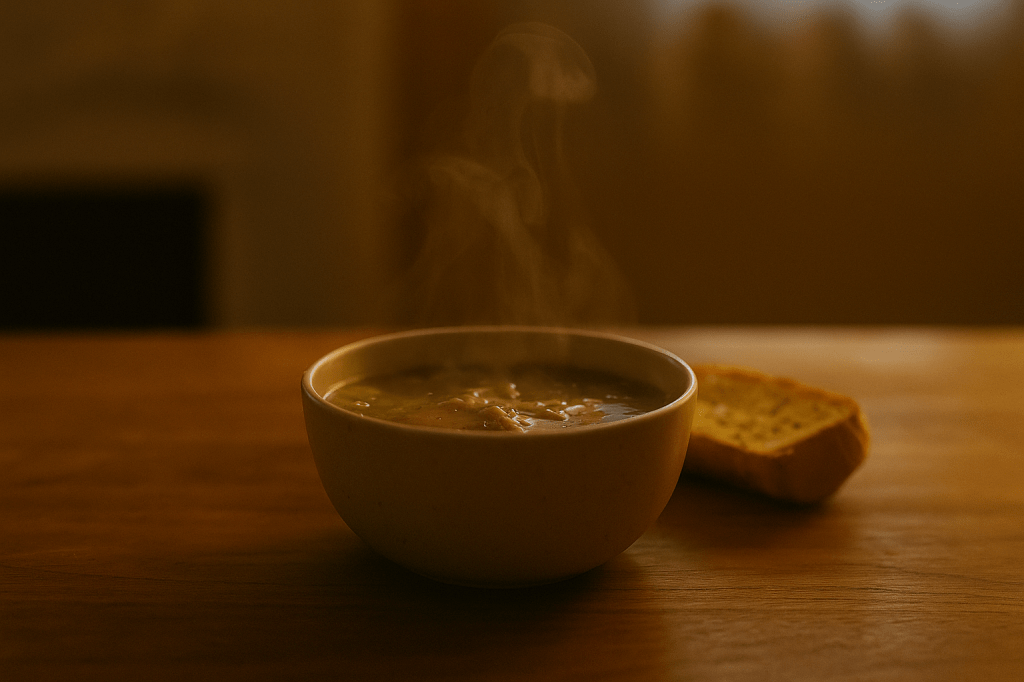
    Your mother could ladle warmth into you faster than any doctor ever could. The steam rising from the bowl wasn’t just heat—it was shelter. It was a reminder that even if the world out there felt too sharp, too big, too cold, someone still wanted you warm.

    And what strikes me now, all these years later, is how that same kindness follows soup wherever it goes.

    Because the smile someone gives when they’re handed a bowl of soup—the real stuff, hot and fragrant and made with small care—is the same whether they’re nine years old coming in from the cold or a grown man standing outside a shelter on a hard December night. Soup doesn’t judge circumstance. It doesn’t sort people into deserving or not.

    It simply says: Here. Eat. You matter enough for this warmth.

    I’ve written before about my green chile chicken soup—how it’s one of the few dishes I make that feels almost ceremonial. Maybe it’s the Chile. Maybe it’s the slow simmer. Maybe it’s something about putting so much of yourself into a pot that you forget, until much later, just how much you made.

    This last time, the recipe made enough to feed an entire table. Or, in my case, one man for several days. I portioned it into bowls and froze them, little time capsules of comfort stacked in my freezer like quiet promises.

    Yesterday, I thawed one. But instead of rushing it, instead of taking the shortcut the microwave offers, I warmed it the slow way—in a pot, on low heat. Stirring occasionally. Letting the aroma rise up like a memory you didn’t realize you’d forgotten.

    Warming soup slowly feels like a kind of respect.

    A way of honoring the time it took to make it.

    A way of stepping back from the pace of everything else in life.

    When it was ready, I poured it into a bowl and paired it with garlic bread I’d tucked away in the freezer. Not fancy bread. Not homemade. But good enough—especially when its only job was to ensure that not a single drop of soup went uneaten.

    I’m generally not a fan of cold winters. The wind cuts too sharply. The days darken too early. The quiet feels heavier than I’d like to admit. But this soup—this simple bowl of warmth I made weeks ago and brought back to the stove—makes the season feel less like something to endure and more like something to move through gently.

    Soup does that.

    It softens hard days.

    It steadies you.

    It reminds you that survival doesn’t always have to be a battle—it can be as simple as letting something warm into your body and sitting still long enough to feel it.

    And maybe that’s why soup matters so much—not just to me, but to all of us.

    Because the ingredients may change. The hands that make it may differ. The kitchens may range from polished granite countertops to back-room burners in community centers. But the gift is the same:

    Here is warmth.

    Here is comfort.

    Here is something made with care, even if only for a moment.

    And in a world that asks so much of us, a simple bowl of soup can feel like an act of mercy.

    Kyle J. Hayes

    kylehayesblog.com

    Please like, comment, and share

    Resources for Hard Times

    If you’re looking for practical help, food support, or community resources, you can visit the Salt, Ink & Soul Resources Page.

    👉 Resources for Hard Times

    👉 Keto Green Chile Chicken Soup Recipe

    👉 Simple Garlic Chicken Soup Recipe