Tag: fear

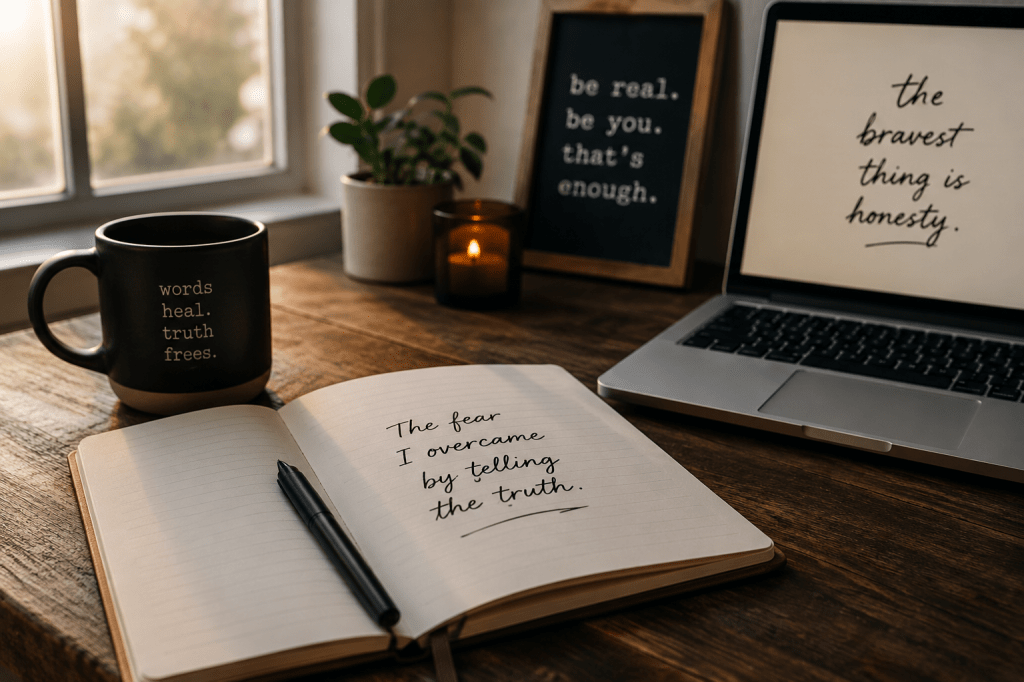
  • What’s a fear you’ve overcome — and how did you do it?

    What’s a fear you’ve overcome — and how did you do it?

    Daily writing prompt
    What’s a fear you’ve overcome — and how did you do it?

    The fear I had to overcome was the fear of truly expressing myself.

    Not writing.

    I could write.

    I had always known there were words somewhere inside me, moving around in the dark, waiting for a place to go. But expression is different from writing. Expression asks more of you. Expression does not let you hide behind cleverness or distance. It asks you to bring the real thing forward.

    The feeling.

    The thought.

    The wound.

    The part of yourself you learned to protect because the world had already shown you what it could do with anything soft.

    I grew up being teased for anything and everything. That kind of thing does not leave you all at once. People like to pretend childhood cruelty is small because children are small, but that is not true. Small hands can still leave fingerprints. Small voices can still become the echoes a person carries into adulthood.

    After a while, you learn to hold yourself back.

    You learn to measure every word before it leaves your mouth. You learn to hide enthusiasm. You learn to make yourself less visible. You learn that being seen can feel dangerous.

    So the idea of putting myself on paper, my feelings, my thoughts, my pain, my emotions, and then placing it online where anyone could read it, was terrifying.

    It felt almost unnatural.

    Like standing in the middle of a room and taking off the armor I had spent years building.

    And yet, I did it.

    Not all at once.

    Not bravely in the way people imagine bravery.

    I did it one piece at a time.

    A sentence.

    A paragraph.

    A post.

    A confession softened by craft.

    A truth placed carefully enough that I could survive seeing it outside my body.

    The more I wrote, the more something inside me began to loosen. Not disappear. Not healed completely. But loosen. Writing became a way to take what had been trapped inside me and give it shape. Once it had shape, it was no longer just pain. It was testimony. It was a memory. It was language. It was something I could hold, examine, revise, and understand.

    And the more I did it, the better I felt.

    The better I got.

    That matters too.

    Because fear wants you to believe that expression will destroy you. It tells you that if people see the real thing, they will laugh. They will turn away. They will misunderstand. They will prove every old voice right.

    And sometimes people may not understand.

    But sometimes they do.

    Sometimes someone leaves a comment that lets you know your words reached a place in them they had not been able to name. Sometimes someone tells you that what you wrote helped them. Sometimes they do not say it loudly, but you can feel it. They saw themselves in your story. They realized they were not the only ones who had carried that kind of ache.

    That changes something.

    Because then the writing is not only about me.

    It becomes a bridge.

    A small one, maybe.

    But still a bridge.

    One person telling the truth from one side of loneliness, and another person hearing it from the other.

    That is how I overcame the fear.

    Not by becoming fearless.

    I do not think that is how fear works.

    I overcame it by learning that the fear did not get the final vote. I overcame it by writing anyway. By sharing anyway. By letting the work prove to me that vulnerability does not always lead to humiliation. Sometimes it leads to a connection. Sometimes it leads to healing. Sometimes it becomes the very thing that helps someone else survive their own silence.

    And in helping them, I help myself.

    That may be the part I did not expect.

    Every time someone responds and says, in some way, I know this feeling too, I am reminded that I am not alone either. The pain I thought was only mine was never only mine. The fear I thought made me strange was part of being human. The loneliness I carried had echoes in other people.

    Writing taught me that.

    Or maybe sharing did.

    Private writing can save you in one way. But public honesty can save you in the long run. It can turn the locked room into a doorway.

    I still feel the fear sometimes.

    I still know what it costs to tell the truth.

    But I also know what silence costs.

    And I have paid enough for that.

    So I keep writing.

    I keep placing pieces of myself on the page.

    Not because it is easy.

    Because somewhere, someone may need the words.

    And maybe I need them too.

    Kyle J. Hayes

    kylehayesblog.com

    Please like, comment, and share

    Resources for Hard Times

    If you’re looking for practical help, food support, or community resources, you can visit the Salt, Ink & Soul Resources Page.
    👉 Resources for Hard Times

  • “Questions for the Future”

    “Questions for the Future”

    There’s a kind of fear that doesn’t arrive all at once. It doesn’t kick down the door. It seeps in, like humidity through cracked paint or smoke through the seams of a closed window. The kind that makes a home in your chest, building slowly and silently. That’s the kind of fear I’ve had about writing.

    Because writing—real writing—isn’t just performance. It’s not what you show them. It’s what leaks out in the spaces you don’t control. In the metaphors you didn’t mean to use. The slip of a memory. The softness in a sentence when you swore you were being strong. That’s the terror. That somehow, on a blank page, people will see you—unasked, unfiltered, unprepared.

    And I’ve been dodging that kind of exposure for a long time.

      You grow up learning to hide parts of yourself. In some neighborhoods, vulnerability is just another way to get hit—emotionally, spiritually, or with something less metaphorical. So you learn. You get good at it. You make armor out of silence and humor out of pain. You laugh loud enough to drown out the parts of yourself you don’t want heard.

      For me, it started early—ridiculed for being soft. For caring. For feeling things too deeply. Every time I let something slip, there was a consequence. Sometimes it was teasing. Sometimes it was loneliness. Over time, the message became clear: protect yourself.

    So I did. I built walls with intention. Not just to keep people out, but to keep something in—me.

      Lately, though, I’ve started letting people in. Not the whole crowd. Just a few. Just enough. You find someone you trust—maybe a friend who knows the shape of your silence—and you let them see a little more. A crack. A draft of warmth. Not a storm.

    But still, I worry.

      Because once the dam is broken, who controls the flood?

    That’s the thing about pain: it’s obedient until it isn’t.

    So I let it out in trickles. A sentence here. A sigh there. I’ve convinced myself that’s safer. That if the moment goes sideways, I can slam the valve shut and pretend like I never said anything at all.

    I’m curious if that’s preservation or cowardice. Or both.

      Sometimes, the isolation feels like a weighted blanket that won’t get off my chest. You carry the weight of your untold stories like overdue bills, knowing the interest is accumulating. You pretend you’re just private. But privacy, in excess, becomes starvation.

    You tell yourself you’re protecting yourself—but at what cost?

    When no one knows your whole name, who will mourn you properly?

      That’s the mess of it. Writing—this act of storytelling—isn’t always about catharsis. Sometimes it’s confrontation. Sometimes it’s putting a mirror to your own face and realizing you’ve spent years looking away. The stories we don’t tell are often the ones we most need to understand.

    I write now not because I want to be known, but because I’m starting to believe that parts of me are worth knowing.

    And if someone out there reads this and recognizes their own mask, their own silence, their own slow-burning rage and resignation—maybe we’ve both done something that matters.

      I don’t have answers. Just questions for the future.

    What happens when you open too much?

    What happens when you never open at all?

    Maybe the trick isn’t to dam the flood or drown in it—maybe it’s to learn to wade.

    Even if it means revealing that you bleed just like everyone else.

    Kyle J. Hayes

    kylehayesblog.com

    Please like, comment, and share

    Resources for Hard Times

    If you’re looking for practical help, food support, or community resources, you can visit the Salt, Ink & Soul Resources Page.

    👉 Resources for Hard Times

  • The Body’s Revolt  

    The Body’s Revolt  

    Today, the rebellion didn’t come from outside. It rose in my own chest—cough first, then that raw-edged scrape across the throat, the slow ache that spreads like a rumor to joints and fingers. My body filed a complaint in every language it knew: fatigue, pressure, heat. It felt less like illness and more like a verdict. Maybe this is what happens when you dare the air to touch you after years of letting walls do the holding. Perhaps some older part of me—the cautious archivist, the keeper of soft corners—finally stood up and said, Sit down.

    I am home. Not the heroic threshold of a parking lot or a panoramic windshield, but the quiet geography of a kitchen table. The Green Tea with Lemon & Honey steeped too long. Honey pools at the rim of a jar like a promise I don’t believe in yet. A pile of tissues sag with the weight of their job. The notebook lies shut under the pen I’d placed there with good intentions, the cover warm from the light but stubborn in its silence. The window stays closed, the sunlight pressing its face against the glass—proof enough, I tell myself, that the air out there can’t be trusted. The room hums softly with my own confinement, the kind of silence that sounds like waiting for permission to move.

    This is not the scene we celebrate. No triumphant shot of road and horizon. No clean moral in which discomfort becomes courage becomes motion. Instead: the stall. The human stutter. The gulp of disappointment that tastes like metal and old plans. I keep waiting for the narrative to break in my favor, for the part where resolve conquers symptoms, where I lace up shoes and walk straight into the weather. But the boots sit obediently near the door, a small sermon on readiness I haven’t earned.

    It would be easier to call this a cold and let it pass without comment. But the body keeps secrets only when we ask it to. Today, mine is talkative. It says: You have learned to love the museum of control. Measured light, predictable temperature, the still life of comforts arranged just so. It says: Maybe cowardice is the name we give the tenderness we don’t yet know how to carry. That one stings. Not because it’s cruel, but because it might be true.

    I take a sip of tea and the heat climbs my throat, then lowers a rope into the hurt. I pretend that counts as bravery. I inventory the tools: steam, citrus, ginger, honey, patience. Each one is a small citizen in the fragile republic of the body. Each one is voting for me to stay. I listen for the old voice—Everything you need is here—and hear its new clause: …for now. There’s mercy in that ellipsis. There’s also a dare.

    People talk about transformation like it’s a door you stride through, a hinge that swings, a sky that opens. Sometimes it’s closer to the slow rotation of a dimmer switch. Sometimes change is a cough you stop resisting, a nap you refuse to shame, a page you agree to leave blank until your hands remember how to hold a line without shaking. I want to be the version of myself who chooses outside as a reflex, not as an achievement. Today I am not him. Today I am a person sitting at a table, watching light lose its patience across the floorboards, trying not to mistake stillness for surrender.

    There’s a particular disappointment that comes from failing your own promise. It arrives with the officiousness of a hall monitor: Weren’t you the one who said— Yes. I was. I am. I will be again. But today the body votes no, and the mind—traitor or guardian, I can’t tell—counts the ballots twice. That, too, is information. Maybe growth isn’t the victory lap; maybe it’s the audit.

    I catch myself reaching for explanations —little alibis to hand the reader on my way past: allergies, the season, the stress that’s stacked up, and finally, asking for rent. But the truth is plainer. Stepping into the world costs something, and my pockets are light today. The shame isn’t that I don’t have the fare; it’s that I keep checking the same empty pockets and pretending I’m surprised.

    So this is what I can offer: witness. The ordinary, unbeautiful courage of not pretending. No conquest narrative, no panoramic proof. Just the still life of a day that didn’t go. Steam thinning above a cup. The honey’s slow gold. A pen that will write again when it’s ready and not a minute earlier. 

      Failure, I am learning, is a translator. It renders ambition into a tongue the body can understand. It says: You want to move? Then rest as if you mean it. It says: You want the world? Then take this room seriously. Practice gentleness here until your hands remember how to carry it outside. It says: Cowardice is a story; try another draft.

    If there’s a lesson in the ache—beyond fluids and sleep and the quiet arithmetic of recovery—it might be this: I don’t have to be the hero of my own day to be its honest historian. The page will forgive me for showing up without a conclusion. The sun, which has shifted now to the other end of the room, will rise again with or without my approval. Some mornings, it will find me on a trailhead with lungs like bright bells. Others, it will find me measuring ginger and watching dust fall through its light like notes on a staff.

    I look at the shoes by the door. I do not put them on. I look at the pen on the notebook. I do not force the line. I lift the cup and let the heat speak through me. The body is still lobbying its case. I am still listening. Between shame and mercy is a small table where I can sit for as long as it takes. The world will wait. The door is not going anywhere. Neither am I—until I am.

    Maybe tomorrow the hinge swings. Next week, the sky opens. Or I could learn to honor the days that don’t move, the ones that teach me how to carry silence without dropping it. If that sounds like cowardice to someone with stronger lungs, so be it. I know what it costs to breathe.

    When the tea is gone and the light snuffs itself along the baseboards, I open the notebook just enough to hear the paper sigh. No sentences come, but the page no longer feels like a closed fist. It feels like a palm.

    That will have to count for progress tonight. And if it doesn’t, I will learn to count differently.

    Kyle J. Hayes

    kylehayesblog.com

    Please like, comment, and share