Tag: food and memory

  • The Kindness Hidden in a Pot of Soup

    The Kindness Hidden in a Pot of Soup

    Salt, Ink & Soul — Humanity Through Food Series

    Some foods impress, and foods that entertain, and foods that demand your attention with spice or technique or flair. And then there is soup. Soup doesn’t perform. It doesn’t shout for applause. It just shows up—quiet, warm, patient—and asks nothing from you except a moment to breathe.

    I’ve been thinking about that lately: the way soup holds a kind of kindness that almost feels ancient.

    When we were kids, a bowl of soup could fix almost anything.

    Cold hands from staying out far too long.

    A bruised knee.

    A disappointment you didn’t yet have words for.

    Your mother could ladle warmth into you faster than any doctor ever could. The steam rising from the bowl wasn’t just heat—it was shelter. It was a reminder that even if the world out there felt too sharp, too big, too cold, someone still wanted you warm.

    And what strikes me now, all these years later, is how that same kindness follows soup wherever it goes.

    Because the smile someone gives when they’re handed a bowl of soup—the real stuff, hot and fragrant and made with small care—is the same whether they’re nine years old coming in from the cold or a grown man standing outside a shelter on a hard December night. Soup doesn’t judge circumstance. It doesn’t sort people into deserving or not.

    It simply says: Here. Eat. You matter enough for this warmth.

    I’ve written before about my green chile chicken soup—how it’s one of the few dishes I make that feels almost ceremonial. Maybe it’s the Chile. Maybe it’s the slow simmer. Maybe it’s something about putting so much of yourself into a pot that you forget, until much later, just how much you made.

    This last time, the recipe made enough to feed an entire table. Or, in my case, one man for several days. I portioned it into bowls and froze them, little time capsules of comfort stacked in my freezer like quiet promises.

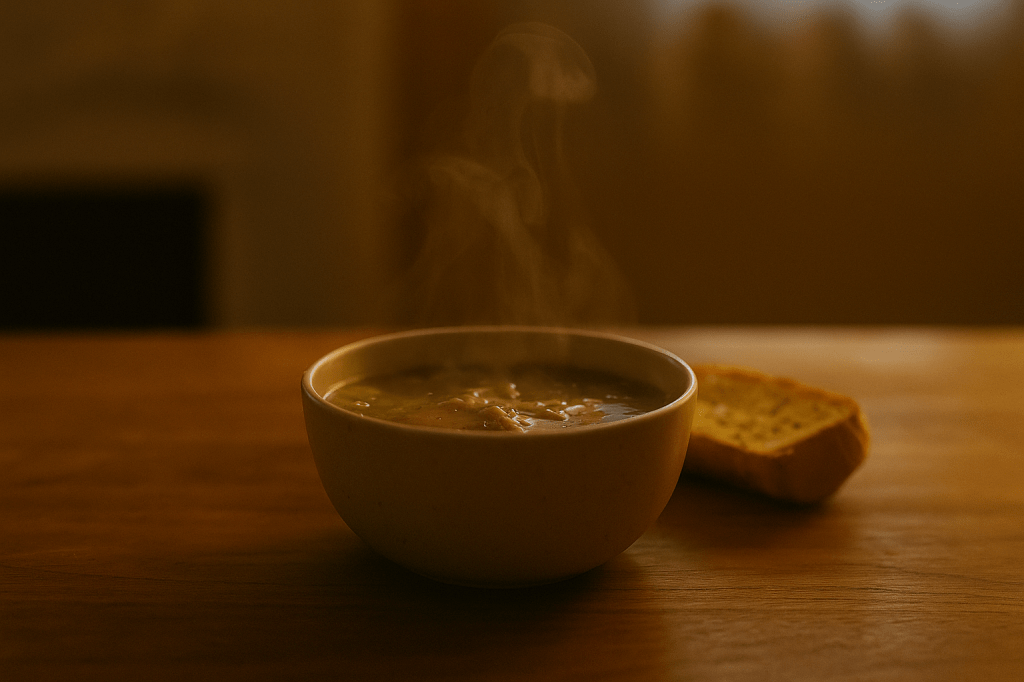
    Yesterday, I thawed one. But instead of rushing it, instead of taking the shortcut the microwave offers, I warmed it the slow way—in a pot, on low heat. Stirring occasionally. Letting the aroma rise up like a memory you didn’t realize you’d forgotten.

    Warming soup slowly feels like a kind of respect.

    A way of honoring the time it took to make it.

    A way of stepping back from the pace of everything else in life.

    When it was ready, I poured it into a bowl and paired it with garlic bread I’d tucked away in the freezer. Not fancy bread. Not homemade. But good enough—especially when its only job was to ensure that not a single drop of soup went uneaten.

    I’m generally not a fan of cold winters. The wind cuts too sharply. The days darken too early. The quiet feels heavier than I’d like to admit. But this soup—this simple bowl of warmth I made weeks ago and brought back to the stove—makes the season feel less like something to endure and more like something to move through gently.

    Soup does that.

    It softens hard days.

    It steadies you.

    It reminds you that survival doesn’t always have to be a battle—it can be as simple as letting something warm into your body and sitting still long enough to feel it.

    And maybe that’s why soup matters so much—not just to me, but to all of us.

    Because the ingredients may change. The hands that make it may differ. The kitchens may range from polished granite countertops to back-room burners in community centers. But the gift is the same:

    Here is warmth.

    Here is comfort.

    Here is something made with care, even if only for a moment.

    And in a world that asks so much of us, a simple bowl of soup can feel like an act of mercy.

    Kyle J. Hayes

    kylehayesblog.com

    Please like, comment, and share

    Resources for Hard Times

    If you’re looking for practical help, food support, or community resources, you can visit the Salt, Ink & Soul Resources Page.
    👉 Resources for Hard Times

    👉 Keto Green Chile Chicken Soup Recipe

    👉 Simple Garlic Chicken Soup Recipe

  • A Love Letter to Potlucks, Church Basements, and Aluminum Trays

    A Love Letter to Potlucks, Church Basements, and Aluminum Trays

    Salt, Ink & Soul — Humanity Through Food Series

    There’s a special kind of magic that happens when a community decides—quietly, without fuss—that everyone needs to be fed.

    Not in some grand, official sense.

    Not with grants or committees or agendas.

    Just fed.

    Fed the old-fashioned way:

    On a folding table in a warm room that smells like memory, grief, pride, and somebody’s auntie’s best Fried Chicken.

    I’ve always had a soft spot for potlucks. Maybe it’s because people bring their best selves to those tables—literally. Every dish arrives covered in foil and hope, carried by someone who has spent the whole morning stirring and tasting and adjusting because they wanted to show what they could do. Not to brag. But to share.

    A potluck is a quiet confession:

    This is the dish I trust to speak for me.

    And there’s something beautiful about the way people place their food on the table and then pretend not to watch. They hover from a distance—not out of ego, but out of longing. Waiting for that smile. That small nod. That moment when someone tastes their dish and closes their eyes, just for a heartbeat, because something familiar touched them.

    You can’t buy that moment.

    You can only feed it.

    Church basements have their own flavor of truth.

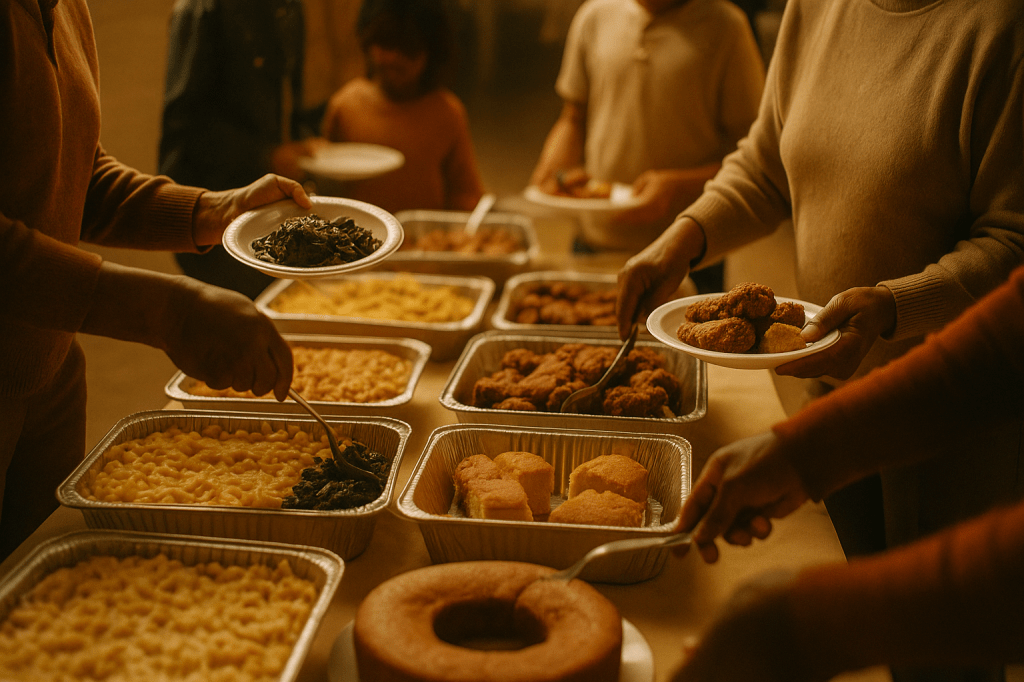
    The ceilings are low. The chairs wobble. The lighting flickers. But none of that matters, because the food—the real food—is honest. Greens cooked down until they surrendered. Cakes that lean to the left but taste like heaven. Macaroni and cheese that could heal almost anything.

    People don’t come to impress in those spaces.

    They come to belong.

    They come to be held by the warmth of a room that has seen everything: baptisms, funerals, heartbreak, and survival. And in every season of life, the table stays set.

    Long before the world used terms like mutual aid, this was it.

    This was the safety net.

    This was how communities kept each other alive.

    No one asked, “What can I bring?”

    They asked, “Who needs to eat?”

    And somehow the table always balanced itself—one person bringing meat, another bringing bread, someone else bringing something sweet, and a few saints making sure the greens showed up so the ancestors wouldn’t fuss.

    It wasn’t organized.

    It was instinctual.

    Care doesn’t need a sign-up sheet.

    It just needs a kitchen.

    I think about those aluminum trays—the ones that bend if you hold them wrong. They don’t look like much, but they’ve carried entire histories. Weddings. Funerals. Reunions. Wednesday nights where people just needed a reason not to be alone.

    Aluminum trays are our generation’s scarred cast-iron skillets: humble, overlooked, essential.

    And they remind me of something I fear we’re losing in our digital, curated world:

    We were feeding each other long before we were performing for each other.

    A potluck isn’t content.

    It’s a community.

    It’s generosity without ceremony.

    It’s survival disguised as Sunday comfort.

    That’s probably why I love them so much.

    Because in a culture obsessed with individualism, a potluck is a rebellion.

    It says: We do this together.

    It says: Come as you are, and bring whatever you can.

    It says: There is room for you at this table, even if life hasn’t been kind, even if you feel small, even if all you could manage today was paper plates.

    Food has always been the language that makes room for the parts of us we don’t know how to name.

    So here’s my love letter—

    to the potlucks, the church basements, the community centers, the too-small living rooms, the aluminum trays carried in trembling hands.

    To the people who show up with their best dishes and their quiet hopes.

    To those who feed others before feeding themselves.

    To the tables that held us long before we had the words for what we were carrying.

    May we never forget how to gather like this.

    May we always remember that survival was never meant to be a solo act.

    And may we keep spreading these tables—wherever we can, with whatever we have—so no one has to face the world hungry, unseen, or alone.

    Kyle J. Hayes

    kylehayesblog.com

    Please like, comment, and share

    Resources for Hard Times

    If you’re looking for practical help, food support, or community resources, you can visit the Salt, Ink & Soul Resources Page.
    👉 Resources for Hard Times

  • The Last Ingredient House

    The Last Ingredient House

    I was just running in for a couple of things — Mozzarella cheese, maybe some crushed tomatoes. The kind of trip you make when you’ve already decided the night’s ritual: I was going to make pizza. And by making pizza, I mean the whole thing — crust proofed over two days, sauce coaxed slowly from garlic, basil, and crushed tomatoes, Cheese grated by hand until my knuckles risked losing skin.

    At the register, the cashier noticed the haul — the Cheese, the flour, the good olive oil — and smiled.

    “Making pizza?” she asked.

    “Yes,” I said. And just like that, a conversation bloomed.

    She told me she came from what she called an ingredient house. A house where the kitchen was a kind of altar — stocked with the quiet assurance that if company came calling at the last minute, her mother could turn out a beautiful meal without panic. Beans soaking on the stove, onions already sweating in cast iron, a roast pulled from the freezer because it had been waiting for just such a night.

    I nodded, letting the phrase roll around in my mind: ingredient house.

    My own home growing up was… not quite that. We had food, sure — plenty of it — but a lot of it came sealed in boxes with microwave instructions printed in cheerful fonts. Frozen lasagna, instant potatoes, and cans of soup you could doctor up if you felt ambitious. There was love in those meals, but also an efficiency, a shorthand. Meals that required only heat or water, not intuition.

    The Age of Premade Fresh

    Now, we live in a time where you don’t even need to own salt. Walk into any grocery store and you’re surrounded by the new altar — pre-marinated proteins, ready-to-bake pizzas, trays of vegetables already washed, chopped, and glistening under plastic. Fresh, yes. But fresh in a way that requires no relationship, no waiting, no patience.

    And then there’s DoorDash — the pandemic’s golden child. The savior we thanked when we could not leave our homes, when fear of each other turned kitchens into bunkers. Now it lingers, reshaping our sense of effort. You don’t even have to boil the water anymore. You just scroll, tap, and wait for a stranger to leave your dinner at the door like a sacrament.

    What We Lose

    Standing there at the checkout, I realized I wasn’t just buying Cheese. I was buying memory. I was buying slowness. I was buying back the hours required to knead dough, to wait for it to rise, to smell the kitchen change as it bakes.

    I thought about her ingredient house — the kind of place where a pantry wasn’t just storage but possibility. And I wondered what we lose when we give that up. When dinner stops being a verb and becomes an algorithm.

    There is something quietly radical about knowing how to feed yourself from scratch. About putting your hands in dough, trusting yeast to do its slow, invisible work, and showing up for it when it’s ready. Something stubborn and beautiful about refusing the constant seduction of “just heat and serve.”

    What’s Next?

    Sometimes I wonder what comes after this. If premade fresh is today’s answer, what’s tomorrow’s? Meals that make themselves while you scroll? Nutrition is delivered intravenously, so you don’t have to chew. Or maybe a return to ingredient houses — not as nostalgia but as rebellion.

    Maybe that’s why I make pizza this way. Because there’s a small act of resistance in it. In a world of frictionless consumption, I choose friction. I choose to slice garlic thin enough to smell on my fingertips hours later. I choose to shred Cheese until my hands ache. I choose to wait for the dough to rise because I want the reminder that some things — the best things — cannot be rushed.

    And maybe, if I keep doing this, my home becomes the ingredient house I didn’t grow up in. A house where you can pull a meal out of thin air, not because it’s convenient, but because you’ve kept faith with the slow, stubborn art of feeding people well.

    By Kyle J. Hayes

    kylehayesblog.com

    Please like, comment, and share

    Please click here for my Pizza Crust and Sauce Recipe.

  • Beneath the Steam: On Illness and the Old Ways

    Beneath the Steam: On Illness and the Old Ways

    It began like a thief who knew my schedule better than I did—slow, deliberate, testing every door before finding the one left unlocked. A scratch in the throat. A heaviness in the limbs. The faint suspicion that breathing had become less casual, less thoughtless, than it had been yesterday. I told myself I’d push through. I said to myself that sickness is for other people, those who have the time for it. But sickness does not bargain. By midweek, it had settled in fully, an uninvited tenant pressing down on my lungs, hijacking one of the things I hold dearest—my taste.

    Something is humbling about losing your sense of taste. I have crossed oceans for flavor. I have eaten in alleys and palaces alike, chasing the elusive truth of a dish. Food, to me, is not just sustenance—it is memory, culture, love made tangible. And now it was gone. My morning coffee could’ve been hot water from a radiator. My favorite bowl of ramen tasted like broth poured through gauze. Even the memory of taste felt muted, as though my brain were looking for a file that had been deleted.

    We live in an age where you can treat almost anything with a credit card and a ten-minute visit to the pharmacy. Pills for the fever, sprays for the throat, syrups that coat the lungs in menthol haze. Convenience at the ready. But the best cures—the ones that live in the marrow of memory—require no prescription. For me, it begins with green tea, lemon, and honey. My mother’s go-to remedy. The scent alone brings her into the room: the citrus brightness cutting through the air, the floral sweetness of honey sinking into the steam, the earthiness of green tea grounding it all. She swore by it. I still do.

    And then, there is chicken soup. I’ve traveled the country, eaten at the tables of strangers, but if America has a single unifying folk remedy, it is this. In Southern kitchens, Italian kitchens, and even kitchens in California, it’s the same idea, different dialects. Chicken, water, vegetables, salt. Sometimes noodles, sometimes rice. Always the intention to heal. And it works. I don’t know if it’s the steam easing the lungs, the broth coaxing warmth back into your bones, or the simple fact that someone cared enough to make it. But it works.

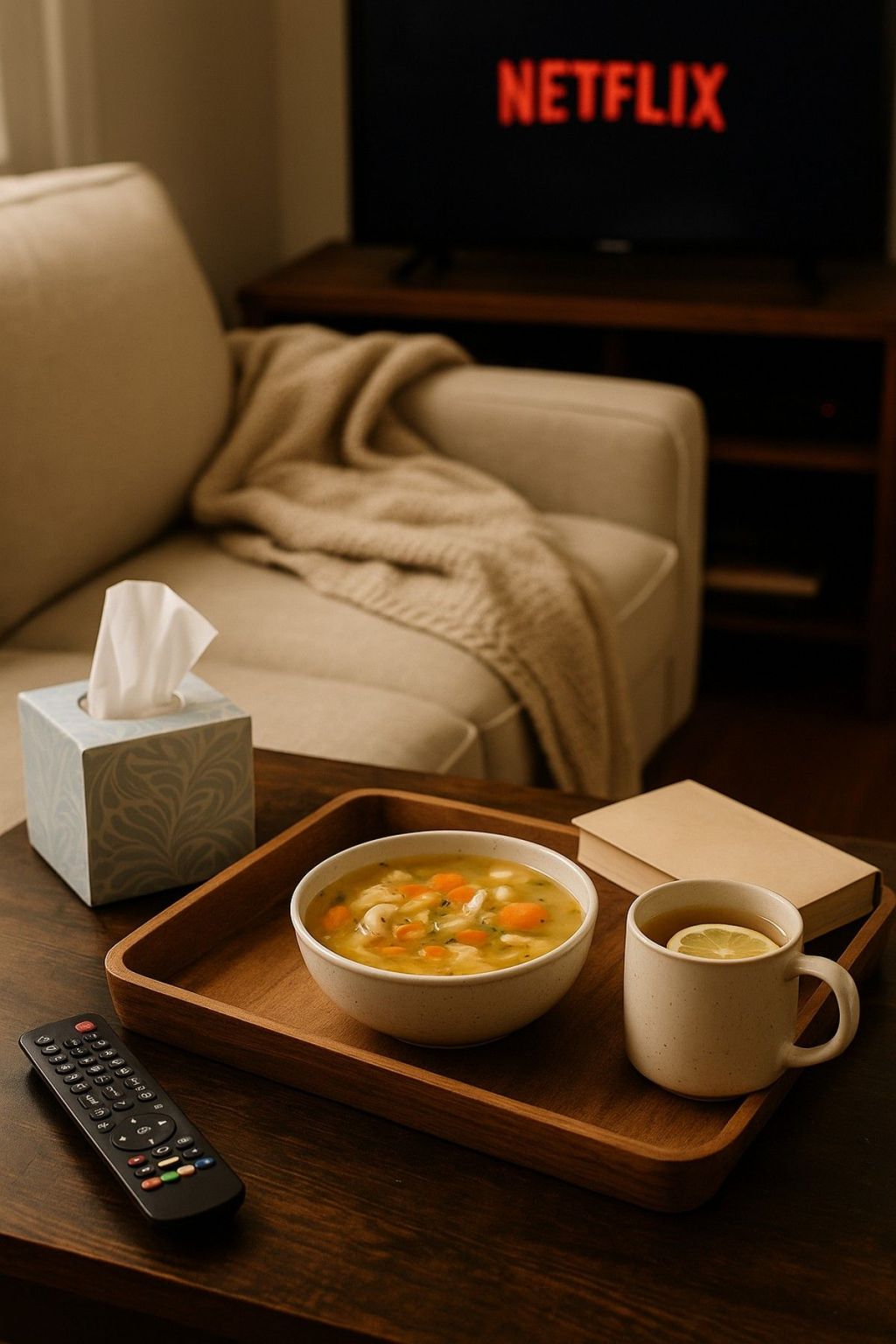
    There’s a ritual to it. Once the soup is simmering, you find your spot. For me, it’s the sofa, where the sun pools in late afternoon. Pillows arranged just so, blanket at the ready. A remote within arm’s reach, Netflix queue prepared to swallow the next several hours. This is not indulgence; this is convalescence. You let the warmth from the bowl linger in your hands before each spoonful, breathing in the scent as if it were a prayer. You sip slowly, allowing the broth to seep into the cracks that sickness has made in you.

    Recovery isn’t just about medicine. It’s about surrender—admitting that you are, in fact, mortal, and in need of care. It’s about allowing yourself to slow down, to be still, to let the old ways work their magic while the world spins on without you. Green tea and lemon. Honey. Chicken soup. These are not just cures for the body—they are acts of remembrance, of connection to the people and places that shaped you. They remind you that before we had walk-in clinics and urgent cares, we had each other. And sometimes, that was enough.

    By the time my taste returns, I know the sickness will already be loosening its grip. But the tea and the soup will remain, as they always have, waiting for the next time life reminds me that I am breakable—and that the cure is as much about being fed as it is about being healed.

    Click here for the full chicken soup recipe

    https://kylehayesblog.com/simple-garlic-chicken-soup/

    By Kyle J. Hayes

    kylehayesblog.com

    Please like, comment, and share

  • This May Sound Like I’m Angry

    This May Sound Like I’m Angry

    This may sound like I’m angry.

    That’s because I am.

    I’m angry about food.

    But not just food.

    I’m angry about what gets buried with it.

    What we let slip through our fingers.

    What we protect so fiercely that we never get to pass it on.

    Some recipes in families are so tied to memory, and they might as well be spiritual.

    Not written in cookbooks, not on notecards, but in gestures.

    In pinches, pours, and stirs done just so, the things you only learn by being in the room.

    But those rooms are empty now.

    We call it tradition, secrecy, and the selfish need to be the one who gets all the oohs and ahhs at the family gathering.

    To be the keeper of the sacred gumbo, the only one who knows how the sweet potatoes get that crust just right.

    We hoard recipes like treasure, and I get it—maybe it’s the only thing some of us ever had to call our own.

    But it’s not treasure if it dies with you.

    That’s not legacy. That’s vanity.

    And the loss is deeper than ingredients.

    Every time someone passes and their recipe goes with them, we don’t just lose a dish.

    We lose a moment.

    A whole damn lifetime of Sundays.

    Of back-porch stories.

    Of laughing so hard over The Red Kool-Aid and potato salad, you forget how hard life has been for a second.

    Healing as it’s passed hand to hand with every spoonful.

    You know what it’s like to taste a memory?

    To close your eyes and feel the presence of someone who’s been gone for a decade, just because their dinner rolls hit your tongue the right way?

    We lost that.

    Because someone wanted to be special.

    Because someone needed to be seen more than they needed to share.

    And then life happened.

    People fell out.

    Phones stopped ringing.

    The kitchen got quiet.

    And just like that, the recipe is gone.

    And all the meals it ever touched, all the stories it ever summoned—gone, too.

    So yes—hell yes I’m mad.

    Because these aren’t just dishes.

    They’re time machines.

    They’re inheritance.

    They’re how a little Black boy in the Midwest learns about a cousin he never met, not through a photograph, but through how his mama seasons her Greens.

    And we’re letting them vanish.

    We call food “soul” and starve our legacy because we’re too proud, wounded, or petty to pass it on.

    We forget that food was how our ancestors hid love in plain sight.

    That in a world where everything could be taken—freedom, names, land—the ability to make a damn good meal was the one thing they couldn’t steal.

    That’s what we throw away whenever we let a recipe die with a grudge.

    You want to be special?

    Be the one who teaches.

    Be the one who says, “Come on. I’ll show you.”

    Be the one who writes it down—not to post online, but to slip into the hands of the next generation.

    To say:

    This is yours now.

    This is where we come from.

    This is how we survived.

    Because the pot of greens is more than flavor.

    The macaroni isn’t just texture.

    The peach cobbler is not just a dessert.

    It’s home.

    It’s a ritual.

    It’s a reminder of who we were, even when the world tried to make us forget.

    So yes—I’m angry.

    Because we’ve buried too much already.

    I’m tired of funerals where we cry over both the person and the food we’ll never taste again.

    I’m tired of silence being passed off as tradition.

    I’m tired of watching people wait until it’s too late to care.

    If we want our culture to live, we must do more than eat it.

    We have to honor it, share it, teach it, and protect it—not like a secret but like the gospel it is.

    Because in the end, a guarded recipe dies in the dark.

    But a shared one?

    That’s how we stay alive.

    By Kyle J. Hayes

    Please Like, Comment, and Subscribe