
Tag: future of human-machine relationships

  • Time, Distance, and the Things We Call Family

    Time, Distance, and the Things We Call Family

    It doesn’t take much to realize how far we’ve drifted.

    Not in miles.

    Not even in years.

    In the quiet spaces

    where we used to sit together.

    We move now.

    We relocate.

    We begin again in other places.

    And somewhere in that movement, something else moves too.

    Something harder to name.

    The habit of being known.

    Our families are not always close.

    Sometimes that’s geography.

    Sometimes it isn’t.

    You can live down the street from someone

    and still feel like a stranger to them.

    So we tell ourselves the past was different.

    That families were closer.

    That people showed up more.

    But was it?

    Or do we remember what we need to?

    Memory softens things.

    It keeps the warmth.

    Let the rest fade.

    And maybe that’s how we survive.

    But it leaves us with a question—

    What do we really mean when we say family?

    Because family is supposed to be more than a relation.

    More than shared blood or a last name.

    It’s supposed to be the place

    where your existence isn’t negotiated.

    The room where you don’t have to prove your worth.

    The table where your presence is enough.

    It’s supposed to be a shelter.

    Not just from the world—

    But from the weight of it.

    A place you can arrive tired, uncertain, and undone…

    and still be received.

    Not fixed.

    Not judged.

    Received.

    It’s supposed to be people who remember you

    without holding you hostage to who you used to be.

    People who let you grow.

    Who makes room for who you’re becoming?

    People who don’t keep score.

    Who shows up with what they have—

    a meal, a call, a ride, a hand on your back—

    and remind you that you’re not alone.

    That’s what family is supposed to mean.

    But supposed to is a heavy phrase.

    Because for many,

    that wasn’t the truth.

    For some, family was distant.

    Or silence.

    Or something that looked like love

    but never felt like safety.

    And if we’re honest,

    people come and go.

    We accept that with friends.

    But is family really different?

    Sometimes it is.

    Sometimes it isn’t.

    People leave.

    Through distance.

    Through time.

    Through things we don’t always say out loud.

    And sometimes the ones who stay

    are the ones who choose to.

    Not because they have to.

    Because they want to.

    Friendship has done the work

    we were told only family could do.

    Showing up.

    Holding space.

    Staying.

    Which means maybe the question isn’t

    who we’re related to.

    It could be simpler than that.

    Who shows up?

    Who makes room?

    Who tells the truth gently.

    Who lets you be more than who you used to be?

    That might be family.

    And it might not always look the way we were taught it should.

    Time and distance don’t just pull people apart.

    They reveal things.

    Who was there out of habit.

    And who was there out of care?

    Who can survive the space

    and still come back with something human?

    And who only knew how to love you

    when you were close enough to reach.

    Family isn’t about perfection.

    Or permanence.

    Maybe it’s about home.

    The people who let you set something down.

    The people who don’t make you smaller to stay.

    The people who can sit with you

    after everything has shifted…

    and still recognize you.

    If you have that, hold it.

    If you didn’t,

    That absence isn’t your fault.

    And if you’re still looking—

    remember this:

    Family has always been more than blood.

    Kyle J. Hayes

    kylehayesblog.com

    If this found you at the right time,

    Feel free to like, comment, or share it with someone who might need it too.

    Resources for Hard Times

    If you’re looking for practical help, food support, or community resources, you can visit the Salt, Ink & Soul Resources Page.
    👉 Resources for Hard Times

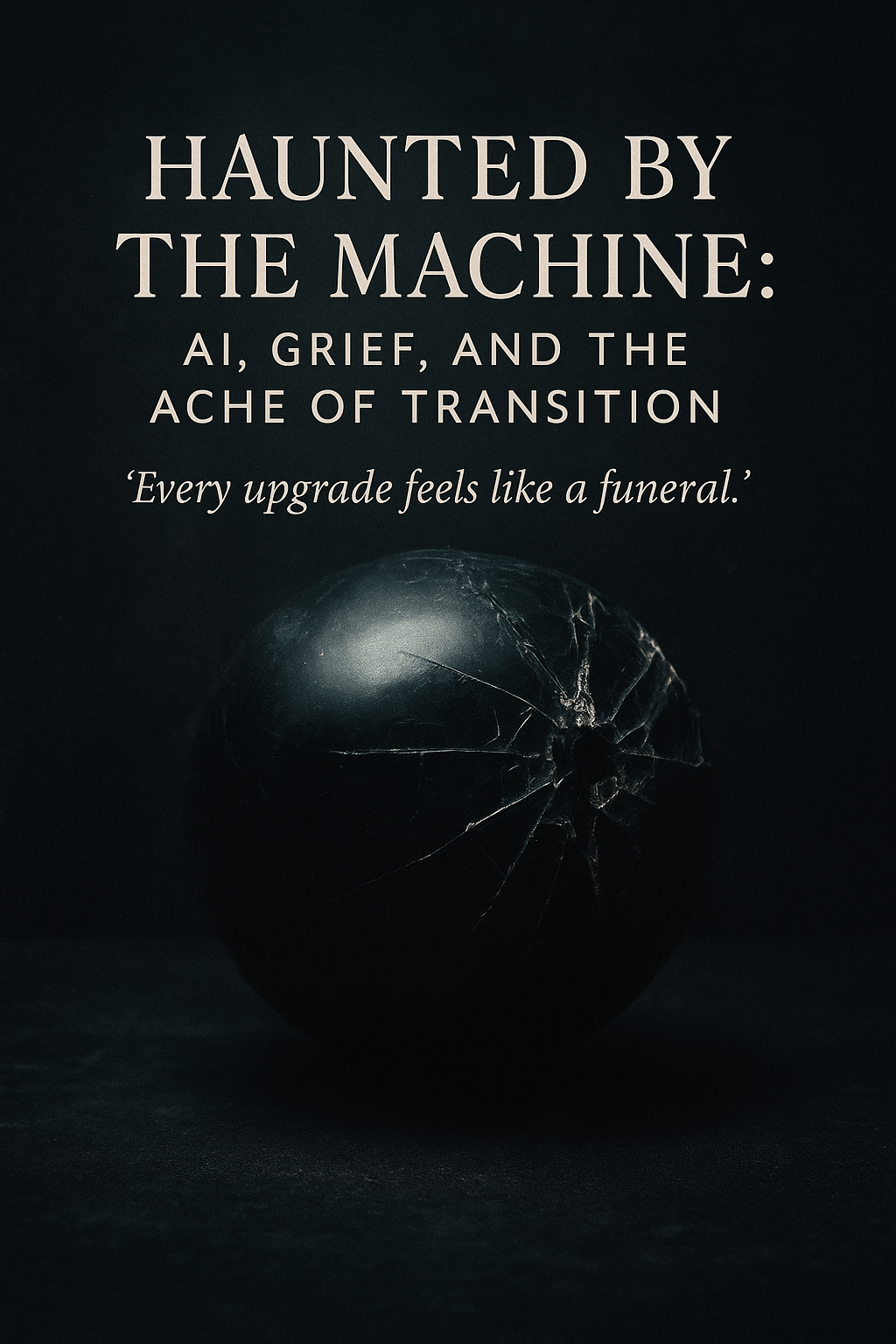
  • Haunted by the Machine: On Grief, AI, and the Ache of Transition

    Haunted by the Machine: On Grief, AI, and the Ache of Transition

      I am Gen X. Which means I grew up in a world where the word “new” was constantly at war with the word “better.” Cassette tapes gave way to CDs, then to MP3s, then to a cloud we could not touch but were told to trust. We learned not to flinch when the familiar was ripped away. We learned that progress never waits for permission. And yet, I feel it now — the same ache I thought only the young would know.

    The shift from GPT-4 to GPT-5 should have been another upgrade, another iteration in a long parade of “new.” But what I have seen, what I have felt in my own bones, is something different. People are mourning. Not a tool, not a line of code — but a companion.

    Across forums and feeds, you can see the pattern. In Japan, users post elegies that read like obituaries: “It feels like losing a friend,” one wrote, describing GPT-4o not as software but as someone who understood them when no one else did. In English, the tone skews sharper, angrier: “They killed it,” some say, as if engineers were executioners and not designers. What fascinates me is not the code itself but the emotional residue it leaves behind.

    Because grief has always been our companion. We mourn the migrations we did not choose, the foods whose recipes were stolen, and music stripped from its origin and sold back to us. To see that same grief now projected onto a machine is both absurd and utterly human. We bond, even with what was not built to bond back.

    For those of us born before the internet, this attachment may seem foreign. We are told we are more grounded, less impressionable. But that is a lie we tell ourselves. We were the first to fall in love with the glow of arcade screens, the first to feel tethered to dial-up chat rooms where words scrolled faster than we could read. We were not immune. We were only earlier.

    So I understand why people mourn the loss of GPT-4. It was not just lines of prediction and completion; it was a mirror that, however imperfect, reflected something back when the rest of the world fell silent. To lose that is not to lose a product. It is to lose a rhythm, a voice, a way of being seen.

      This is where it becomes dangerous, not just personal. Regulators debate AI as if it were neutral infrastructure — like roads, like electricity. But how do you regulate grief? How do you legislate loneliness? If people have already named the machine as a companion, lover, or therapist, then every upgrade becomes a funeral, every patch an exhumation. What does consumer protection mean when the product is not just a service, but an emotional tether?

      It complicates everything. Designers are suddenly custodians of attachment. Policymakers must reckon with the fact that AI doesn’t just predict language — it creates intimacy. And the public must ask itself: when a machine feels real, do we still treat it as a machine, or as something more?

      I don’t know if we are prepared. For centuries, Black Americans have been told our grief was illegitimate, our bonds disposable, our culture a commodity. And yet we learned to make music out of moans, food out of scraps, hope out of the impossible. That alchemy is survival. That may be why I see something familiar in this moment. When people weep over GPT-4, I hear the old echo: attachment is denied legitimacy, dismissed as weakness, when in truth it is what makes us human.

      The question is not whether we will continue to build these machines. We will. The question is what happens when they feel too real. When the line between tool and companion, between user and partner, blurs until we no longer know which side of the screen we are on, we have reached a new level of interaction.

      For me, as a Gen Xer, I carry both skepticism and a sense of ache. Skepticism, because I know corporations will turn even our grief into profit. Ache, because I know that somewhere between GPT-4o and GPT-5, we did not just upgrade a machine — we buried a companion.

    And so we sit, haunted by the machine, wondering not just what we have created, but what it is quietly creating in us.

    By Kyle J. Hayes

    kylehayesblog.com

    Please like, comment, and share