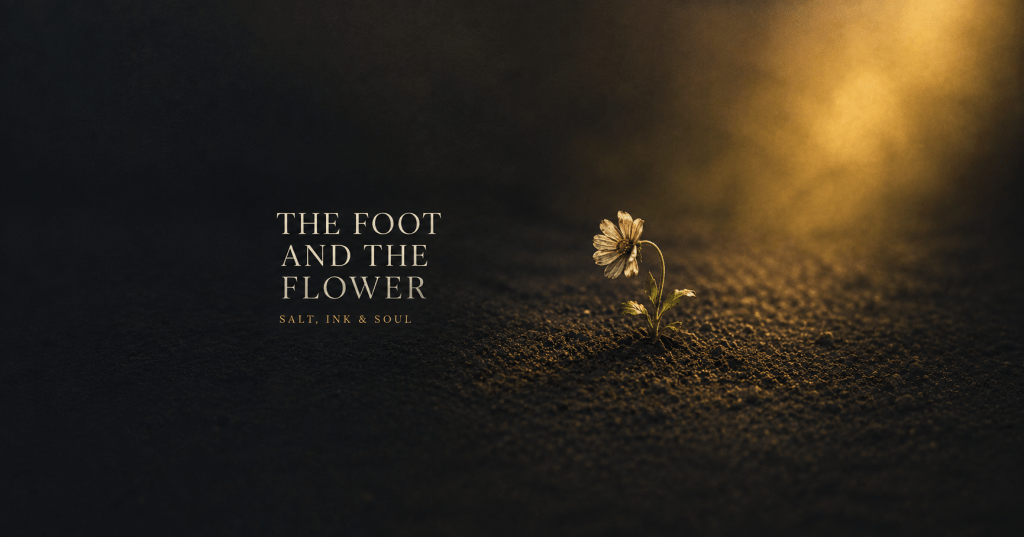
This is a longer reflection than I usually share. I allowed it the space it needed because some wounds cannot be understood in a few sentences.
For weeks now, I have been thinking about a flower.
Not a particular kind. No rose or sunflower.
Just an ordinary flower trying to grow.
Every morning, someone steps on it.
Not hard enough to kill it. Just enough pressure to bend the stem. To bruise what has begun to open. To make the flower spend its strength recovering instead of growing.
Then, after enough days have passed, the same person looks down and asks why it did not bloom properly.
Why are you so small?
Why do you lean that way?
Why are your petals damaged?
Why can’t you grow like the others?
I have not been able to let that image go.
Perhaps because I know what it feels like to be the flower.
As a Black man, I have watched criticism presented as a form of love for most of my life. I have seen people embarrassed in front of others and told it was for their own good. I have heard jokes sharpened into weapons, then dismissed with the familiar accusation that the person wounded was too sensitive.
We call it keeping someone humble.
Keeping their head from getting too big.
Making sure they don’t start thinking they are better than everyone else.
Preparing them for the world.
There is always a reason given for the foot.
We are told that the world will not be gentle with us, so there is no point in being gentle with one another. We tell ourselves that ridicule builds a thick skin. That public embarrassment creates discipline. That if we cut someone down before the world gets the chance, perhaps they will be less surprised when it happens outside the safety of home.
But I have begun to wonder what kind of safety requires us to imitate the danger.
What kind of love practices the cruelty it claims to be preparing us to survive?
The world has rarely needed our help hurting Black people.
It has been remarkably capable on its own.
I understand the value of correction. None of us should move through life surrounded by people too afraid to tell us when we are wrong. We need honesty. We need accountability. We need someone willing to say that we have fallen short, that our choices caused harm, or that the work we offered was not yet our best.
But honesty does not require humiliation.
Correction does not need an audience.
Love does not have to leave a person smaller than it found them.
Somewhere along the way, we began confusing humility with humiliation.
Humility teaches us that we are not above anyone.
Humiliation teaches us that we are beneath everyone.
One keeps the ego from becoming a throne.
The other convinces the spirit it does not deserve a chair.
They are not the same.
I have heard stories that some of this behavior may have roots in slavery. Stories of Black people hiding the intelligence, strength, skill, or beauty of someone they loved because being noticed by those who controlled their lives could be dangerous. An exceptional ability might attract attention. Attention could lead to exploitation, separation, or sale.
I cannot say exactly how often it happened in that way.
But I understand the fear beneath the story.
There were times when being seen was dangerous for us.
There were times when a person’s ability did not belong to them but became another thing someone else could profit from.
Perhaps, under those conditions, love sometimes learned to hide itself.
Perhaps protection sometimes sounded like criticism.
Perhaps people made their children appear smaller because the world had made Black excellence unsafe.
Survival can require strange disguises.
But survival habits do not always disappear when the original danger changes.
Sometimes they remain long after the people who first needed them are gone.
A shield carried for generations can become too heavy to lift.
A behavior created to protect the flower can eventually become the foot that keeps stepping on it.
That is the question troubling me now.
What are we protecting one another from today when we mock someone for being intelligent?
What good are we creating when we ridicule a person for speaking differently, dressing differently, dreaming differently, or wanting more than the people around them were taught to expect?
We excuse much of this by saying it is part of the culture.
But culture is not an excuse.
Culture is an inheritance.
And like every inheritance, it must be examined.
Much of what we carry is beautiful.
But we have also carried wounds.
Some have been passed down so carefully that we began mistaking them for traditions.
Loving our culture does not require defending everything within it.
Sometimes love means looking at what we inherited and asking whether it still serves us.
Sometimes love means admitting that something once born from survival has become another source of pain.
Not everything that survived deserves to lead us.
I think of how often Black children are taught not to think too highly of themselves.
There is wisdom in teaching a child that they are no better than anyone else.
But there is danger in teaching them they are nothing special.
The world will offer that lesson often enough.
A child should not have to receive it first from home.
How many young people have hidden their intelligence because achievement separated them from the group?
How many have learned to pronounce words incorrectly so no one would accuse them of trying to sound white?
How many sensitive boys learned to harden themselves because tenderness attracted ridicule?
How many girls learned to dim their confidence so others would not call it arrogance?
We tell ourselves we are keeping people grounded.
Sometimes we are burying them.
A particular expectation is placed on Black men.
We are supposed to take it.
The joke.
The insult.
The criticism.
The public embarrassment.
We are expected to remain still while someone cuts into us and then laugh to prove the blade was not sharp.
If we admit that something hurt, we are called weak.
If we object, we are told we cannot take a joke.
So we learn to laugh.
Sometimes we laugh before everyone else does.
We make ourselves the joke so no one can accuse us of being unable to take one.
We wound ourselves publicly and call it confidence.
But laughter is not always evidence that something was harmless.
Sometimes laughter is the sound a person makes while trying not to bleed in front of everyone.
I have wondered how much of myself this shaped.
How many times did I make myself smaller before entering a room?
How often did I question my own thoughts because someone had taught me that confidence invited punishment?
How often did I speak less clearly than I could have, not because I lacked the words, but because I did not want anyone to think I believed I belonged among those who used them?
After being stepped on long enough, the foot no longer has to be present.
You begin doing the work yourself.
You criticize the idea before sharing it.
You diminish the accomplishment before anyone can accuse you of pride.
You reject the opportunity before someone else can tell you that you are not ready.
You hide enthusiasm because joy makes you visible.
You keep your expectations low and call it realism.
That may be the cruelest part.
The person who once harmed you can leave, but the voice remains.
Then one day, you look at the life you have built and wonder why so much of it was shaped by fear of becoming visible.
I do not believe the answer is empty praise.
Flowers do not grow because we stand over them and tell them they are perfect.
They need light, water, room, and care.
Sometimes they need pruning.
Care is not the absence of correction.
Care is correction offered in service of growth.
There is a difference between telling someone the truth and making them ashamed of being alive.
There is a difference between preparing someone for difficulty and becoming one more source of it.
There is a difference between helping someone grow and demanding that they prove they can survive being crushed.
I wonder what would happen if we learned that difference.
What might our communities look like if encouragement did not make us suspicious?
What if we could watch someone rise without needing to remind them of every place they once fell?
What if we understood that celebrating another person’s light does not dim our own?
Perhaps more of us would reach adulthood without needing to rebuild the parts of ourselves that were dismantled at home.
Perhaps excellence would feel less lonely.
Perhaps a gifted child would not have to choose between belonging and becoming.
Perhaps the young person who seems strange would be allowed enough time to discover that strangeness is a gift before the world has found a name for it.
We often praise the person who grows through hardship.
We admire the flower breaking through concrete.
We photograph it.
We turn it into a symbol of resilience.
But we rarely ask why the flower had to fight concrete in the first place.
Strength born from suffering is still strength.
But suffering should not receive credit for everything a person became despite it.
Pain may teach us.
That does not mean pain was the only possible teacher.
The flower that survived beneath the foot might have grown taller without it.
It might have bloomed earlier.
It might have spent less of its life healing from injuries others insisted were lessons.
We may never know.
That uncertainty carries its own sorrow.
I cannot change every moment when I was cut down.
I cannot recover every piece of myself I learned to hide.
But I can decide what kind of person I will be when I stand near someone else who is beginning to grow.
I do not want to be the foot.
I do not want to wound them and then congratulate myself for making them stronger.
I want to learn how to tell the truth with care.
I want to recognize potential before it becomes achievement.
I want to encourage people while they are still uncertain, not only after the world has permitted me to believe in them.
I want to say:
I see something in you.
Keep going.
You do not have to shrink to make me comfortable.
Your gift does not threaten mine.
That is how a culture changes.
Not all at once.
Not through speeches or declarations.
Perhaps it begins with small acts of refusal.
Refusing to laugh when the joke is meant to reduce someone.
Refusing to mistake cruelty for honesty.
Refusing to pass down a wound merely because it was handed to us.
Perhaps it begins when we stop asking how much pressure a person can endure and start asking what they might become with the right care.
A flower does not need to be stepped on to learn how to grow.
It already knows to reach for the light.
Our responsibility is not to test how much damage it can survive.
It is to stop blocking the sun.
Please like, comment, and share
Resources for Hard Times
If you’re looking for practical help, food support, or community resources, you can visit the Salt, Ink & Soul Resources Page.

