
Tag: gratitude

  • The Places We Choose to Live

    The Places We Choose to Live

    Over the past year, I have found myself changing more than my routines.

    I have been changing my environment.

    Not simply the places I spend my time, but the conversations I allow myself to remain in. The voices I listen to. The people I keep close enough to influence the way I see the world.

    What surprised me most was not the change itself.

    It was how uncomfortable certain environments suddenly became.

    Conversations I once tolerated now leave me exhausted. Gatherings that once felt ordinary now feel strangely heavy. I find myself noticing how easily some people can take something beautiful and immediately begin searching for what is wrong with it.

    There is an old saying about finding fault in a rose.

    Most of us know people who could walk through a garden and speak only of the thorns.

    They witness kindness and wonder what someone wants in return.

    They hear good news and begin predicting how it will end.

    They receive a blessing and instinctively search for the hidden cost.

    For a long time I wondered why.

    The older I become, the less interested I am in judging those people.

    Life has a way of teaching difficult lessons.

    Pain can narrow our vision.

    Disappointment can convince us that hope is dangerous.

    Betrayal can make suspicion feel wiser than trust.

    Many people are carrying wounds the rest of us will never fully understand.

    Remembering that has made me more compassionate.

    But it has also taught me something equally important.

    Compassion does not require residency.

    You can understand someone’s pain without moving into it.

    You can love someone without adopting their way of seeing the world.

    You can care deeply for another person while quietly protecting the peace you have worked so hard to cultivate.

    That has become one of adulthood’s quiet responsibilities.

    Not every invitation deserves acceptance.

    Not every conversation deserves your attention.

    Not every headline deserves your emotion.

    Not every opinion deserves a room inside your mind.

    We spend so much time protecting our homes from damage.

    We lock our doors.

    We replace broken windows.

    We tend our yards.

    Yet many of us leave the front door of our souls standing wide open, allowing resentment, outrage, cynicism, and fear to wander in whenever they please.

    Eventually, whatever is allowed to stay begins rearranging the furniture.

    These days I find myself less interested in what is popular and more interested in what is nourishing.

    Less interested in what demands my attention and more interested in what deserves it.

    I’m not sure what to call this change.

    Maybe it is wisdom.

    Maybe it is simply growing older.

    Or maybe it is finally understanding that peace is rarely something we find.

    More often, it is something we protect.

    I’ve noticed that when I become careful about what enters my mind, everything else begins to change.

    My thoughts become gentler.

    My patience grows longer.

    Gratitude arrives more often than complaint.

    Even in a world that still contains cruelty, injustice, and heartbreak, I begin noticing small mercies I once hurried past.

    The darkness has not disappeared.

    I simply refuse to make my home inside it.

    Perhaps that is what tending the soul has always meant.

    Not pretending evil does not exist.

    Not closing our eyes to suffering.

    But choosing, again and again, to give more of ourselves to what is true than to what is loud, more to what is beautiful than to what is broken, more to what nourishes than to what merely consumes.

    Because a soul is not unlike a garden.

    It does not become what we admire.

    It becomes what we cultivate.

    Kyle J. Hayes

    kylehayesblog.com

    Please like, comment, and share

    Resources for Hard Times

    If you’re looking for practical help, food support, or community resources, you can visit the Salt, Ink & Soul Resources Page.

    👉 Resources for Hard Times

  • Becoming Careful About What Enters the Soul

    Becoming Careful About What Enters the Soul

    Years ago, for reasons I could not fully explain, I found myself moving in the opposite direction of everyone around me.

    People were talking about The Sopranos. They loved it.

    I tried.

    More than once.

    I could appreciate the acting. I could see the craftsmanship. I understood why people were drawn to it.

    But I never enjoyed it.

    Then came The Wire.

    Again, I tried.

    Everyone said it was brilliant. Everyone said it was important. Everyone said I simply needed to give it another chance.

    I did.

    Several times.

    Yet something in me remained unmoved.

    Then came Breaking Bad.

    The same story.

    The same recommendations.

    The same praise.

    And the same feeling that this was not for me.

    At the time, I thought perhaps I was missing something.

    Maybe I was.

    But as the years passed, I began to realize I was not rejecting great storytelling.

    I was becoming sensitive to what those stories required me to sit with,

    so many of them invited me to spend hours living inside darkness.

    Crime, violence, manipulation, corruption, and Greed.

    The slow collapse of the human spirit.

    The older I became, the less interested I was in making those places my home, even temporarily.

    What surprised me most was that the change did not stop there.

    Movies I once enjoyed began losing their appeal.

    Military films.

    Action movies.

    Stories built around guns, revenge, and destruction.

    Eventually I found myself turning away from anything that seemed determined to convince me that darkness was depth.

    Then I began noticing something else.

    Many stories no longer seemed interested in heroes.

    Even stories that claimed to be about heroes often spent most of their time glorifying villains.

    The villain was smarter.

    The villain was more interesting.

    The villain got the best lines.

    The villain became the person audiences secretly admired.

    Goodness became boring.

    Decency became weakness.

    Kindness became naïveté.

    And somewhere along the way, I realized I was growing tired.

    Not physically.

    Spiritually.

    I began asking myself a simple question.

    What am I feeding my mind?

    We understand this concept when it comes to food.

    No one is surprised when a person feels different after changing their diet.

    Yet we often act as though the soul can consume endless negativity without consequence.

    Hour after hour.

    Day after day.

    Year after year.

    Violence.

    Conflict.

    Anger.

    Fear.

    Contempt.

    Cynicism.

    Then we wonder why peace feels so difficult to find.

    So I started making changes.

    Not dramatic changes.

    Just intentional ones.

    I became more selective about what I watched.

    More selective about what I listened to.

    More selective about the conversations I participated in.

    I began paying attention to the words I spoke.

    I tried to spend less time discussing people and more time understanding them.

    Less time dwelling on problems and more time looking for solutions.

    Less time feeding outrage and more time feeding gratitude.

    Something changed.

    Not overnight.

    But slowly.

    Quietly.

    The way sunrise arrives.

    You do not notice it all at once.

    Then suddenly the darkness is no longer where it was.

    Kyle J. Hayes

    kylehayesblog.com

    Please like, comment, and share

    Resources for Hard Times

    If you’re looking for practical help, food support, or community resources, you can visit the Salt, Ink & Soul Resources Page.
    👉 Resources for Hard Times

  • To All the Men Called Dad

    To All the Men Called Dad

    To all the men who answer to Pop, Pops, Dad, Daddy, Father, or even “The Old Man.”

    Happy Father’s Day.

    Most of us do not ask for recognition. We do not keep score. We simply do what needs to be done.

    We wake up early. Stay up late. Carry worries we rarely speak aloud. We fix things, provide what we can, protect who we love, and keep moving even when we are tired.

    Much of what fathers do goes unnoticed because, when it is done well, it looks ordinary. The lights stay on. The bills get paid. The advice is there when needed. The steady hand remains available even when no one thinks to thank it.

    That is the nature of fatherhood. Much of the work happens quietly.

    But we know.

    We know the sacrifices made, the opportunities passed by, the extra hours worked, the fears swallowed, and the promises kept.

    So today, take the day.

    Take a breath.

    Sit in your favorite chair. Enjoy your coffee a little longer. Watch the game. Fire up the grill. Take a nap. Spend time with the people you love.

    The work will be there tomorrow.

    Today, give yourself a moment to appreciate the man in the mirror.

    You have earned it.

    Happy Father’s Day

    Kyle J. Hayes

    kylehayesblog.com

    Please like, comment, and share

    Resources for Hard Times

    If you’re looking for practical help, food support, or community resources, you can visit the Salt, Ink & Soul Resources Page.

    👉 Resources for Hard Times

  • A Quiet Thank You at Year’s End

    A Quiet Thank You at Year’s End

    There are twenty of you here—readers who chose to subscribe, to return, and to spend time with this blog over the past year. That number may look small from the outside, but it doesn’t feel small to me. It means that twenty people, in a world that’s moving faster every day, chose to slow down and read words without being in a hurry.

    This year, Salt, Ink & Soul became a place I didn’t fully understand until I was already inside it. A place where food could carry memory without needing to justify itself. Where children’s stories could sit beside reflections on grief, resilience, and the quiet weight of being human. Where the idea of “enough” could be asked gently, without demanding an answer right away.

    Some of you read every post.

    Some of you arrive when a title catches something familiar.

    Some of you read quietly, without ever commenting or leaving a trace.

    All of that is welcome here.

    What I’ve learned this year is that writing doesn’t have to shout to be heard. It only has to be honest. Showing up—again and again—even when the words come slowly, even when the questions remain unfinished, has felt like its own kind of discipline. And knowing readers are willing to sit with that uncertainty has meant more than I can adequately say.

    If you’re reading this as a subscriber, thank you for choosing to stay. Thank you for trusting this space enough to let it arrive in your inbox. Your presence—steady, patient, unassuming—has helped shape what this place is becoming.

    And if you’re reading this for the first time, know this: this is a quiet corner. A place for stories about food, memory, children, and the small moments that often get overlooked. You’re welcome here, whether you pass through once or decide to stay awhile.

    As the year turns, I don’t have grand promises. What I do have is intention. I’ll keep writing. I’ll keep paying attention. I’ll keep trying to make this space feel warm, thoughtful, and human—a place where reflection can breathe.

    Thank you for being here at the beginning. Thank you for reading slowly. Thank you for taking the time to read words written with care.

    If there’s a story you’re still waiting for, or a question you carry quietly, I hope you’ll continue to walk through this space with me. There will be more stories ahead, more moments to sit with, more chances to pause together—and I’m grateful for every reader who chooses to return.

    With gratitude and hope

    Kyle Hayes

    Salt, Ink & Soul

    If you’d like to spend more time with these themes, my books explore food, memory, resilience, and emotional truth in greater depth.

    Explore the books here → Felix collections or on Amazon

  • What I’m Grateful For on the Days After

    What I’m Grateful For on the Days After

    Salt, Ink & Soul — Weekend Reflection

    The days after Thanksgiving have always felt like a breath I didn’t realize I was holding. The noise fades, the house settles, and suddenly there’s space — space to think, to feel, to hear the quiet truths that get lost in the rush of the holiday.

    There’s a different kind of gratitude that lives in these slower hours.

    Not the big, performative kind that gets spoken around tables or posted online.

    But the smaller, steadier kind — the gratitude that rises from the life you return to when the celebration ends.

    I’m grateful that I have a place to stay — a space that holds me, shelters me, and gives me room to breathe.

    I’m grateful that I have food to eat — not just the leftovers stacked in the fridge, but the comfort of knowing the next meal is within reach.

    I’m grateful that I have a job to go to — a place to show up, to contribute, to remain anchored in a world that often feels uncertain.

    And I’m grateful — deeply, quietly grateful — for my friends.

    The ones who check in without being asked.

    The ones who text or call just to make sure I’m alright.

    The ones who notice the small shifts in my voice and remind me I don’t have to carry everything alone.

    That kind of care is its own blessing.

    Soft, steady, and honest.

    I’m grateful for the leftovers that gently carry me into the days ahead.

    For the containers packed a little fuller than expected.

    For the warmth of yesterday lingering inside today’s refrigerator light.

    Some blessings arrive loud.

    Others whisper.

    And I’m learning — slowly, steadily — to hear both.

    Kyle J. Hayes

    kylehayesblog.com

    Please like, comment, and share

    Resources for Hard Times

    If you’re looking for practical help, food support, or community resources, you can visit the Salt, Ink & Soul Resources Page.
    👉 Resources for Hard Times

  • A Veterans Day Reflection

    A Veterans Day Reflection

    Lately, this space has been about doing what I can — small things, quiet things. Writing about food that costs less but still feeds fully. Reminding people that hard times have come before, and somehow, we made it. Trying to turn memory into a map, so maybe others can find their way through their own lean seasons.

    But today, I want to turn that attention outward — toward a different kind of endurance. Toward a group of people who also know what it means to do what they can — and often, far more. The ones who gave years, limbs, sanity, and sometimes everything, in the name of something larger than themselves.

    We set aside a day for them — Veterans Day — meant to honor those who served this country and, in too many cases, came home carrying its invisible weight. We say “thank you for your service,” and we mean it, most of us. But I keep wondering if that’s all we’ve learned to say.

    You don’t have to look far to see the contradiction: a country that never stops telling itself that it leaves no one behind, and yet, at almost every intersection, you can see someone it did. Veterans sleeping under bridges. Holding cardboard signs. Waiting at food pantries. People who once trained to survive in the most hostile places on earth are now fighting to survive at home.

    Yes, there are programs. Yes, there are benefits. But if you’ve ever stood in line at the VA or talked to someone navigating that system, you know the difference between what exists and what works.

    I’m not here to offer solutions. I don’t have them. I don’t know how to fix the machinery of a government that can spend billions on war but seems to run out of compassion on the return trip. What I know are smaller things — human things. I know how to say thank you. I know how to feed someone. I know how to remember.

    And maybe that’s something, even if it isn’t enough.

    When I write about food, I’m really writing about survival — about how we keep going when everything feels stripped bare. And in a way, that’s what veterans know better than anyone. They know how to keep moving through the noise. How to turn discipline into a ritual. How to make meaning in the middle of chaos. They’ve done it for us, even when we didn’t deserve it.

    The stories I tell, about stretching enough to feed a family — they’re small, domestic wars of endurance. Theirs were louder, bloodier, lonelier. But the lesson is the same: survival costs something, and someone always pays.

    I think about the phrase “thank you for your service.”

    How tidy it sounds. How quick. It fits easily into conversation, into tweets, into holiday speeches. But behind that politeness are pieces of people scattered across decades — the ones who never came back, and the ones who did, but not completely.

    I don’t have parades or medals to give.

    I have words — small, imperfect ones, but offered with weight.

    To every man and woman who served — thank you. For your strength, your sacrifice, your impossible patience. For doing what many couldn’t or wouldn’t.

    And to those still fighting their own wars at home — for housing, for healthcare, for peace of mind — I see you. I don’t have answers, but I have recognition. I have gratitude. And I have the conviction that we can do more, that we must do more, for a country that still calls itself free.

    So today, I’ll do what I can — remember, write, feed whoever I can reach.

    Because service shouldn’t end when the war does.

    Kyle J. Hayes

    kylehayesblog.com

    Please like, comment, and share

    Resources for Hard Times

    If you’re looking for practical help, food support, or community resources, you can visit the Salt, Ink & Soul Resources Page.
    👉 Resources for Hard Times

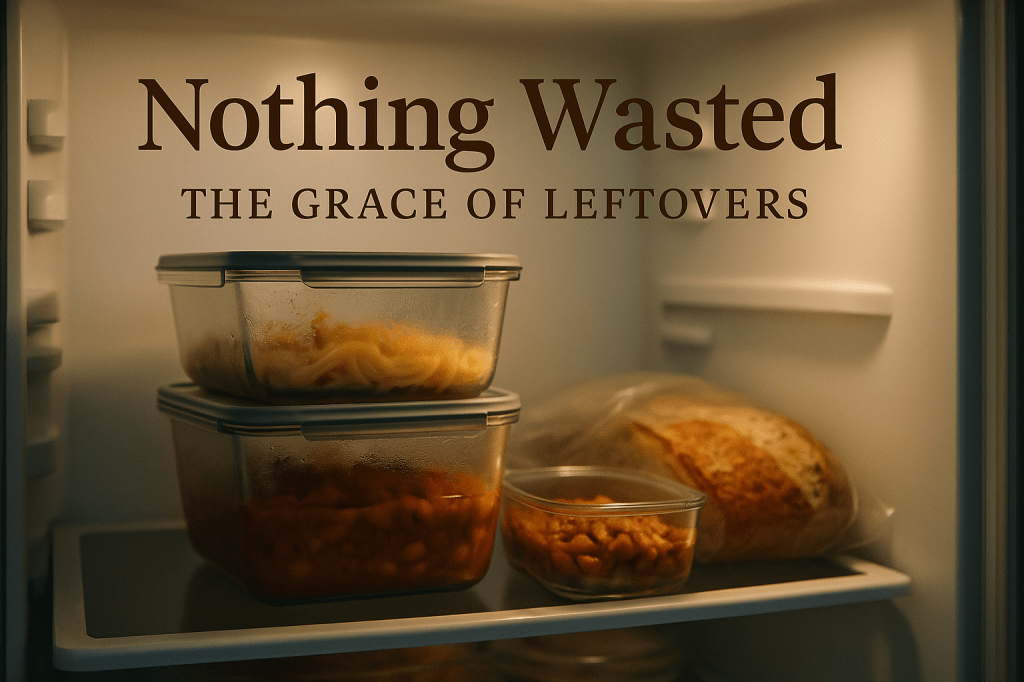
  • Nothing Wasted – The Grace of Leftovers

    Nothing Wasted – The Grace of Leftovers

    I grew up in a house where tomorrow lived in the refrigerator—stacked in mismatched containers, labeled only by memory and love. We didn’t have much, so we learned to keep what we had. A pot cooled on the stove like a promise. A slice of bread wrapped in a paper towel felt like insurance against whatever the next day might bring.

    So when I hear people say they don’t eat leftovers—say it like a flex, like the world owes them a fresh performance every night—I don’t understand. Why throw away another lunch, another midnight snack, another chance to make something out of almost nothing? Where I’m from, waste isn’t just waste. It’s disrespect—to the hands that cooked, to the hours that earned the money, to the hunger we remember even when our plates are full.

    Leftovers carry a particular kind of grace. They’re proof that somebody planned ahead, that care was stretched across time. They’re the echo of yesterday’s effort, still singing. And yes—I still cook too much on purpose. Because there’s a relief in opening the door after a heavy day and finding your own kindness waiting for you in a glass dish.

    The world will tell you that food is a spectacle, a one-night show with a Michelin curtain call. But in the kitchens where I learned, food was a continuum. It traveled: pot to plate to container to skillet to lunchbox to after-school bowl. It got better with time, the way beans deepen and soups settle into themselves. The trick wasn’t reinvention for the sake of reinvention. It was respect.

    Here’s what I’ve learned about the second life of supper—the way a meal can keep feeding us if we let it.

    Second Lives (How I use Leftovers)

    Bread

    • Day 2: Toast with a swipe of butter and a little salt.
    • Day 3: Croutons (cube, oil, bake) or breadcrumbs (dry, blitz, jar).
    • Day 4: Bread pudding—milk, eggs, a handful of raisins; Sunday morning becomes gentler.

    Roast Chicken or Baked Thighs

    • Night after: Shred into tacos or quesadillas with onions and a squeeze of lime.
    • Lunch: Chicken salad with whatever’s around—celery, apple, a spoon of yogurt or mayo.
    • Final act: Simmer bones with onion ends and carrot stubs to create a stock that tastes like patience.

    Rice

    • Day after: Fried rice—egg, scallions, soy, any lonely vegetables.
    • Or fold into soup to make it stick to your ribs.
    • Or press into a pan with oil for a crispy rice cake topped with a soft egg.

    Beans

    • Next day: Blend half for a quick refried spread; reserve the other half whole.
    • Stretch: Chili with whatever ground meat (or none), or spoon over toast with hot sauce.
    • Last stop: Bean soup—stock, garlic, a heel of Parmesan if you’ve got it.

    Roasted Vegetables

    • Breakfast: Hash in a skillet with an egg on top.
    • Bowl life: Toss with greens and grains; finish with vinaigrette.
    • Soup move: Blitz with warm stock, then drizzle with olive oil and a sprinkle of pepper.

    Pasta & Sauce

    • Baked life: Mix with a spoon of ricotta or cottage cheese, top with breadcrumbs, and bake.
    • Pan-fry in a little olive oil until the edges crackle; suddenly, the old becomes new.

    Casseroles

    • Next day slice: Reheat in a skillet with a little butter for crisp corners and a better story.
    • Croquettes: Mash, bread, pan-fry—humble gold.

    Steak, Pork Chops, or Sausage (leftover bits)

    • Fried rice, breakfast hash, or quick tacos with pickled onions.
    • Tiny pieces become flavor—sprinkled into greens or beans like punctuation.

    The Scraps

    • Herb stems → chimichurri or stock.
    • Parmesan rinds → soup.
    • The last spoon of jam → vinaigrette with vinegar and oil.
    • Pickle brine → marinade for chicken, or a bracing splash in potato salad.

    The Quiet Rules (Because Respect Is Also Safety)

    Cool food within two hours. Store in shallow containers.

    Most cooked dishes: 3–4 days in the fridge; many soups and casseroles freeze up to 2 months.

    Reheat until steaming—not just warm, but honest. Label and date so that in the future you don’t have to guess.

    The Weeklong Buffet We Call Thanksgiving

    Thanksgiving is the high holy day of leftovers—the only time Americans brag about cold turkey like it’s a love language. The fridge becomes a geography: stuffed with hills, cranberry lakes, and green-bean valleys. We start with the classic sandwich—turkey, dressing, gravy, maybe that scandalous swipe of cranberry—and then we get clever:

    • Turkey pot pie with leftover vegetables and gravy, topped with a quick crust.
    • Stuffing waffles pressed in the iron, crowned with a runny egg.
    • Mashed potato pancakes—crisp outside, forgiving inside.
    • Bone broth that warms the house for days.

    Thanksgiving teaches what the year forgets: abundance is not a single meal but a stretch of days made tender by forethought.

    When people say they won’t eat leftovers, I hear a kind of amnesia. I hear a forgetting of the hands that peeled, stirred, salted, tasted. I hear a forgetting of the mile between hunger and relief. In my kitchen, we don’t forget. We reheat. We revive. We say thank you twice.

    Because leftovers aren’t the past. They’re the persistence of care.

    They are proof that enough can last, if we let it.

    And in a life that asks so much of us, there’s no virtue more radical than refusing to throw away what still has love to give.

    Kyle J. Hayes

    kylehayesblog.com

    Please like, comment, and share

    Resources for Hard Times

    If you’re looking for practical help, food support, or community resources, you can visit the Salt, Ink & Soul Resources Page.
    👉 Resources for Hard Times